
Humans news stories

A recent study published in The Journal of Clinical Psychiatry suggests that a single dose of psilocybin, paired with psychological support, may rapidly and safely reduce chronic suicidal thoughts in adults with severe depression. The findings provide evidence that psychedelic-assisted therapy tends to offer lasting relief for individuals who have not responded to standard psychiatric treatments.


The figurine, dated to between 750 and 650 B.C., was excavated at the ancient Mesoamerican site of La Blanca, located on Guatemala’s Pacific coast. The study, published in Latin American Antiquity, argues that the dots may be an early form of number writing that hints at the link between numbers, bodies and identity in ancient Mesoamerica. If true, this would make the figurine a key piece of evidence in understanding the murky history of the origins of writing in this region of the world.

From the air, you see it only through the constant jolt, tilt, and shudder of the low-flying Cessna aircraft…It feels random, almost unreadable. Only gradually does the pattern resolve itself: raised causeways or paths fanning out to link the forest islands, and a dense, scattered web of canals threading the terrain. Slowly, you realize it’s a structured network of intersecting lines, enclosures, and roads—the imprint of past human design.

Somber, still, and timeworn, Stonehenge looms large in humanity’s mythos – an ancient, enigmatic monument that has stood sentinel over southern England for millennia…Now, a new analysis shows that at least part of the journey had to be aided by human effort. The paper was published in the Journal of Quaternary Science.

Scientific dating proves streaks on walls of Bacon Hole, near the Mumbles in south Wales, is Palaeolithic rock art… Archaeologists have used the latest scientific means to date the rock art, discovering that it was in fact created 17,100 years ago – making it the oldest example in Britain as well as north-western Europe. International academics have just published a scientific paper on their research in the journal Quaternary.

How was iron produced 2,000 years ago in Senegal? A recent study at the Didé West 1 archaeological site, in the Falémé Valley in eastern Senegal, sheds light on an ancient iron production technique.
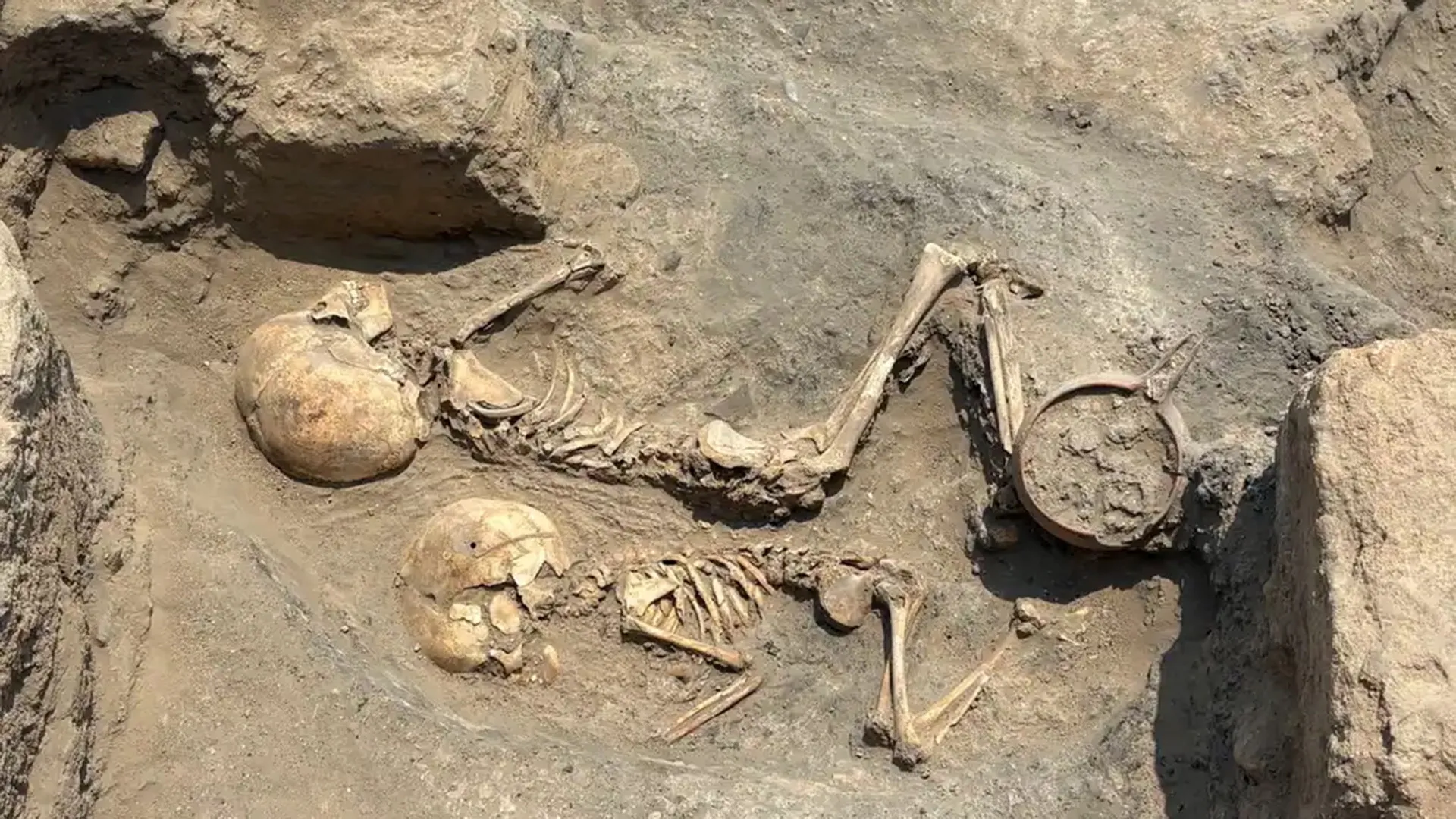
The 4,000-year-old skull of a Bronze Age child buried in what’s now Uzbekistan bears scars from a cranial surgery known as trepanation. It is the oldest documented evidence of surgery in Central Asia and one of the oldest examples of surgery in all of Asia, the researchers report.

Australian researchers have trained lab-grown brain cells on a silicon computer chip to play the nineties shooter game “Doom” and say they are just scratching the surface of what the neurons could be capable of doing.

A brainy human relative who lived during an ice age nearly 150,000 years ago adapted to the bitter cold by developing a sophisticated stone-tool industry, according to a new study of a crystal-studded rib bone found in China. This research was published in the Journal of Human Evolution.

Analysis of more than 3,000 lithic artifacts from the Cova Gran de Santa Linya site (Les Avellanes-Santa Linya, Lleida) shows that anatomically modern human communities occupying the southern Pyrenees during the Upper Paleolithic used flint (chert) exclusively for tool production. The findings, published in the journal Quaternary International, indicate that raw-material selection was closely linked to technological changes, mobility organization and the ways in which these groups interacted with the landscape.

A new revelation about the pyramid’s design could add another feather to Egyptian engineering caps. According to new research, several properties of the structure could make it surprisingly earthquake resistant – whether the builders intended it or not. The fortifying features include the empty “relieving chambers” directly above the burial chamber of Pharaoh Khufu. The findings have been published in Scientific Reports.

A new study at the University of York delves into the archaeology of the 4,000-year-old Mohenjo-daro, the Indus civilization’s largest city… By analyzing house sizes across the ancient city, researchers found that Mohenjo-daro was not only more equal than its neighbors in Mesopotamia and Greece, but it actually became more egalitarian over time. The findings were published in the journal Antiquity.


Special Operations veterans suffering from traumatic brain injuries and posttraumatic stress disorder experienced notable improvements in their symptoms after a single dose of the psychoactive drug ibogaine. Brain scans revealed that the therapy was associated with persistent increases in cerebral blood flow and the widespread reorganization of neural networks. The research was published in the journal Biological Psychiatry: Cognitive Neuroscience and Neuroimaging.

The research, published in the journal Proceedings of the National Academy of Sciences, shows that 115,000 years ago Neanderthal groups from Los Aviones Cave (Cartagena, Region of Murcia, Spain) were already consuming mollusks following a clearly seasonal pattern, particularly during the colder months of the year, from November to April.
War God: Night of Sorrows
Get your copy of War God: Vol III


Magicians of the Gods
Get your copy of Magicians of the Gods: