





We warmly welcome Aloys Eiling, author of A True(r) Prehistory: An Unofficial History of Heaven, Man, and Earth, as our featured author this month. Aloys has a background in Physics and Astronomy and a doctorate in Physics. He has also studied history and ancient languages. This combination gives him a unique perspective on the past and allows him to explore it through the lens of science and history. His book series (Volume 1-4) outlines an alternative history of the solar system and humankind, drawing on the natural sciences, mathematics, archaeology, sagas, myths, and the texts of ancient writers to evaluate the book’s hypothesis and conclusions that present a radically revised version of human prehistory, our solar system and the place of humankind in nature and the cosmos.
In Volume 1—The True(r) Prehistory: Gods and Man—linked below, Aloys provides answers to the question of whether humans are solely the product of natural evolution or whether genetic engineering has influenced our development. He also reinterprets the global spread of humanity and explores the remarkable mathematical and scientific knowledge held by the ancients. In his article here, Aloys introduces the reader to his central hypothesis on the passage of the Red Sun. A cosmically catastrophic event that Aloys argues changed the course of human history and the state of our solar system.
Interact with Aloys on our AoM forum here.
Abstract
Throughout human times, life on Earth has endured three devastating catastrophes. This period of catastrophe, which I explored in my previous articles on this website and my book series, A True(r) Prehistory, was triggered when a young, disk-surrounded dwarf Sun passed through the Solar System. 1 I referred to this sun as the ‘Red Sun’. Myths preserved the memory of the accretion disk by describing it as a snake. For instance, Judaism remembers it as the giant serpent Leviathan.2 The gravity of the Red Sun perturbed the orbits of all the planets, changing the state of the solar system forever. Regarding life on Earth, it did more: due to the heat emanating from the accretion disc, the planet’s climate plunged into chaos. When the planet was positioned close to the Red Sun, large amounts of water evaporated due to its intense heat, triggering torrential downpours on a grand-scale. Subsequently, when the Red Sun withdrew, it became bitterly cold under the dense cloud cover. These cataclysmic events caused entire species to die out. The Earth was hit hard, but Venus was hit even harder, grilled by extreme heat as the Red Sun passed close by. However, there was a fifth planet in our solar system —that I refer to as Tiamat—that had the misfortune to lie in the Red Sun’s path. All that remained of the large planet beyond Mars was debris that would trigger future catastrophes to life on Earth at the hands of the cosmos.
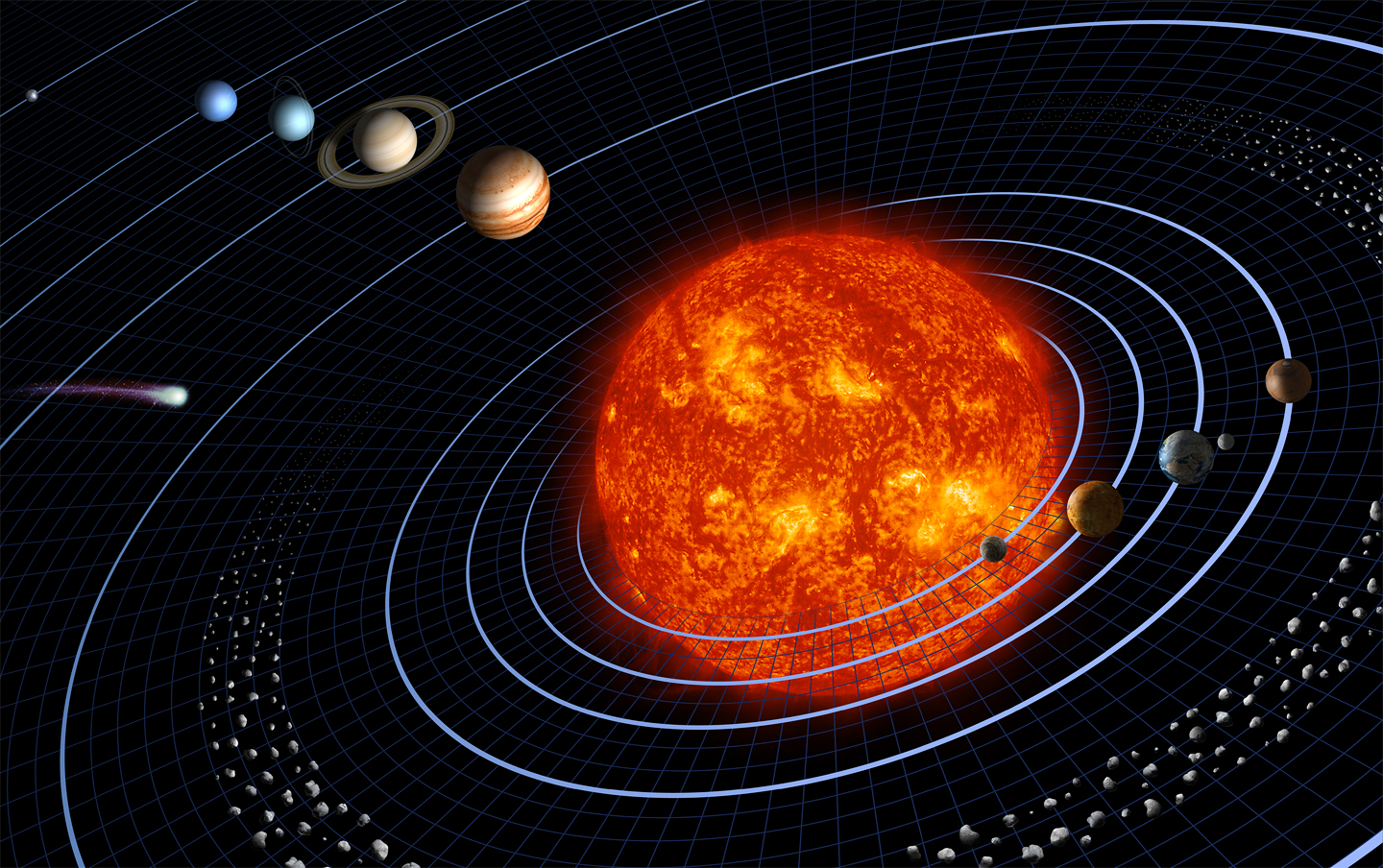
Image by Harman Smith and Laura Generosa / NASA (PD-USGov)

When did the Red Sun, i.e. Nibiru, traverse the Solar System?
Introduction
Since the memory of this event has been handed down in myth, it must have occurred in prehistoric but already human times, i.e. between 60,000 and a few thousand years ago. The aim of this article is to narrow down the date of this passage. Although this happened a very long time ago, I will show that it is possible to narrow the timeframe to within a few thousand years. Nevertheless, the distance of this event to the present must be greater than a few millennia, as any date in the recent past would have had a much stronger reverberation in early civilizations. We would find more than rock carvings of Stone Age people, remote symbols and cryptic myths. To determine the event’s date, I follow a rigorous procedure that combines astronomy, natural science, and mythology to create a consistent picture.
Ancient Mexican codex
Undoubtedly, it would be a stroke of luck to find a date for the transit of the Red Sun in an ancient record. Incredible as it may sound, such a source does exist. In fact, it gives a year that fits my first rough estimate, not too early and not too late.
The source is a Mesoamerican calendar known as the Codex Dresdensis. The codex depicts a serpentine figure on page 62a with a date inserted between the serpent’s coils (Figure A). The number indicates the year 33,142 BC. For a classical historian, it is more than surprising to find a quantitative date that points so far back into the past. After all, the official doctrine is that this was an age of distant prehistory—devoid of civilization and especially of writing. Not to mention that there were supposedly no humans living in the Americas at that time.
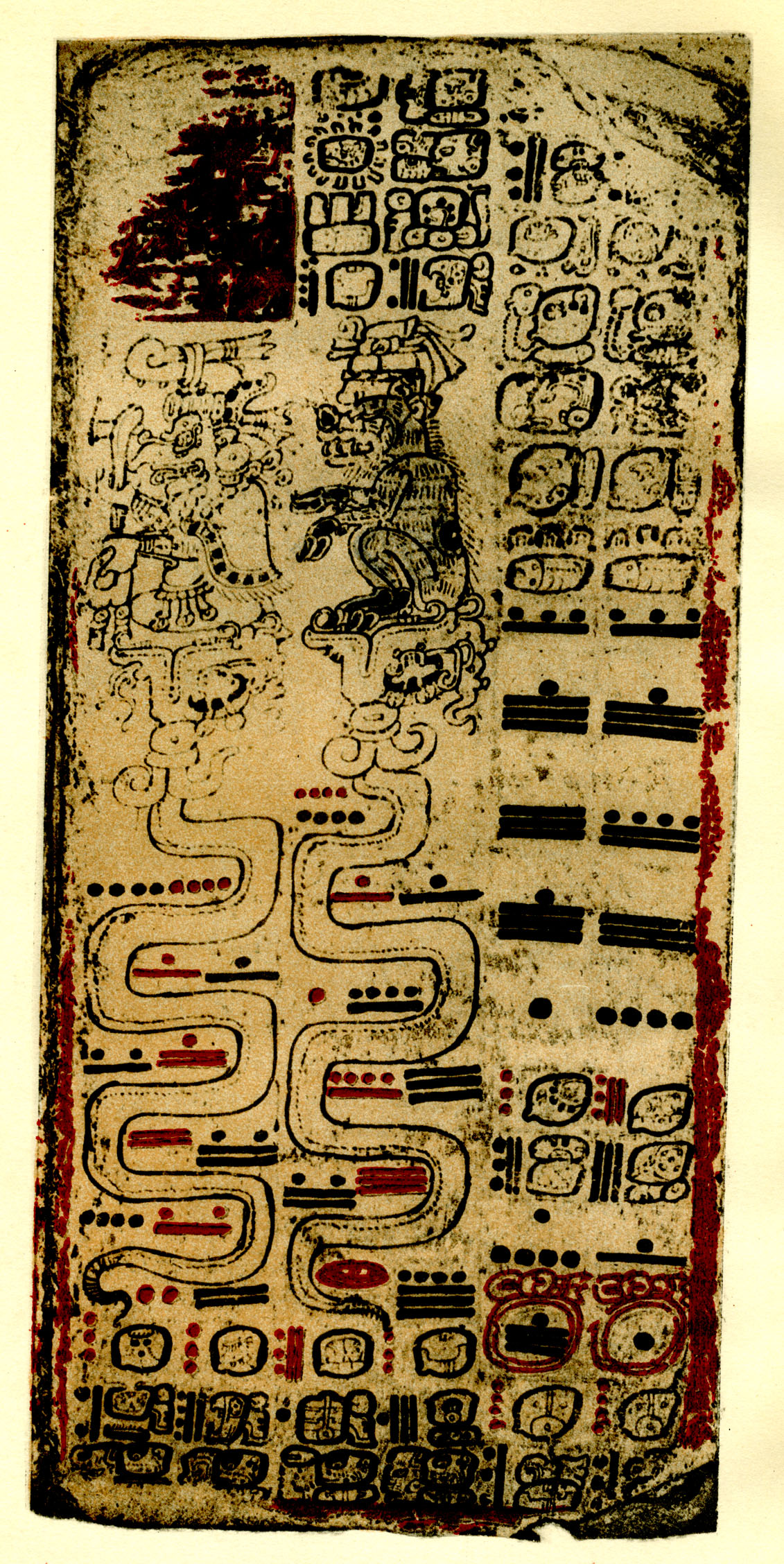
Figure A – Page 62 of the Dresden Codex, showing the Serpent Numbers. (Public Domain)3

Note: The Maya had a system of dots and dashes for the representation of numbers.
The date, written between the coils of a snake, points the way to the solution of what the number means. As discussed in detail in the previous articles, spirals or, as a naturalistic symbol, a serpent, are often used to describe the Red Sun, since this animal in feature and behavior suitably describes the appearance of the huge accretion disk.
In view of the significance of the Mayan date for our investigation, we quote a passage from the thesis of Michael John Grofe, who, of course, is unaware of our thesis of the passage of an alien sun, but who, like all scholars, is surprised to stumble upon a date from a legendarily distant past. Here are some sentences from his thesis: 4
However, as Hermann Beyer first demonstrated in 1943, it appears that this version of the flood myth relates to the Serpent Series, named for immense intervals of time written amidst the coils of undulating serpents. Each of these distance numbers count forward from a unique earlier base date 9 K an 12 K’ayab, over 30,028 years prior to the era base on 4 Ajaw 8 Kumk’ u.
In this case, using the tropical year value identified by John Teeple from Copan and found throughout the Serpent Series, the base date 9 K’an 12 K’ayab would have fallen on a summer solstice in 33,142 BCE, thereby corroborating that the flood scene relates to the summer rains, while also supporting the proposal that the flood simultaneously commemorates the cosmogonic flood.
The fact that this quote trivializes a cosmic event as a summer rain and a Platonic year to satisfy the need for explanation does not change the message or the date. I find this explanation highly unlikely; what is this isolated date supposed to record other than a traumatic event from a very distant past? Whether it was really humans – or aliens – who recorded this date is debatable, but that ambiguity doesn’t change the date either.
After this first clue, the question now arises: Does this date stand alone, or do other myths and especially scientifically derived data point to the same or at least a compatible value?
Periods of selected sednoids
For life on Earth, the passage of the Red Sun meant mass extinction. Australia was hit hardest. All animals weighing more than 20 kg became extinct there.5 Just as cataclysmic clues are left on the face of the Earth, a cosmic event leaves cosmic traces. Most evidently, this is preserved in the elliptical and inclined orbits of the planets.
To this end, and to confirm the Mayan date, we analyze the orbits of the sednoids. Sednoids are small, distant objects in our Solar System that have extremely far-out, elongated orbits. And so, at first glance, given the distance of sednoids, this approach seems far-fetched. Sednoids are minor planets that form a separate class of objects in the Solar System. They are named after one of their representatives, the minor planet Sedna. Their orbits extend as far as the Oort Cloud, and their orbital periods are measured in millennia. The large perihelion distance classifies the Sednoids as objects that formed independently of the planets, and their orbits are unaffected by the planets.6 For example, sednoids are so far beyond Neptune, the furthest planet in our Solar system, that Neptune’s gravity is unable to shape their orbit.
Typically, extremely elliptical orbits occur when a light body passes close to a much larger mass; the resulting orbital perturbation is called a swing-by. Depending on the nature of the swing-by interaction, the location of the interaction will be close to either the new perihelion or the new aphelion. Without a sufficiently massive perturbator known to exist at a distance near their perihelion, the orbits of sednoids are a great mystery. This is one of the reasons why astronomers have been searching for years for an object far enough away from the Sun and massive enough to perturb minor planets into orbits like those of the sednoids. Despite great efforts, the search has been unsuccessful.7
A dwarf star in the distant forecourt of the Sun would have perturbed the orbits of all objects closer than a few Astronomical Units (AU) to it. In this thesis, I propose that the present-day sednoids originally orbited as minor planets at their present perihelion distance.
To test this hypothesis, I simulated the orbits of sednoids, starting from presumed primordial orbits, to explain their orbits in terms of a perturbation by the Red Sun. The plots in Diagram 1 compare three such calculated orbits with the known orbits of three sednoids.
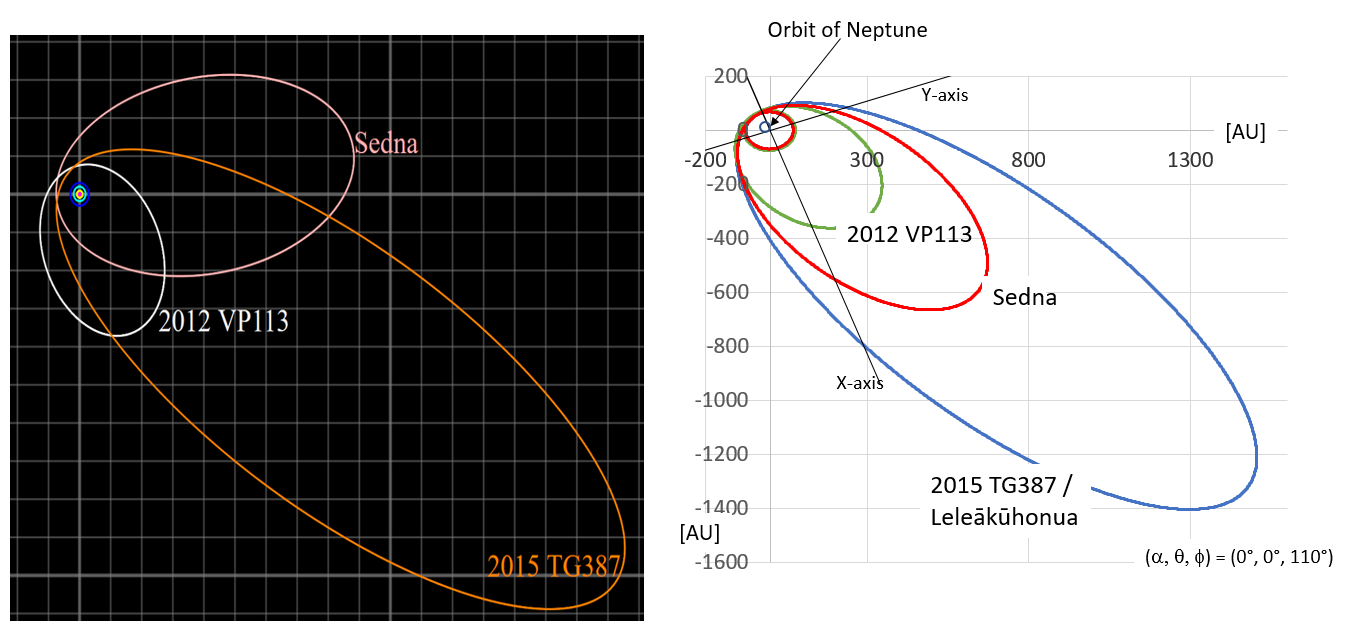
Diagram 1 – Three sednoids and their orbits
Left graph: Orbits of three relatively large sednoids, drawn on a 100 AU grid for scale.8. Image by Tomruen (CCBYSA4.0)

Right plot: Calculated orbits for three sednoids, assuming an encounter with the Red Sun. The tiny circle at the origin of the coordinates corresponds to the orbit of Neptune. Image by Author.
Deriving the time of the Red Sun’s passage from these orbits of the sednoids is based on the following consideration: If the disruption of the sednoids’ orbits by the Red Sun occurred on an astronomical time scale in the recent past, they would have only completed a few orbits since then. If we now find several sednoids near their perihelion at the same time, their orbital periods must be in a rational relationship to each other, if the orbital deformation really happened at (almost) the same time.
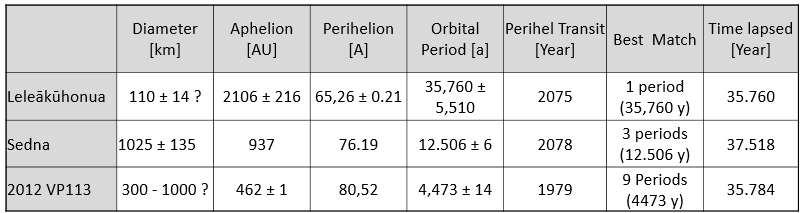
Table I – Data for three sednoids whose orbits are assumed to be perturbed by the Red Sun.
All three objects are currently close to their perihelion.
The approach yields a date close to that given in Codex Dresdensis. The difference can be explained by errors in the orbital periods, or, it is more likely, that the orbital periods do not exactly fulfil the condition of rational orbital ratios.
It should also be noted and corrected that 500 to 1000 years must be added to the date. For one thing, the Red Sun still had to move the rest of the way to the center of the solar system. Second, it took some time for the sednoids to swing into their new orbits. Overall, there is a consensus in both approaches on the time elapsed since the appearance of the Red Sun.
Inclination of the planetary orbits
A bold, perhaps overly optimistic approach to determining the time of the Red Sun transit is to use the orbital inclinations of the planets or in other words, the tilt of the planets’ orbits. As I outlined in my previous articles, the Red Sun’s gravity has permanently distorted the planets’ orbits. With an educated guess, I adjusted the mass and trajectory of the Red Sun and achieved congruence in shape and distance of the orbits of all the planets. Most significantly, the Red Sun altered the orbits from their former circular shape to an elliptical one.9 The question arises as to whether I achieved the same level of accuracy in calculating the orbital disturbance as I did in determining the orbit shape. It is worth noting that, in principle, planets formed from an accretion disk should have no orbital inclination at all.
Since in a perfectly planar system there are no torques—an interaction that causes orbital changes—which in the present case lift the orbits out of the common plane, we can rule out interactions between the planets as the cause of the difference in orbital inclinations of the planets and must assume an external perturbation. 10
Checking whether the calculated inclinations match the actual inclinations is neither straightforward nor trivial. There are a number of effects that need to be taken into account before reading the corresponding calculated orbital inclinations from my simulated data.
The Red Sun tilted the orbits of all the planets away from the primordial ecliptic, including the orbital plane of the Earth. Using the Earth’s orbit, tilted 1.9° by the Red Sun, as a reference affects the measured tilt angles of all other planetary orbits.
When analyzing the orbital inclinations of the planets, it must be noted that their apses rotate (apse: = major axis of the orbital ellipse), and as a result of the rotation of the apses, the inclinations of all the other planets will decrease or increase, depending on the relative position of the orbital nodes. If the orbital nodes of the Earth and the planet happen to be at the same angle, the inclination measured against the Earth’s orbit becomes minimal. However, if they are 180° opposite, the orbital tilt is maximal. As a result, the orbits of the other planets wobble continuously up and down by 1.9° over time, varying by twice the angle by which the gravitational pull of the Red Sun tipped Earth out of its primordial orbital plane.
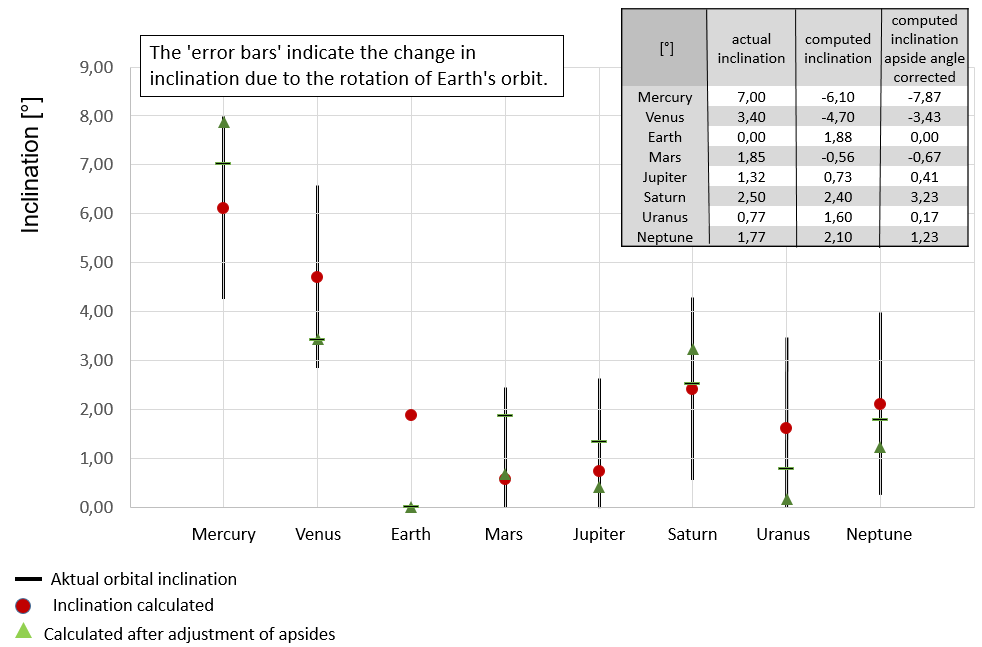
Diagram 2 – Orbital inclinations of the planets relative to the orbital plane of the Earth. Image by author.
The raw data from the simulation (red dots) have been corrected for the calculated inclination of the Earth’s orbit and additionally for the angle between the orbital node of the relative planet and the Earth (green triangle). The vertical bars reflect the ± 1.9° of the orbital inclination of the planet due to the rotation of the apses relative to Earth’s apsis.
All actual data (black bars) fall within the range of variation of the timely change of inclination given by the Earth’s orbital inclination and the rotation of its orbit.
Looking at Diagram 2, the orbital inclination data provides further support for my model. The simulation of the perturbations caused by the Red Sun not only yields the correct ellipticities of the planetary orbits but also provides a description of the current values of the inclinations of the planetary orbits within the limits of possible variation.
After confirming that the results from my model are fundamentally consistent with the state of the planetary system, I can go one step further and examine whether the time of the Red Sun’s transit can be determined from the evolution of orbital inclinations. For this analysis, I assume that the orbital inclinations of all the planets are fixed. The rise and fall of the orbits occur only because the orbits of the planets move at different angular velocities in a rosette around the Sun. From the Earth’s perspective, the resulting change in the orbital nodes causes their inclinations to wobble. If I stick to the assumption that the passage of the Red Sun took place in prehistoric times, i.e. in geologically recent times, I can justifiably neglect any torque the planets exert on each other’s orbits.
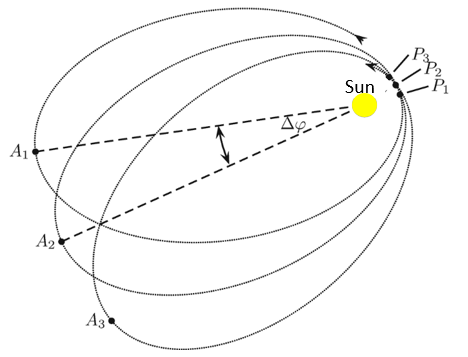
Diagram 3 – Graphical representation of the rotation of the apsidal line (= major semi-major axis) with the end points perihelion, P1 to P3, and aphelion, A1 to A3. A complete rotation of the Earth’s orbital rosette takes 111 thousand years (see Table II). Image by author.
This rotation of the orbits is not as slow as it seems, since it does not even take geologic time to become relevant. Table II lists the values by which the major semi-major axes of the planets are currently rotating. For example, the ellipse of the Earth’s orbit rotates at 0.323° per century, so it takes only 111,500 years to complete a full rotation.
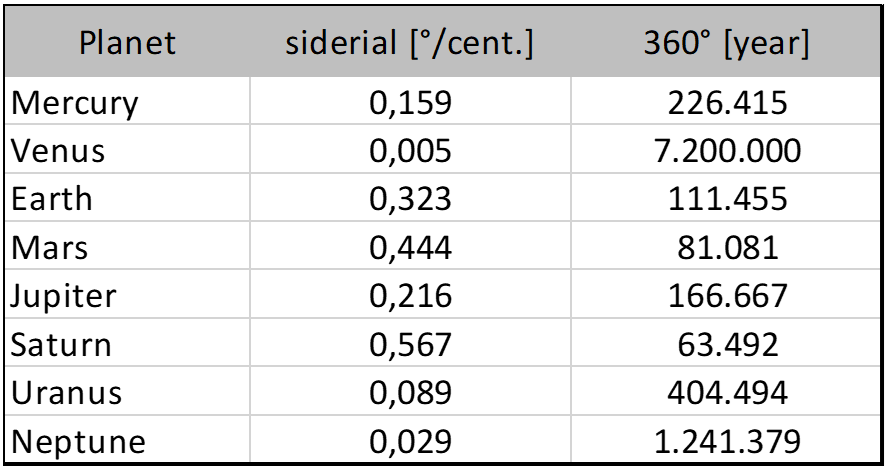
Table II – Apsidal rotation of the planets11
The middle column shows the angular velocity at which the apses of the planets are currently rotating.
The right column shows the time required for a 360° rotation.
As a result of the rotation of a given planet’s orbit, the angle between the nodes changes. As a result, from Earth, the inclination of the other planets appears to rise and fall periodically at the rate of the difference in the rotation of the apses (perihelia). Since the rate of rotation of the perihelia is known, extrapolation of the values derived by my simulation should give the time of the distortion by the Red Sun. From this point on, using the values in Table II for the time evolution, the point of coincidence with the current inclination corresponds to the period of time that has elapsed since then.
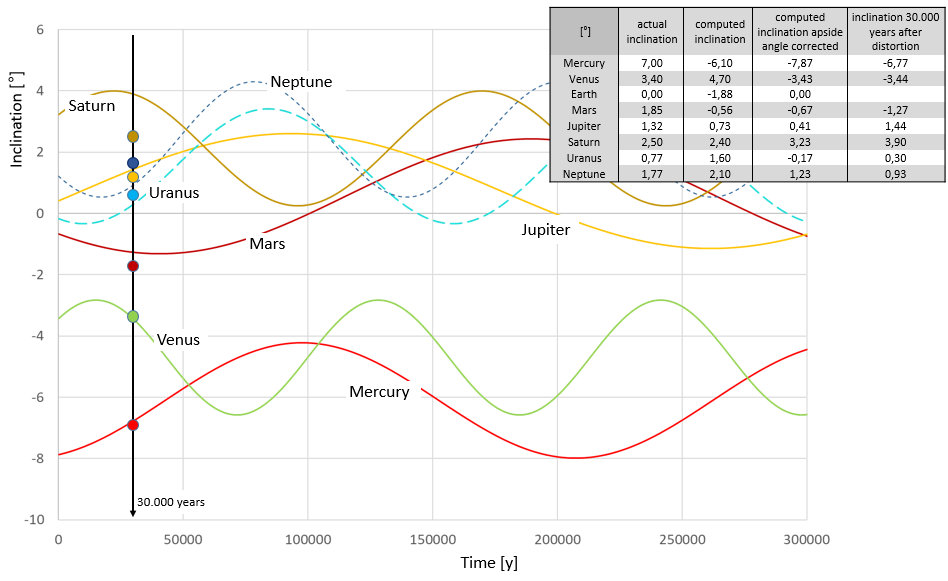
Diagram 412 – The variation of the inclination angles of the planetary orbits over time, determined as the sole consequence of the inclination of the Earth’s orbital plane and the rotation of the apsidal lines.
The values at t = 0 correspond to the calculated orbital inclinations (see those in Figure 2). The curves represent the changes in orbital inclination of each planet as seen from Earth. The dots indicate the actual values relative to the ecliptic.
Since the orbit of Venus is nearly circular, the apsidal line of Venus rotates extremely slowly at 0.005°/century. Therefore, the periodicity of the inclination of Venus’ orbit essentially reflects the rate of rotation of the Earth’s orbital inclination.
The table at the top right shows the main data for the orbital inclinations.
Based on our calculation of the initial inclination and node position of each planet, the best time match with today’s values, we obtain a date of 30 thousand years ago. In the diagram, this time is indicated by the vertical line. According to our reasoning, this date corresponds to the time of the passage of the Red Sun.
At this time, the orbital inclinations of Mercury, Venus, and Jupiter are quite close to the actual values. The deviation for Mars looks tolerable, while the deviation for Saturn is significantly different from the actual values.
Image by author.
In an analysis based on the calculated orbital inclinations, we find that the transit of the Red Sun occurred about 30,000 years ago, about 5,000 years younger than the two determinations above.
Considering that we had to build the model using best guesses about the Red Sun’s trajectory and guessing the exact position of each planet on its orbit, it is remarkable that we have obtained such meaningful data at all. However, there is no shortage of possible explanations for this younger date. In particular, our assumption of a constant rate of rotation of the apses is critical. The rate depends on the position of the ellipses in relation to each other, and this state is not constant over the period in question. Second, it will have taken time for the planets to return to stable rotation after the perturbation. This delay will also have taken some time.
Taking these sources of error into account, we can easily explain the remaining difference and even use this analysis as additional evidence for the timing of the Red Sun transit, despite the discrepancy.
Derivation of time from a geological event
So far, we have used astronomy and a number from the Codex Dresdensis to determine the date of the Red Sun’s passage. Most likely, and as I assume not by chance, a geological event is suspiciously close to the dates we have determined so far. Paleontological data show that about 40,000 years ago, Earth experienced an ecological catastrophe that led to the extinction of many species. From fossils, we know that during an event of unknown or, at best, hypothetical origin, radioactivity increased sharply. The ecological catastrophe is reflected in elevated levels of radioactive isotopes carbon-14 (14C) and beryllium-10 (10Be) in fossils from that time.13
Current understanding links this catastrophe to a temporary weakening of the Earth’s magnetic field known as the Laschamp event.14 This weakening, including a migration of the magnetic field across the globe, was considered fatal because it reduced the shielding against cosmic radiation.
However, I doubt that a weak or even absent magnetic field for a short period of time is effective enough to endanger the survival of entire species on the planet. Instead, I bring the Red Sun into play and consider it by far the more plausible cause of mass extinction. This is because the weakening of the magnetic field and pole shift during the Laschamp event were by no means a one-time occurrence. During the last 2 million years, there have been 14 such proven pole excursions15, 16, and none of them was as deadly for life on Earth as the event during the Laschamp epoch.
The fact is that the weakening of the magnetic field during a pole excursion leads to increased exposure of life to cosmic particles.17 Thus, the weaker magnetic shield will increase the risk of developing cancer and increase the probability of harmful mutations. As a result, mortality increases, but at the same time, evolution is promoted. Full-scale extinction of species is not expected.
To explain the high 14C content of fossils from this period, there must have been a more potent event, and the Red Sun would have been such an event. For one thing, the star was very, very young, still surrounded by an accretion disk, from the center of which grew plasma flares containing fast particles, which caused the radiation exposure of the Earth’s surface to grow into a radiation hurricane. This radiation reached the surface regardless of the magnetic field’s strength. No matter how strong the magnetic field was, it lost all effect against the radiation storm emanating from the Red Sun.
To my understanding, the pole weakening was not crucial but just a temporal coincidence. The possible parallel weakening of the magnetic field becomes a side note compared to the devastation caused by the Red Sun. Within a time window of a few thousand years, the mistaken assignment of elevated 14C to the Laschamp event remains plausible.
A more significant criticism of the 14C time determination method in these circumstances is the inherent uncertainty of the method itself. Any excess of 14C in relation to the stable isotopes 12C and 13C falsifies the time determination. Without recognizing the 14C excess, a simple application of the 14C method shifts the date too far into the past. Any correction applied is a guess, and the method takes on the character of a lottery.
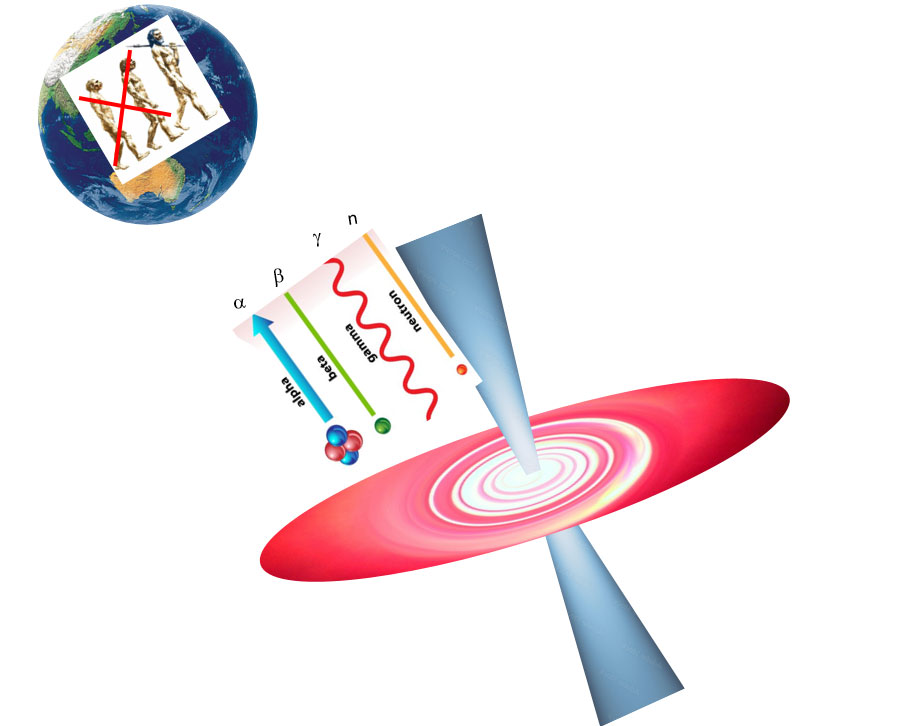
Figure B – Illustration (not to scale!) of the close encounter between the Earth and the Red Sun, highlighting the heat and radiation storm (α, β-particles γ-rays and neutrons) that emanated from this sun and, in particular, from its accretion disk. In fact, the Earth and the Red Sun never really came close to each other (see my earlier article),18 otherwise life on Earth would have been over. Despite the distance maintained, the catastrophe was immense. Image by author.
Some additional words about the shielding effect of the Earth’s magnetic field. It is important to note that there is by no means a linear relationship between the weakening of the magnetic field and the production of 14C. Reducing the magnetic field to one-tenth of its current value increases the rate of 14C production by a factor of two and a half.19 And any further reduction does not increase 14C production at all.
The magnitude of the radioactive isotope values published by Laj et al.20, and in principle, associated with a time around the Laschamp event, do not fit with other published data related to this pole excursion. These researchers find an extremely high and narrow peak in 14C production for a period of 41,000 years ago. Contrary to what would be expected from a magnetic field weakening alone, the peak is at least 4 times higher than the base value. Thus, this measured 14C level cannot be explained by a weaker or absent magnetic field alone.
As I understand it, the timing of the development and decline of radioactivity is consistent with a persistent dust fall from the disintegrating accretion disk. When the Red Sun retreated, most of the dust and small grains from the disintegrating accretion disk were left behind in the solar system. As a result, the planets, including the Earth, moved in a cloud of dust for several millennia.
To determine the age of prehistoric fossils, the ratio of isotopes is measured, and the stratigraphic situation is used in parallel, which, in the event in question, poses a serious problem. The stratigraphic method usually assumes a constant or at least derivable deposition rate. It is doubtful whether the underlying depositional rate was really so predictable for the time in question. The accretion disk probably had a radius of many millions of kilometers, far exceeding the luminosity of the Sun. Furthermore, the appearance of the Red Sun was accompanied by a global flood, rendering stratigraphic data useless.
Yvonne Stratmann describes in her book Das Steinzeit-Paradoxon the Hopi legends that tell of a time when people lived underground.21 Since the natural habitat of humans is the surface of the planet, only an extreme event could have driven them underground. Since neither a missing magnetic field nor cosmic radiation is perceived by the human senses, without this knowledge, there was no reason to crawl underground. However, the underground escape becomes plausible when you consider the Red Sun’s fire wheel. The heat from this gigantic infrared lamp grilled the Earth. And I argue that the Red Sun did not cause the extinction of many animal species through radioactivity, but through heat, followed by years of freezing cold. And it was this climate chaos that forced humans to hide in underground caves.
At this point, we will take a brief digression on the devastation of earthly life caused by the Red Sun and turn our attention to what caused the Great Dying, and why and how did whole species disappear?
The situation triggered a climate collapse. Large amounts of water evaporated in the radiant heat of the second sun. As a result, the Earth was covered in a thick mantle of clouds, turning the planet into a dark sauna. Torrents of water poured down from the sky. A veritable deluge of rain fell as the land was submerged in water. This deluge brings us back to the Mayan message quoted by Michael J. Grofe (see above), which speaks of a deluge during the Serpent Age. The flood was a killer, but worse, in the heat and darkness, the plants rotted, and the food chain collapsed. Large animals with high food requirements starved to death. Scavengers had a better chance of survival at first, but later they starved as well.
After the Red Sun retreated, the global sauna became freezing cold. A mile-thick cloud cover reflected sunlight, and the Earth froze into a global winter. Then, after the Earth was packed with snow and ice, the increased albedo (the reflection of the white surface) prolonged a long, cold period. The dust left behind by the disintegrated accretion disk of the Red Sun may have intensified this severe ice age by shading the sun’s light in addition to the high albedo. Perhaps a short, brutal and sudden global ice age occurred. The abrupt climate change from heat to cold was the final killer blow to hit life on Earth. There was no time to adapt or escape the deadly radiation, the drowning that came with the scorching heat, followed by frost. Survival was a matter of luck.
Even small animals had a hard time. In light of these prehistoric events, it no longer seems a coincidence, for example, that the oldest termite mounds in the world were found to be 34,000 years old.22 We take this not as a coincidence, but as another clue in support of our dating.
The extinction of hominids
The radiation emitted by the Red Sun, consisting of fast elementary particles, X-rays and gamma rays, was harmful to all living creatures. If they could not hide deep enough underground, the radiation would not necessarily and immediately kill them, but it would make them sick and damage their genes.
In the end, it is likely that only a few – or, sometimes, just too few for a sustainable existence – of a given species survived. There was no Noah; they just disappeared. The humans of the Homo Sapiens race, who had retreated into caves to escape the heat of the Red Sun, were unknowingly shielding themselves from the dangerous radiation. Other human races were less fortunate and did not survive the Red Sun. Our genetic cousins, the Neanderthals and Denisovans, became extinct. A misunderstood sudden extinction that our model explains almost in passing.
After sharing the planet with Homo sapiens for well over a hundred thousand years, these closely related hominids were simply out of luck. Modern humans were left alone. If the myths mentioned by Y. Stratmann are to be believed, the survival of mankind may not have been so accidental after all; the myths she cites tell of extraterrestrial helpers, the ant people, who survived the Red Sun by retreating to the subterranean or living underground anyway.
Whether the Neanderthals and Denisovans were killed by climate, hunger, or radiation will probably never be known. The fact is that they disappeared around this time, or they survived in groups too small for long-term survival. Perhaps radiation-induced genetic damage also killed them off for good in the medium term. Parts of their genes survived in modern humans, with whom they had previously interbred23—the ghost of our human ancestors preserved in our genetic code.
Other sources
Finally, I mention some vague but intriguing dates. One such date can be derived from a prehistoric artifact found in France that shows a ring with a protruding cone. It is thought that reindeer hunters carved the rock, and on this stone canvas, they may have scratched a crude image of the Red Sun, alongside impressive animal images. In fact, it remains unclear what object was depicted.24 The engraving (cave of Abri Castanet) is dated to 37,000 years ago, which is quite consistent with my other data.
A more quantitative indication can be found in Massey’s book on Ancient Egypt, where he quotes: 25
When Herodotus was in Egypt, the “mystery teachers of the heavens” told him that during a certain length of time which had been reckoned by the Egyptian astronomers, “the sun had four times risen out of his usual quarter; that he had twice risen where he now sets, and twice set where he now rises.
If we take this quote as a reliable source of information and apply it to the precession of the Earth’s axis, we can conclude that the passage of the Red Sun occurred at least 50,000 years ago. This date is considerably older than those previously established. But perhaps Herodotus misinterpreted the message. Perhaps twice meant just within the second cycle. This interpretation would bring us back to a reasonable window of time in line with the previously derived dates.
Afterword
The events and changes that took place at the end of the era, 40,000 years ago, exceed what I have deduced from my current analysis of astronomical considerations, myths, and palaeological findings. Some aspects appear as mere footnotes, while others could have been world-changing events. To give an example of each, one side note is certainly that the oldest termite mounds date back to this era.26 This discovery is amazing, but not conclusive as proof. What is truly astonishing is the relationship between the languages of humankind and this cataclysmic era. Unlike Neanderthals and Homo erectus, Homo sapiens did not become extinct. Did they have helpers? Did the helpers do more than save them from extinction? Did they give them language? Is it just a coincidence that the invention of language is estimated by linguistics to be around 35,000 years ago, based on linguistic relationships? 27 If so, language would not be the work of humans, but would have been taught. This is a common theme in mythology. In any case, prehistoric peoples attributed language to a god. Whether it was Brahma among the Indians, the Norse Odin, the Sumerian Oannes, the South American Viracocha, or other alien messengers, they were all bringers of culture and language.
The passage of the Red Sun outlined represents the most concrete echo of a distant past that has faded into the most ancient myth. Keen to dig deeper? I will follow the trail. Perhaps my search will provide enough material for another article on this website.
References
1 https://grahamhancock.com/eilinga4/; https://grahamhancock.com/eilinga5/ and https://grahamhancock.com/eilinga6/
3 https://commons.wikimedia.org/wiki/File:Maya_Hieroglyphs_Plate_32.jpg
4 Michael John Grofe, The Serpent Series: Precession in the Maya Dresden Codex, University of California, Dissertation (2007); https://www.mayaexploration.org/pdf/Serpent%20Series-Grofe2007.pdf
5 https://www.geomar.de/en/news/article/humans-caused-megafauna-extinction-in-australia
6 https://www.avl-lilienthal.de/newsreader-astrophysik/wie-funktioniert-das-swing-by.html
7 https://open.library.ubc.ca/soa/cIRcle/collections/ubctheses/24/items/1.0434211
8 https://commons.wikimedia.org/wiki/File:Sednoid_orbits.png
9 Aloys Eiling, https://grahamhancock.com/eilinga4/
10 Jacques Laskar, https://arxiv.org/pdf/0802.3371.pdf and https://arxiv.org/pdf/1209.5996.pdf
11 https://de.wikipedia.org/wiki/Apsidendrehung
12 Unfortunately, this figure requires a comment. In previous publications on this subject, I did not consider the sign of the orbital inclinations, but all calculations of the temporal changes were made assuming positive signs of all calculated inclination data. This error is corrected here.
13 Alan Cooper et al., SCIENCE Vol. 371, pp. 811-818; https://www.science.org/doi/10.1126/science.abb8677
14 https://www.civilsdaily.com/news/what-is-laschamp-excursion/
15 A. P. Roberts, Geomagnetic excursions: Knowns and unknowns; https://agupubs.onlinelibrary.wiley.com/doi/abs/10.1029/2008GL034719
16 Eerily enough, the Earth’s magnetic field currently seems to be heading towards a similar migration and weakening. The magnetic north pole is currently at 86° North and is ‘ barreling’ towards Siberia at 60 km/year. This speed sounds minor but corresponds to the value during the Laschamp event.
17 The carbon isotope 14C is radioactive with a half-life of 5730 years. It is constantly reproduced from 14N by cosmic radiation. Assuming a constant radiation flux, an equilibrium has been established between production and decay. The age of fossils, which have not absorbed any more 14C after death, can be determined from the remaining proportion of 14C. The determination works up to a maximum of 60,000 years, after which the remaining 14C content is too low for analysis. The method is calibrated by comparison with the decay of other isotopes (10Be and 36Cl). It is important to know that this technique measures traces of traces. This may work for steady-state, stable conditions, but hardly or even not at all for spike events. The error in determining the true time increases. Errors, which are normally in the order of magnitude of centuries, become millennia, so that the allegedly measured 41,400 years can also become 37,000 years.
See for example: Sergey Koldobskiy, Ilya Usoskin, Gennady A. Kovaltsov,
18 Aloys Eiling, https://grahamhancock.com/eilinga4/
19 Tzu-Chien Chiua et al., https://doc.rero.ch/record/210342/files/PAL_E4381.pdf
20 Carlo Laj et al., Philosophical Transactions A 358(1768) 1009-1025; https://royalsocietypublishing.org/doi/10.1098/rsta.2000.0571 (cited in: Tzu-Chien Chiu et al., https://doc.rero.ch/record/210342/files/PAL_E4381.pdf
21 Yvonne Stratmann, Das Steinzeit-Paradoxon: Muss die frühe Menschheitsgeschichte neu geschrieben werden? (2022)
22 https://scitechdaily.com/astonishing-discovery-34000-year-old-inhabited-termite-mounds-discovered-in-south-africa/
23 Tom Higham, „The World Before Us“, Penguin (2022), p. 202 ff
24 https://archaeology.org/issues/january-february-2013/collection/top-10-2012-abri-castanet-vulva/top-10-discoveries-of-2012/
25 Gerald Massey, Ancient Egypt: The Light of the World, https://www.theosophy.world/sites/default/files/ebooks/AncientEgyptTheLightOfTheWorld_GMassey.pdf, page 444
26 https://scitechdaily.com/astonishing-discovery-34000-year-old-inhabited-termite-mounds-discovered-in-south-africa/
27 Vitaöy Shevoroskin und Paul Sidwell (eds.), Languages and their Speakers in Ancient Eurasia,
https://ia902901.us.archive.org/24/items/shevoroshkinsidwelleds.languagesandtheirspeakersinancienteurasia2002/Shevoroshkin%20%26%20Sidwell%20%28eds.%29%20-%20Languages%20and%20Their%20Speakers%20in%20Ancient%20Eurasia%20%282002%29.pdf
The main page illustration is a colouring of the Flamarion image. Coloure by me:
https://www.facebook.com/photo.php?fbid=10213605312361782&set=pb.1672516585.-2207520000&type=3
Credits?
Hello Aloys – thank you for this wonderful article, which not only demonstrates how badly mainstream science is letting us down with its rigid adherence to a fixed solar system model, but how brilliant it is to have lateral thinkers like yourself out there, diligently scraping together the evidence and crunching the numbers to produce a more coherent picture of our solar system’s history. The Red Sun model certainly would explain a great many Earth mysteries, not to mention supports the idea that human history stretches way beyond its currently recognised expanse of time. I would suggest that along with the Red Sun of c34,000 years ago, our solar system has suffered many such incursions and perturbations throughout history, and possibly there are others still to come. Your work provides valuable support for these ideas – not to mention warnings for the future! Thank you!
Hi Lee,
Thank you for this very positive and encouraging comment. Don’t worry, the tenured professors on their locked-down battleships won’t let me nor anyone else on deck.
Greetings sir. I have now read all your essays/articles on this website, culminating with this one. I must say that they join a lot of dots – a crucial dot joining for me being your discourse regarding the inexplicable disappearance of the Neanderthal and Denisovan strand of human development. Furthermore your treatise on myths developing into religious dogma was particularly interesting.
I thank you for these marvellous reads.
Hello,
I am pleased that you find my thoughts interesting and noteworthy. Occasionally, I get the impression that my writing is a fruitless endeavour.
It is also worth noting that the ridiculous “accretion disc” idea was proved impossible decades ago.
Ridiculous and proven impossible decades ago. I didn’t know this. Can you help me with the reference?
There is much evidence contradicting this idea. One is the distribution of angular momentum in the solar system. The angular momentum of the Solar System is largely concentrated in the planets, particularly the gas giants like Jupiter and Saturn. This fact is counterintuitive: the Sun contains more than 99.8% of the mass of the Solar System, but only about 2% of its total angular momentum. In contrast, Jupiter and Saturn alone account for more than 90% of this angular momentum. This plus a whole bunch of other characteristics of the planets show they cannot have “coalesced” together from dust.
Varying composition of the planets, orientations of planetary rotation, etc. indicates most appear to have been born separately and later came into orbit around the sun.
Taking the facts together nullifies the accretion disc theory. Efforts have been made to keep the theory and explain away the facts ah hoc, but this devolves into a quasi-religious debate rather than a scientific enterprise.
I cannot comment on the accretion disk/planetary angular momentum aspect of your reply (not qualified enough to do so), but your quasi-religious debate criticism is a bit strong imho. However myths arise from whatever very early event in human history occurred, religions are a biproduct of these and, to me, that seems obvious.
Thanks Mr.Clarke. By quasi-religious I was referring to the general inability of certain branches of so-called science to easily give up a theory when faced with controverting evidence. This is quite common and identifies the theory as more of a religious type belief than a scientific theory.
The whole angular momentum issue finished off the nebular hypothesis/disc accretion model years ago. Astronomers tried to hang on to the theory with speculation about how our sun could have shed angular momentum, none of the speculation was based in observation. Beginning in 2009, astronomers began to find planets revolving around stars that rotated in the opposite direction. https://www.space.com/7125-newfound-planet-orbits.html
No nebular hypotheses can account for this. The theory is invalidated by direct observation.
Hello to an expert,
Your explanations of the angular momentum distribution in the solar system may be correct, but the question remains: What do they have to do with my article? In my model, the accretion disk does not originate from within the solar system; rather, it approaches the solar system alongside a dwarf star. You seem to have completely missed that point. Furthermore, you appear to have a very specific theory about the formation of the planetary system with which not everyone will agree.
Regarding the theses of the passage of a dwarf star through the solar system, I can refer you to a recent publication: Garett Brown, Renu Malhotra, and Hanno Rein, https://arxiv.org/pdf/2412.04583. Attention: No easy read!
Furthermore, I suggest you to take a look at my article describing my model, see https://www.academia.edu/105309190/Distortion_of_the_Solar_System_by_a_Traversing_Alien_Sun,
or to read my prior articles on this subject (Red Sun) published on this website.
Hello Plebney,
It would be better if you only commented on topics that you truly understand, rather than topics that you think you understand. There is no doubt about the existence of accretion disks as the birthplaces of stars. Have you heard of Herbig-Haro objects?
This should convince you: https://en.wikipedia.org/wiki/Herbig%E2%80%93Haro_object.
There is much experimental evidence and literature on the subject.
Mainly referring to the formation of planetary systems. Individual bodies are likely to have been formed by accretion. A system with orbiting planets not so much. I did not mean to criticize your article, only the theories regarding the formation of our solar system and other planetary systems.
Thank you for your work here.
Hello, I discovered the way to fuse metal and bone. This technology will be used to place robotic prostheses in humans