





My book, The True(r) Prehistory,1 introduces the possibility of a radically revised account of human prehistory through a multidisciplinary investigation that draws on the natural sciences, mathematics, archaeology, myths, and knowledge from ancient texts. The book explores humanity’s place in nature and the cosmos, the cataclysmic events that have shaped humankind and our solar system and offers a thought-provoking case for a paradigm shift in how we understand our origins.
Having presented my view of an alternative prehistory of humanity in several (too) thick books and in more than ten articles in this publication, I would like to use this article to provide a brief overview of the chronological sequence of cosmic catastrophes that I have identified as turning points in human history.
I am by no means the first to try this approach. Like Franz Xaver Kugler,2 I believe that there were several catastrophes in prehistory that afflicted the Earth, life on it, and thus the development of humanity. Kugler assumes that at least two cosmic catastrophes occurred: a fire catastrophe and a flood catastrophe. He views these events as more severe and distinct from the myth of a historic World Fire, which was most likely an overflight of a large meteorite. The memory of this celestial event was undoubtedly recorded in the myths about Phaethon, the son of the god Apollo, who lost control of the sun chariot he had borrowed from his father.3
The explanation of the catastrophes remains somewhat vague and cryptic when Kugler classifies one disaster as caused by a comet-like ‘meteor sun’. Considering the limited understanding of comets during his era, his choice of vocabulary suggests that he hypothesized that the devastating phenomenon in question was similar to a sun-like entity resembling a comet. It was an incomplete theory—more of an idea—that nevertheless fit perfectly into my explanation. When Kugler speaks of global catastrophes, he refers to them as ruptures in human history. With his catastrophe theory, he agrees with the thesis of world ages, which neither he nor modern alternative prehistorians invented; rather, it is an idea that emerged from accounts drawing on ancient human memory, even though established historians dismiss them as mere fantasy or myth. Yet undeniable facts are evident. The existence of megalithic structures that defy the assumed technological capabilities of our ancient ancestors and the advanced prehistoric knowledge of mathematics, geometry, and astronomy has not been explained by academia so far. Undoubtedly, there was more technology and skill in prehistory than is officially conceded.
To encounter accounts detailing past ages of man, one need not invoke the Aztec “suns”4 or the yugas of Hindu belief; Greek and Roman writers, too, recognize four ages, which they divide—in the context of societal decline—into a Golden, Silver, Bronze, and the current Iron Age. Norse mythology knows the turning point of Ragnarök,5 and the sober-minded Cicero considers recurring, all-destructive floods (deluges) and world fires to be a fact.6
I have identified three turning points that mark four distinct eras in human history, which I will now briefly discuss.
The Red Sun
Life on Earth will have suffered earlier and similarly terrible catastrophes before the dawn of humanity, but in the time span regarded, the first turning point occurred approximately 40,000 years ago. It was the first epochal turning point to remain in human memory. Traces of it can be found in myths, obscure accounts, and rock art, as well as most convincingly in astronomy. At that time, a foreign dwarf star passed through the planetary system, causing havoc on an astronomical scale. In my interpretation, Kugler calls this phenomenon the “meteor sun.”
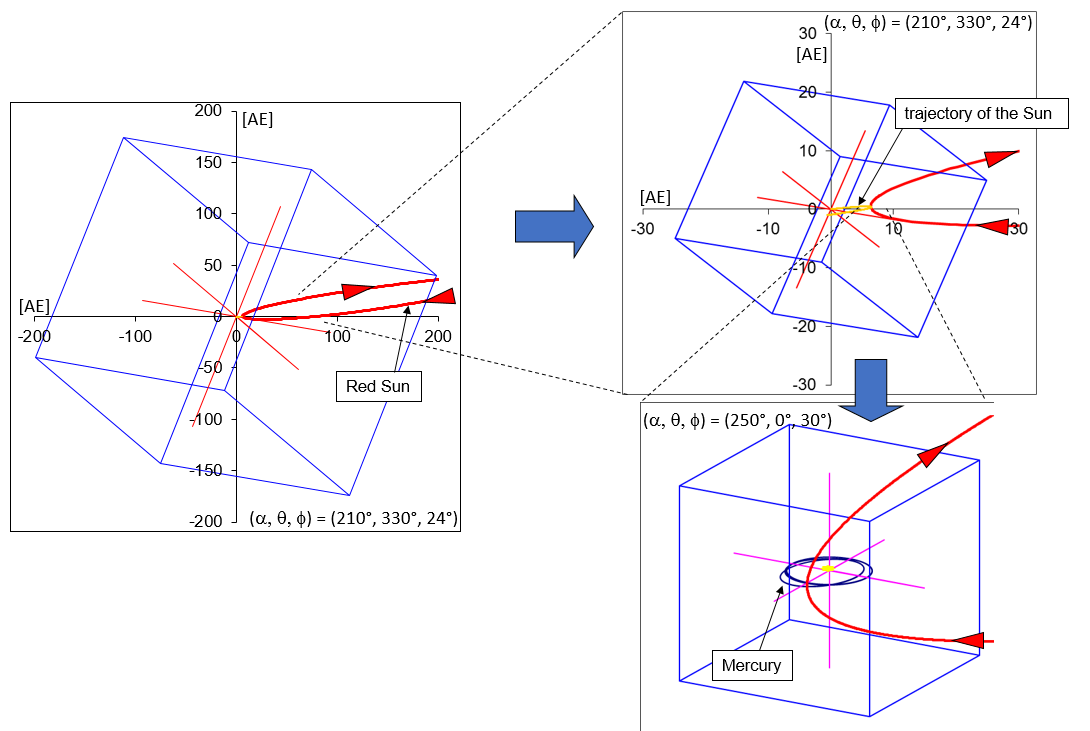
Diagram 1
The calculated path of the dwarf star, which I call the Red Sun, through the planetary system (my own computation). Its passage disrupted the orbits of the planets. It penetrated deep into the solar system and orbited the Sun within Mercury’s orbit. The disturbances are clearly preserved in the elliptical orbital shapes and orbital inclinations. I determined the rough orbital path based on myths, and fine-tuned it based on the current state of the planetary system (The calculations for this are clearly outlined in Volume 2 of my book series).
Image by Aloys Eiling
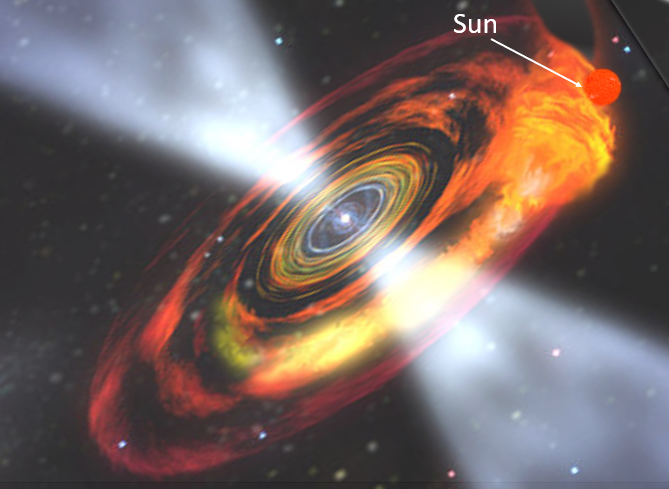
Image A
Artist’s rendering of the dwarf star that traversed the planetary system.7 It was a very young star, still surrounded by an accretion disk, with plasma flares erupting from its center. Note the size of the accretion disk in comparison to the Sun.
Image: NASA (PD-USGov)

The upheavals that accompanied the appearance of the Red Sun affected not only Earth, but the entire solar system. Although the Red Sun was a lightweight star at the lower end of the mass range for a luminous star, its gravity was sufficient to distort the planets’ orbits. The distortions of Earth’s orbit were relatively insignificant; the primary cause of the cataclysmic impact on Earth was that the Red Sun was a nascent star still encircled by an accretion disk. This enormous disk cut through the solar system like a gigantic saw. Before the Red Sun’s passage, a fifth planet existed in our solar system, which I refer to as Tiamat, that was shattered by this maelstrom. The other inner planets were scorched by the fire emitted from the accretion disk. The disk’s radiation intensified as the gravity of our Sun disrupted the orbits in the accretion disk and dissolved it from the edge. By internal friction, the initially cooled-down accretion disk grew into a fire dragon.
The memory of the traverse of an alien sun is preserved not only in ancient rock carvings but also in many ancient myths about a fiery cosmic object. The Babylonian myths and reports about the god Marduk and his star, “Nibiru,” in particular, confirm my explanation by pointing out the accretion disk and its appearance.8
The Earth maintained a distance from the Red Sun. Nevertheless, entire species, primarily megafauna, disappeared forever, even though Earth’s biological foundation remained intact. Among those who vanished were hominid species. The Neanderthals died out, leaving only a faint genetic trace in Homo sapiens, with whom they interbred. Living beings who found refuge in caves had the best chance of survival. However, hiding was also dangerous. In the heat of the second sun, the rate of water evaporation increased dramatically. Clouds kilometers high eclipsed the Sun, counteracting the unchecked global warming. The downside of the thermal shading was the deluge of water that crashed from the clouds to the ground in downpours spanning the globe. This caused drowning and mudslides rolling toward the sea.
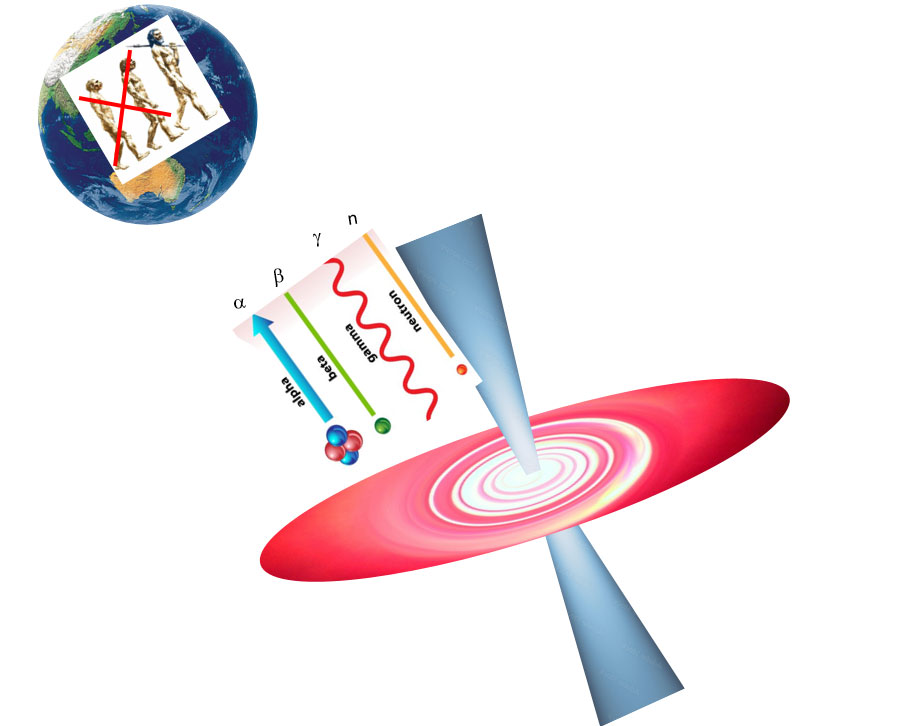
Image B
Illustration (not to scale!) of the close encounter between Earth and the Red Sun, depicting the heat and radiation storm (alpha and beta particles, gamma rays, and neutrons) emanating from the Red Sun, particularly from its accretion disk. Besides drowning, radioactivity also led to mass extinctions. Luckily, the Earth and the Red Sun never actually came close to each other; otherwise, life on Earth would have been wiped out.
Image by Aloys Eiling
Spiral and circular patterns carved into rock around the world preserve the memory of the Sky Dragon. Most notably in rock carvings, the great die-off and the Red Sun itself are deeply etched into humanity’s memory. The Red Sun offers a simple explanation of where the motif of these age-old carvings stems from and why it is found in hundreds of places across every continent.
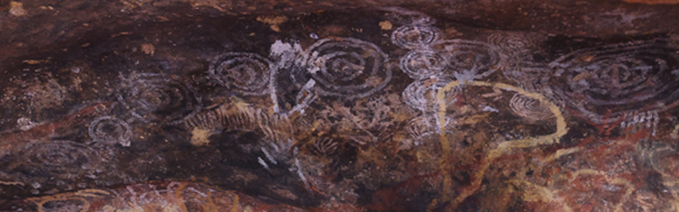
Image C
Example of rock carvings of circles and spirals, here at Ayers Rock in Australia. These are likely images of the Red Sun.
(Photograph provided and taken by Thomas Stinder, president of the GreWi-Forum Münsterland.)
Image reused with permission.
(A selection of such rock carvings from around the world, albeit with questionable classifications, can be found at: https://www.tainoage.com/spirals.html)
Those who had survived the heat and torrential rains had been lucky thus far, but the final chapter was still to come. After the Red Sun retreated, it became bitterly cold on Earth. A thick blanket of clouds continued to envelop the Earth, reflecting the Sun’s radiation. Freezing temperatures and hunger were next to present survivors with the ultimate challenge.
The concept that the Red Sun was surrounded by an accretion disk is not a figment of the imagination. In fact, this thesis is supported by measurable evidence in the form of traces of radioactive elements that are too short-lived to have survived from the earliest days of the solar system. These elements are present because, during and after the Red Sun’s passage, fresh stardust rained down on the planets from the dissolved accretion disk.
The Capture of the Moon
When the Red Sun departed, it left behind an ugly legacy. Along with the dust and grit of the disintegrated accretion disk, rogue planetesimals and giant fragments of the fifth planet, shattered by the disk, roamed among the planets. Some were large enough to shake a planet to its very foundations upon collision. One particularly large and deadly wanderer was the former companion of the fifth planet. It had lost its partner planet but survived the passage through the accretion disk. Its new orbit extended from within Earth’s orbit to the present-day asteroid belt, the former orbital distance of the fifth planet.
Since this minor planet’s orbit crossed both Mars’s and Earth’s orbits, a close encounter with a planet was inevitable. Ultimately, it was Earth that experienced an extremely close encounter with the minor planet. The rogue minor planet’s close flyby (at a distance of about 20,000 km) resulted in its capture and wreaked havoc on Earth. Contrary to official doctrine, I consider the Moon to be a young companion of Earth. Consequently, Earth was bestowed with its Moon in the relatively recent past (on a geological timescale!), approximately 12,000 years ago.
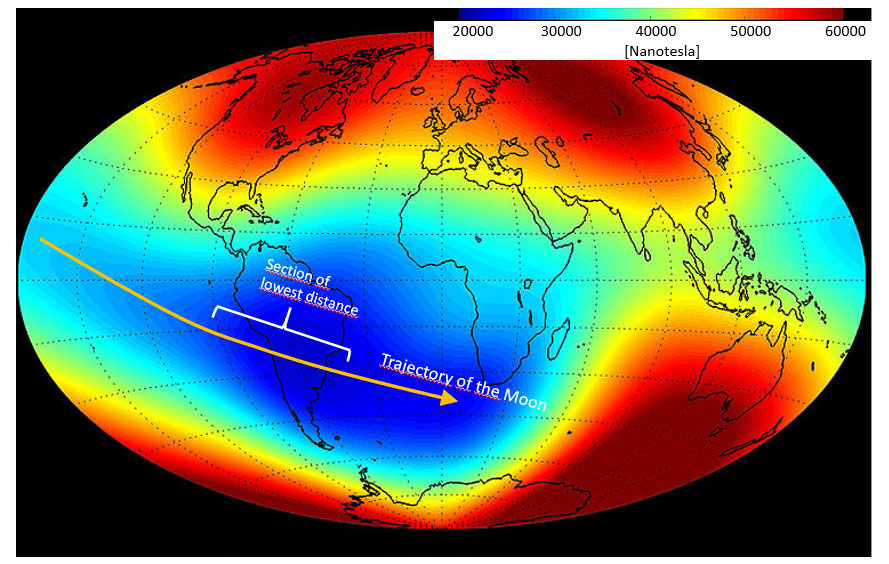
Image D
The Moon’s close flyby weakened the Earth’s magnetic field locally by distorting the crust and mantle with its gravitational pull..9
Image: ESA (PD)

In order for the minor planet to become Earth’s moon, its orbital velocity had to slow down to match Earth’s. The enormous deceleration in energy was distributed across many sinks. For example, during the close flyby, Earth’s gravity deformed the moon into a cigar shape, overcoming its internal gravitational forces. This deformation caused the Moon to stop rotating, resulting in its synchronous rotation from the moment it became Earth’s satellite. Deformation, frictional energy, and halted rotation slowed the Moon’s orbital motion. Since these deformations are all energetically irreversible, most of the energy is converted into heat during relaxation. This energy conversion explains the pockets of heat inside the Moon that do not conform to the expected shell-shaped cooling pattern.
The same force that reshaped the Moon acted on Earth as well. Rather than slowing Earth’s rotation, the Moon’s passage over Earth accelerated its rotation, shortening the day by 15 minutes. Combined with the altered orbit, the year became five days longer overall.
The Moon’s capture led to a catastrophe of unimaginable proportions for humans and animals as a significant amount of energy reshaped the Earth’s geography and geology. The Moon’s overflight caused water mountains to build up, flooding entire continents and washing them clean. America was hit hardest because it lay in the path of an enormous wave building up in the Pacific. The estimated height of the wave created by the Moon’s gravity is approximately 4 km. This height actually increased as the wave hit the continental shelf.
The Moon’s close flyby ruptured tectonic plates and shifted fragments. In the south, the Scotia Plate was pushed in the tow of the Moon far into the Atlantic between South America and Antarctica.
A land bridge that had previously connected the two continents disappeared. In the north, the Caribbean Plate pushed into the Atlantic, and the narrow land bridge of Central America became the land connection that had previously linked the north and south much further east. Only the chain of Caribbean islands has remained above water from this ancient land bridge.
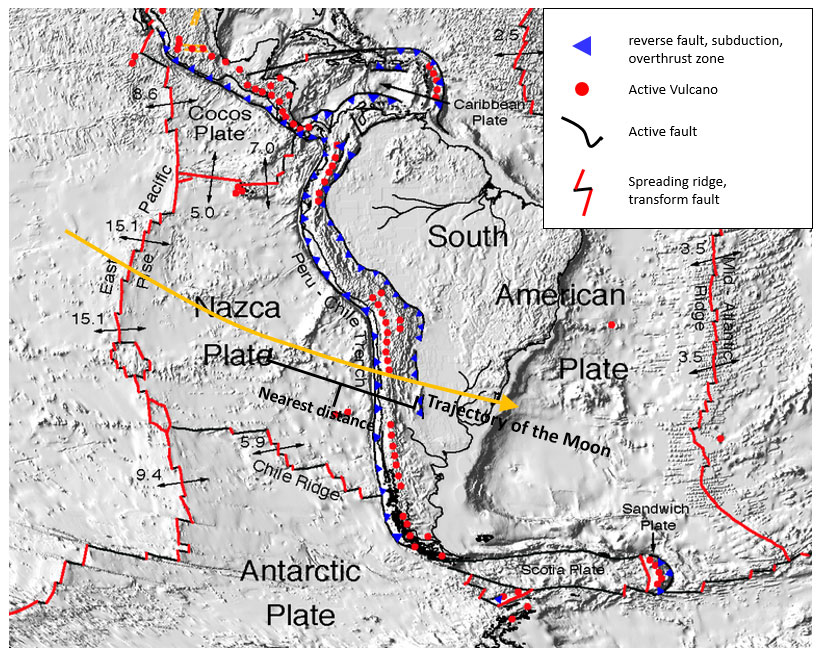
Image E
This geological map illustrates the obliquity of the South American Plate and the two minor plates, the Scotia Plate and the Caribbean Plate, that have been pushed into the Atlantic. I attribute the formation of these geological patterns to the Moon’s capture.
Image: NASA (PD-USGov)

America was not the only continent to be submerged; the others were flooded as well when the oceans surged deep inland. The catastrophe reached true global proportions when the Earth’s axis was thrown off balance by the Moon’s flyby, causing it to tilt 24.5°. The nearby Moon absorbed the change in angular momentum, which is still evident today because the Earth’s and Moon’s in-plane orbital angular momenta are equal.*
As the Earth’s axis tilted, the equatorial bulge moved around the planet. The displacement, which depended on longitude, reached nearly 2,500 km at its maximum. The 22-km-high equatorial bulge rolled, exerting pressure on the Earth’s crust and causing a shift in the crust’s geological strata. In some places, this resulted in the top layer becoming the bottom layer.
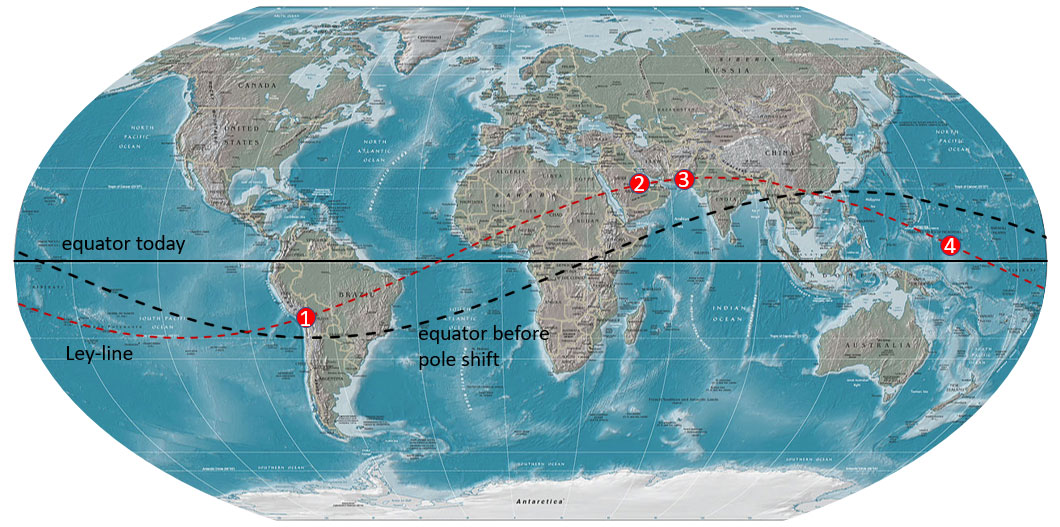
Image F
Shift of the equator due to the tilting of the Earth’s axis. Note the location of some important prehistoric sites near the equator.
Image by Aloys Eiling, derivative of PD-USGov CIA map

- Tiahuanaco
- Dilmun
- Mohenjo Daro
- Nan Madol
The fact that all of this happened in prehistoric times is not only derived from geology. Preserved myths around the world speak of the Moon’s capture and the catastrophes that accompanied it. For example, the ancient Greeks preserved the memory of a pre-lunar era by referring to the inhabitants of Earth at that time as “Proselenos,” meaning people who lived when the moon did not exist. The most fitting account of the Moon’s capture and the subsequent changes can be found in Zulu mythology. These myths explicitly state that the seasons only emerged after the Moon appeared. This is convincing evidence to support my conclusion that the Moon’s capture caused the Earth’s axis to tilt.
The Fall of Venus
Close encounters between rogue dwarf planets and real planets can have several consequences, ranging from impact and moon capture to deflection or even ejection from the solar system. One of the minor planets left behind in the Red Sun’s wake disappeared when Earth captured it, becoming the Moon. Fortunately for the inner planets, most of the large fragments from the shattered fifth planet took wide orbits around the Sun. Only meager remnants remain, orbiting between Mars and Jupiter in a zone called the asteroid belt.
Another catastrophe loomed when Jupiter deflected a massive fragment of the fifth planet into a much narrower orbit, causing it to cross the orbits of the inner planets. A celestial body’s duration in such an orbit is measured not in millions of years, but in millennia. In this case, Venus drew the short straw.
Today, Venus is a hostile planet. Its atmosphere is so dense that lead and zinc melt on its surface. Its status is strange because few of its properties align with those of the other planets. This is all the more puzzling given that its proximity to the Sun places Venus well within the Sun’s habitable zone. A cosmic catastrophe just about 6,000 years ago reduced the planet to its current state. Not only do I propose this, but I also argue that Venus was once teeming with life. I take this idea further by claiming that Venus was home to an advanced civilization that practiced interplanetary space travel prior to that disaster. Despite all their technology, the inhabitants of Venus—the rulers of the planetary system and the gods of our progenitors—were powerless against an onrushing minor planet.
Not only do physics and astronomy chronicle Venus’s fall, but so do the myths and religions of ancient cultures.
Some Venusians managed to escape to Earth before their habitat was destroyed. There, they acted as culture formers and were worshiped by humans as gods. Thus, the gods of human history did not come from Sirius or Aldebaran, but rather from right next door. When Venus fell, the Venusians lost their home and became refugees among humans. They could still initiate construction and found cities. But likely, their group was too small to survive. Due to death and internal strife, their power base and divine status gradually crumbled. Perhaps some of their descendants still silently exist, having simply lost interest in humanity. Perhaps it is they that we occasionally catch glimpses of with their UAPs and observe them from time to time as the grey ones.
The consequences of my assertion are anything but insignificant. Assuming that extraterrestrials once walked on Earth means that we no longer need to consider interstellar travel.
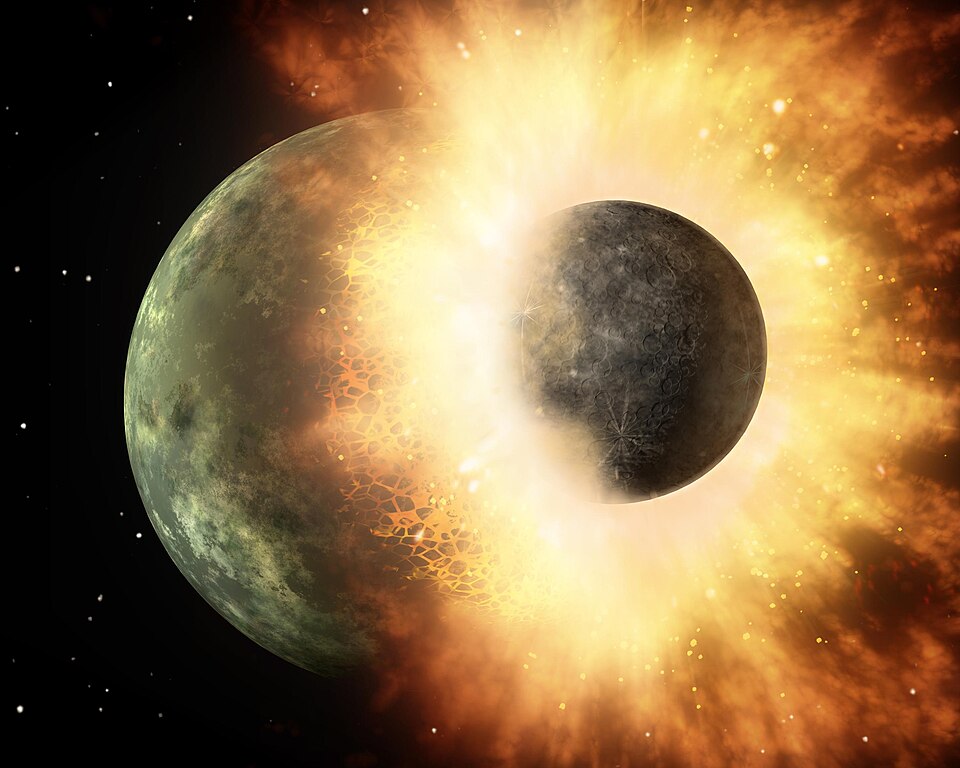
Image G
Artist’s rendering of a cosmic collision 10
Image: NASA (PD-USGov)

When the collision occurred, a blinding flash illuminated the solar system and made Venus the brightest object within hundreds of light-years for a brief moment.
The minor planet collided with Venus near its equator, opposite its direction of rotation. The resulting energy release and imparted angular momentum altered the planet’s structure and mechanics. Venus became a glowing ball that continued to smolder for centuries and still exhibits a dramatically high surface temperature today. My calculations, which I fully lay out in Volume 3 of my book series, suggest that the collision occurred less than 6,000 years ago, and the inner heat continues to rise to the surface, albeit slowly. It will take millions of years for the surface to cool to a normal equilibrium.
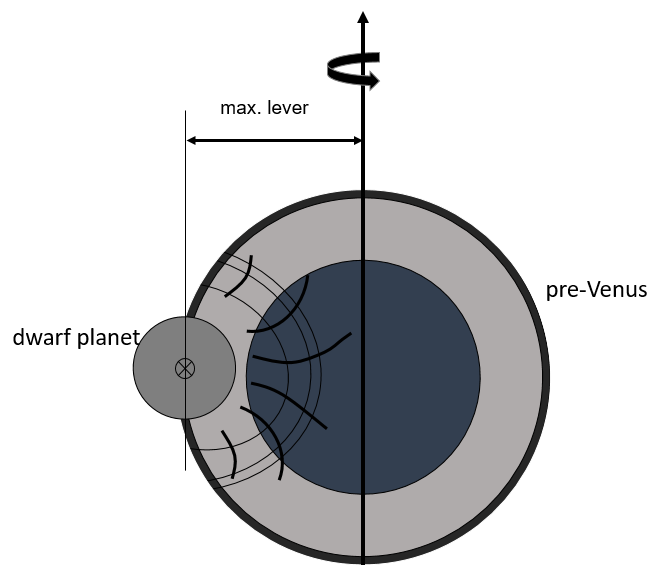
Image H
Illustration of a minor planet impacting Venus, which was a cooled, normal planet prior to the impact.
Image by Aloys Eiling
The atmosphere expanded due to the energy released by the impact, which heated it to over a thousand degrees. The atmosphere’s pressure increased even further manyfold. This happened as carbonate rock decomposed at high temperatures, and the release of enormous amounts of CO₂ caused the atmosphere to expand even more.
The boiling lava broke the water down into oxygen and hydrogen. The oxygen formed high-melting oxides, while the light hydrogen rose into the atmosphere and was blown away into space by the solar wind sweeping through the giant atmospheric balloon. From Earth, Venus appeared like an enormous comet with a tail extending beyond Earth’s orbit.
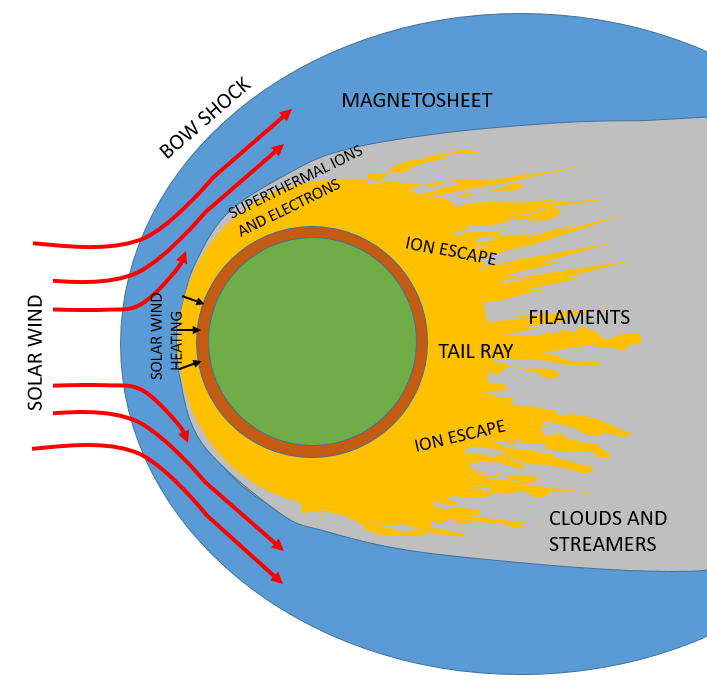
Image I
After the impact, Venus took on the appearance of a giant comet.11 A comet-like tail extended beyond Earth’s orbit.
Image by Aloys Eiling, based on PD-USGov, NASA

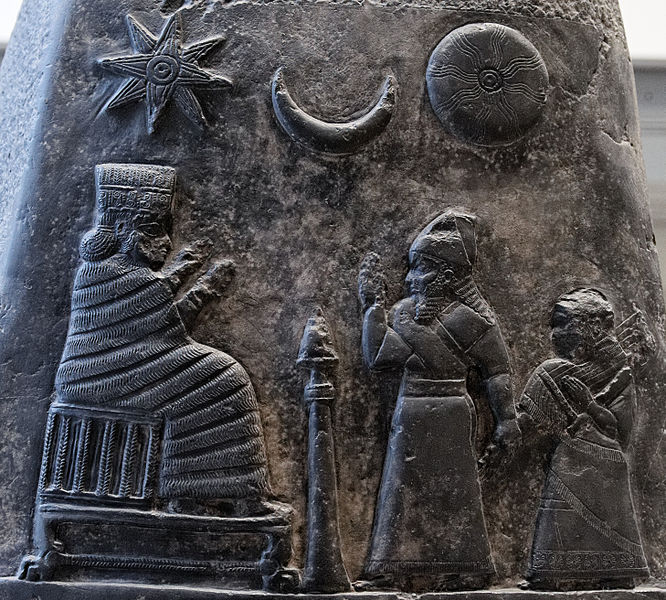
Image J
Relief of the prehistoric tri-star in Earth’s sky shows the Sun (left), the Moon (center), and Venus (right), which in prehistoric times was bright and self-luminous..12 The wavy lines in Venus’s inflated atmosphere reflect the pressure induced undulating motion.
Image: Jastrow (PD)
The impact nearly halted the rotation and even slightly reversed its direction, so that today a Venusian day (one full rotation around the axis) lasts longer than a Venusian year (orbit around the Sun). The additional energy input was sufficient for humanity to experience another Great Flood. As Hertha von Dechend, the grande dame of classical mythology, noted: This Great Flood was a bonus.
This cosmic event in Earth’s vicinity and its temporal proximity to our own time provide a perfectly natural explanation for Venus’s prominent position in global mythology. This event revived ancient myths about cosmic events and has been handed down with more than just vague details.
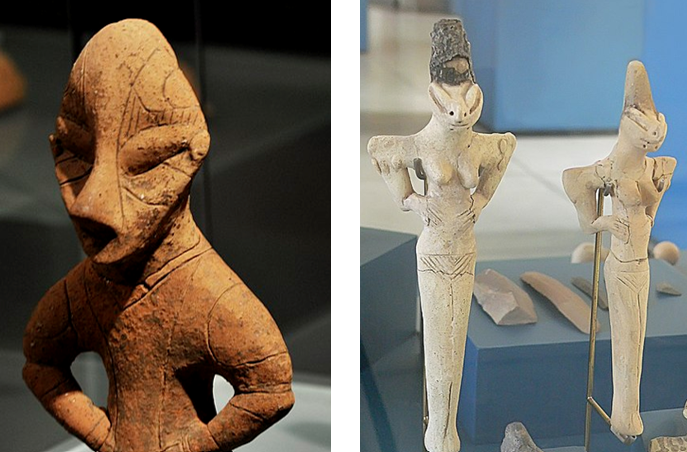
Image K
These are what the gods from Venus might have looked like. Such figurines, which are characteristic of their alien-like heads, date back to prehistoric times and have been found all over the world.13, 14
Left: image by Arbenllapashtica (CCBYSA4.0)
Right: image by Mary Harrsch (CCBY2.0)


Summary
My alternative theory of prehistory is not a patchwork of unrelated events. Instead, it provides a comprehensive picture spanning 40,000 years. However, since it contradicts official doctrine, tenured historians will dismiss it as fringe science. They are accustomed to this attitude toward those outside their field, considering them ignoramuses or, more likely, dimwits. They feel authorized to gleefully dissect the inconsistencies in alternative prehistorians’ explanations and point out their errors and discrepancies. Yet, they constantly forget about the shortcomings in their own explanations.
My theory posits that epochs and their associated turning points are explained and defined by catastrophes of cosmic origin. The doctrine of world ages may be dismissed as a fairy tale or an idealized utopia. However, I believe this is not necessarily the case. I have identified at least three major ruptures that have left their mark on human history. By combining myths, archaeological facts, and written accounts from ancient authors with mathematics and the natural sciences—particularly astronomy—I elevate my alternative prehistory from a collection of plausibilities and puzzles to a level previously considered unattainable.
The first turning point in human history occurred forty thousand years ago when the Red Sun, a dwarf star, passed through the solar system and devastated it. The Red Sun destroyed the fifth planet and altered the other planets’ orbital parameters. Amid a storm of radioactive particles and intense heat from this additional sun, a mass extinction event occurred on Earth. The subsequent rebuilding of civilization from nearly nothing is remembered in Egyptian mythology as the Zep Tepi era.
Approximately 12,000 years ago, a second cataclysm took place when the Moon was captured. A sky-high wave crashed over the Earth, triggered by the Moon’s close flyby. The Earth’s axis tilted, the equator shifted, the oceans surged, mountain ranges folded, and land bridges broke apart. Continents were submerged, and entire species of animals vanished instantly or dwindled to numbers too low to ensure long-term survival. The floods remained most vividly in human memory in myths. Among these myths, the story of the Great Flood in the Bible stands out.
Though less devastating than the previous two cataclysms, the climate catastrophe that occurred about 6,000 years ago was still terrible for those affected. A collision with a rogue minor planet transformed Venus into a planetary sun. The additional heat radiation transformed Earth into a sauna. Torrential rains washed entire civilizations into the sea. The era following this third flood saw the emergence of the so-called classical civilizations. We still live in this epoch today.
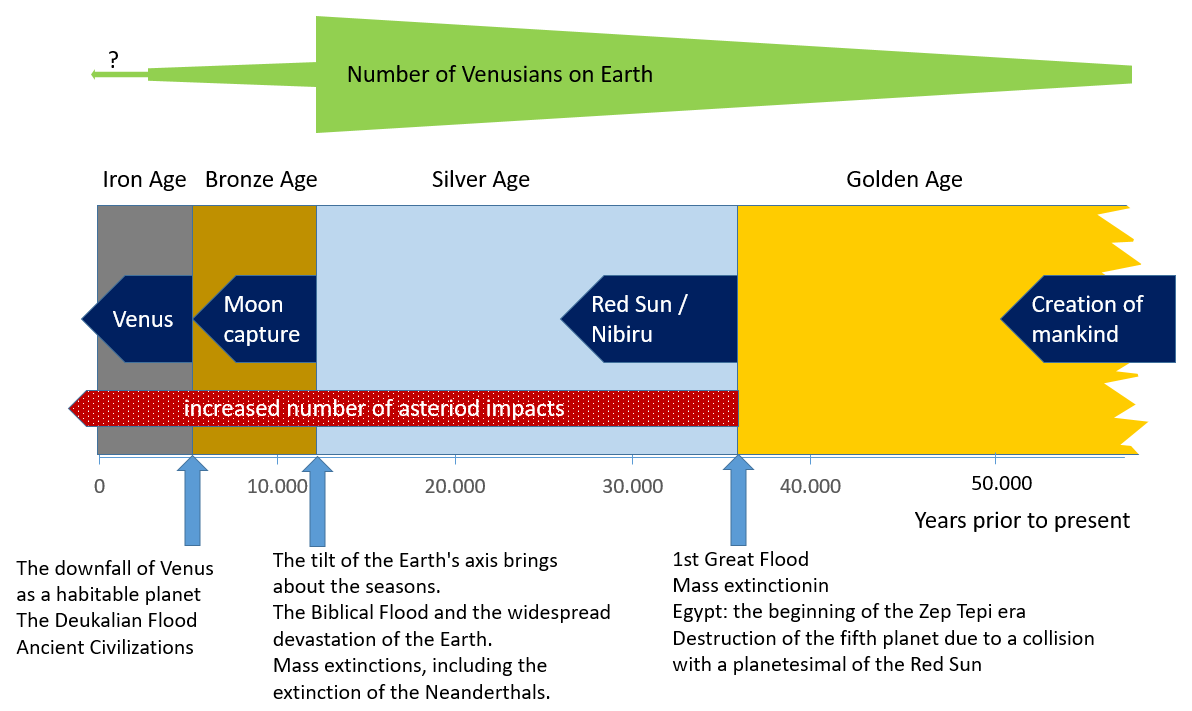
Image L
A graphical illustration of the eras in human history according to my “true(r)” prehistory theory.
Image by Aloys Eiling
The idea of gradually deteriorating living conditions, as recounted in myths, taught in religions, or written about by ancient writers, is all too human. It’s normal to romanticize the past, even over shorter periods of time. In fact, already, older generations often have a negative perception of the following one.
Even if I dismiss the idea of the ages of the world as a fairy tale or a utopian ideal, the cataclysmic turning points are real and persist in human history and consciousness.
It’s also worth noting that our civilization is not set to last forever. The question is whether we will wait for the sky to fall on our heads or wipe ourselves out in a nuclear war.
As Mephisto in Goethe’s play ‘Faust’ states: And rightly so, since everything created in turn deserves to be annihilated.15
References
1 Aloys Eiling, ‘Die wahre(re) Vorgeschichte‘; BoD – Books on Demand (2022)
2 Franz Xaver Kugler S. J. was a polymath who earned a doctorate in chemistry and completed full courses of study in philosophy and theology. He was also an expert in ancient languages. As an assyriologist, he could read cuneiform and had an exceptional grasp of ancient literature and mythology. For many years, he taught higher mathematics as a professor at the University of Valkenburg in the Netherlands. Crucially, his demystification of mythology was informed by his deep understanding of astronomy. Drawing on this remarkable body of knowledge, he analyzed and compiled scattered quotations from ancient writers regarding prehistoric myths. He interpreted these as descriptions of specific events, providing evidence that they were real occurrences. Given the breadth of Kugler’s knowledge, his reflections on the interpretation of myths are incredibly enlightening.
3 Franz Xaver Kugler, Sibylline Stellar Battle and Phaëthon in the Light of Natural History; https://archive.org/details/MN40024ucmf_4
For a critical review and summary of his work in English, see: http://www.defendgaia.org/bobk/Kugler/kuglrml.html
6 Marcus Tullius Cicero: Somnium Scipionis; http://12koerbe.de/pan/qu.htm
7 Designed using: NASA animation, see: https://upload.wikimedia.org

8 https://web.archive.org/web/20200714103701/https://cdli.ucla.edu/files/publications/cdlb2015_003.pdf
9 Aloys Eiling, ‘A Different View on the Deluge and the Moon’, https://grahamhancock.com/eilinga2/
For a more complete discussion see: Aloys Eiling, ‘Achtung Mond’; Ancient Mail Verlag (2025)
11 Sketch is drawn according to https://commons.wikimedia.org/wiki/File:Arc-1978-ac78-9464_copy.jpg
15 Johann Wolfgang von Goethe – Faust; https://antilogicalism.com/wp-content/uploads/2017/07/faust.pdf
* In mechanics, angular momentum, which is a measure of rotational motion, or how much spin something has, is a conserved vector quantity, meaning its magnitude and direction stay constant over time. This vector points perpendicular to the plane of motion. In a given coordinate system, it can be broken down into different components. Here, the components of Earth’s rotation and the Moon’s orbit that lie parallel to the plane of the ecliptic are equal.
Greetings Aloys,
In my opinion, only a close passage of a massive object, possibly within the Roche limit of said object, fits the narrative of the world flood myths accurately, where only those who escaped to the highest mountaintops were able to survive. Whether or not this object was the Moon may be debatable, but it is certainly plausible.
Do you think that the “Red Sun” could possibly have been a primordial black hole? This scenario could also support the accretion disc, plasma jets and mass required to disrupt the solar system.
Cheers ZF
Hello Alloys,
Very intriguing article and thoroughly enjoyed reading it. Seems to fit a lot of the ancient mysteries puzzle together quite neatly.
My own research over the last 20 or more years has been into the idea that the ancient Egyptians witnessed a pole shift event. Certainly some of their ancient texts tell of such an event as well as documenting some of the effects: changed seasons, sun rising/setting in opposite horizons and so on.
But what no one seems to have realised is that the Giza monuments demonstrate this pole shift and show its geographic extent. Most intriguingly of all, the ground shift is matched perfectly by the shift of the heavens which they also recorded. In short, the ground shift matches the shift of the heavens – perfectly.
You can see this in my short videos here: https://www.youtube.com/watch?v=vP9eNPslk-M&list=PLcpRmKch9zoY (Giza: Portrait of a Pole Shift Parts 1, 2 & 3).
I am now trying to figure out if this shift recorded by the ancient Egyptians can fit with the shift you propose.
Excellent article and thanks again.
SC
Hello ZF,
The myths surrounding the Moon’s appearance at prehistoric times support my physics-based conclusion that the devastating cosmic object was the Moon. The explanation for so many facts is simply too plausible to be a coincidence or an unfounded idea. Taken together, all my arguments paint a consistent picture that, to my knowledge, is new.
You are right to question the characteristics of the Red Sun. Indeed, it is possible that the Red Sun was a small black hole. In fact, I adopted this idea as the explanation in my novel Götterdämmerung über Asgard.
Both the book on the capture of the Moon (*Achtung Mond!*) with its more in-depth discussion and the novel featuring the passing of a black hole—bother unfortunately available only in German—present a more in-dept discussion with additional arguments.
If you are not satisfied with the answer, or if you have any further questions, please feel free to contact me.
Best regards,
Aloys Eiling
Greetings Aloys,
An excellent article, I thank you. Your scientific analysis (or rather astronomical/geological) fits the myths and art, whether it be rock art, early writings et al, logically. I only wish the major part of the archeology community would stop being so narrow-minded in so far as protecting their out of date theories. That discipline cannot move forward if stuck in the past (pun not intended).
Regards
Michael Clarke
Hallo Aloys
Can you elucidate the reasoning behind the Equator incurring ‘shift’ ?
In the event of Earth’s rotational axis incurring change of obliquity — cohesive ’tilting’ — Earth retains its geographical & directional attributes, whereby Antarctica remains on the S.Pole.
Your Image ‘F’ and the description related thereto imply differently -i.e. “equator before poleshift” -VS- “equator today” (applicable only in the event of crustalf shift).
QUOTE
“Earth’s axis was thrown off balance by the Moon’s flyby, causing it to tilt 24.5°”
Being the product of Earth’s spin, the polar axis & equator are locked into 90°. Consequently, ‘prior to the Moon’s capture and tipping over’, the geographic poles would’ve:
a). facilitated glacial of exceedingly great proportion.
b). been in allignment with the poles of the Ecliptic. Accordingly, the Equator in alignment with the plane of the Ecliptic
i.o.w. 0°obliquity -i.e. the CelestialPole & EclipticPole in unison.
Hence absence of seasons – in addition thereto, temperature in the equatorial region would’ve been unbearable…
THE CAPTURE OF THE MOON paragraph
QUOTE
“..Earth was bestowed with its Moon… approximately 12,000 years ago.” *
QUOTE:
“The FACT that all of this happened… is not only derived from geology. Preserved myths around the world speak of… This is convincing EVIDENCE to support my conclusion…” (EMPHASIS added)
QUOTE
“… the Moon’s passage over Earth accelerated Earth’s rotation, shortening the day by 15 minutes.”
“Combined with the altered(?)orbit, the year became five days longer”
i.o.w. prior to presence of the Moon, one day comprised 1455min. Likewise, the year consisted of 360 days.
‘Longer days’ in combination with Earth’s present orbital parameters & velocity yield a year reduced by 3.8 days.
1455×365.25=531,438.75 -VS- 1440×365.25=525,960
531,438.75 − 525,960 = 5478.75 min. /1440 = 3.8046875
(The 60 base time system, of course, would not be compatible with ‘a longer day’ – therefore demonstrative only).
QUOTE
“…the Earth’s and Moon’s in-plane orbital angular momenta are equal.”
Footnote thereto: “the components of Earth’s rotation and the Moon’s orbit that lie parallel to the plane of the ecliptic are equal.”
However, the Moon’s orbit is offset by some 5° w.r.t. the plane of Earth’s orbit (which I presume was unaffected by the catastrophic events you describe).
* The geological record predates that timeline and moreover, is reconciled with sea level subsequent to LGM – ref. https://grahamhancock.com/phorum/read.php?1,1320246,1322699#msg-1322699
Hallo Hendrik,
That’s quite a list of questions and comments! I’ll try to give short but clear answers.
So, one by one:
Comment 1
In my model, the Earth does not physically tilt, but rather the axis of rotation changes position. This moves the poles in parallel without any displacement of the crust being required. As the Earth is quite spherical, there is almost no stabilization due to the main axes of inertia. Note that if there is a second body to take up the change in angular momentum, the Earth can rotate about any axis.
Comment 2
In my model, it is not the Earth’s body that tilts, but rather the position of its axis of rotation that shifts. This moves the poles in parallel without any displacement of the crust being required. As the Earth is quite spherical, there is almost no stabilization due to inertial axes. Note that if there is a second body to take up the change in angular momentum, the Earth can rotate about any axis.
Comment 3
There are several facts that support my argument. For example:
– the salinity of Lake Titicaca;
– the minimally eroded submarine canyons;
– the coral reefs in the High Andes;
– the extinction of large mammal species in the Americas.
The myths are an added bonus.
Comment 4
The 360-day year does not stem from the plausibility of the base-60 system. I derived the faster rotation of the Earth and the expansion of its orbit from physical calculations. Agreed, I was happy that it fitted.
“…the Earth’s and Moon’s in-plane orbital angular momenta are equal.”
Footnote thereto: “the components of Earth’s rotation and the Moon’s orbit that lie parallel to the plane of the ecliptic are equal.”
However, the Moon’s orbit is offset by some 5° w.r.t. the plane of Earth’s orbit (which I presume was unaffected by the catastrophic events you describe)
Comment 5
Angular momentum is a vector and is conserved in all cases. The component of the Earth’s rotational angular momentum that is not perpendicular to the orbital plane (the ecliptic) is equal to the component of the Moon’s orbital angular momentum that is not perpendicular to the ecliptic. I do not consider this to be a coincidence, but rather I assume that the Moon’s orbital inclination has taken up the change in the angular momentum of the Earth’s axis as it tilted.
Comment 6
In fact, I do not care whether 12.000 year ago or 12.000 BC. Both data within the error of my assessment.
I hope you found my answer helpful. Please feel free to contact me with any further questions or comments.
Based on your name, I assume you’re fluent in Dutch. If so, reading a book in German shouldn’t be a problem for you. If so, I recommend my book Achtung Mond! which answers most of your questions in much greater detail.
Best regards,
Aloys
I conteplated that option but due to dual meaning of wording, discarded it – thanks for confirming. In that context — referring ‘the equator before poleshift’ in image F — it implies the N.pole was located on the Eastern extreme of Baffin Island, whereby the polar ice cap could extend to New York, with which concensus is in agreement.
The prospect thereof also conforms insofar accountability for the amount of thawing contributable to subsequent sea level rise (the mechanism for the occurrence thereof is worthy of consideration however). The catastrophic run-off from the Rocky Mt. range cut the Grand Canyon and emptied into the Gulf of California. The topography of central and Eastern regions accordingly determined drainage via the network of river systems – all of which recorded sedimenrary deposits.
The S.pole — located in the ocean between Australia and Antarctica — wouldn’t have facilitated the same extent of glacial buildup as the American-Greenland landmass, moreover, Antarctica would’ve been largely ice free (another interesting prospect).
The question I ask myself… how can it be known with any reasonable certainty, what Earth’s orientation was prior to capture of the Moon? The only aspect that can be taken for granted is the plane of Earth’s orbit. The red ‘Lei-line’ shown in image F, is actually the EclipticPlane. The separation distance between that and the ‘former equator’ is indeed indicative of obliquity – correspondingly, there would’ve been a tropical belt (i.o.w. seasonal swings) albeit narrower than the present – judging from the image, by half -i.e. 12.25°)
Hence, the subsequent tilt would’ve been less pronounced in order to settle at 24.5°..?
Another aspect of interest – prior to capture of the Moon, axial pression AKA reversal of the Equinox, would’ve been absent alltogether – insofar Luni-Solar gravitation being the driver.
PS I’m South African and although third generation descendant, my command of the language is limited to amusing German tourists, hence the book recommended is put on ice..
Hi Hendrik,
A few comments. If I were to answer everything in full detail, it would go way beyond the scope of this post—it would turn into a book.
1. Sea levels rose primarily because ice and glaciers on the mainland melted. Ice in the ocean—and that’s where the new pole was located—displaces as much water as it weighs. So it’s a zero-sum game.
2. Before the Earth’s axis tilted, the South Pole was located on the edge of Antarctica (south of Australia), but still somewhat inland. The northwestern part of Antarctica—Graham Land, across from Tierra del Fuego—may have been ice-free. At that time, however, there was still a land bridge connecting Antarctica and the Americas. I think large parts of the continent were already covered in ice even before the Earth’s axis tilted.
3. The tilt’s direction can be roughly deduced from the orientation of structures from before the Flood, such as the Road of the Dead in Teotihuacán. The strongest arguments are of a geological nature. In Canada and Antarctica, for example, there are gravel deposits from pre-Flood rivers that align chronologically with the date of the moon’s capture. When I place the centre of impact in the region of Central Argentina, the direction of the tilting follows from the torque (perpendicular to the applied force). I have estimated that the uplift of the Pacific Ocean caused by the Moon passing overhead was approximately 4 km. (In fact, the moon stretched the Earth and a tidal bulge also formed on the opposite side.) When the wave struck the continental shelf, the water bulge grew even larger.
4. The wave flooded all of the Americas. The impact of the wave and the subsequent movement of the tectonic plates triggered the Earth’s tilt. Crucially, the angular momentum of the Moon’s orbital inclin ationparallel to the ecliptic corresponds to the parallel angular momentum of the Earth’s axial inclination relative to the ecliptic. The coincidence limits the inclination prior to the full tilt of today to ±2°.
5. 5There is also a very detailed myth that describes the impact of the wave and the uplift of the Andes. I don’t know if you’ve read my article.
6. The salt lakes, as well as Lake Titicaca, are relics of this giant wave. The Grand Canyon, other large valleys and, above all, the deep-sea canyons along the continents’ main drainage channels were carved out by receding ocean water after the inundation of all continents. In some high mountains, only bare rock remained, as all the soil was washed away. The soil of the Andes can be found in the form of scree plateaus to the east and west. If you haven’t already, please check out https://grahamhancock.com/eilinga2/. In it, I discuss the capture of the Moon. I also recommend taking a look at my book Achtung Mond! — if only for the pictures.
I hope I was able to answer at least a few of your questions. https://mythen-goetter-und-gelehrtes.jimdofree.com/publikationen-englisch/
Best regards from the same time zone,
Aloys
I’m not terribly knowledgeable. My question is probably naive, but…
I presume you have a stellar candidate in the local neighbourhood? If not, it would seem to be the most obvious flaw in your ‘Red Sun’ hypothesis. Such a recent passage of 40,000 yrs would make it the nearest most readily visible stellar object (the accretion disk alone would be extremely visible), especially to today’s telescopes. Its parallax compared to other stellar neighbours (and especially to the rest of the galaxy) should be obvious, even over a relatively short observation window.
Why can’t we see it?
Hello,
That’s a great and valid question!
During the time of its approach to the solar system, I referred to the Red Sun as a ‘dark sun’. Later, the main source of radiation became the accretion disk as it approached the Sun and became radiatively active. Given the mass of the object is barely sufficient for it to be considered a true sun. Its low mass can hardly sustain nuclear fusion, causing such a lightweight tar to emit only weak radiation. However, this small star would explain the orbital shapes and inclinations of the planets. It would also account for the chaos in the Kuiper Belt region and beyond. There is supposedly a Planet 9 there to explain this, but despite extensive searches, it has not (yet) been found.
If the Red Sun is actually more a kind of a rogue planet today, it would be very difficult to find. Moreover, 30,000 years is not an insignificant timeframe. Assuming a distance of more than 2 light years is not unreasonable. In conclusion, its absence is a problem and at least unfortunate, but does not disprove my model.
What makes you think it was 40,000 BC? IMHO it is more likely to be 74,000 BC when the gene pool got hit hard to the point that only tens of thousands humans were left world wide. We can see the effect in the genetics of humans today.
Hi Tim,
I think, an event that transpired 74,000 years ago is too remote in time for it to have been plausibly transmitted through mythological traditions.
A mass extinction of large animals occurred around 40,000 years ago, and the other human species (Neanderthals, Denisovans, Homo erectus, etc.) died out around that time, leaving only Homo sapiens. The weakening and shifting of the Earth’s magnetic field has traditionally been blamed for increased radiation exposure, which is thought to have caused the extinction. While it can increase mortality rates, it cannot cause mass extinction. To me, the Red Sun makes the more likely option.
I have outlined these and other arguments in the article https://grahamhancock.com/eilinga13/.
May be, modern humans were created 74,000 years ago through genetic engineering. But this is mere speculation.
Your concerns are valid. Nothing is more important than thinking for yourself and asking questions. Otherwise, nonsense and lies go unchecked and gain ground.
Best regards,
Aloys
Who says in the Tri-star picture is the Sun in the left, Moon and the Venus? Even if number 8 often belongst to Sun, in this picture, on the left is the Earth with its 8 cardinal points( 4+lesser 4)! And the Crescent Moon as a symbol of Grotto in Milky Way( often as Moon also) and right not Venus, but Sun with the radiating sun-rays as wave energy…No Venus here…When the Sun gets into the Grotto of Milky Way, is reborn, and thus the Earth cardinal points moves in solstices and equinoxes…
On the Tri-star note the ” pillar” under the Crescent GROTTO OF MILKY WAY, and the Creator( Potter= YoSeR) on the throne on the left side…The Axis mundi and cardinal points changes Sun once it gets into the Grotto= in Dark Rift/ Cleft) where the Cygnus X-1 decides the repolarisation of Sun and Earth cardinal points! On the Sun with the waved sun-rays is Sun…Venus gives no sense in this Galactic alignment with consequences for the Sun and Earth!!! The ” pillar” is the Axis mundi or ” Atlantis or Mount Meru” if you wish…
After 40+ years in ancient archeo-astronomies on global scale, I am skeptical about our ” scholars” as recognised authorities, yet they do not know how to correctly read ancient pictures, symbols, monuments and so on…On Dresden Codex, the last,74th page interpret the ” solar” explosion from the black hole and galactic center from the Caiman Jaws as ” Flood ” with cannonation to ” water”, but it is Solar and Light energyoutburst from the 13th house of the zodiac in the Serpent cultures of America and Mesoamerica!!! With the descend of ” god L” with two arrows as ” two edged sword” of chaos and war period…In the Dresden Codex are the most important two(2) pages: 20th and 74th…Matching the Great Sphinx as the zGreat Precessional stone marking point from Aquarius to Leo and to new Aqypuarian Age…The human head, either recarved or original symbolises the Aquarian Age starting point and the Head of the zodiac in the cca 25,800 years lasting precession…It could be the year of 2074 as the END OF ANNUS MAGNUS, supported also by the 1611KJV Bibles with 2074 verses difference within the Ennead, and also the Cambridge University Press publication with Red verses has a last, 70th code as 20J74 ar the end, on page 339…I saw the same pattern used at the funeral service of Pope John Paul Ii in 2005…Since 20×74= 1480, it is the Greek gematria value of Christos/ Christ…And 1480 x 6 as the width of the Sphinx, it is 8880, where 888= gematria value of name Iesous…Amazingly, the Great Sphinx as ” Iesous Christos”, but let the reader decide in his own mind…By the way, Aquarius was YoSeR/ ZoSeR/ DJoSeR in ancient Egypt, as the Potter and Creator…His 6 stepped pyramid was the First one in Egypt….
The same problem I have with the ” scholars” interpreting the solar king Janaab Pakal’s famous Lid and thevPyramid-Temple of Inscriptions, indirrectly ” insulting” us, the better educated public by deliberately denying number- date 745 as so visible on the Lid on the left crossbar of the Maya Cross= Tree of Life on the left bar ending as Septagon/ 7, atop as Square/ 4, and in the right end bar as Pentagon/ 5…745 when ” Palenque?” rather Na-Chan or Naga royal city started to decline!!! Furthermore, on the Serpent atop the crossbarbis 9 like ” candles” enlightening this Tree of Life of the Mayas atop the snake body, becausevthe Serpent/ snake in the Dark Rift of Garden of Eden symbolises the enlightening Black hole= Cygnus X-1 energy filled with spiritual and Light energy from the Thronebin Galactic Womb and Center!!! And this additional DATEVOF 9,745 BC points at the destruction of Atlantis, instead of fake given “9,600” BCE…9,745 BC I see used frequently by freemasonry, as I see 745 as well! Like Santisima Bendita Seas Madre…9,745 letters…or just Bendita Seas Madre, similarlynin Latin letters in the basilika of Holy Mary of Seven Sorrows in Slovakia, where besides 745 letters is also a Maya calendar with 4 lines and 8 words consisting from 48 letters and organised as 13&9 and 13&13 letters, as Precessional and Tzolkin calendars! And the musical organnin the Slovak Patronness basilika is 3113th ” opus dei” of famous company of Varhany Krnov, producing a such instruments of music for centuries in the heartbof Central Durope, where Slovakia is located! Slovakia is from ” Slovo= Word” like Word of God! In 3113 BCE started this 5th Sun Age by Julian calendar…And to the Temple of Inscriptions leads 69 steps calendrically organised as 9.13.19.19.9. Fromntop to bottom, whichbis 3,824 lunar years, or 3,744 solar years for repolarisation of the Sun, as M.Cotterell pointed out in his book of Tuthankhamun Prophecies! That date takes us to 710 AD, and the bottom up date of 9.19.19.13.9. As 3,942 years takes us to cca 828AD as downfall of Naga-Palenque Maya Sun kingdom…The date is solar max.activity…And inside the Temple of Insriptions leads another 66 steps turning toward red East= place of Rebirth/ Resurrection and new sunrise…Together as 135 steps, an important number in the Haab calculus, but also as the Maya ” Bolon Yokte Ku”= 9 yoked stars of Northern CROSS which is also part of the Cygnus constellationnof Rebirth with 84 stars matched by the 84 cm high stztue of Mary, Mother of Christ indoor the Slovak basilica of Mafy’s Seven Sorrows…And matched by the RKC and 1611KJV Bibles with 84 books in total, including their Apocryphal and Deuterocanonical books!!! [ Islamic Aur’an has 84 Initial codes in Arabic alphabet]…Number 84= Judgement number, Jacob punished 7 years = 84 years, Israel 70 years= 840 months, etc.!And Bernardino Sahagun the 1 +3+5 stars surrounded by 17 daisy chain stars described as Pleiades, but it is Northern Cross Rebirth/Resurrection constellation with Cygnus X-1 black hole, and X-2 & X-3 binary stars…And the ” Bolon Yokte Ku” 1+3+5 stars started to descend upon our world after 13 Bak’tuns ending in December 2012…For cca 18 yearsofbthe Hal degree diameter of our sun, aligning with the effect of the Black hole its spiritual force and Light force, after the temporary chaos and warmongering in the world…