





Abstract
What if the Biblical story of Adam and Eve isn’t original but represents the culmination of ancient mythological traditions that encoded astronomical knowledge into narrative form? Rather than being divine revelation, Genesis may represent humanity’s ancient attempt to preserve astronomical knowledge through storytelling, with creation myths serving as cultural vessels for star-based wisdom passed down through generations. This article traces the story back through Mesopotamian sources, as well as parallel Greek and Hindu myths, to reveal the foundations of the Adam and Eve myth.
The myth of Adam and Eve and the serpent (See Fig. 1) in the Biblical Genesis is by no means the original story. It was taken from earlier cultures. All these cultures were heavily involved in astronomy. In fact, their entire belief system revolved around it.
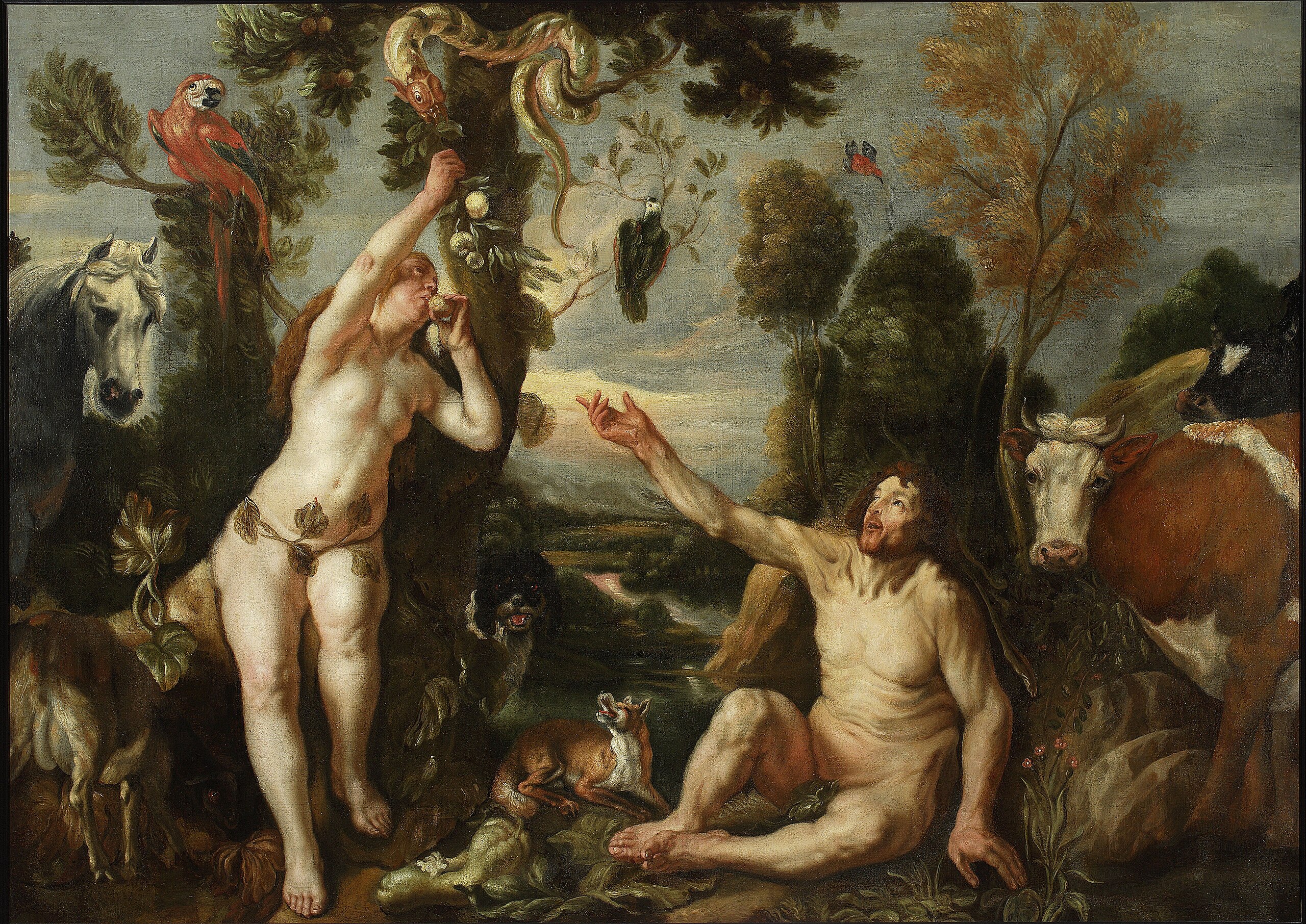
Fig 1: Adam and Eve in the Garden of Eden
Adam and Eve, Workshop of Jacob Jordaens, 1640s (Public Domain)
The Mesopotamians (Sumerian, Akkadian, Babylonian) had earlier traditions that resembled the later Adam and Eve story in the Book of Genesis. There are some parallels in themes of first humans, creation from clay, gardens, a snake, and a divine test.
1.0 MESOPOTAMIAN PRECURSORS
1.1 Adapa (Adamu)
In Akkadian myth (ca. 14th century BCE), Adapa—sometimes called Adamu—was the first man, created by the god Ea/Enki. Like Adam, he was a prototype of humanity, gifted with wisdom but denied eternal life. Summoned before the sky-god Anu, Adapa was offered the bread and water of life. On Ea’s advice, he refused, thereby losing immortality. His very name, Adapa/Adamu, resonates with the Hebrew Adam (1,2).
1.2 Dilmun Paradise (Enki and Ninhursag)
In the Sumerian Dilmun myth (3rd millennium BCE), the land of Dilmun was described as a deathless paradise. The god Enki, however, ate forbidden plants, leading the mother goddess Ninhursag to curse him. When Enki fell ill, she healed him by creating deities from his afflicted body parts. Here we find echoes of Eden: a lush garden, forbidden food, a divine transgression, and consequences for disobedience (3,4).
1.3 Atrahasis and the Creation of Humans
The Atrahasis Epic (ca. 18th century BCE) tells how the gods created humans from clay mixed with divine blood to relieve themselves of labour. Though not a story of temptation, the motif of humanity being fashioned from clay anticipates Genesis, where Adam is moulded from the dust of the earth (5).
1.4 Gilgamesh, Enkidu, and Shamhat
In the Epic of Gilgamesh (c. 1200 BCE), Enkidu’s seduction by Shamhat introduces him to sex, bread, wine, and civilization—losing his innocence and true nature, akin to Eden’s fall (6). Later, Gilgamesh’s search for the plant of life is thwarted when a serpent steals it and rejuvenates—again echoing loss of immortality despite a different serpent role (6).
2.0 ADAMA AND HAVYAVATI – BHAVISHYA PURANA
There is also a story similar to Adam and Eve in the Hindu epic Bhavishya Purana, where they are called Adama and Havyavati:
At that time the Kali-purusha prayed to Lord Narayana with his wife. The Lord appeared and said that Adama and Havyavati would be born and propagate generations of mlecchas. In a forest under a Papa-Vriksha (sinful tree), the serpent Kali-purusha deceived them; Adama ate the forbidden fruit of the tree.
The dating of the Puranas remains uncertain. While 5th-century CE inscriptions cite verses from Padma, Bhavishya, and Brahma Puranas, this does not confirm their present-form existence. Scholars argue the Puranas are layered, fluid compilations defying precise dating.
3.0 THE ASTRONOMY BEHIND THE MYTH
The Tree in Eden can be seen as a metaphor for the North Celestial Pole (NCP)—the pivot of the heavens.
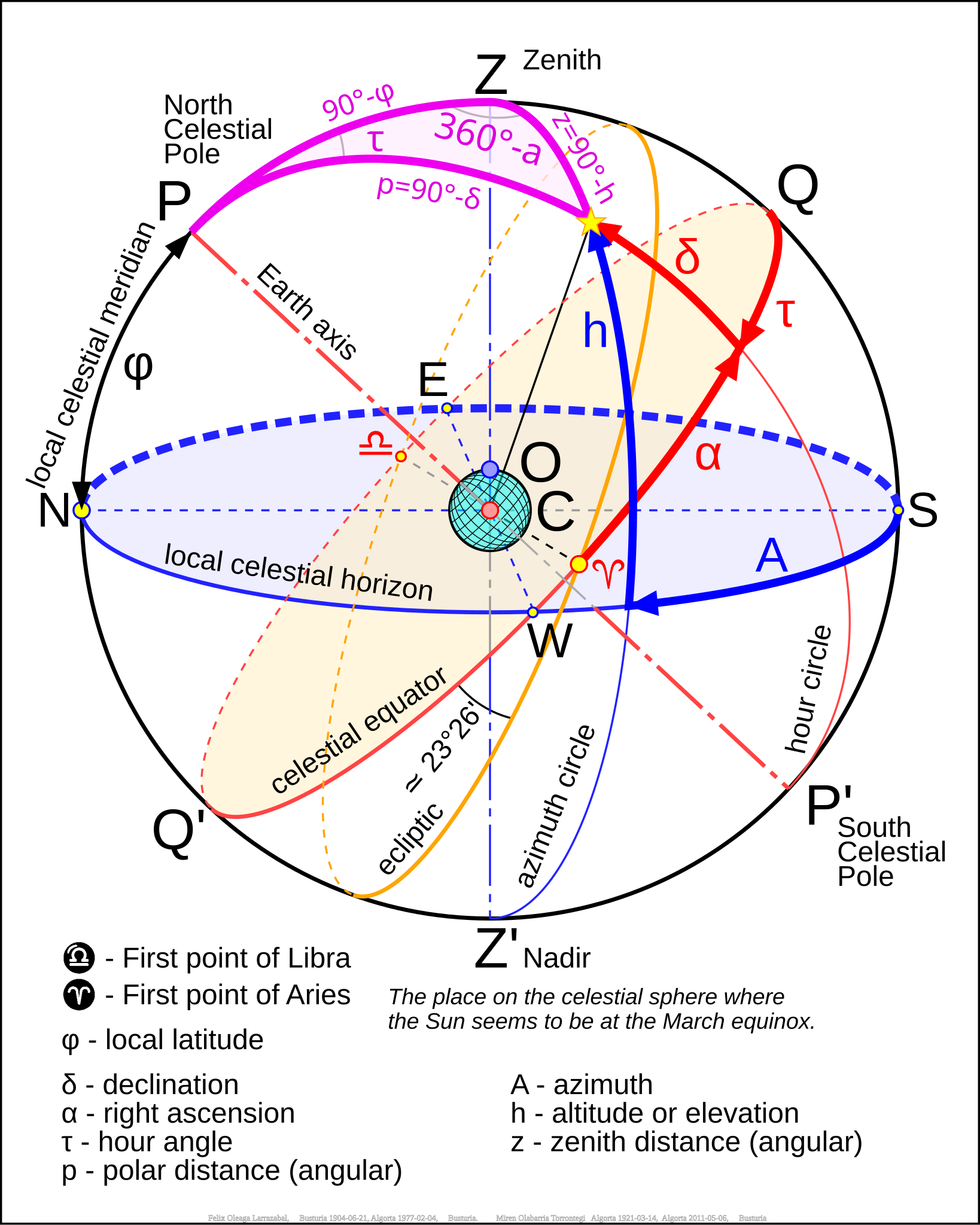
Fig. 2: Celestial Sphere, showing the North Celestial Pole
Image: Jon Peli Oleaga (CCBYSA4.0)

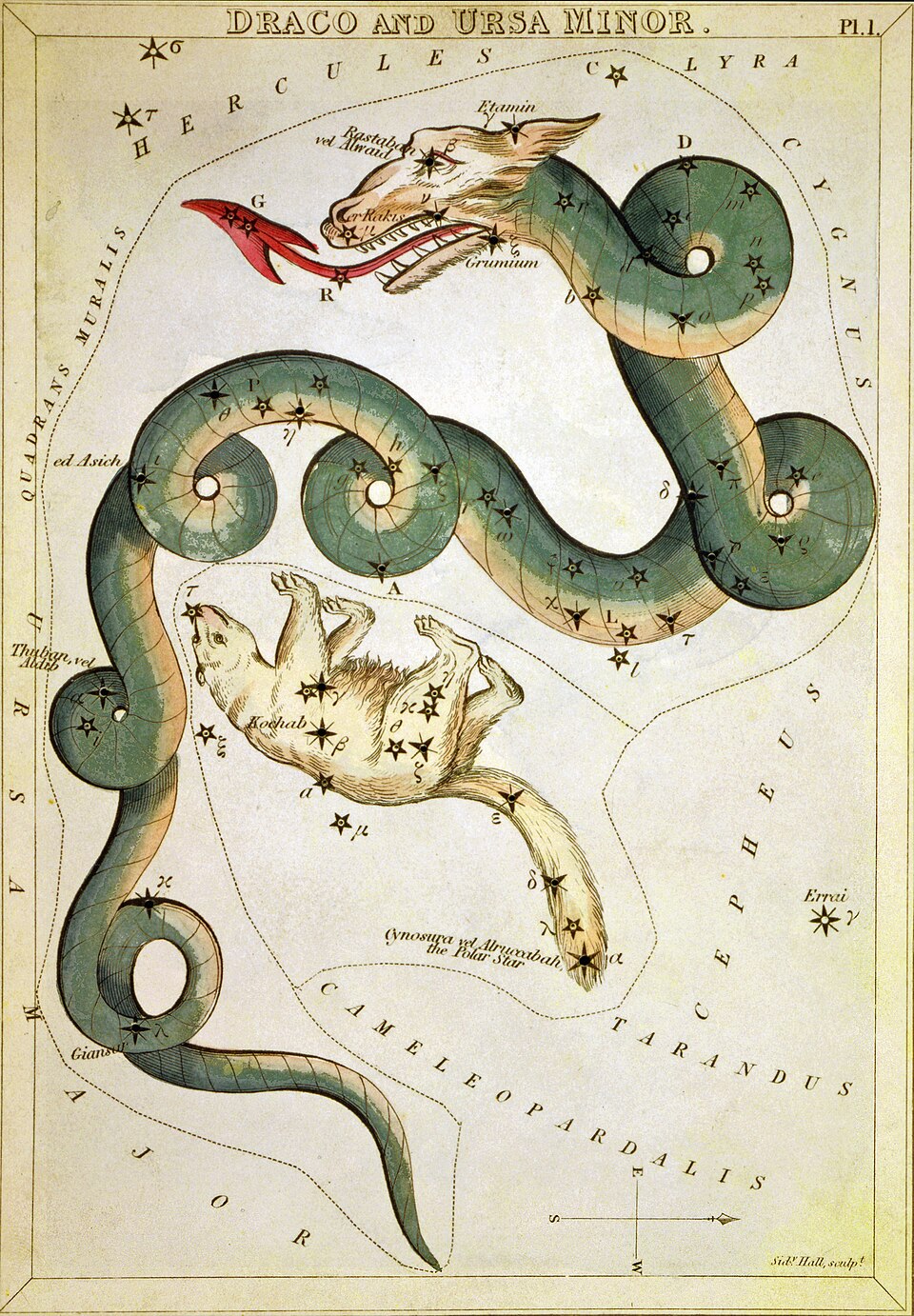
Fig. 3: Constellation Draco (Public Domain)

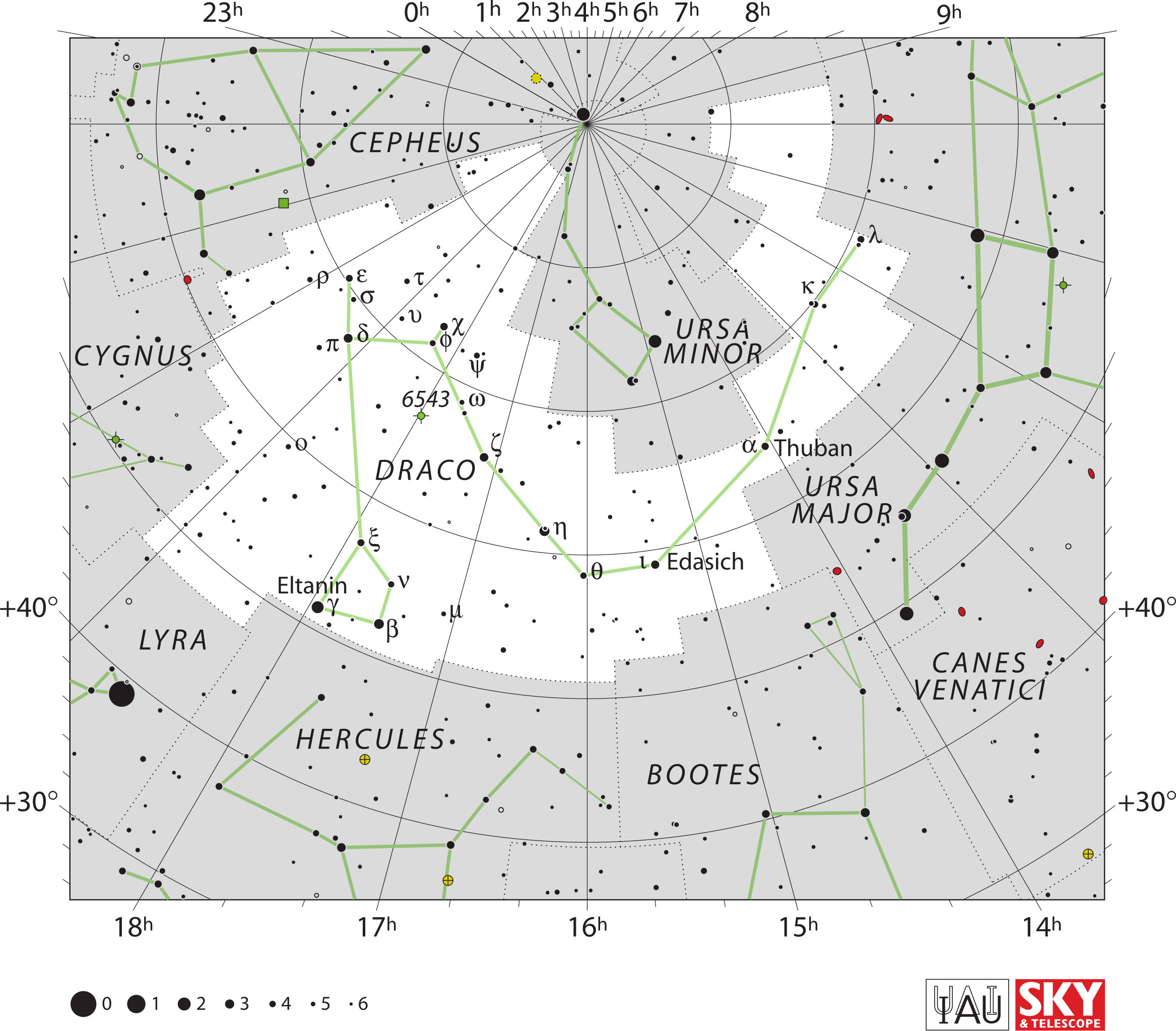
Fig. 4: Constellation Draco surrounding the Pole
Image: IAU and Sky & Telescope magazine (Roger Sinnott & Rick Fienberg) (CCBY3.0)

The serpent corresponds to the constellation Draco, coiling about the pole (See Fig. 3 & Fig. 4).
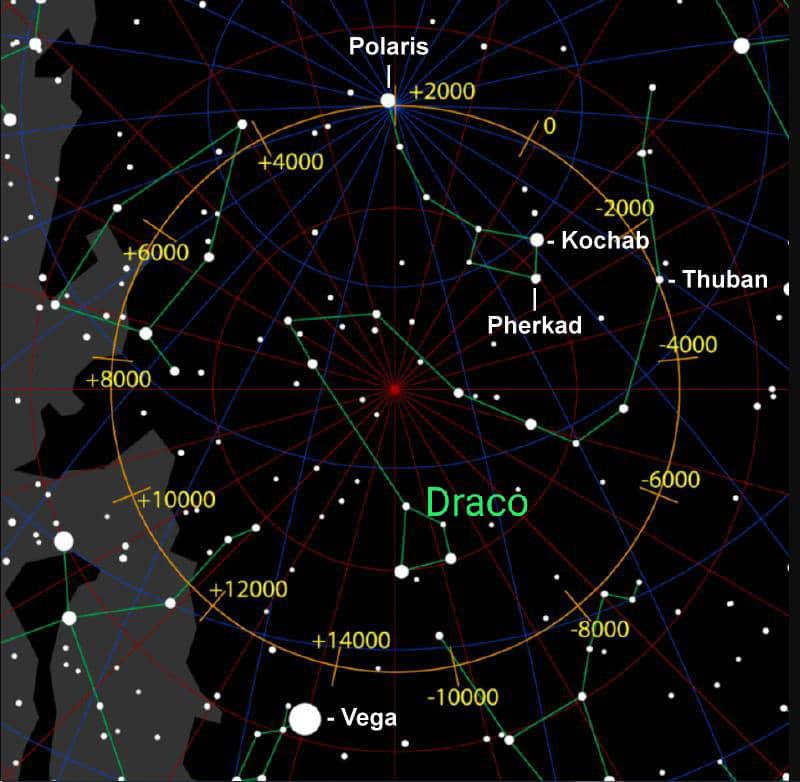
Fig. 5: Guardians of the Pole (Kochab & Pherkad) and Draco
Image: Tauʻolunga (CCBYSA2.5)

Kochab (β Ursae Minoris) and Pherkad (γ Ursae Minoris), dubbed the “Guardians of the Pole” [8], served as twin pole stars approximately between 1700 BCE and 300 CE (See Fig. 5). This span intriguingly overlaps with the period when the story of Adam and Eve was moving from oral tradition into written scripture.
- In the early second millennium BCE, Mesopotamian myths such as the Atrahasis and the Epic of Gilgamesh already spoke of paradises, serpents, and the loss of immortality [9,10].
- Between 1700 and 1000 BCE, Israelite oral traditions circulated similar motifs, just as Kochab and Pherkad were standing watch near the pole.
- Around 1000–900 BCE, the Yahwist writers first shaped these traditions into the Adam and Eve narrative [11].
- By the 6th–5th centuries BCE, during the Babylonian exile, the Priestly redactors gave the creation story its final form in Genesis—still under the guardianship of Kochab and Pherkad [11].
- Between 300 BCE and 300 CE, Jewish and early Christian thinkers reinterpreted Adam and Eve, developing themes of sin, redemption, and paradise lost, while the “Guardians” continued to frame the pole. Augustine of Hippo (354 CE – 430 CE), better known as St. Augustine, took scattered ideas and systemized them into a full doctrine called Original Sin.
This celestial pairing lends symbolic force: Kochab, the brighter star (apparent magnitude +2.07), can be likened to Adam, the more prominent figure in the Genesis account, while Pherkad, the fainter star (apparent magnitude +3.05), corresponds to Eve [12]. Together, they watch the cosmic tree while Draco, the serpent, coils about its trunk.
Before Kochab and Pherkad, Thuban (α Draconis) held sway around 2700 BCE, close to the pyramid-building age of Egypt and great Mesopotamian cultures such as Uruk, Jemdet Nasr, and Akkad. Each pole star era carried its own mythmaking, reshaped by the slow precession of the equinoxes every 26,000 years [8].
A parallel myth appears in Greece. In the tale of Heracles (Hercules), the hero is sent to obtain the golden apples from the Garden of the Hesperides, guarded by the dragon-serpent Ladon [13]. The poet Hesiod (c. 750–650 BCE) in his Theogony mentions the Hesperides and Ladon; later sources describe them as guardians of golden apples. Over time, this mythic imagery likely influenced the later European association of apples with the Eden story—though Genesis itself never mentions apples, referring only to the “fruit” of the tree.
In sum, the story of Adam and Eve is not an isolated narrative but the culmination of a long tradition of mythmaking rooted in the heavens. From Mesopotamian clay-born humans to serpents stealing immortality, from the paradise of Dilmun to the celestial coils of Draco, and from the Guardians of the Pole (Kochab as Adam and Pherkad as Eve) to the serpent’s eternal circling, the themes of creation, temptation, and loss of eternal life were written first in the stars before being inscribed in sacred texts. Genesis, then, can be seen not as an original revelation, but as a cultural inheritance—an astronomical allegory reshaped by generations, preserving humanity’s oldest attempt to anchor meaning in the movements of the sky.
GLOSSARY
Serpent – Constellation Draco
The serpent in Eden symbolizes Draco, a dragon-shaped constellation that coils around the North Celestial Pole.
Adam – Star Kochab (β Ursae Minoris)
One of the “guardians of the pole” stars in the Little Dipper (Ursa Minor).
Eve – Star Pherkad (γ Ursae Minoris)
The second “guardian of the pole” star, paired with Kochab, representing Eve.
Tree of Knowledge / Tree of Life – The Celestial Pole (Axis of Heaven)
The “tree” stands for the central axis of the sky –
the point around which all stars appear to revolve.
Garden of Eden – Circumpolar Sky (North Celestial Region)
The “garden” represents the eternal part of the sky that never sets — a celestial paradise.
In short:
The author believes the Adam and Eve story is a coded star map — showing constellations and stars near the northern sky’s centre, later turned into a moral and religious story.
References
- Sacred Texts. The Myth of Adapa [Internet]. Available from: https://sacred-texts.com/ane/adapa.htm
- Mark JJ. The Myth of Adapa [Internet]. World History Encyclopedia. 2011. Available from: https://www.worldhistory.org/article/216/the-myth-of-adapa/
- Al-Noori KA. The Myth of Dilmun: Features of Sumerian Mythological Literature. J Hum Sci. 2015;35–43.
- Sacred Texts. Sumerian Mythology: Enki and Ninhursag [Internet]. Available from: https://sacred-texts.com/ane/sum/sum07.htm
- Pinto JD. The Sacrificed God and Man’s Creation. Studia Antiqua. 2014 [Internet]. Available from: https://scholarsarchive.byu.edu/cgi/viewcontent.cgi?article=1224&context=studiaantiqua
- Sacred Texts.The Epic of Gilgamesh [internet] . Available from: https://sacred-texts.com/ane/eog/index.htm
- Bhavishya Purana (Pratisarga Parva, Adama & Havyavati story) [PDF on Archive.org] Available from: https://archive.org/download/ShivaPurana/Bhavishya%20Purana.pdf
- Howell E. Has Polaris always been the North Star? How Earth’s 26,000 year cycle changes the pole star [Internet]. Space.com. 2025 May 20. Available from: https://www.space.com/stargazing/has-polaris-always-been-the-north-star-how-earths-26-000-year-cycle-changes-the-pole-star
- Oxford Handbook of Heracles. Labor XI: The Apples of the Hesperides. [Internet]. Available from: https://journeytothewestresearch.com/wp-content/uploads/2025/08/The-Oxford-Handbook-of-Heracles-2021.pdf
- Ridpath I. Star Tales: Draco. Ian Ridpath’s Star Tales. Available from: https://www.ianridpath.com/startales/draco.html
- Lambert W.G., Millard A.R. Atra-ḫasīs: The Babylonian Story of the Flood. Oxford: Clarendon Press; 1969
- George A. The Epic of Gilgamesh: A New Translation. London: Penguin Classics; 1999.
- Friedman R.E. Who Wrote the Bible? New York: HarperOne; 1997.
- European Space Agency. Hipparcos and Tycho Catalogues. ESA SP-1200. 1997.
- Hesiod. Theogony. Trans. Evelyn-White H.G. Cambridge, MA: Harvard University Press; 1914.
Interesting prepective and outlook in this article on what we have know.
” In sum, the story of Adam and Eve is not an isolated narrative but the culmination of a long tradition of mythmaking rooted in the heavens.”
Of course the Bible absorbed the main mythological ideas of previous civilizations.
And it’s interesting that the heavens played such an important role in constructing the myths.But it’s important to understand WHY THE HEAVENS played such a huge role in it.The question is : did all spiritual elites/priests know something ”exclusive” indeed
or they just helped the political elites to fool/control/submit commoners? (for the sake of interests of both – spiritual and political elites)
Btw – Terence Mckenna in his book “Food of the Gods” offered quite a curious explanation of this phenomenon…
Hi Larisa,
People have many insecurities and have an inherent need to fined comfort and solace. Hence the need to believe.
In ancient times, they turned to the stars, believing them to be gods. In time, religious figures emerged. If they gave comfort, then well and good. Those would be the sincere ones. However, history is full of cases of wolves in sheep’s clothing. They exist, irrespective or religion. They are the ones who will use religion to manipulate and control.
Terence McKenna wrote about psychedelic substances and altered states. I am not quite sure how that relates to my topic. However, I am sure that there are others better qualified to answer this question.
Dear Chris! Terence meant that the Mother EARTH gave people psychedelics to experience the most wonderful psychological conditions/states.He wrote that the source of those psychedelics were psilocybin mushrooms which were growing on the crap of cows – that’s why – BTW – COWS are being regarded in India as sacred animals.And later as far as the base for those psychedelics became small smart people – priests – switched the passion/needs of commoners to the HEAVENS(but the priests had access to those psychedelics).It’s a pity but deficit/shortage always generates problems…:-)
Thank you Suresh. There is much to explore.
Good job Chris! I do have a question, however.
If Adam and Eve are astronomical, what’s the earliest date you would assign to the Eden story? Do you think that Eden could have been a real place?
If the story of the Garden of Eden (or a version of it) is found in Gilgamesh as Dilmun, doesn’t that push it back to about 2100 BCE? At least. Using Draconis, the oldest the story could be is ~ 3900 BCE. There could also be even older versions of the story we haven’t found yet.
Thanks Kristin.
My focus is on Adam & Eve as it appears in Genesis. I had mentioned however, that the Adam & Eve story in Genesis was built around earlier myths, which you are touching on.
I mentioned that the Israelite oral traditions of Adam and Eve would have circulated around 1700 and 1000 BCE, just as Kochab and Pherkad were standing watch near the pole. This is close to what Biblical scholars say about Yahwist writers shaping the Adam and Eve tradition at around 1000-900 BCE. I had also mentioned that the Priestly redactors gave the creation story its final form in Genesis during the 6th–5th centuries BCE, during the Babylonian exile.
If you go back further in time, you will see that the fragmentary “Adapa and the South Wind” was written around the 14th century BCE. On the other hand, the Epic of Gilgamesh was written around 1200 BCE. There was no true pole star at this time, although it was moving closer to Kochab. Note the appearance of Adapa/ Adamu, but no mention of an Eve-like figure in myth as yet.
Thuban (Alpha Dracronis) was pole star from 3940 BCE to 1800 BCE, peaking in accuracy to around 2700 BCE. This was the time frame of Sumer, Akkad, and Dilmun.
From what I observe, mythological figures are usually placed on real landscapes. This happens in the Rig Veda as well.
Lake Van fits the mountain-headwaters imagery, but Eden’s symbolic geography and cultural background point more strongly to southern Mesopotamia and the Persian Gulf traditions.
There was a Sumerian “Edin” and an Akkadian “Eddinu” that sounds like “Eden”, but it meant “steppe” or “plain”. In other words, an uncultivated open grassy land. It hardly sounds like a lush paradise. Whatever the case, the name may have been remembered and was passed down centuries later as the Hebrew “Eden”.
There is a paradise described in Dilmun, and they are associated with the god Enki and the goddess Ninhursag. However, if you look closely at their stellar identities, you will see that they are not pole stars, but are the constellations Aquarius and Virgo respectively.
All of this shows that the Hebrew Adam and Eve story is a composite of more ancient myths.
It is relatively easy to show from simple mathematical analysis of the bible that the document could not have been written by any human or group of humans without the involvement of an incredibly higher power. That has been known for at least a hundred years. So regardless of the possible history of the stories, regardless of whether they are factual or allegorical, the origin is supernatural. This can be confirmed by anyone and is completely independent of any source except the text of the bible itself.
Humanity’s oldest attempt to anchor meaning in the movements of the sky? The meaning was anchored there long before humans arrived.
Thank you for your response.
This is all a matter of personal belief.
Most modern biblical scholars agree that the opening chapters of Genesis were compiled and redacted from earlier oral and written traditions.
My whole point is the objective evidence in the document itself, available to anyone. Hopefully, even for you, facts aren’t a matter of personal belief.
Dear Chris, it’s obvious that a lot of hard research has gone into your work. Work of this kind bonds the human spirit and humanity itself. As I was reading, I myself feel convinced that there can be some truth. We know knowledge has been traveling amongst the old civilizations. Please continue your journey of exploration. Must support your earnest efforts. From Dr Apparow Sannasai.
Dear Dr. Apparow,
Thank you for your kind words. I shall continue with my endeavour to uncover the truth behind ancient myths.
Genesis 3:24 refers to the Cherub guarding the gates of Eden with his flaming whirling sword – I wonder if that has any astronimical significance in relation to Chris’s fascinating insight? I’ve always wondered if there was a deeping meaning to this particualr moment, and I think that Chris’s astronomical perspective surely opens the way for a stellar interpretation.
Thank you for your kind words Russell,
Yes there is an astronomical origin to the Cherub guarding the gates of Eden. I address it in my new article “Ezekiel’s Vision – Angel, Alien, Or Cosmic Model?”, which should be uploaded in the Articles section on Graham Hancock’s website in a few days.
All religions is about suns, moons and stars, thats why the bible is written in parables/codes like all other ancient esotheric texts. The solarsystem meaning the soul Ah system. Adam is man and Eve is woman, the atom and the electron but the serpent meaning knowledge and the apple is about the duality in this world. In duality we have to forget to remember, we go from darkness to light and we learn things backwards because of the fire/sun. The features ofthe cube and its dual octahedron correspond one for one with dimensions reversed.
I agree that almost all religions have a stellar origin. I have been decoding the astronomical identities of deities for nearly 20 years.
Adam & Abraham are the Hero Twins. Adam began mapping the sky, & Abraham finished the job.
He determines the number of the stars and calls them each by name.
Psalm 147:4
Please explain
Yes, there IS an astronomical origin to the story of Adam and Eve. But it’s not quite the way the article is presenting it.
Firstly, I would HIGHLY recommend a book called “The Celestial Code of Scripture” by John McHugh. He details how the ancients interpreted the constellations by “reading” them as specific logograms (pictographs) in one language (e.g. Sumerian) and then translating them to their native tongue (e.g. Akkadian, Babylonian, etc.) and making word-plays out of the translations. He goes through EXTENSIVE evidence that this method is precisely what gave rise to many of the world myths.
However, as in the article you cited, he dates the origin of the influence on Israelite Scripture to the Babylonian period. Which is not correct, and I’ll explain why not.
In order to date the earlier chapters of Genesis – including Genesis 1-3 – we need a historical anchor point. This historical anchor point will serve as a terminus ad quem for the date of composition of those chapters of Genesis. Past this point, no outside cultural influence would have affected the formation of Genesis.
We actually have such a historical anchor point, in the form of the Tower of Babel story, which is strongly linked to the Ur III period of Sumer, circa 2100-2000 BCE. That means that – for instance – Genesis 1-3 CANNOT have been influenced by the Babylonian Enuma Elish, despite the literary similarities, because the Enuma Elish was composed circa 1400 BCE.
Genesis 10:8-12 explains that Nimrod founded a very early empire in the land of “Shinar” (Sumer), beginning in “Babel” and extending to several cities in Sumer, and from there, spreading to several other cities in “Assyria.” Genesis 11:1-2 tells us that the Tower of Babel story was situated in the land of “Shinar” (Sumer) – linking this early empire with the Tower of Babel. The ONLY possible match for such an empire is the one that dates to a very brief part of the Ur III period of Sumer. Specifically, to the reign of Amar-Sin.
Amar-Sin attempted to finish building a ziggurat (the “tower” of Babel) in the ancient city of Eridu – the very first city of Sumer. He used a slave force to build this ziggurat, but because the path of the Euphrates river had diverged so far from its original course (when Eridu was founded, it was on the bank of the Euphrates), crops would no longer grow in Eridu and Amar-Sin was forced to leave this ziggurat INCOMPLETE.
Amar-Sin’s reign was the very apex of this empire. Not long after his reign, the resurgence of Sumer came to an end, and the Sumerians were SCATTERED.
Sound familiar? There are MANY more links than just those, but I want to keep this part of my reply brief.
Since we can firmly link the Tower of Babel story with the reign of Amar-Sin, circa 2047-2038 BCE, that means that Genesis 11 could not have been composed AFTER that period. Could it have been passed down orally for centuries? Possibly, but that would still completely refute the possibility of this story having originated with the Babylonian captivity, as many minimalist Biblical scholars are wont to presume.
Moreover, Genesis 11:1-9 is linked to Genesis 10:8-12. According to the Documentary Hypothesis, Genesis 11:1-9 is Elohist (dating to the divided monarchy period), whereas Genesis 10 is Priestly (dating to either the time of Isaiah, or post-exilic). Either way, we should NOT expect to find an earlier text literarily dependent on a later text! Therefore, the DH is deeply flawed.
Are there unusual textual features that the DH correctly identifies? YES! But that does NOT mean that these unusual textual features are the result of later composition and even later editing and redacting.
Nevertheless, we can establish that the place names in Genesis 10 (and also in Genesis 2) were edited, most likely during the 7th century BCE, during the reign of King Josiah. Yes, editing most certainly did take place! But we shouldn’t view the text through the lens of late **composition**, simply because of evidence of late **editing**.
Furthermore, the literary point of establishing the Tower of Babel story as an early empire is strongly linked with the concept of “dominion” from Genesis 1:26-28. Thus, the Tower of Babel story depends on the prior existence of Genesis 1, at the very least, if not all of Genesis 1-3. And Genesis 1 is supposed to be the LATER (Priestly) text!
Now, let’s revisit the idea of an astronomical link with the story of Adam and Eve.
Genesis 1:1 opens with the beginning of God’s creating the heavens and the earth. The Hebrew word for “heavens” is “shamayim” – which is a derivation of the Hebrew word for “waters” – “mayim” – found in verse 2. Basically, **the waters on earth are being represented as a MIRROR of the waters in heaven**!!!
God then creates plants, fish, birds, animals, etc., **mirroring what’s in the constellations in heaven** – which contain plants, fish, birds, animals, and so on. God creating man in His own image is just the last thing to be created, in a long line of things bearing the image of something or other in heaven!
What’s the point of this? **GOD IS “MIRRORING” WHAT’S IN HEAVEN, ON EARTH**. That includes the dominion given to Adam and Eve. And that explains why we then see an **unrighteous dominion** in the form of the Tower of Babel, in Genesis 11!
The Bible often uses heavenly symbolism to represent things on earth. For instance, read Isaiah 34:1-3, which talks about God gathering armies (“hosts”) to Jerusalem, so that He can destroy them. In verse 4, God compares this to rolling up the heavens like a scroll, and the stars (“host”) of heaven falling from the sky. That heavenly, figurative symbolism is just a poetic way of representing what’s going on, on the earth!
The same is true for the constellations. There are constellations representing not only the serpent (Draco) and the Tree of Life, but ALSO the Garden of Eden itself (the Pegasus Square), Adam and Eve, and even the four rivers!
Furthermore, the four rivers are linked in heaven…BUT NOT ON EARTH. That’s because Genesis 1 was supposed to FORESHADOW a future dominion on earth that hadn’t fully come down from heaven yet! Only at the end of the sixth day – the sixth thousand years – would the Kingdom of Heaven be established on earth.
That was the point of Genesis 1. It was never meant to be understood as the creation of the universe at all. In fact, ancient myths often speak of a “place where creation occurred” which is a real place, not a made-up location. This place is WHERE THE PEOPLE WHO WROTE THAT MYTH, LIVED.
It’s also UNIQUE to that particular people. So Sumer had their own “place where creation occurred,” Babylon had theirs, Egypt had theirs (several different places in Egypt, in fact), and so on.
That means that the Biblical “place where creation occurred” – the Biblical Garden of Eden – CANNOT BE THE SUMERIAN ONE. Or any other one! It’s unique to the people of the Bible!
I have already addressed your concerns on Graham Hancock’s authors Facebook page.
‘People of the Bible’ – which ‘people’ and which ‘bible’? Surely it has ‘evolved’ over 3,000 years?
I am fascinated by this article and the commentary following it.
Thank you. I am glad you liked it.
A different perspective:
Adam, or the first man myths, might be based on the giant squatting/stick man figure that once upon a time seem to have appeared in the skies when Earth was under an intense electrical stress. The stick man figure developing in the most intense phase of the plasma column as described by physicist Anthony Peratt.
In this perspective and using Peratt’s glasses the pole star is not the star above the north pole but a “star” above a very visible pole/column, curiously per Peratt findings emanating from the south pole. Figures likely representing this formation can be found around the world. Similar to a keyhole as can be the Kofun mounds, Tanit figures, Celtic cross etc.
An example and interpretation that seems to fit the above can perhaps be found in Daniel’s dream :
…You looked, O king, and there before you stood a large statue-an enormous, dazzling statue, awesome in appearance…
…The head of the statue was made of pure gold, its chest and arms of silver, its belly and thighs of bronze, its legs of iron, its feet partly of iron and partly of baked clay…
…The wind swept them away without leaving a trace. But the rock that struck the statue became a huge mountain and filled the whole earth…
Speculating a bit more the colors are perhaps due to the different parts of the figure being in different elevations. Like a rising moon has different colors depending on elevation.
Another quick account that might again confirm the previous, this time from Habakkuk:
…God came from Teman, the Holy One from Mount Paran. Selah His glory covered the heavens and his praise filled the earth…
…His splendor was like the sunrise; rays flashed from his hand, where his power was hidden…
No direct reference to a statue/man but it had hands… Notice also where God did come from: Teman, in other words “the southern tip of the Arabian peninsula”. If the observer lived in the fertile crescent Teman is the south.
Another possible example from a very different culture:
…In Norse mythology, Muspell or Muspellheim (“home of desolation”) is a flaming, torrid region, the land of fire far to the south…
…Muspell is ruled by the fire giant Surt, whose wife is Sinmore. At the final battle of Ragnarok Surt will set the World Tree on fire and kill the unarmed god Freyr…
Giant, south, world tree (the world tree shares likely the same origin has the tree of life/Celtic cross/fiery bush/Excalibur/Christmas tree etc).
The serpent is either the Ouroboros (Peratt coauthored a paper on this subject) or another figure that developed in the skies. For other serpent like figures one can check the Serrania de la Lindosa pictographs. A very interesting site as it seems to contain many worldwide symbols…
Eve is as many have proposed the same as Innana/Isis/Athena/Venus and a large etc. Just type “is eve a reference to venus?” in a search engine. An extract: “In art, such as Botticelli’s The Birth of Venus, the goddess Venus is sometimes interpreted as a pre-Fall Eve, symbolizing pure, divine love before the introduction of sin”
The only question is if it was originally the planet or was it a later association. Again using Peratt’s glasses I’d say the associations to the planets was a later one, same as for the constellations, which are likely derived from plasma figures later on associated with them.
In this context Eve would be the world navel, the center of the upper circle and obviously Adam her son. The man that came from the (celestial) sea to teach humanity.
Thank you for sharing this perspective — it’s certainly an imaginative and thought-provoking interpretation. While the idea of ancient people witnessing large-scale plasma formations is intriguing, it does seem difficult to reconcile with what we know from physics and the geological record.
Modern plasma effects can only be observed under controlled laboratory conditions, so it’s hard to imagine how ancient civilizations could have seen or understood such phenomena. Nonetheless, I appreciate how this theory tries to find common visual themes between ancient symbols and natural forces — it’s an interesting way of looking at how humans might have connected what they saw in the sky with their myths and stories.
Christopher, I am ecstatic at the possibility of your interpretation and insight becoming a clear view to open the door to a higher and different perspective that is not a smack in the face to people’s beliefs. I must admit my surprise, because I had discerned the ancient text and myths and came to the same conclusions. It is hard for me to understand why my attempt to present the same truth has been denied. Your interpretation as far as the creation of Adam and Eve is off the mark, and I am sure if you were to read, as I have read your’s, my book, “Noah Ark Discovered 28,400 BC – the Great Rift of Time”, by Cory Coston, ,or at least Chapter 5 “The Tree Of Life”, you would see that it is more in sync with other cultural text, i.e.; Sumirian, Egyptian, Native American, Japanese, Meso America,etc.. My assertion that the Tree of life is the Magnetic North Pole, and the Tree of the Knowledge of Good and Evil I the Geographical North Pole, and Eve as the Zodiac Constellation of Cancer, the snake as the Constellation of Hydra bruising the heel.Also, it says that “the Lord God planted a garden Eastward in Eden”. Eastward is the eastern horizon. “So he drove out the man;and he placed at the east of the garden of Eden cherubim and a flaming sword which turned every way, to keep the way of the tree of life.”(Gen.3:24) The cherubim, to the east of Aries are the Pleiades, and they are the only significant group of stars that could possibly be symbolic of the cherubim, for the Greeks, they are known as the Satyrs. The flaming sword was a giant star that had went supernova and is most likely Vela X. I hope you take serious time and patience as I have done over the years. My first manuscript was written in 2009. It has been a hard road, but I finally published in July 14, 2024. I will follow your work and wish you the best.
Dear Cory,
Thank you for your thoughtful message. It’s always inspiring to meet a kindred spirit who also recognizes the astronomical origins behind the story of Adam, Eve, and the Serpent. While our interpretations differ in some details, it’s clear we’re both seeking to uncover the same underlying celestial truths that ancient cultures sought to express in their myths.
I appreciate your sharing the ideas from your book and the years of work you’ve dedicated to it — that kind of persistence and conviction deserves respect. I’ll certainly look into your interpretations of the Tree of Life and the constellations you mentioned.
By the way, I was intrigued by your phrase about not being “a smack in the face to people’s beliefs.” Could you share what you meant by that? I sense you’ve encountered some resistance to your ideas, and I’d be interested to understand your experience a little more.
Wishing you continued success on your journey of discovery.
Kind Regards,
Christopher
Christopher John says:
“I agree that almost all religions have a stellar origin. I have been decoding the astronomical identities of deities for nearly 20 years.”
Hi Christopher, I have just discovered your writings, which I enjoy. Curious: Have you written any about the ancient Egyptians Mythological lore about “Zep Tepi”, the “First Time,” astronomically coded onto the Giza Plateau with the Precessional Cycle? Thanks, Randy