





ABSTRACT
This paper reinterprets the prophetic vision of Ezekiel (c. 622–570 BCE) as a synthesis of theology, mythology, and early cosmology. It explores how the imagery of the divine chariot (Merkavah), the four-faced cherubim, and the “wheels within wheels” reflects possible influences from Babylonian cosmology during Ezekiel’s exile in Babylon. The study traces the origins of Ezekiel’s cherubim to the Lamassu. These are composite guardian figures that embodied the constellations marking the four seasonal points of the zodiac during the Age of Taurus. It further examines the “firmament” and “throne” in Ezekiel 1 as an ancient description of the celestial dome and zenith, paralleling the early Greek cosmological model of Anaximander, a contemporary of Ezekiel. By comparing religious symbolism with cosmic knowledge of the time, this paper argues that Ezekiel’s vision was not merely mystical or theological but a profound, symbolic attempt to describe the ordered structure of the heavens, bridging the worlds of prophetic revelation and proto-scientific cosmology.
1. THE PROPHET EZEKIEL
Ezekiel (c. 622–570 BCE), the son of Buzi, was a priest from the Kingdom of Judah. He lived during a time of immense political upheaval. Following King Nebuchadnezzar II of Babylon’s victory over the Egyptians at the Battle of Carchemish in 605 BCE, Judah became a Babylonian vassal state [1]. It was after this that the Prophet Daniel was taken to the court of the Babylonian King Nebuchadnezzar II [2].
When King Jehoiakim of Judah rebelled, Nebuchadnezzar besieged Jerusalem once again. After Jehoiakim’s death, his son Jehoiachin, who is also called Jeconiah, took over. However, he soon surrendered and was exiled to Babylon along with 10,000 captives, including Ezekiel. Nebuchadnezzar then installed Zedekiah as a puppet king [3].
Ezekiel lived among the exiles by the Kebar River in Babylon, where he became a voice of warning, judgment, and eventual hope for his people [4].
2. EZEKIEL’S CHARIOT
During his vision, Ezekiel described a storm coming from the north -“a great cloud with fire flashing forth continually and a brilliant light around it.” From this storm emerged the divine chariot (Merkavah), surrounded by four living beings (ḥayyot), each with a human form but possessing four faces —those of a man, a lion, an ox, and an eagle —and four wings. Their legs shone like burnished bronze, and under their wings were human-like hands.
They moved in perfect coordination, accompanied by “wheels within wheels,” glowing like beryl. The spirit of the living creatures was said to be within the wheels, indicating a unified movement.[4] Later, these same beings are explicitly identified as cherubim [5].
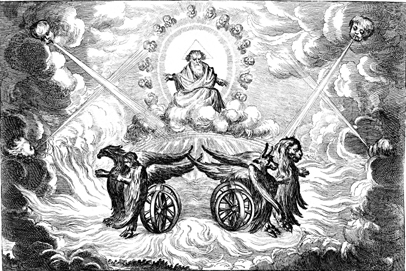
Fig 1: Ezekiel’s Chariot – Ezekiel, Nuremberg, 1702 (woodcut). Source: Public Domain, Wikimedia Commons.

Many artists have attempted to capture Ezekiel’s vision over the centuries, with differing results. Figure 1 shows one such attempt.
3. INTERPRETATIONS
a. Jewish Interpretation
For centuries, Ma‘aseh Merkavah (“Work of the Chariot”) was regarded as one of Judaism’s most sacred and dangerous mysteries [6]. The Mishnah (Ḥagigah 2:1) forbade its public teaching[7]. Only a select few students could study it privately.
Between the 3rd and 6th centuries CE, Merkavah mystics developed visionary practices. This included chants, meditations, and “ascents” to the heavenly throne, as preserved in Hekhalot Rabbati and 3 Enoch. In the Middle Ages, Maimonides reinterpreted the vision as metaphysics and cosmology, passing its meaning to only advanced students [8]. Thus, for over a millennium, Ezekiel’s vision was seen not as literal but as symbolic of divine knowledge and cosmic order.
b. Christian Interpretation
Early Christian theologians reinterpreted Ezekiel’s vision through the lens of the four Gospels. St. Irenaeus (2nd century CE) was the first to associate the four creatures with the four Evangelists. Later, St. Victorinus of Pettau assigned their symbols: the lion to Mark, the ox to Luke, the man to Matthew, and the eagle to John. St. Jerome and Pope Gregory I formalized this association, making Ezekiel’s vision a key symbol of Christ’s universal mission [9]. The imagery became central to Christian art and iconography, adorning countless cathedrals and manuscripts.
c. Ancient Astronaut Theory
In 1968, Erich von Däniken’s Chariots of the Gods? proposed a radical reinterpretation: that Ezekiel’s “chariot” described a spacecraft. Von Däniken cited details such as “wheels within wheels,” fire, and noise as evidence of advanced technology [10].In 1974, NASA engineer Joseph F. Blumrich expanded on this idea in The Spaceships of Ezekiel, proposing that the description fit a landing craft with rotors and a command module [11].
Though speculative, this theory popularized the “Ancient Astronaut” hypothesis, that ancient people misinterpreted extraterrestrial technology as divine revelation.
But was any of the above truly what Ezekiel saw? To explore this, we must return to the world of his Babylonian exile.
4. EZEKIEL IN BABYLON
During his captivity, Ezekiel lived amid the splendour of Babylon. He may have seen the Ishtar Gate, decorated with dragons (mušḫuššu), and the brick Processional Way leading to it [12]. He might also have heard of, or glimpsed, the legendary Hanging Gardens of Babylon [13].
Babylonian civilization was steeped in astronomy and astrology. Their records, like the MUL.APIN tablets (c. 1000 BCE) and the Venus Tablet of Ammisaduqa (c. 1700 BCE) show sophisticated celestial observation [14,15]. Nebuchadnezzar II himself rebuilt the great ziggurat Etemenanki, possibly the inspiration for the Biblical Tower of Babel [16].
A Babylonian tablet from Nebuchadnezzar’s 37th year (568/567 BCE) records a mysterious “red glow” in the night sky, which was likely an aurora borealis [17]. Ezekiel’s world, therefore, was rich in cosmic symbolism. As a priest, he may have encountered Babylonian astronomer-priests, whose celestial imagery could have shaped his own visionary language.
5. THE LAMASSU AND THE ORIGINS OF THE CHERUBIM
a. The Earliest Origins (c. 3000–2000 BCE)
Long before the Hebrew cherubim, Mesopotamian civilizations revered the Lamassu – a hybrid guardian being with a human head, the body of a bull or lion, and the wings of an eagle. These beings embodied protection, divinity, and cosmic order.
The earliest Lamassu appeared around 3000 BCE in Ebla [18]. In Akkadian myth, they were linked with Shamash, the Sun god, believed to hold open the gates of dawn each morning [19].
b. The Assyrian Period (c. 900–700 BCE)
The neo-Assyrian Empire lay in northern Mesopotamia and was centred around Nineveh and Assur. The Neo-Babylonian Empire arose later in Southern Mesopotamia (Fig. 2).
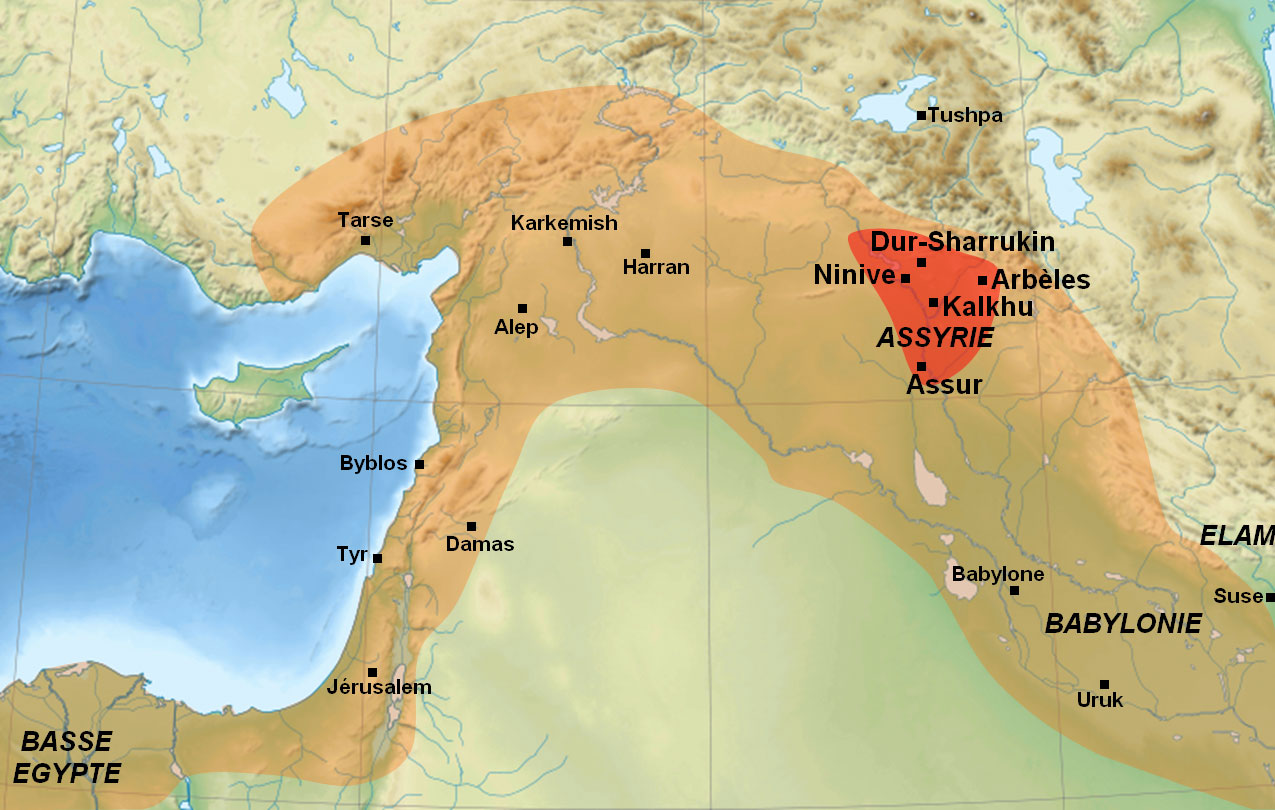
Fig 2: Neo-Assyrian Empire and Neo-Babylonian Empire. Source: by Zunkir CCBYSA3.0

By the Neo-Assyrian period, Lamassu sculptures guarded palace gates at Nimrud, Nineveh, and Dur-Sharrukin. At the Citadel of Sargon II (modern Khorsabad), colossal Lamassu flanked entrances, symbolizing divine protection. (See Fig. 3).
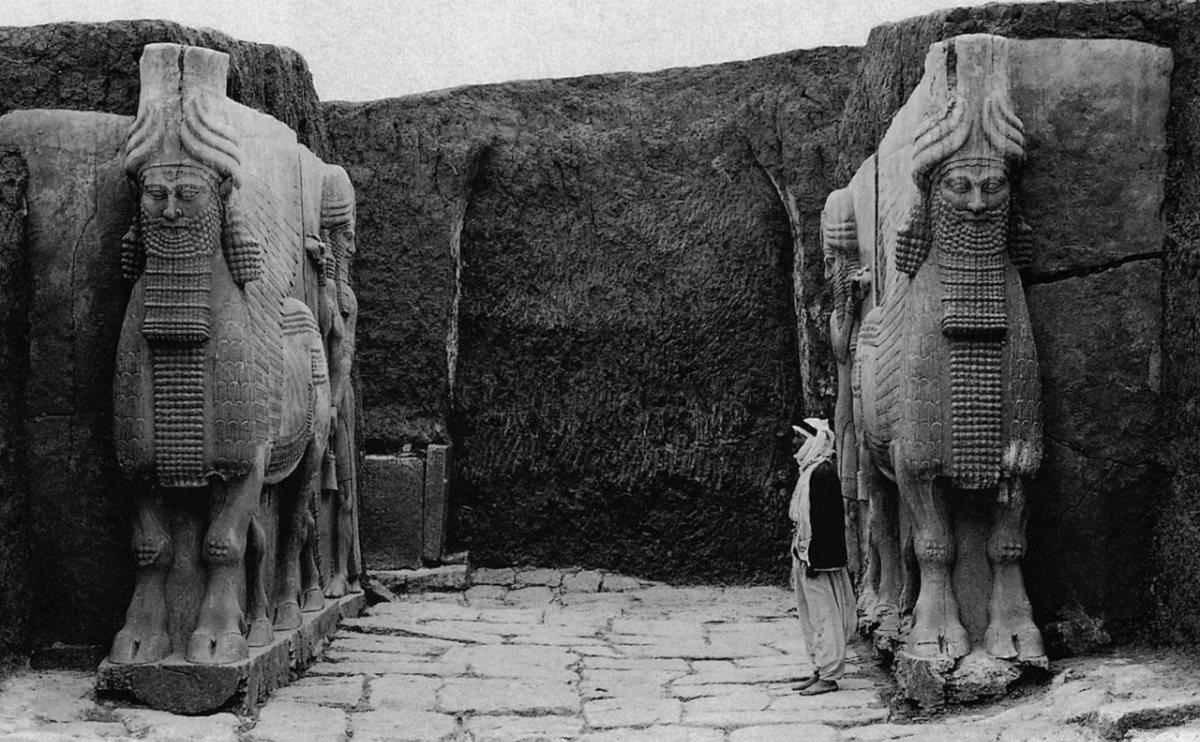
Fig 3: Gate A of the Citadel of Sargon II, Dur Sharrukin (present-day Khorsabad, Iraq). c. 721-706 BCE. Source: Alemazzi, CCBYSA4.0 Wikimedia Commons.

The purpose of the Lamassu mirrored that of the cherubim with flaming swords, who guarded the Tree of Life on the east side of Eden, following the expulsion of Adam and Eve [20]. The specification of “east” is significant: at the equinoxes, the Sun rises due east and sets due west, while at the solstices it reaches its northernmost and southernmost points, forming a solar cross that marks the four cardinal directions. Though the precession of the equinoxes gradually shifts the background constellations – creating the Ages of Taurus, Aries, Pisces, Aquarius, etc – the cardinal directions themselves remain fixed by Earth’s rotation, making east a constant point of orientation and symbolic significance.
In 2025, archaeologists unearthed a Lamassu at Tell Nabi Yunus near Mosul (ancient Nineveh), dating to Esarhaddon’s reign (680–669 BCE). It is believed to have originally been one of a pair that decorated the main gate of the hall [21].
After Assyria’s fall to Nabopolassar in 609 BCE, its people continued under Babylonian rule [22]. Ezekiel, living in Babylon, could have encountered Assyrian artisans or even Lamassu statues taken as war spoils. This would have familiarized Ezekiel with their iconography.
c. Linguistic and Theological Continuity
The Hebrew keruv (cherub) likely derives from the Akkadian karabu, meaning “to bless.” [23]. This linguistic link shows that the Hebrew cherubim were inherited from the Lamassu tradition. As Mesopotamian culture spread westward, its imagery infused Israelite religion, especially during the Babylonian Exile.
d. The Astronomy Behind the Lamassu/Cherubim
The Lamassu are depicted with the head of a bearded man with a horned crown, the wings of an eagle, and the body of an ox (See Fig 4).
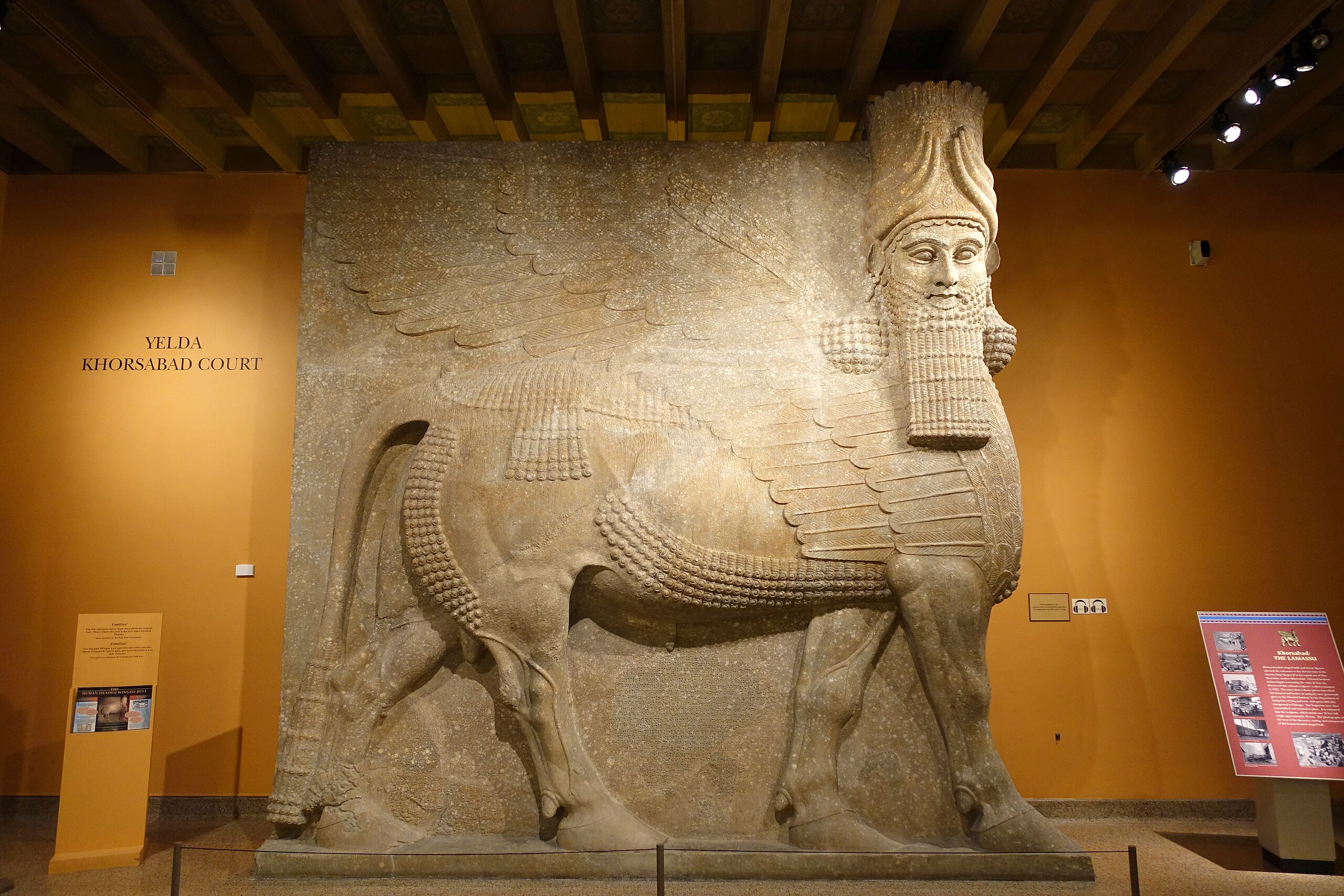
Fig 4: The Lamassu from the Palace of Sargon II, Khorsabad. Photograph by Daderot (2014), (CC0).

Sometimes, the Lamassu is depicted with the body of a lion, instead of an ox, as displayed at the Metropolitan Museum of Art [24].
Ezekiel’s four-faced being (man, lion, ox, and eagle), as depicted as the Lamassu/Cherubim in Figure 4, represents constellations. Ezekiel himself lived during the Astrological Age of Aries (1700 BCE to 200 BCE), so the Lamassu imagery would have arisen earlier during the Age of Taurus (4300 BCE to 1700 BCE) [25]. It was during the Age of Taurus when the following constellations marked the four seasonal points of the year (See Table 1). This is due to the Precession of the Equinoxes.
-
Creature Zodiac Sign Seasonal Marker Bull Taurus Spring Equinox Lion Leo Summer Solstice Eagle Aquila / Scorpio Autumnal Equinox Man Aquarius Winter Solstice
Table 1: Seasonal markers during the Age of Taurus
During this era, Scorpio was often symbolized by an eagle rather than a scorpion, a symbolism possibly retained in Ezekiel’s vision. This suggests that his imagery was not random but cosmological, echoing the star lore of ancient Mesopotamia.
6. THE “BOWL OF HEAVEN” (THE FIRMAMENT) & THE THRONE
Ezekiel describes “a firmament, like the colour of crystal, stretched out above their heads.” To ancient eyes, the sky appeared as a luminous, bowl-shaped dome arching over the Earth, with a throne on top of it [26, 27].
Astronomical meaning:
- The firmament represents the celestial dome, the visible hemisphere of the heavens.
- Stars appear as “eyes” embedded in this crystalline structure.
- Above the dome was “a throne,” symbolizing the zenith, the highest point in the sky.
The “figure on the throne” could represent the Sun at its zenith, echoing Mesopotamian imagery of Shamash, the solar deity seated in judgment at the peak of the heavens. Alternatively, it could have depicted Yahweh, who, in some schools of thought, is a solar deity.
The imagery thus far is shown in Figure 5 below.
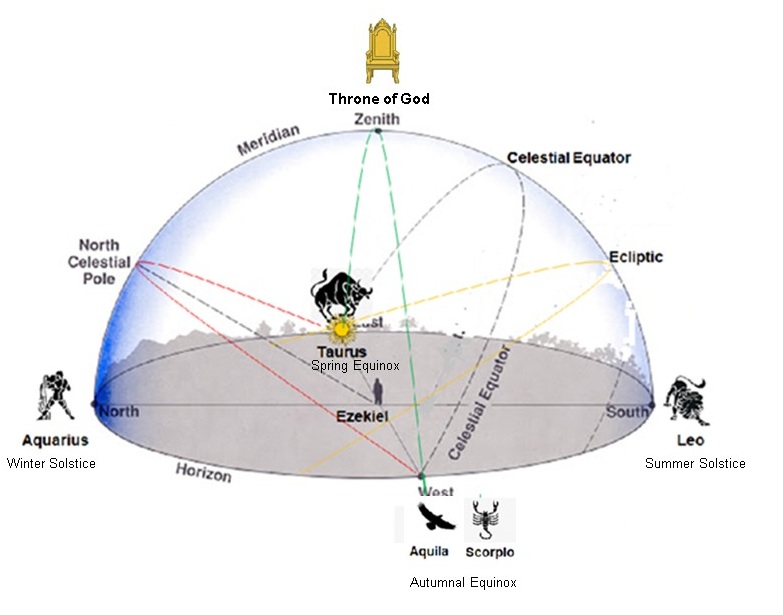
Fig 5: Celestial dome interpretation of Ezekiel’s vision (author’s own illustration).
7. COSMOLOGICAL MODEL
Ezekiel’s vision appears to be a conceptual cosmological model, but it remains incomplete, as he has described other elements of this model in his vision. In this regard, a comparison between Ezekiel’s model and Anaximander’s cosmological model is in order.
Ezekiel (c. 622–570 BCE) was a contemporary of Anaximander (c. 610 – c. 546 BCE), who lived in Miletus, Ionia, located in modern-day Türkiye. While Ezekiel lived in Babylon, Anaximander, though never having travelled there nor dealt directly with Babylonians, likely absorbed astronomical concepts that had spread westward from Babylon through intermediaries.
Ezekiel’s model is a prophetic vision, not a scientific description. Its purpose is theological and to reveal the glory and presence of God, and not to explain how the heavens are structured. Anaximander’s model, on the other hand, is explicitly cosmological. Anaximander is credited with creating one of the earliest conceptual models of the heavens, which laid the groundwork for the later idea of celestial spheres.
A point-to-point comparison between Ezekiel’s and Anaximander’s models is presented in Tables 2-6 below. Interestingly, both Ezekiel and Anaximander use the word “chariot”, which is discussed in Table 2 below [ 4, 28].
-
FEATURE EZEKIEL ‘S CHARIOT ANAXIMANDER’S CHARIOT Meaning of the chariot A divine throne-chariot (Merkabah) symbolizing God’s presence and mobility – “wheels within wheels” full of eyes, moved by the spirit. A cosmic wheel model explaining the structure of the heavens – celestial bodies as fiery chariot wheels revolving around the earth. Function of the chariot Spiritual and symbolic: reveals divine glory, omnipresence, and movement of God’s throne. Philosophical and explanatory: describes how the sun, moon, and stars move in circular paths within the cosmos.
Table 2: Description of Chariots
-
FEATURE EZEKIEL’S WHEELS ANAXIMANDER’S WHEELS Motion The wheels move in unison with the living creatures; can go in any direction without turning. Wheels rotate in fixed circular paths around the Earth; light appears through their openings. Energy / Life Source “The spirit of the living creatures was in the wheels” – motion is animated by divine or spiritual force. Motion is inherent and natural – the wheels move in perfect circles due to symmetry, not divine animation. Appearance of Light The rims are “full of eyes” (interpreted as brightness, awareness, or celestial lights). The fire within the wheels shines through openings; eclipses and lunar phases occur when openings close. Material Composition Visionary and luminous – possibly metallic or crystalline in symbolic terms (“sparkled like topaz”). Physical — made of “opaque vapor,” hollow, and filled with fire (natural elements, not divine metal). Directionality Multidirectional: can move north, south, east, west Fixed circular rotation around Earth; one-directional orbital motion.
Table 3: Description of Wheels
-
FEATURE EZEKIEL’S FIRE ANAXIMANDER’S FIRE Role of fire Signifier of divine presence; an awe-filled vision; symbolic of holiness, light, glory. Natural/cosmological force; a physical/metaphysical element in cosmic origin and structure. Fire’s dynamism / movement Fire moves among creatures; flashes of lightning; burning coals; brilliant light; dynamic in the vision Fire emerges, grows, separates; forms a sphere; breaks apart; is involved in cycles of generation and decay.
Table 4: Description of Fire
-
FEATURE EZEKIEL’S EARTH ANAXIMANDER’S EARTH Description of Earth Ezekiel sees “a wheel on the ground beside each creature,” and the surface beneath them looks like glowing metal (bronze). The Earth is cylindrical, like a drum, suspended freely in space. Its height is one-third its width.
Table 5: Description of Earth
-
FEATURE EZEKIEL’S SEASONAL MARKERS ANAXIMANDER’S SEASONAL MARKERS Seasonal Marker Four creatures facing the four directions (man, lion, ox, eagle) – moving without turning; associated with the four seasons Describes the earth suspended at the centre; the sun, moon, and stars revolve around it in circular paths; the Sun has a higher arc in summer, lower arc in winter
Table 6: Description of Seasonal Markers
It is clear from Tables 2 to 6 that both Ezekiel and Anaximander were describing conceptual cosmological models.
Subsequent thinkers expanded upon these early insights: Eudoxus of Cnidus (c. 390–337 BCE) introduced nested spheres to account for planetary motions [29]. Archimedes (c. 287–212 BCE) constructed a mechanical planetarium replicating the movements of celestial bodies [30]. Finally, Hipparchus (c. 190 – c. 120 BCE) developed the first true celestial globe [31].
8. CONCLUSION
Ezekiel’s vision stands at the intersection of theology, mythology, and cosmology. Whether viewed as divine revelation, mystical ascent, or ancient cosmology, it reflects humanity’s enduring attempt to understand the structure of the universe.
The imagery of the cherubim, rooted in the Lamassu of Mesopotamia, bridged religion and the stars, uniting heaven and Earth through symbolic forms. His “firmament,” “throne,” and “wheels within wheels” prefigure the celestial models of early Greek thought, showing that both Hebrew prophets and Ionian philosophers were reaching toward the same cosmic truth: that the heavens move with divine order.
Thus, Ezekiel’s vision was neither merely angelic nor alien. It was cosmological. It was an ancient attempt to describe the mechanics of heaven in the language of faith, myth, and light.
REFERENCES
Texts
- TheTorah.com. The History Leading Up to the Destruction of Judah: The Battle of Carchemish [Internet]. Available from: https://www.thetorah.com/article/the-history-leading-up-to-the-destruction-of-judah
- Bible Gateway. Daniel 1 – New International Version (NIV) [Internet]. Available from: https://www.biblegateway.com/passage/?search=Daniel%201&version=NIV
- Enduring Word. 2 Kings 24 – Commentary [Internet]. Available from: https://enduringword.com/bible-commentary/2-kings-24/
- Bible Gateway. Ezekiel 1–3 – New International Version (NIV) [Internet]. Available from: https://www.biblegateway.com/passage/?search=Ezekiel%201-3&version=NIV
- Bible Gateway. Ezekiel 10 – New International Version (NIV): The Cherubim [Internet]. Available from: https://www.biblegateway.com/passage/?search=Ezekiel%2010&version=NIV
- Jaron G. Through the Gate of Dreams – These Texts Are Not Church Hymnals [Internet]. Available from: https://www.garyjaron.com/through-the-gate-of-dreams-lovecraft-dreamland-novel/through-the-gate-of-dreams-152-these-texts-are-not-church-hymnals
- TheTorah.com. Ezekiel’s Vision of God and the Chariot [Internet]. Available from: https://www.thetorah.com/article/ezekiels-vision-of-god-and-the-chariot
- Stanford Encyclopedia of Philosophy. Maimonides [Internet]. Available from: https://plato.stanford.edu/entries/maimonides/
- Revelation: The Apocalypse of Jesus Christ [Internet]. Kigali: University of Rwanda; Available from: https://oldmis.kp.ac.rw/admin/admin_panel/kp_lms/files/digital/Core%20Books/Theology/Revelation-the-apocalypse-of-jesus-christ.pdf
- von Däniken E. Chariots of the Gods [Internet]. New York: Bantam Books; Available from: https://archive.org/details/chariotsofgodsun00dnik
- Blumrich JJ. The Spaceships of Ezekiel [Internet]. Available from: https://ia801902.us.archive.org/29/items/TheSpaceshipsOfEzekiel/The%20Spaceships%20of%20Ezekiel.pdf
- DailyArt Magazine. The Ishtar Gate: A Gateway to Babylonian Grandeur [Internet]. Available from: https://www.dailyartmagazine.com/the-ishtar-gate-a-gateway-to-babylonian-grandeur/
- World History Encyclopedia. Hanging Gardens of Babylon [Internet]. Available from: https://www.worldhistory.org/Hanging_Gardens_of_Babylon/
- Hunger H. MUL.APIN: Babylonian Astronomy Text [Internet]. Available from: https://peachv.org/images/MuslimGeo/BabyAstroMulApinHunger.pdf
- Walker C. The Venus Tablets of Ammisaduqa [Internet]. J Hist Astron. 1982;13:23–34. Available from: https://adsabs.harvard.edu/full/1982JHA….13…23W
- Bible Archaeology Report. Nebuchadnezzar: An Archaeological Biography [Internet]. Available from: https://biblearchaeologyreport.com/2019/10/17/nebuchadnezzar-an-archaeological-biography/
- Stephenson F. A Clay Tablet Recording Numerous Lunar and Solar Eclipses, 567 BC [Internet]. Astron Geophys. 2004;45(6):15. Available from: https://ui.adsabs.harvard.edu/abs/2004A&G….45f..15S/abstract
- SyriacPress. Lamassu [Internet]. Available from: https://syriacpress.com/blog/2022/03/04/lamassu/
- The Oriental Institute of the University of Chicago. Lamassu Factsheet (A7369) [Internet]. Available from: https://isac.uchicago.edu/sites/default/files/uploads/Lamassu_A7369_1990_factsheet.pdf
- Bible Gateway. Genesis 3 – New International Version (NIV) [Internet]. Available from: https://www.biblegateway.com/passage/?search=Genesis%203&version=NIV
- Archaeology Magazine. Colossal Assyrian Winged Bull Unearthed in Mosul [Internet]. 2025 Sep; Available from: https://archaeologymag.com/2025/09/colossal-assyrian-winged-bull-unearthed-in-mosul/
- Livius.org. ABC 3: Fall of Nineveh Chronicle [Internet]. Available from: https://www.livius.org/sources/content/mesopotamian-chronicles-content/abc-3-fall-of-nineveh-chronicle/
- Dante’s Isofo. Cherubim [Internet]. Available from: https://dantesisofo.com/cherubim/
- The Metropolitan Museum of Art. Human-Headed Winged Bull (Lamassu) [Internet]. Available from: https://www.metmuseum.org/art/collection/search/322609
- Mastering the Zodiac. Astrological Ages [Internet]. Available from: https://masteringthezodiac.com/astrological-ages
- Bible Gateway. Ezekiel 1 – Easy-to-Read Version (ERV): The Bowl [Internet]. Available from: https://www.biblegateway.com/passage/?search=Ezekiel%201&version=ERV
- Bible Gateway. Ezekiel 1:22 – New King James Version (NKJV): The Firmament [Internet]. Available from: https://www.biblegateway.com/passage/?search=Ezekiel%201%3A22&version=NKJV
- Internet Encyclopedia of Philosophy. Anaximander [Internet]. Available from: https://iep.utm.edu/anaximander/#SH6b
- The Scientific Teen. The Geocentric Model of the Universe [Internet]. Available from: https://www.thescientificteen.org/post/the-geocentric-model-of-the-universe
- Pastore G. Archimedes’ Planetarium or Orrery [Internet]. Available from: http://www.giovannipastore.it/ARCHIMEDES1.htm
- Mediterranean Archaeology and Archaeometry. Astronomical Alignments in Ancient Architecture [Internet]. Available from: https://www.maajournal.com/index.php/maa/article/view/738/664
Images
- Ezekiel’s Chariot – public domain, Ezekiel, Nuremberg, 1702 (woodcut) [Internet]. Wikimedia Commons; 1702 [cited 2025 Oct 7]. Available from: https://commons.wikimedia.org/wiki/File:Ezekiel_Nuremberg,_1702.jpg
- Neo-Assyrian Empire and Neo-Babylonian Empire [Internet]. Wikimedia Commons; [cited 2025 Oct 7]. Available from: https://commons.wikimedia.org/wiki/File:Assyrie_general.PNG
- Gate A of the Citadel of Sargon II, Dur Sharrukin (present-day Khorsabad, Iraq), c. 721–706 BCE [Internet]. Wikimedia Commons; [cited 2025 Oct 7]. Available from: https://commons.wikimedia.org/wiki/File:Lamassu_at_the_Gate_of_Sargon_II.jpg
- Lamassu from the Palace of Sargon II, Khorsabad. Photograph by Daderot. Wikimedia Commons; 22 Aug 2014 [cited 2025 Oct 7]. Available from: https://commons.wikimedia.org/wiki/File:Lamassu_-_Palace_of_Sargon_II,_Khorsabad_-_Oriental_Institute_Museum,_University_of_Chicago_-_DSC07525.JPG
- Celestial dome interpretation of Ezekiel’s vision [2025]. Created by: Christopher P. John
The entire book of Ezekiel, along with Amos, Isaiah, Jeremiah, Lamentations, Habbakuk, and most of Psalms, are all about the coming, planned WW3 that is going to annihilate the USA which is the real Mountains of Israel and Zion and Armageddon! It will happen the same day the evil FakeJooBastards nuke the USA with the nuke they stole in 2007 and blame it on Iran. That day Russia, China and the whole SCO are going to nuke and invade the USA. Planet X that the chemtrails hide will end the war when it rips the earth apart again like it did in Noahs day. This is all planned by your evil criminal bastard governments and their satanic FakeJooBastard masters!
Great article. It only makes sense that Ezekiel was inspired by the Babylonian Lamassu. I also love how you tied Ezekiel’s vision to the constellations. Excellent work!
Thank you so much for your kind words! I’m really glad you found the article meaningful and that the connections resonated with you.
Your observation that Ezekiel may have drawn on the iconography of the Lamassu during his exile in Babylon—and how that imagery links to constellations—is exactly the type of syncretic pattern I was hoping to highlight. The convergence of theology, symbolism and ancient cosmology is fascinating, and your comment affirms that this thread comes through.
Thanks again for reading and for taking the time to comment—comments like yours make writing these pieces very rewarding.
You’re always welcome!
Good job as usual, Chris. I completely agree that the cherubim are the Lamassu. Just like the Israelites were heavily influenced by the Egyptians during that captivity, they couldn’t avoid the influence of the Babylonians.
Anaximander was a titan of natural philosophy whose influence in the pre-Socratic world can’t be understated. He had theories on everything from cosmology to evolution. He also took some Babylonian ideas and introduced them into Greece. It’s not impossible that Ezekiel at least heard of him and his ideas.
Thanks, Kristin! I completely agree with your points. The cherubim in Ezekiel’s vision and on the Ark of the Covenant really do seem like an adaptation of the Mesopotamian Lamassu concept—winged protective guardians. Abraham, having spent time in Ur and Haran, would have been exposed to these kinds of symbolic figures, and even if Moses never visited Mesopotamia directly, the idea could easily have been transmitted through Israelite cultural memory.
It’s fascinating to think that the cherubim weren’t just abstract symbols—they likely drew directly from actual guardian figures in Mesopotamian art. So, if we were imagining the real Ark, Indiana Jones-style, it probably featured two guardian Lamassu, not the simplified cherubim Hollywood gave us in the blockbuster. Ancient protective symbolism was far more imposing and hybridized than the cinematic version!
And regarding Anaximander—he really was a titan of early natural philosophy. His cosmological and evolutionary ideas, influenced by Babylonian thought, show just how interconnected ancient intellectual traditions were. It’s even possible that some of these ideas filtered indirectly into Israelite culture, highlighting the rich cross-cultural exchanges of the time
Hi Chris,
I love the idea of the cherubim on the Ark being the Lamassu. Moses built the Ark after the flight from Egypt, and there was almost undoubtedly contact between the Egyptians and Mesopotamians. Even before the Israelites were enslaved in Egypt (if you believe that story), Joseph was sold into slavery in Egypt. Before THAT, Abram himself went to Egypt to escape famine in Canaan.
Great point — the cherubim on the Ark were probably closer to fierce lamassu than to the chubby baby angels who missed out on Valentine’s Day. Given all the cultural crossover between Egypt and Mesopotamia, it’s not hard to imagine Moses borrowing from those majestic winged guardians. Indiana Jones would’ve definitely approved of that design choice.
Very cool article. Both the cherubim and the lammasu are such confounding and epic visionary beings, and it’s exciting to see a link. One of my favorite works in the Metropolitan Museum of Art was always the giant lammasu, and I wondered at the difference between the two in their lion/ox feet. I’m inspired to take another look at Ezekiel in the bible.
I’m really glad to hear that you feel inspired to revisit the Book of Ezekiel!
The Metropolitan Museum of Art must be an incredible place to experience the grandeur of the lammasu in person.
In fact, the autumnal equinox should have been denoted by Scorpio, but in ancient Mesopotamian traditions it was represented instead by Aquila.
Interestingly, the scholar and philosopher Sir William Drummond of Logiealmond (1769–1828) suggested that the zodiacal sign Scorpio was symbolized by an eagle rather than a scorpion. While this interpretation isn’t widely dismissed, it’s worth noting that the constellation Aquila (the Eagle) lies relatively close to Scorpio. It’s quite possible that Ezekiel’s vision may have referred to Aquila rather than Scorpio.
Wasn’t Scorpio originally depicted as an eagle?
The earliest Lamassu appeared around 3000 BCE in Ebla as a winged hybrid guardian—part man, bull, lion, and eagle.
Between 2500 and 2000 BCe, the Lamassu’s role as a celestial guardian began to overlap with that of the Scorpion-Man (Girtablullu), depicted on Elamite seals from Susa. Both guarded cosmic thresholds—day and night, life and death—leading to an early blending of eagle and scorpion imagery in Mesopotamian cosmology.
By the Epic of Gilgamesh (c. 2100–1200 BCE BCE), the Scorpion-Men had become underworld gatekeepers, while the Lamassu retained its place as a sky guardian.
In the Babylonian MUL.APIN catalogues (1000–700 BCE), the traditions were finally separated: ScorpiO was defined as MUL.GIR.TAB, “The Cutter,” and Aquila as MUL.A.MUSHEN/
Thus, the confusion between Aquila and Scorpio arose in the third millennium BCE, long before formal astronomy, when both represented guardians of the cosmic horizon.
Edit: The Greeks had a huge influence on Jewish thought. In fact, there is a school of thought called Hellenistic Judaism. Alexandria and Antioch were the two great centers of learning. The Jews knew all about Pythagoras, Plato, Socrates, and Aristotle.
Thanks. It’s clear that the Greeks had an influence on Jewish thought, but that would have been around the time of Alexander the Great or after. Alexander, Pythagoras, Heraclitus, and Xenophanes mostly post-date Ezekiel.
Thales and Anaximander were true contemporaries of Ezekiel. Anaximenes was alive but very young.
Hi Christopher, excellent article. My 5 cents due to inflation. In your Figure 5 I immediately saw reflected what has been left to us by the sages of Giza who knew how to read things astrologically, probably to be figured out by some future Sidereal Astrologer using Fagan/Bradley’s Sidereal Zodiac. I am a Sidereal Astrologer but I don’t have the celestial mechanical knowledge to figure this out for other Sidereal Astrologers. I see the star Alnitak representing the Great Pyramid sitting on “the throne of god” depicted in your Figure 5, trying to figure a possible Mundane World Horoscope at Giza.