




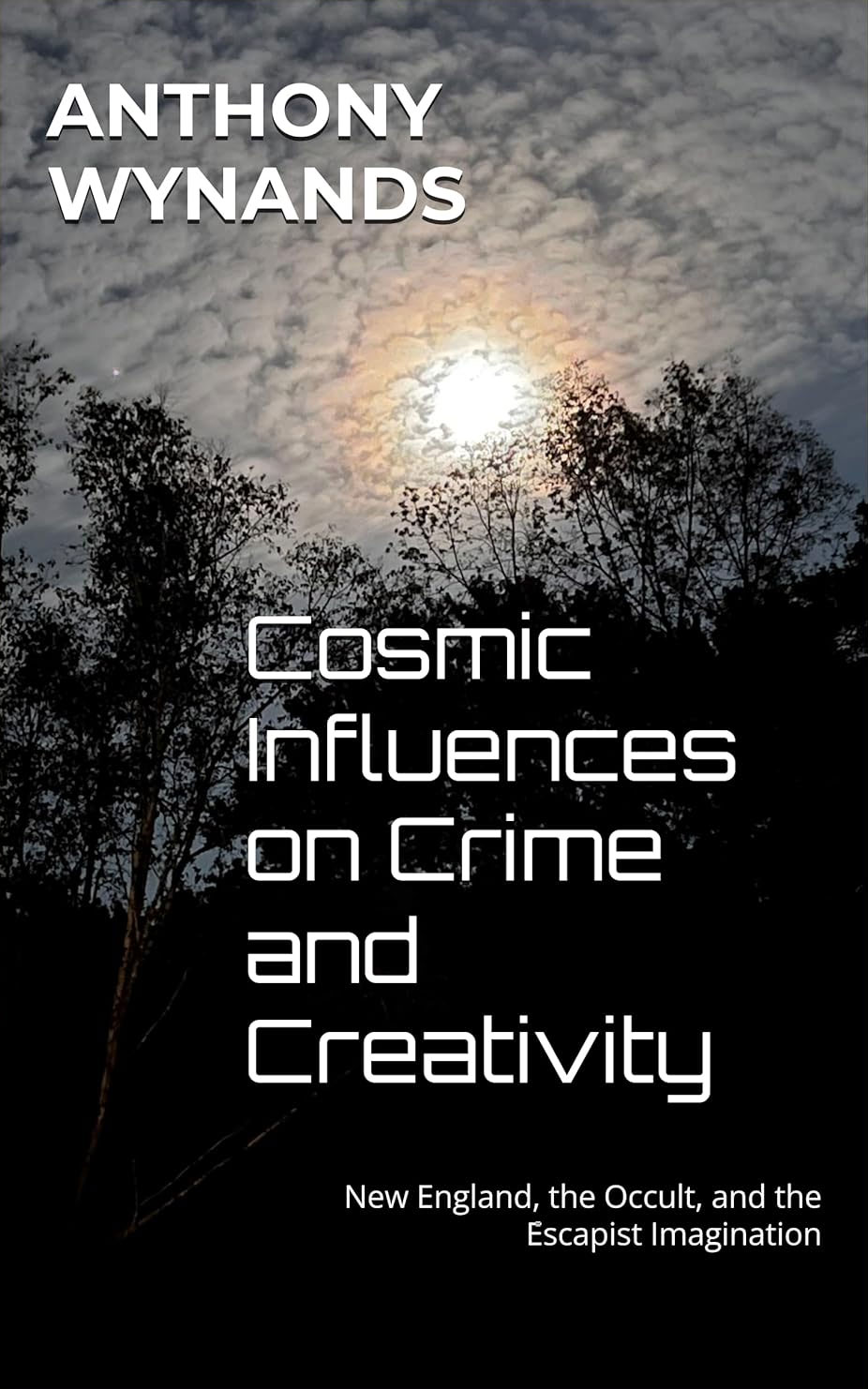
We warmly welcome Anthony Wynands, author of Cosmic Influences on Crime & Creativity: New England, the Occult and the Escapist Imagination, as our featured author this month. In his book, Anthony describes how and why astrology can authentically assess the human experience of consciousness. He argues that by observing biographies, psychological archetypes, and patterns in the night sky, we can gain a deeper understanding of the workings of the human mind and the driving forces behind the hemispheres of human behaviour, and perhaps even break through the barriers that limit the evolution of our own consciousness. In his article, Anthony takes the reader on a journey through some of the enigmatic individuals and places that led him to his investigations into astrology and the development of an occult methodology through which he aims to achieve a better understanding of the human condition and imagination.
Interact with Anthony on our AoM forum here.
The past articles I have submitted to Graham Hancock’s website are my attempts to graph a comparative network of cosmic influences pertaining to certain individuals after extensive analytical reviews of their natal charts, paralleled with their biographical life narratives that they have written or have been written about them. I have developed my own method rooted in astronomy, as well as the occult. My book, Cosmic Influences on Crime and Creativity: New England, the Occult, and the Escapist Imagination, is a deeper dive into these attempts. I begin by telling the story of the 1914 New York City prosecution of the American Astrologer, Evangeline Adams, where Adams had been arrested for fortune-telling (i.e., psychic readings, astrology, etc.), which at the time was illegal in NYC. Yet, she won her case. Historically, Adams returned to the public spotlight weeks before the 1929 stock-market crash, where a few weeks prior, she had wrongly predicted stocks would rise.
While Adams’ past surely is interesting, it was not her personal history that pulled me in. I found it intriguing that Adams owned a cabin in Hebron, New Hampshire, and once hosted the notorious English Occultist, Aleister Crowley, for a summer:
He stayed at her cabin and read, wrote, and thought about the universe, canoed on what was then known as Lake Pasquany and is now Newfound Lake, crucified and ate a frog, performed a ritual designed to end Christianity, was visited by a phantom fireball, started to formulate his Star Sponge vision, in which he postulated that the universe is “nothingness with twinkles,” and practiced some sex magick. It was good times there in that little cabin in the summer of 1916. His sojourn in New Hampshire lasted about four months, after which he left refreshed and ready to transgress the social and religious mores of contemporary Western society.1
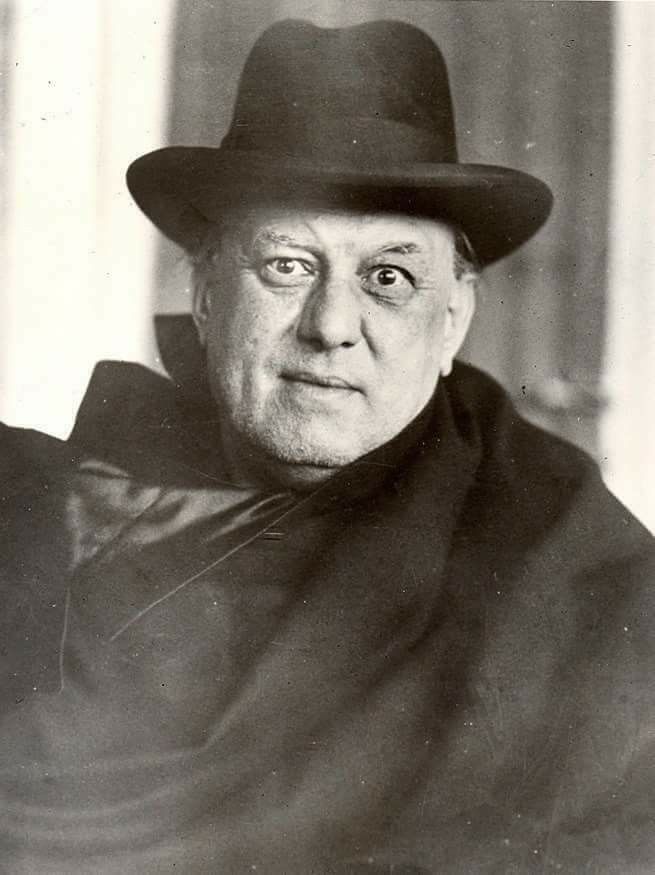
Aleister Crowley, 1929 (Public Domain)
I lived in NYC for a few years, and I was born and raised in New Hampshire. After four years in the army, I attended college near the White Mountains. The school is not too far from Hebron, in fact. I am fascinated by the true-crime narratives that take place here—drawn to them—and often find weird literary and occult associations therein.
As a French language and literature undergraduate student in college, my early interest in the occult began when reading Guy de Maupassant’s famous horror story, “La Horla.” My imagination lit up when I read it in its original French. In the story, some invading spectral entity enters a man’s life, followed by subsequent haunts and torments. The man’s confounded speculations about his declining health and his eventual realization of the supernatural origin of his decline is confirmed when he witnesses milk consumed from his glass in the middle of the night by something unseen. I was fascinated by the craft of such a story, let alone the subjective suspense I experienced when attempting to imagine such an occurrence. Further interest in the genre eventually led me to H. P. Lovecraft’s literature:
This story has been cited as an inspiration for Lovecraft’s ‘The Call of Cthulhu,’ which also features an extraterrestrial being who influences minds and who is destined to conquer humanity. The word horla itself is not French and is a neologism. Charlotte Mandell, who has translated ‘The Horla’ for publisher Melville House, suggests in an afterword that the word ‘horla’ is a portmanteau of the French words hors (‘outside’), and là (‘there’) and that ‘le horla’ sounds like ‘the Outsider, the outer, the one Out There,’ and can be transliterally interpreted as ‘the what’s out there.’2
After I graduated, I moved to Brooklyn, NYC and soon found more examples of “the what’s out there.” I developed a strong desire to visit the locations Lovecraft wrote about, like Red Hook or the Dutch-Reformed Church on Flatbush Avenue, where he cast his story, “The Hound”, a homage to Sir Arthur Conan Doyle’s own Sherlock Holmes story, “The Hound of the Baskervilles.” I even visited places he did not use as settings in his stories but still frequented in person, as read in his letters to friends, like the apartment where his friend Rheinhart Kleiner lived.
After NYC, I lived in Seattle, Washington, for a few months. A friend brought me to Snoqualmie Falls and introduced me to David Lynch’s Twin Peaks, which shows the Falls in the show’s opening sequence. After watching the entire run, I was stunned by how comparable my own hometown was to Lynch’s show.
I grew up in New Boston, New Hampshire—the town that entrepreneur and economist Roger Babson declared as “The Gravity Center of the World” due to its distance from New York and Boston during World War II—far enough away to survive the hypothetical German/Japanese atomic attack on either of these cities, based on the atomic destructive potential of the technology at that time. The town later became a focus point of anti-gravity research by Babson. In fact, Babson bought up properties all over town for the creation of his Gravity Research Foundation. There is a marker in the center of town showcasing this history. Babson had moved from one New England “Lynchian town” to another before setting his eye on New Boston. His fascination with a particular area in Massachusetts, that came to be known as Dogtown, led him to fund a project that carved inspirational mottos in a series of large, glacially deposited boulders leading into Dogtown — they were later coined The Babson Boulders:
In Friedrich Nietzsche’s The Birth of Tragedy, tragedy stems from the conflict between mankind’s civilizing, Apollonian desire for order and our yearning for wild, Dionysian abandon. At the time of its inception, this colonial village represented an Apollonian ideal, but by the turn of the nineteenth century, when the Commons Settlement became known as Dogtown, the Dionysian impulse had overtaken the place. The region may indeed have been overrun with dogs back then, but it also began to inspire a certain type of human wildlife. Many of Dogtown’s ‘witches’ made fiery home brews, told fortunes, hosted buccaneers and gambling parties, and profited from prostitution. The folkloric record maintains that a couple of these women cursed anyone who attempted to enter their desolate village. Even in 1984, Dogtown remained a place where people escaped civilization either by going there to party with abandon or to lose themselves peaceably in nature. By the twentieth century, Dogtown had become a unique landscape, an isolated, municipally bound wilderness—not a manicured park—and a ruin-filled ghost town where the Dionysian principle with its knife’s-edge balance between creative inspiration and destructive madness seemed to prevail. Dogtown enabled both Marsden Hartley and the influential postmodernist poet Charles Olson to cross the internal wilderness of their respective creative crises. Others, less fortunate, did not safely traverse either the actual, physical wilderness of Dogtown or the mental one it could impose. This wayward quality may have been the reason why a Bible-thumping millionaire named Roger W. Babson decided to have twenty-four large boulders hand-carved with Protestant prescriptives during the Great Depression. The lessons imparted by Babson’s boulders—’USE YOUR HEAD,’ ‘TRUTH,’ ‘BE ON TIME’—stand out boldly against this confusing landscape as patent guideposts for those who may wander too far astray.3
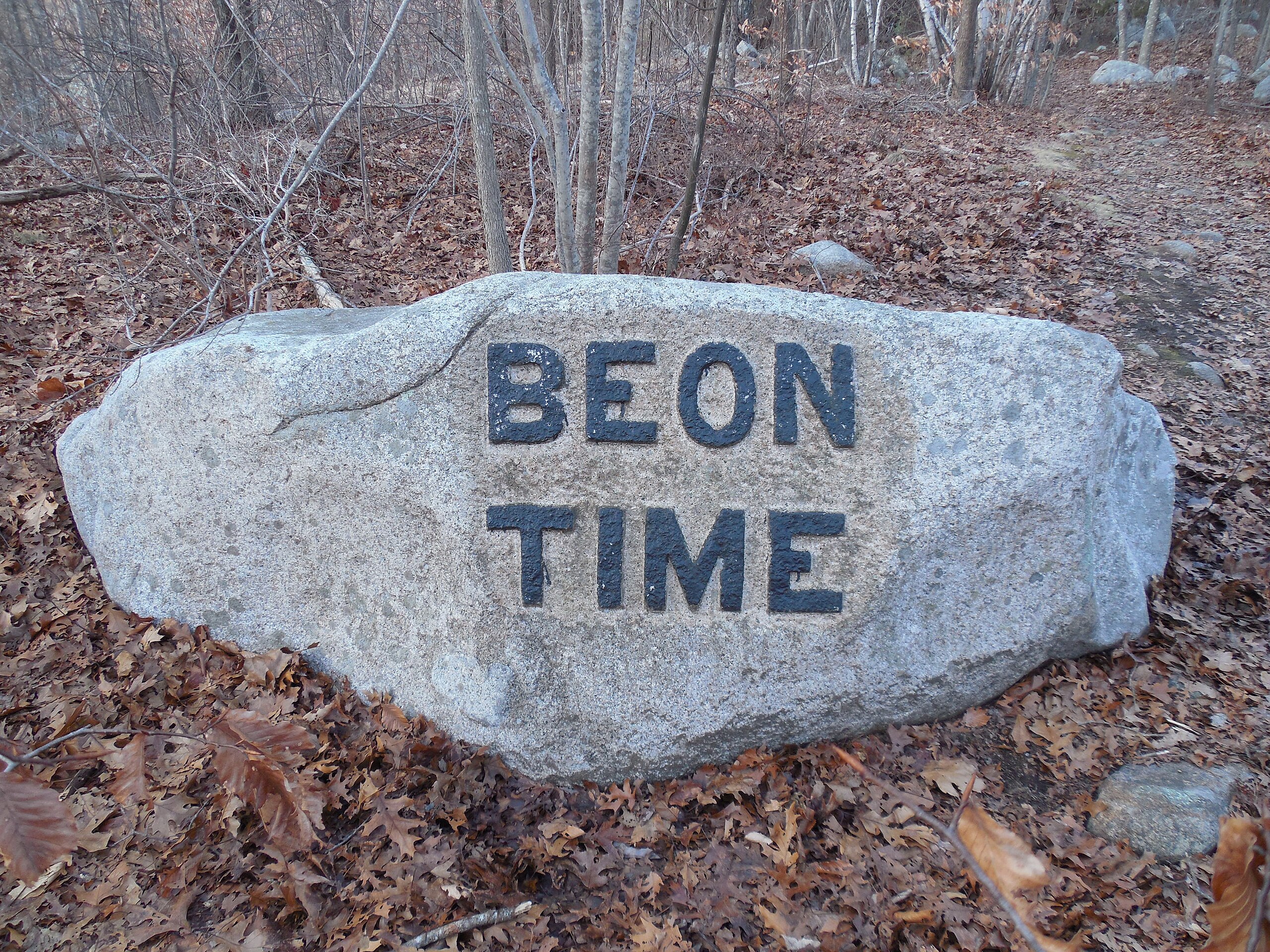
Be On Time, Dogtown, Massachusetts, photo John Phelan (CCBY4.0)
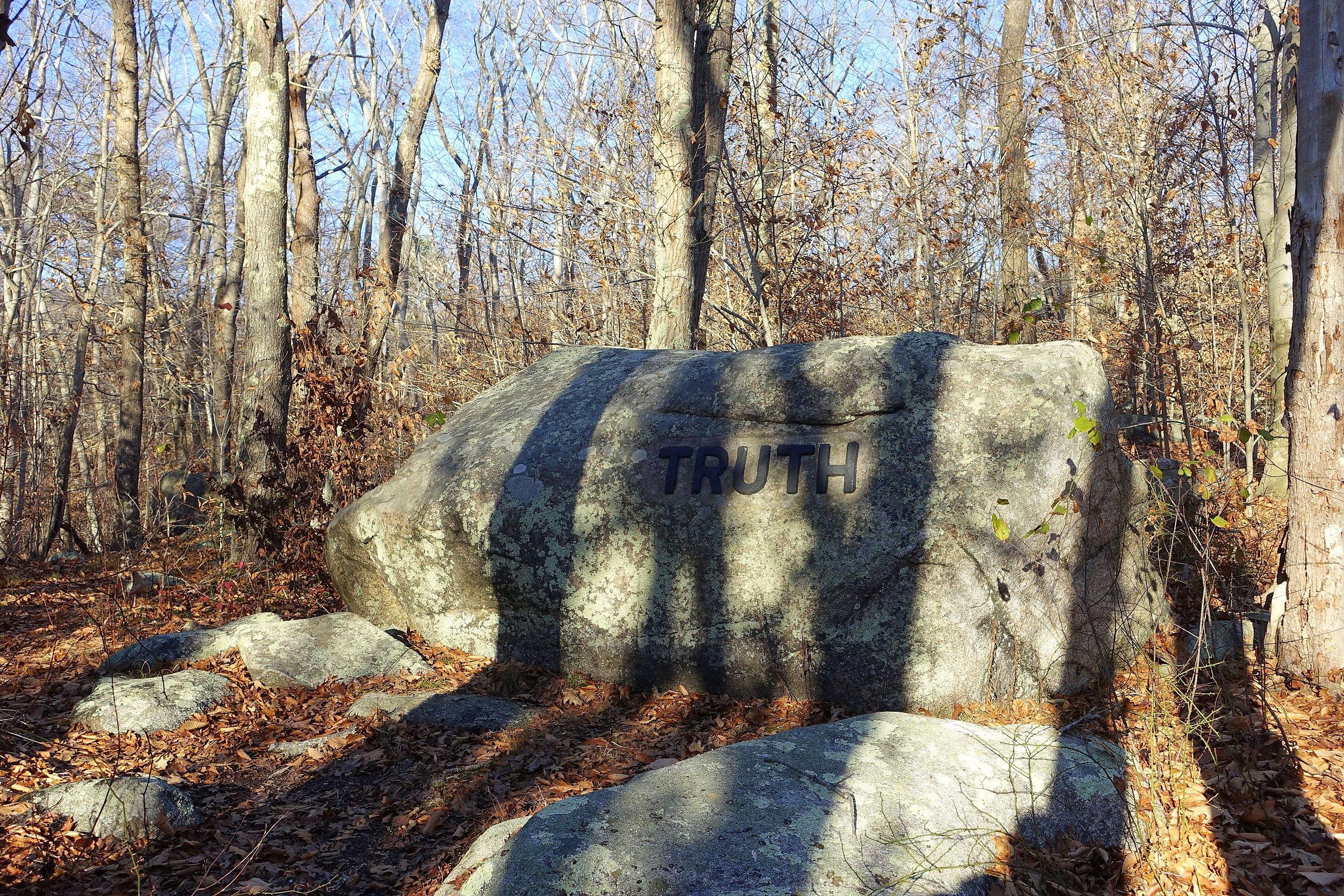
Babson’s Boulders, Dogtown, Massachusetts, photo Daderot (Public Domain)
The Casting of a Weird World
There are many notable examples from New Boston’s history that correspond to the “weird” in Twin Peaks. For example, the town mysteriously burned down in early settlement history: the culprit’s house mysteriously untouched, she was then exiled from town; this same woman previously documenting occurrences of “goblin lights” around the highest point in town—Joe English Hill—in a poem in book celebrating the town’s centennial a few years before; a military base established before WWII at the very point that the supernatural phenomena occurred, today existing as a former Air Force, now Space Force base; lastly, the town shares a weird true-crime history:
One winter morning in 1854, Sevilla Jones was walking to Schoolhouse #3 near Joe English Hill with her younger brother Plummer. They were approached by Henry Sargent, a 23-year-old woodcutter whose family lived near the Jones family. Henry loved Sevilla, and he believed that she had ‘given him encouragement.’ However, he had a rival in another young man, named Bartlett. According to a long, rambling note written in his diary, Henry believed that Bartlett’s mother had conspired with Sevilla’s mother to convince the girl to prefer Bartlett. ‘She proved false, by bad advice,’ he wrote. Henry used an Allen & Thurber pepperbox revolver to shoot Sevilla four times, killing her instantly. He then shot himself, with less immediate success. It has been said that a doctor was fetched, but this doctor was so angry with Henry that he wouldn’t treat Henry’s wound. Henry died four hours later. As for the curious epitaph on the gravestone—some say that it was written by Bartlett’s mother.
SEVILLA, daughter of George and Sarah JONES.
Murdered by HENRY N. SARGENT, January 13, 1854.
[At the age of] 17 years and 9 months.
Thus fell this lovely blooming daughter
By the revengeful hand – a malicious Henry
When on her way to school he met her
And with a six self-cocked pistol shot her.4
In a similar circumstance, a girl from my school bus in elementary school went missing on July 25, 1989, in New Boston; her remains were found by another kid from my bus on July 18, 1991, while he was playing in the woods with his friends. From the police investigation of witness statements on the day of her disappearance, theories had arisen that her case shared similarities to the cases of the victims of the Connecticut River Valley serial killer in the 1980s—the best resource to read about this mystery is Philip E. Ginsburg’s The Shadow of Death: The Hunt for the Connecticut River Valley Killer. The girl from New Boston, Carrie Moss, is still an unsolved cold case today.5
It is bizarre how certain memorable events can leave lasting footprints in your own identity. I began emailing an author after reading his book in 2020—the book was about Maura Murray, a former West Point and UMass Amherst nursing student who drove to Northern NH for no particular reason in 2004 and disappeared; it remains a NH cold case. James Renner—the author of that book, True Crime Addict: How I Lost Myself in the Mysterious Disappearance of Maura Murray—recalled how, for him, the similar disappearance of a local girl when he was young had also affected him in a specific way:
I’m a bit of an unsolved mysteries junkie. The colder the case, the better, as far as I’m concerned. I’ve spent years trying to bring Amy Mihaljevic’s killer to justice. In a Hollywood screenplay, this would be the scene the director uses to explain why I became a true crime journalist—my origin story, as it were. However, my fascination with human predators actually began a couple of years before this. By the time I was thirteen, I was already obsessing over Amy Mihaljevic: riding my bike to area shopping malls, looking for the face of her killer in the crowds. I had fallen in love with Amy Mihaljevic when I saw her MISSING poster hanging on a utility pole when I was eleven years old…My psychologist smiled tightly. Roberta was a seasoned counselor working out of a square office below a fitness center in West Akron. I’d been seeing her for three years. I picked her out of the yellow pages in 2006, around the time my first book was published. It was a nonfiction account of my investigation into the abduction and murder of a ten-year-old girl named Amy Mihaljevic. After the book was released, I started having panic attacks in grocery stores. My mind kept insisting that the guy in front of me at checkout was keeping girls tied up in his basement. Turns out I had contracted secondhand post-traumatic stress disorder, the kind embedded war journos sometimes get. That was an idea that took me a long time to accept, by the way, and I still feel guilt when thinking about it. After all, I never served in a war. What the hell do I have to complain about that’s so terrible? And yet, there was no denying the symptoms.4b
Edgar Allan Poe, in an analysis of his poem, “The Raven,” about the loss of a lover, remarks, “the death…of a beautiful woman is, unquestionably, the most poetical topic in the world?” It seemed that all of these occurrences struck a chord with me—murder and loss, mysteries, and the literature that connects it all. Between Elyssa East’s Dogtown (the narrative of the murder of Anne Natti, which I evaluate in my book), the murder of Sevilla Jones, the murder of Laura Palmer in Twin Peaks, the murder of Carrie Moss, and the disappearance of Maura Murray, they appeared, all of them, as narratives containing the Greek allegory of Persephone entering the Underworld. It was years later that I kept finding patterns like this with the authors that wrote about these topics, making these connections, like Poe, Lovecraft, Nietzsche, Crowley, and Lynch: they all shared a specific natal astrological pattern, and that pattern was a natal planet conjunct the fixed star Spica on the day they were born.
This fascination of mine with the weird and the occult—similar to German astronomer and mathematician Johannes Kepler’s own attraction to understand and condemn metaphysics, like astrology—instead compelled his interest to research more about the subject. Kepler was convinced that the discipline could one day become an empirical science; I fall into this same school of thought.
I approached this study in the same spirit, focusing on local cases to make a persuasive argument. What I found in natal charts that had a planet conjoined Spica—that is, in between the Earth and that very star—seemed to symbolize or act as an indicator of certain patterns of interest and events in certain individuals’ lives.
Spica is the brightest star in the constellation Virgo. Appearing as a single brilliant bluish-white point of light from Earth, though it is actually a close binary star system, whose name Spica derives from Latin meaning “ear of the grain,” which refers to the mythological depiction of Virgo. Classical representations seem to come from Ptolemy, indicating “success, renown, riches, a sweet disposition, love of art and science, unscrupulousness, unfruitfulness and injustice to innocence.”6 However, Ptolemy’s description, which seems to influence any historical Western mention, does not lend credence to the very weird patterns that noteworthy natives with natal Spica planets demonstrate. My own research over the past five years, evidenced in my book and the articles I have written on this website, has been an observation of these strange patterns and phenomena.
Spica, or Arista (Alpha Virginis), is at 22 degrees, 43 minutes of tropical Libra, and it forms the chaff or ear of wheat in the left hand of constellational Virgo, considered the symbolic representation of the Greek virgin-goddess Persephone (or Ishtar) in our contemporary understanding. As the fermented barley wheat that grew in ancient Eleusis was the main ingredient in the Eleusinian Mysteries’ kukeon—the alcoholic/psychotropic drink that allowed one to ‘meet’ Persephone during the ancient ritual—modern toxicological tests on archeological sites where these chalices have been found has also tested positive for ergot, which grows on this wheat and alters its form. Ergot is notable, historically, because the discovery of its chemical nature led to the development of LSD by Albert Hoffman in Switzerland—a critical factor in the expansion of human consciousness.7

Spica (Alpha Virginis). Image: Pablo Carlos Budassi (CCBYSA4.0)
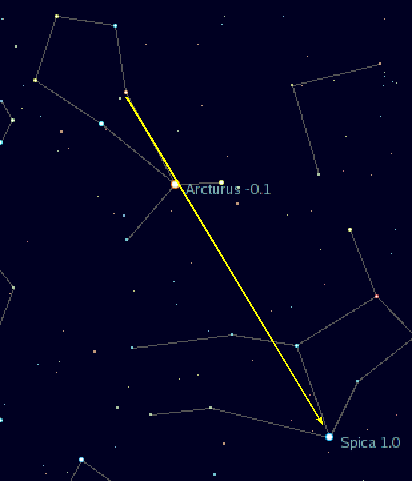
Diagram showing how to locate the star Spica by following a line made through Arcturus. Picture created by Jim Thomas by using a screen captured image from KStars. (GNU)
The two most fortunate stars in the sky, Spica and Arcturus, are very close in longitude. While Spica is sweet and innocent, Arcturus is more apt at dealing with the darker aspects of life on Earth. In ancient Mesopotamia, Arcturus was linked to the god Enlil, and also known as Shudun, ‘yoke.’ The traditional name Arcturus is derived from the Ancient Greek and means ‘Guardian of the Bear,’ ultimately from ‘bear’ and ‘watcher, guardian.’ In Arabic, Arcturus is one of two stars called al-simak ‘the uplifted ones’ (the other is Spica). Arcturus is a fine, big, yellow star, easily seen if one follows down a little from the curved sweep of the Bear’s stars (the handle of The Plough, or Dipper), and one may continue to sweep down to the horizon to meet the all-important Spica, Ishtar, Queen of Heaven. The two stars are almost conjunct by longitude, leading the Arabs to see Arcturus as her protector: Al Haris al Sama, Protector of Heaven, and Al Haris al Samak, Protector of the Defenseless One. So there we see the role of Arcturus: a protector, yes, but an unbiased protector of all. While we take what we may from Spica, from this symbol of the Heavens and Earth together, we are protected. But abuse that bounty, or take it from others, or deny it to them, and the Regent-Protector steps in upon us as upon any other predator. We are ourselves that same Regent, of course, so that it is our own hand and deed that calls us sharply to order. That is why older texts warn of Arcturus above [the] inviting Spica, as though God has maliciously placed a ‘bad’ star right on a ‘good’ one. One must marvel at the debased kind of astrology that does not accept a need to give as well as to receive of life’s bounties.8
Understanding Birth Charts
Flash forward ten years, and I was living back in New Hampshire after my time spent in NYC and Seattle. I began this journey by reading Alan Oken’s Complete Astrology just after the pandemic resulted in everyone remaining indoors—sadly, Oken would later pass from COVID-19. I was reluctant to read the book, at first, and put it off for a while because astrology simply had no appeal to me. However, after I delved into it, taking the time to interpret astrological glyphs and the entire philosophy, and voraciously reading as much literature as I could about the topic, I developed a deeper understanding of why I was drawn to stories of the macabre. I read other works from other astrologer-authors, practiced the delineation methods they used, applied multiple approaches when investigating my own birth chart, and began to pick up patterns outside of the ones astrological authors parroted. I’ll use myself as an example.
Attempting to understand the birth chart, like anyone else, has been an ongoing personal challenge. My birth certificate indicated I was born during the afternoon, while my mother firmly believed the accurate time was in the evening. I began to see why individuals like Carl Gustav Jung learned how to best understand his own ACTUAL birth-chart time, while Aleister Crowley, an individual who had rectified his own birth time, seemed less motivated to understand his actual birth chart and more inclined to understand his MODIFIED time. History is full of notable individuals changing their birth times when they initially navigate natal astrology, learn the traditions, and choose not to identify with their actual birth times; it is nothing new. Confusion often occurs when recollecting the time the nurse scribbles down when the child is born, especially when confronted with a family member demonstrating a keen attention to detail of certain events occurring during that birth time: case-in-point, my mother remembers that dinner was being served when she went into labor, which was well over two hours after my birth certificate time.
In my own case, this evening birth time gives me an ascendant/rising sign within 1 degree of Lovecraft’s own ascendant/rising sign. This is compelling for a Lovecraft fan like me to believe that there may be a lot in common with individuals born around this time of day when Libra was in the eastern horizon—the more I research, the more I believe this. However, to believe one time over the other also means to recognize that similar natives born around the same ascendant may share similarities.
Much of my investigation focuses on the lives of prominent native Spicas such as Crowley, who was a natal Spica with a strong faith in astrology, and Lovecraft, another natal Spica creative, who strongly condemned astrology. However, Lovecraft’s fiction and personal letters to friends would lead any reader to suspect otherwise. Occultists, such as Crowley, have used and continue to use his fictional literary universe, “Cthulhu Mythos” — a realm inhabited by powerful, indifferent cosmic entities such as the god Cthulhu, and made up of alien landscapes, forbidden knowledge, and dangerous arcane texts — in ritual ceremonies involving astrology. His fictional characters portray cosmic archetypes that occur in all cultures—authors Kenneth Grant and Peter Levenda have researched these occurrences. In the following quotes, Grant and Levenda provide the very context that inspired my own research. Here, Grant—Crowley’s secretary—demonstrates how strongly Lovecraft fits into Grant’s observation of the occult:
I refer to Howard P. Lovecraft whose occult experiences, disguised as fiction, vividly adumbrate the awful possibility at which Crowley but vaguely hints in Moonchild. But-read his poetry! He cannot there conceal, as he does persistently in his letters-the real source of his visions, of the intrusion of forces completely in accord with the archetypes, symbols—call them what you will—that Crowley brought through when in contact with a transmundane entity of supreme power; I refer to Aiwass. The quality of evil with which Lovecraft invests the types of his Cthulhu Cult and other mythoses is the result of a distortion in the subjective lens of his own awareness, and I have shown elsewhere how these images emerge when not so deformed, approximating sometimes to the point of actual identity with Crowley’s cult-types of Shaitan-Aiwass and The Book of the Law. Lovecraft’s literary hangers-on are interested in bolstering the fallacy to which he himself gave the initial impulse because they wish, no doubt, to preserve the illusion of originality which they ascribe to him. To their limited vision, it seems, Lovecraft maintains his unique position only at the cost of tearing out of its real context his undeniably remarkable achievement. This is both foolish and shortsighted because Lovecraft’s achievement is not diminished but greatly enhanced if one sees it in its correct perspective, for it is an occult tradition-and Lovecraft gave it persistent utterance in his writings—that some transfinite and superhuman power is marshalling its forces with intent to invade and take possession of this planet.9
And here, Levenda provides a coincidental/synchronistic event connecting Crowley and Lovecraft, which Grant also observed:
In 1907, Crowley was writing some of the works that became seminal to the doctrines of Thelema, known as The Holy Books. These include Liber Liberi vel Lapidus Lazuli, Liber Cordis Cincti Serpente, and other works written between October 30 and November 1 of that year, and Liber Arcanorum and Liber Carcerorum, written between December 5th and 14th that same year. Lovecraft would have had no knowledge of this, as he was only a seventeen-year-old recluse living at home on Angell Street in Providence, Rhode Island, dreaming of the stars. Instead, he later would write of an orgiastic ritual taking place that year in the bayous outside New Orleans, Louisiana, and on the very same day that Crowley was writing the books enumerated above. The story Lovecraft wrote is entitled ‘The Call of Cthulhu’ and is arguably his most famous work. He wrote the story in 1926, in late August or early September, but placed the action in New Orleans in 1907 and later in Providence in 1925. How is this relevant? Lovecraft’s placement of the orgiastic ritual in honor of the high priest of the Great Old Ones, Cthulhu, and the discovery of a statue of Cthulhu by the New Orleans police on Halloween, 1907 coincides precisely with Crowley’s fevered writing of his own gothic prose. In the Liber Liberi vel Lapidus Lazuli, for instance, Crowley writes the word ‘Tutulu’ for the first time. He claims not to know what this word means, or where it came from. As the name of Lovecraft’s fictional alien god can be pronounced ‘Kutulu,’ it seems more than coincidental, as Kenneth Grant himself noted. In Crowley’s Liber Cordis Cincti Serpente—or ‘The Book of the Heart Girt with a Serpent’—there are numerous references to the ‘Abyss of the Great Deep,’ to Typhon, Python, and the appearance of an ‘old gnarled fish’ with tentacles…all descriptions that match Lovecraft’s imagined Cthulhu perfectly. Not approximately, but perfectly. Crowley’s volume was written on November 1, 1907. The ritual for Cthulhu in New Orleans took place on the same day, month and year.10
It has been the observation of patterns like this that has inspired me to repetitively observe the same connections of this star system in the prominence of people born with a planet in between that star and Earth. In my case, I was born when Pluto was exactly in between or conjoined Spica.
The life and literature of Lovecraft continues to serve as an effective lens to navigate the Natal-Spica phenomenon, along with the research of Michel Gauquelin, Richard Tarnas, Colin Wilson, and Percy Seymour. Wilson, an existentialist philosopher and novelist, wrote extensively about true crime, mysticism, and the paranormal. He was instrumental in actualizing a certain pattern I observed with Lovecraft and Spica. From Wilson’s literature:
The definition of the imagination—as the third dimension of consciousness—would seem to be broader than the ‘escapist’ definition. The imagination, like the reasoning faculty is an extension of the powers for survival. All animals need reason to stay alive, but no animal needs Boole’s symbolic logic, or Planck’s quantum theory. The kind of recreation of the past in which Proust spent twenty years of this life is quite simply a luxury. And yet Proust, no doubt, would have agreed with Wells: that without this luxury he had no desire to stay alive.11
In some ways, [H. P.] Lovecraft is a horrifying figure. In this ‘war with rationality,’ he brings to mind W. B. Yeats. But, unlike Yeats, he is sick, and his closest relations is with Peter Kürten, the Düsseldorf murderer, who admitted that his days in solitary confinement were spent conjuring up sexual-sadistic fantasies. Lovecraft is totally withdrawn; he has rejected ‘reality’; he seems to have lost all sense of health that would make a normal man turn back halfway. Lovecraft is interesting mainly because he is a perfect example of the ‘escapist imagination.’ It is hard to agree with August Derleth that his death was ‘a great loss to American letters’ because he had not yet reached ‘the fullest development of his powers.’ It is doubtful whether Lovecraft had any more to say. As it is, he wrote far too much. Moreover, since he so determinedly created an unreal world in opposition to the real world, it seems that he willed his own death. His whole life is a spectacle of self-destruction; he strikes one as being like a chronic alcoholic or a drug addict.12


Crime and Creativity
In Cosmic Influences on Crime and Creativity, I also dig into eleven New Hampshire true-crime cases: four from the New Hampshire Attorneys General’s incident reports, six from published print narratives, and one Netflix series, revealing intriguing astrological patterns in the natal charts of those involved.
My book also dives into the lives of several historically notable creative individuals—all Spica natives—who have exhibited what Wilson described as creating “an unreal world in opposition to the real world”: Percy Shelley, Emanuel Swedenborg, Joseph Smith, Edgar Allan Poe, Friedrich Nietzsche, Robert W. Chambers, Richard Wilhelm, Aleister Crowley and Carl Gustav Jung. The following excerpt is C. G. Jung’s section from my book:
Jung is an extremely notable individual, not only given the relationship Jung demonstrated with his imagination, but from the copious documented examples of his proactive life journey to understand it. Very early on in life Jung recognized that he exhibited one personality of reason and logic and another that was its antithesis. It was Jung’s early attempt to reconcile his ‘Number 1’ and ‘Number 2’ personalities (i.e., left and right brain) that led to his lifelong interest and work in the vocation he coined as ‘analytical psychology.’
Jung is credited with many accomplishments in psychology, cutting his teeth in his apprenticeship in psychiatry at Burghölzli Mental Hospital in Switzerland and his research and American-academic speaking tour with Sigmund Freud. The experience most notable in reference to his own ‘escapist imagination’ would be the self-oriented research during his mid-life crisis.
Jung had visions in his childhood, as well as mid-life. His own exploration of his visions, dreams, and unconscious from 1913-1930, he recorded in his Liber Novus—this work was only known by those close to him, but with consent of Jung’s descendants, Liber Novus (or The Red Book) was published by Sonu Shamdasani in 2012.13
Here, Hyde describes in his book Introducing Jung some revelations from The Red Book:
Image and fantasy are the way into the depths, and throughout The Red Book, Jung narrates, draws and paints his fantasies on his journey. To heal his soul, Jung embraces the Spirit of the Depths and travels through deserts and darkness, snow-covered countries and hell, discoursing with his soul and with serpents, the Devil, the dead, anchorites, and magicians. He kills Siegfried, the hero, and is himself reborn, but he has the task of saving the dying Izdubar. He carries him as an egg to the western lands where Izdubar is born again out of the egg. Yet later, writing his memoires, Aniela Jaffe records that Jung believed ‘many of these fantasies were a hellish combination of the sublime and the ridiculous’. It is through fantasy, however, that Jung developed the active imagination he used later with patients…In The Red Book, Philemon heals the Spirit of this Time and raises the question of the non-intrapsychic (in your own head) status of fantasy thinking, understanding the Spirit of the Depths and its magic as a reality…From a psychiatric point of view, Jung was talking to himself and Philemon is a fantasy, a psychotic symptom, similar to the delusions and voices suffered by the schizophrenic. Within the framework of Jung’s later work in analytical psychology, Philemon can be labelled an ‘archetypal image of the spirit’ from the fund of the unconscious images which can fatally confuse the mental patient. But it is also the matrix of ‘mythopoeic imagination’ which has vanished from our rational age. Though such imagination is present everywhere, it is both tabooed and dreaded…Jung brings modern psyche back to its archaic root. His project is a reorientation of individual psychology within a collective and cosmological frame, that of the one world, unus mundus. His taking up of the occults completes the circle that binds together the modern ‘discovery of the unconscious’ with the ageless foundations of spiritual experience, prophecy and divination.14
My book delves into Jung’s life and the fascinating planetary conjunction present in this Spica native’s birth charts. Jung came from a long line of Christian practitioners. His Father was a Swiss Reformed Church Evangelical minister, and his eight uncles were clergy, as well as his maternal grandfather. From a very early age, Jung’s visions were of a religious nature:
Jung says that his intellectual life began with a dream at the age of three. In his dream, he descended into a hole in the ground. It leads him into a large chamber, a red carpet and a golden throne on which a strange being sits. Decades later, Jung came across a reference to the motif of cannibalism in the symbolism of the Mass. And only then did the image of the ‘man-eater’ make sense to him. He realized that the ‘dark Lord Jesus, the Jesuit and the phallus were identical’. They represented a dark creative force in nature, the investigation of which he pursued throughout his life. But it was God who really interested Jung. God tested him out by tempting him to think unutterable sinful thoughts. ‘I gathered all my courage, as though I were about to leap forthwith into hell-fire, and let the thought come. I saw before me the cathedral, the blue sky. God sits on His golden throne, high above the world—and from under the throne an enormous turd falls upon the sparking new roof, shatters it, and breaks the walls of the cathedral asunder’…Instead of damnation, Jung felt this vision was an act of grace. He had been shown another side of God altogether, different to the one his father and uncles spoke of in their sermons.15
The Escapist Imagination
Broadly speaking, the “Escapist imagination” refers to how a person might use their imagination to distract themselves from unpleasant or difficult aspects of daily life. But from an astrological and literary perspective, there is much more to it than this. My book attempts to more effectively define the “escapist imagination” in light of the patterns I have observed with Spica:
Evidence in the form of non-fiction and creative non-fiction biographical narratives, when applied to traditional astrology, reveals the spectrum of creativity and true crime. Patterns and observations arise when natives like Lovecraft are conditioned and adhere to the negative conceptual forms of their early childhood and educational experiences, or when natives reintegrate those traumas and become positive examples. True crime narratives are akin to voluminous expressions of authors’ left-brain recollections given the biographical subjects’ right-brain experiences. Biographies become symbolic of pirate maps generalizing observable information and potential value. When narratives are illuminated under the occult reading lamp they reveal the hidden, luminescent ink that leads to treasures. Personally, I do not think the ‘escapist’ designation is the holistic qualitative assessment of the Spica influence; however, I do believe something akin to ‘caught between worlds’ is a more effective description. I believe ‘escapist imagination’ has more to do with the ability of an individual to provide an audience firsthand access to the ultimate change-agent humanity has ever known: the fear of the cosmic unknown.16
By observing Colin Wilson’s use of the concepts of the “escapist imagination,” being “caught between worlds,” and “willing his own death,” I observed that creative Spica natives shared comparable demonstrative parallels. In short, there is a pattern—a cosmic influence—that can yield qualitative results through an astrological diagnostic method.
By creating a baseline of research for Spica natives—creatives and criminals—a continued pattern may be observed, given the following more current Spica natives, such as David Lynch, Vladimir Putin, David Berkowitz, Bruce Dickinson, J. K. Rowling, Alex Jones, Russell Brand, and Jarvis Leatherby, to name a few.
How do I make sense of this in reductionist terms? To revisit the best “escapist imagination” definition, in summary, I can estimate that it may be the “ambassadorial role of the reintegration of the role death plays in the world of the living”; that is, somewhat likened to the role of the psychopomp—the role of the mercurial Hermes in Greek myth. However, in contrast to Hermes’ shuttling of souls to the underworld and paying Charon to ferry them further on, it seems Spica natives like Jung were able to rediscover the nature of the liminal, almost like the myth of Orpheus. Son of Apollo and the Muse Calliope, Orpheus’ tale in relation to Jung’s Liber Novus and what we can discover about Spica may be a good foot forward to understanding the nature of consciousness and the integral role that the “escapist imagination” plays within it.
References
1 Ocker, “Mr. Crowley, Do You Like My White House?”
2 Wikipedia, “The Horla.”
3 East, Dogtown, 12.
4 Rothman, “Sevilla Jones.”
4b Renner, True Crime Addict, 12-28
5 More information on Carrie Moss can be found at https://www.doj.nh.gov/criminal/cold-case/victim-list/carrie-moss.htm.
6 Robson, The Fixed Stars and Constellations in Astrology, 250.
7 Wynands, Cosmic Influences on Crime and Creativity, 40.
8 Astrology King, “Fixed Star Arcturus.”
9 Grant, Aleister Crowley and the Hidden God, Location 443.
10 Levenda, The Dark Lord, 191.
11 Wilson, The Strength to Dream, 251.
12 Wilson, The Strength to Dream, 23.
13 Wynands, Cosmic Influences on Crime and Creativity, 304.
14 Hyde, Introducing Jung, 106.
15 Hyde, Introducing Jung, 110.
16 Wynands, Cosmic Influences on Crime and Creativity, 91.
Bibliography
Astrology King. “Fixed Star Arcturus.” Astrology King. https://astrologyking.com/arcturus-star/.
East, Elyssa. Dogtown: Death and Enchantment in a New England Ghost Town. New York: Free Press, 2012. Print.
Grant, Kenneth. Aleister Crowley and the Hidden God. London. Starfire Publishing, 2013. Print.
Hillman, James. Lament of the Dead: Psychology After Jung’s Red Book. New York: W. W. Norton & Company, 2013. Kindle.
Hyde, Maggie. Introducing Jung: A Graphic Guide. London: Icon Books, 2015. Kindle.
Joshi, S. T. Lovecraft and a World in Transition: Collected Essays on H. P. Lovecraft. New York: Hippocampus Press, 2015. Kindle.
Levenda, Peter. The Dark Lord: H. P. Lovecraft, Kenneth Grant, and the Typhonian Tradition in Magic. Lake Worth: Ibis Press, 2013. Kindle.
Ocker, J. W. “Mr. Crowley, Do You Like My White House?” New Hampshire Magazine. New Hampshire Magazine, 2010.
Renner, James. True Crime Addict: How I Lost Myself in the Mysterious Disappearance of Maura Murray. New York: Thomas Dunne Books, 2016. Kindle.
Robson, Vivian. The Fixed Stars and Constellations in Astrology. Tempe: The American Federation of Astrologers, 2017. Kindle.
Rothman, Dan. “Sevilla Jones.” New Boston Historical Society. https://www.newbostonhistoricalsociety.com/cemetery/SevillaJonesandHenrySargent.pdf.
Wikipedia. “The Horla.” Wikimedia Foundation, December 1, 2022. https://en.wikipedia.org/wiki/The_Horla.
Wilson, Colin. The Strength to Dream: Literature and the Imagination (Outsider Cycle). London: Aristeia Press, 2021. Kindle.
Wynands, Anthony. Cosmic Influences on Crime and Creativity: New England, the Occult, and the Escapist Imagination. Self-published, 2025. Kindle.
Great job Tony.
Thank you, Donna!
It’s been a journey of discoveries!
Mister Crowley, what went on in your head?
Oh, Mister Crowley, did you talk to the dead?
Your lifestyle to me seemed so tragic
With the thrill of it all
You fooled all the people with magic
Yeah, you waited on Satan’s call
Mister Charming, did you think you were pure?
Mister Alarming, in nocturnal rapport
Uncovering things that were sacred
Manifest on this Earth
Ah, conceived in the eye of a secret
And they scattered the afterbirth
Mister Crowley, won’t you ride my white horse?
Mister Crowley, it’s symbolic of course
Approaching a time that is classic
I hear maiden’s call
Approaching a time that is drastic
Standing with their backs to the wall
Was it polemically sent?
I wanna know what you meant
I wanna know
I wanna know what you meant, yeah
Just what did Ozzy mean? It may have also inspired Bruce Dickinson in “Moonchild” from Iron Maiden’s “Seventh Son of a Seventh Son” album: https://grahamhancock.com/wynandsa6/
I wouldn’t trust anything Mr Crowley said with a barge pole….https://davidicke.com/2025/01/10/this-is-a-very-good-summary-of-how-the-dark-poses-as-both-the-dark-and-also-the-false-light-we-are-seeing-this-so-clearly-today-with-the-globalists-dark-and-the-trumpers-muskers-false-ligh/
That’s exactly why I find this Spica-conjoined-natal-planet pattern so fascinating. It’s many different sides of the coin, but the same flavor of essential value in the natives’ lives. How can this be? And why? And do secret societies maintain awareness of this astrological metric, because astrology is of utmost importance to them; however, in what vein? I’ll leave off with another interesting pattern: Friedrich Nietzsche, Aleister Crowley, Michael Aquino, and Charlie Kirk all had their natal Sun conjunct Spica. All had prophetic dreams (see recent Candace Owens podcast transcripts describing her discussions with Charlie about his). Who’s a lesser-known individual with a natal Spica Sun? Seth Mazzaglia. Who is this? Internet search his involvement with Kat McDonough in Lizzie Marriott’s murder. You can connect the patterns with the narrative about the case by Kevin Flynn and Rebecca Lavoie: “Dark Heart: A True Story of Sex, Manipulation, and Murder.” I dedicate a chapter in the analysis of this case in my book. Also, they may have all communicated (or simply heard/followed) and inner voice that compelled the individuals’ behaviors.