




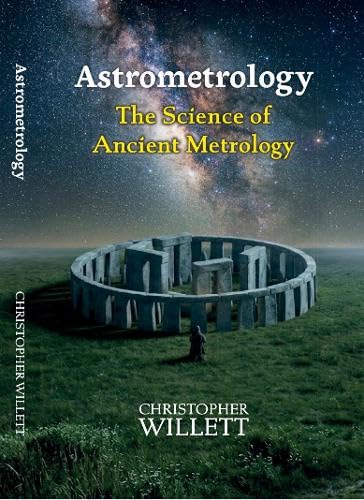
We warmly welcome Christopher Willett, PhD, author of Astrometrology: The Science of Ancient Metrology, as our featured author this month.
Chris is an independent researcher with an academic background in engineering. His doctoral research in applied geometry identified a unifying physical principle governing the attractive forces between particles, from which he developed an equation that is still used in simulation software today. That same interest in hidden underlying principles has since led him to the study of ancient measurement.
In his debut book, Chris sets out to identify the single, timeless standard of length from which, he argues, all ancient units of measurement were derived. He also explores how ancient builders may have embedded design plans into monuments around the world through a combination of geometry, whole numbers, and units of length, so that each structure becomes its own mathematical blueprint, waiting to be read.
In his article, Chris turns our attention to two of the world’s most renowned monuments, Stonehenge and the Parthenon, and asks what their dimensions might reveal about the knowledge of the people who designed them, inviting readers to reconsider much of what they have been told about our past.
Interact with Chris on our AoM Forum here.
A Lost Timeless Science of Measurement
The Holy Grail of ancient metrology is to identify the fabled mensura perpetua: an original, ultimate standard of length, described by Pythagoras as the “invariable prototype taken from nature”.
Legend has it that in times lost to memory, a magnificent engineering achievement was carried out to measure the length of the circumference of the Earth, or rather the length of the equator. The legend continues that this measurement was used as an absolute invariable standard of measure, acting as the ultimate recalibration backstop, and from which all ancient measurements are derived, and the principal dimensions of ancient monuments are constructed. Astrometrology1 is the rediscovered lost science of ancient metrology based on the recent discovery that the fabled mensura perpetua is the equator. It sweeps the board clear of units of length estimated inductively and measured in multiples of inches or millimetres and replaces them all with precise definitions based on harmonious divisions of the length of the equator.
It has been argued that the location of the equator would be beyond the wit of the ancients. However, observing the sunrise alone can provide its location quite accurately. The rise angle of the sun can be used to determine an observer’s latitude, as shown below:
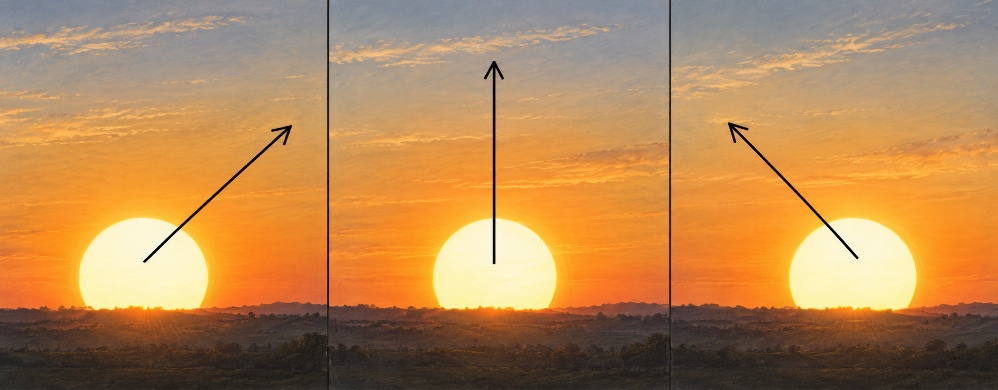
Figure 1: Illustration of the rise angle of the sun: a) north of the equator, b) at the equator and c) south of the equator. Generated using OpenAI’s ChatGPT image-generation tool from an original draft created by the author.
Moreover, on the equinox, the sun passes directly overhead at midday if you are standing on the equator. This phenomenon of an overhead sun on the equinox also provides a means to measure the length of the equator merely by observing an overhead sun on the equinox from multiple locations along the equator. It is therefore more than theoretically possible that the length of the equator can be accurately measured by making solar observations only: it is a practical reality.
In this article, we will demonstrate that the mensura perpetua has been found and is the equator. Not only was a measurement of the equator carried out in a forgotten distant era, but the result of the measurement was recorded and, indeed, encoded deep within the architectural designs of both Stonehenge and the Parthenon.
Stonehenge as record of the mensura perpetua
The Station Stone rectangle at Stonehenge is well known for its alignments with sun and moon rising and setting positions, as dramatically revealed by Gerald Hawkins2. This is therefore as likely a place as anywhere to contain a record of a length defined by the movement of the sun, such as the equator.
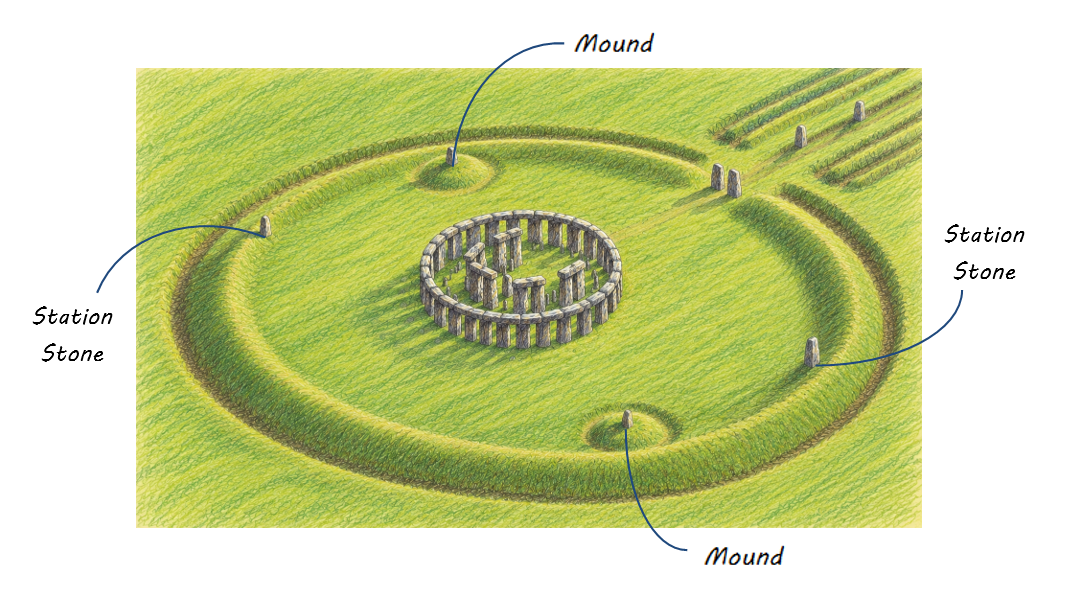
Figure 2: Perspective view of the layout of the Station Stones and mounds forming the Station Stone rectangle. Generated using OpenAI’s ChatGPT image-generation tool from an original draft created by the author.
This simple but exquisitely formed rectangle comprises four Station Stone locations, two of which today are marked by a physical Station Stone. The other two locations are described as mounds but clearly mark the Station Stone location due to indentations in the underlying chalk bed.
The Station Stone locations are positioned just inside the encircling chalk bank and ditch enclosure. As their name suggests, it is generally agreed that they represent a rectangle with two parallel long sides and two parallel short sides. Beyond that, there is little agreement regarding the relative dimensions. That the rectangle may have been originally constructed in the relative proportions of 5 to 12 was originally suggested by William Dibble3 in 1976. In 19784 Professor Richard J. C. Atkinson and Professor Alexander Thom carried out an on-site survey based on the physically excavated, exact positions of all four station locations. They cut into the ground to locate the exact, buried stone holes for the missing markers by mapping the real, physical sockets. Atkinson and Thom thereby achieved accuracy that previous surface-level surveys could not achieve. Atkinson, however, considered it to be impossible to determine the precise shape and even felt unable to confirm that they formed a rectangle.
The 5 to 12 ratio was, however, seemingly confirmed by Ranieri5 in 2003, who analysed the plans published in the English Heritage report. He found that a best-fitting inscribed rectangle had sides with relative lengths of 2.395±.02, within 0.2% of the ratio of 12:5 (which is 2.4). However, others have suggested other geometric arrangements, such as a portion of an octagon, as suggested by Johnson6, which would put the side lengths in a ratio of 2.414, which is just within the outside limit of the range identified by Ranieri. This difference is so small that John Michell7 considered it undetectable and a geometric conundrum, although he noted that Richard Atkinson’s survey data gave 45.17° at the centre, suggesting, like Ranieri, that the 5-12 construction is more likely.
Resolving this is far from an academic exercise. An octagon can be generated by peg and rope8, whereas a 5-12 rectangle implies a high level of geometry far earlier than it is traditionally believed to have existed. The answer therefore has a bearing on the knowledge level of the Stonehenge builders.
Given the tiny differences in length between these two geometric solutions, a conclusive answer will indeed remain forever out of reach as long as we are confined to the tool of measurement alone. To discriminate between the two and solve the conundrum, we would ultimately require knowledge of the architect’s original design plan. However, surely to even consider the retrieval of an original architect’s plan would be unthinkable? Perhaps not. Let us now take our first step through the looking glass and ask the stones the following question:
Q: How many times does the distance between the stones and mounds divide into the modern length of the equator?
We will use the surveyed lengths reported by Richard Atkinson and compare them to the length of the equator we know to be the most accurate, which is 40,075,014 m, as used by the International Association of Geodesy and the International Astronomical Union. The results are shown below in Table 1.
| Dimension | Measured Length (m) | Division into equator |
|---|---|---|
| Short Sides | ||
| 91-92 | 34.17 | 1,172,813 |
| 93-94 | 32.70 | 1,225,536 |
| Long Sides | ||
| 92-93 | 79.93 | 501,376 |
| 91-94 | 80.26 | 499,315 |
Table 1: Calculation of the number of times the sides of the Station Stone rectangle fit into the length of the modern measurement of the equator.
It is as though the numbers 5 and 12 are appearing through the mists of time, like a message sent to us from the architect. We can see a clear signal of the number 500,000 appearing for the long sides. However, for the short sides, the result is unclear. Let us then try to increase the signal relative to the noise of thousands of years of weathering. We will repeat the calculation, this time taking the simple averages for the sides. The results are as follows:
| Dimension | Measured Length (m) | Division into equator |
|---|---|---|
| Average of Short Sides | 33.435 | 1,198,595 |
| Average of Long Sides | 80.095 | 500,344 |
Table 2: Calculation of the number of times the average of the sides of the Station Stone rectangle fit into the length of the modern measurement of the equator.
By averaging the two short sides and the two long sides, the signal has increased significantly. It is now clear that the number 500,000 appears, and we now see the appearance of 1,200,000 for the short sides. We can therefore conclude the following:
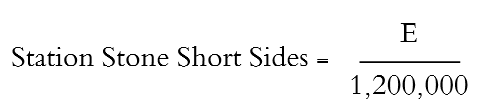
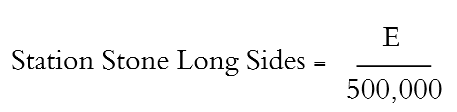
This simple procedure of division has revealed the numbers 12 and 5, but in an encrypted form: 12 appears as 1,200,000 and 5 appears as 500,000. In other words, the stones themselves contain the numbers 5 and 12 within their spacings, as if to confirm the apparent geometry of the rectangle they form. What is truly incredible, however, is that the number 12 appears in the calculation for the short sides, and that the number 5 appears in the calculation for the long sides. The numbers 12 and 5 do not appear as multiples of some unit length, but as divisions of the length of the equator scaled down by the factor 100,000. Their use in the divisions therefore acts as a form of a cross-check built into the stones. It is these factors that allow us to confidently conclude that this was intentional design. We can therefore illustrate this result as follows:
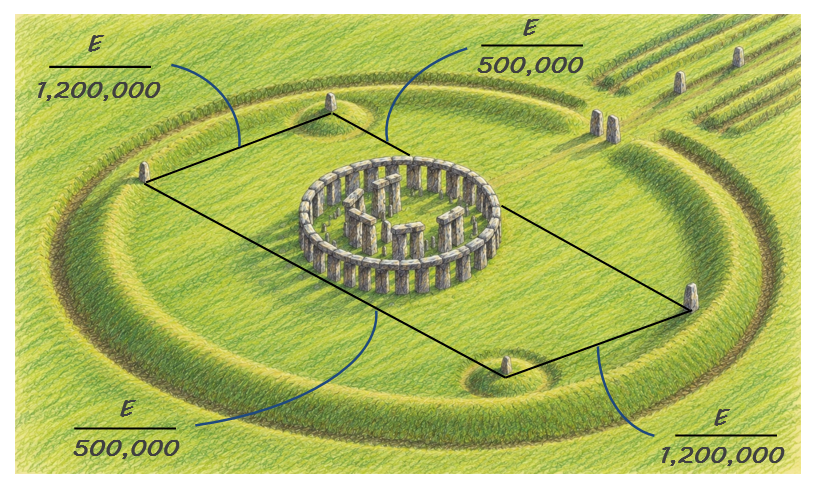
Figure 3: Perspective view of the layout of the Station Stones and mounds with their Astrometrological solution. Generated using OpenAI’s ChatGPT image-generation tool from an original draft created by the author.
Amplifying the Signal still further
However, there is one more way we can turn up the signal even further. We can take a weighted average of all four sides. If we take the total of all four measurements, we will obtain a measure of the perimeter of the rectangle. If we then divide this by 34, this will give the ‘unit length’ for the perimeter, since it is comprised of two lots of 12 and two lots of 5 lengths. The result of this calculation is shown below:
| Station Stone Side | Measured Length (m) | Unit Length (m) | Division into equator |
|---|---|---|---|
| Perimeter | 227.06 | 6.678235 | 6,000,839 |
Table 3: Calculation of the unit length of the Station Stone rectangle and its division into the modern equator length
We now receive our clearest signal yet, and it is truly stunning. The unit length of the Station Stone rectangle is the modern length of the equator divided by 6,000,000:
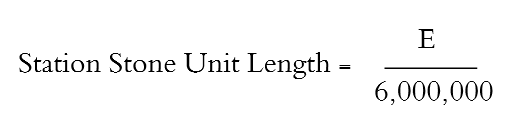
This is, however, much more than a simple determination that the architect used a unit length that is the 6,000,000th division of the modern length of the equator, as it reveals the use of a sexagesimal number system. However, even more significantly, it also reveals another detail in the plan: the numbers 12 and 5 are factors of 60. This choice of unit length therefore provides, as a mathematical result, that 12 will produce the number 5 and 5 will produce the number 12.
What this implies is much more than a mere encoding of the length of the equator. This implies a form of encryption, using the elements of cardinal number (in this case 5 and 12), geometry (the rectangle and the Pythagorean triple relationship of 5-12-13), together with mathematical harmonic scaling (the use of 100,000 and 60, which have factors of 5 and 12). These are the elements of the Quadrivium.
The Quadrivium Code
What appears to have been the architect’s intention is not just to record the length of the equator to a modern level of accuracy, but to make that fact readable from the monument. The geometry of the monument itself gives the mathematical objects 5 and 12, which can then be used as the cipher by which the Station Stone rectangle can be decrypted, and its stored information released to us.
Applying the harmonic scaling factor of 100,000 when combined with the cipher gives the division of the equator, a length generated by knowledge of astronomy. When so divided, the lengths of the Station Stone rectangle are provided, producing a completely closed loop of logic. It is this that is embedded into the rectangle, and therefore the means by which the length of the equator is encrypted. Perhaps the most important property of all was the choice of the scaling factor of 100,000, as it was this choice by the architect that makes the embedded code self-revealing. The unavoidable conclusion is that the architect intended this information to be read from the monument.
The self-revealing plan therefore follows the procedure shown below:
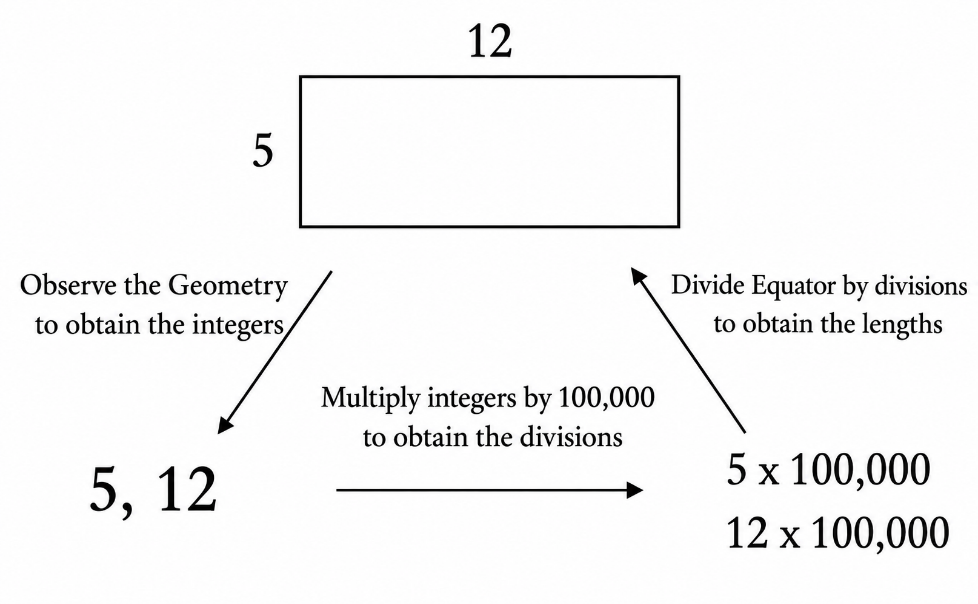
Figure 4: The architect’s self-revealing plan for the Station Stone rectangle, a Quadrivium Code. Drawn by the author.
The plan uses the elements of the Quadrivium: number (5, 12), geometry (the 5-12 rectangle), astronomy (the use of the equator length) and harmonic scaling (the use of 100,000). It seems that these must have been chosen precisely because they are eternal and transcend any culture that may arise in the future. It is therefore a universal language, a permanent and indestructible code, placed into a rectangle in a field in Wiltshire. This finding alters reality forever. However, this is just the beginning of our journey.
Let us now go deeper still and, with new eyes, investigate the Parthenon in Athens.
The Parthenon
Who built the Parthenon in Athens? Who built Stonehenge? These are questions that are of profound importance and yet are never asked because the answers are seemingly so far out of reach. However, if we could identify common architectural features between the two monuments, that would shed a significant amount of light onto such questions.
The Parthenon sits atop a rectangular base, called the stylobate. The base has a slight curvature to it, but it is essentially rectangular in plan. Stuart and Revett9 reported in 1787 one of the earliest traceable measures of the sides of the stylobate. They commented that the sides are “so nearly in the proportion of 100 to 225, that, had the greater measure been ¼ of an inch less it would have been deficient of it”. This combination of relative lengths provides us with the widely recognised design plan that the rectangle has side lengths in the ratio of 4:9. This design plan is shown below:
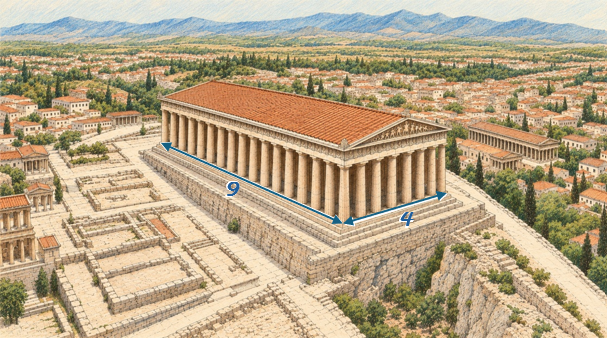
Figure 5: Perspective view of the Parthenon and the 4:9 geometry of the stylobate upon which it sits. Generated using OpenAI’s ChatGPT image-generation tool from an original draft created by the author.
These measures were followed in 1881 by Wilhelm Doerpfeld,10 who gave the width of the stylobate as 30.86m and its length as 69.51m. This was followed in 1888 by Francis Penrose,11 who believed that earlier measurements could be improved upon and measured the width of the upper stylobate at the slightly longer values of 101.34ft for the width and 228.14ft for the length. A more recent notable survey was carried out by Orlandos12 and followed by Angelopoulos,13 who argued that the earlier measurements that came before Orlandos were simply not correct. Although the measurements seemingly developed over time in their accuracy, in all cases the ratios of these measures maintain an almost perfect match with the 4:9 plan.If we divide the measures of the side lengths into the equator we do not yield any immediately obvious results as we did for Stonehenge. However, what if this is not because there is no similar pattern here, and merely because a different scaling factor than 100,000 was used? What if the Parthenon uses a similar design to that at Stonehenge, but where the scaling factor is some other number? Since at Stonehenge the side lengths are provided by the equator divided by a scaling factor and then again divided by the cardinal numbers, we can use this design structure to determine the scaling factor at the Parthenon.
In other words, the short sides of the stylobate multiplied by nine and the long sides of the stylobate multiplied by four give the scaled-down equator length. Let us then step through the looking glass once again and ask the stone the following question:
Q: If your short sides and long sides are generated by dividing a scaled down equator length by 9 and 4, what is the scaling factor?
Instead of dividing the measures of the Parthenon directly into the equator, we therefore divide 9 times the short side length into the equator, and 4 times the length of the long side into the equator. Using the measures of Stuart and Revett (S+R), Doerpfeld (D), Penrose (P), Angelopoulos (A) and Orlandos (O), this produces ten independent calculations of the scaling factor, and the results are as shown in Table 4 below:
| Stylobate Side | Measure ft, inches | Measure (m) | Scaled length (m) | Equator Scaling factor |
|---|---|---|---|---|
| Short | 101ft 1.7 in | 30.83 (S+R) | 277.47 | 144,430 |
| Short | – | 30.86 (D) | 277.74 | 144,290 |
| Short | 101.341ft | 30.89 (P) | 278.01 | 144,149 |
| Short | – | 30.935 (A) | 278.41 | 143,940 |
| Short | – | 30.9205 (O) | 278.28 | 144,007 |
| Long | 227ft 7.05 in | 69.37 (S+R) | 277.48 | 144,425 |
| Long | – | 69.51 (D) | 278.04 | 144,134 |
| Long | 228.141ft | 69.54 (P) | 278.16 | 144,072 |
| Long | – | 69.59 (A) | 278.36 | 143,968 |
| Long | – | 69.556 (O) | 278.22 | 144,039 |
Table 4: Measured lengths of the sides of the Parthenon taken by Stuart and Revett (S+R), Doerpfeld (D), Penrose (P), Angelopoulos (A) and Orlandos (O), and computed values for the scaling factor
This calculation reveals the stunning result that, as the measurements of the stylobate developed over time, the equator scaling factor used in the stylobate of the Parthenon converges on a final value of 144,000. As strange as it may seem, it can seemingly be concluded that the plan used is indeed of the same form as that used to design the Station Stone rectangle at Stonehenge. The only difference is the choice of scaling factor in the Parthenon is 144,000 rather than 100,000, which can be seen as related to each other as 122 relates to 102. The most curious result of all, however, is that this solution to the Parthenon is seemingly only obtainable having already had in hand the solution to the Station Stones at Stonehenge. Without the structure identified previously, it is likely this hidden plan would remain hidden forever.
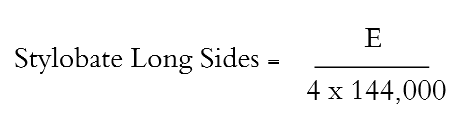
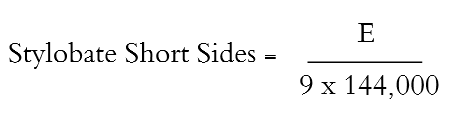
This therefore means that, as incredible as it may sound, we have uncovered an underlying embedded Quadrivium code in the stylobate of the Parthenon. It is once again self-revealing because the geometry provides the cardinal numbers, which are then used as divisions of the length of the equator, together with a scaling factor, to produce the final dimensions. The self-revealing plan therefore follows the procedure shown below:
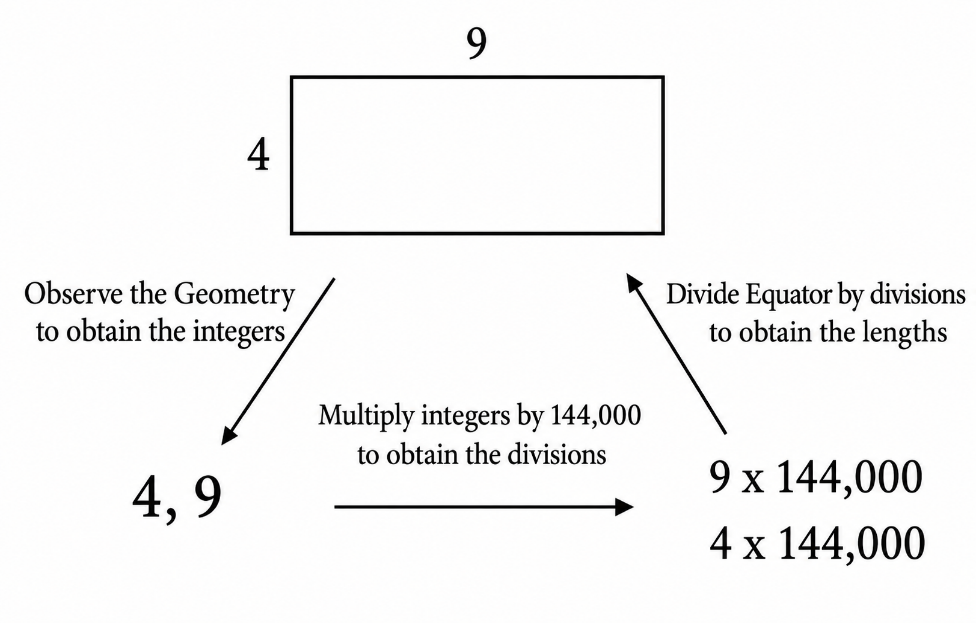
Figure 6: The self-revealing Quadrivium code embedded into the stylobate of the Parthenon. Drawn by the author.
The upper stylobate of the Parthenon appears to have been designed by taking the length of the equator and scaling it down by a factor of 144,000. This is then further divided by 4 to give the long side and divided by 9 to give the short side. This, once again, reveals an internal harmony, as the length of E/144,000 divided by 4 gives the side of length 9, and divided by 9 gives the side of length 4. This is precisely the same harmonious design structure we found in the Station Stone rectangle at Stonehenge.
Furthermore, these design features are, once again, self-revealing due to an embedded Quadrivium code revealable by the 4:9 cipher, in an encryption method that is of the same pattern as that used in the Station Stone rectangle at Stonehenge. However, as incredible as this unifying architectural design between the two monuments is, we have one further conclusive connection to demonstrate.
The Secret in the Internal Rooms
The plan of the Parthenon is dominated by two ‘rooms’, sometimes referred to as the Hekatompedos and the Parthenon rooms. These are both rectangular and therefore, as for the stylobate, lend themselves to straightforward mathematical analysis. To make things simpler still, both rooms appear to have the same width and differ primarily in their lengths (that being their dimensions aligned with the main axis of the entire monument).
We are fortunate enough to have multiple internal measures of these rooms from Stuart and Revett (S+R), Wilhelm Doerpfeld (D), Penrose (P) and Athanasios Angelopoulos (A).
| Dimension | Measurement (ft, inches) | Measurement, m |
|---|---|---|
| Parthenon Room Length (S+R) | 43’ 9.75’’ | 13.354 |
| Parthenon Room Length (D) | – | 13.37 |
| Parthenon Room Length (P) | 43.003 | 13.107 |
| Parthenon Room Length (A) | – | 13.2145 |
| Parthenon Room Length Average | 13.261 | |
| Hekatompedos Room Length (S+R) | 98’ 7.25’’ | 30.055 |
| Hekatompedos Room Length (D) | – | 29.89 |
| Hekatompedos Room Length (P) | 98.08 | 29.895 |
| Hekatompedos Room Length (A) | – | 29.8 |
| Hekatompedos Room Length Average | 29.910 |
Table 5: Measured lengths of the internal rooms of the Parthenon taken by Stuart and Revett (S+R), Wilhelm Doerpfeld (D), Penrose (P) and Angelopoulos (A)
The incredible result here is that the average lengths of the rooms, 29.910m and 13.261m, have a ratio of 2.255. This result is so close to 2.25, which is a ratio of 9:4, that it seems that we can conclude that the lengths of the rooms are in a ratio of 9:4. This means that the designers not only encoded the whole number ratio of 9:4 in the stylobate, but they also encoded it in the lengths of the two internal rooms. This incredible result is illustrated below.
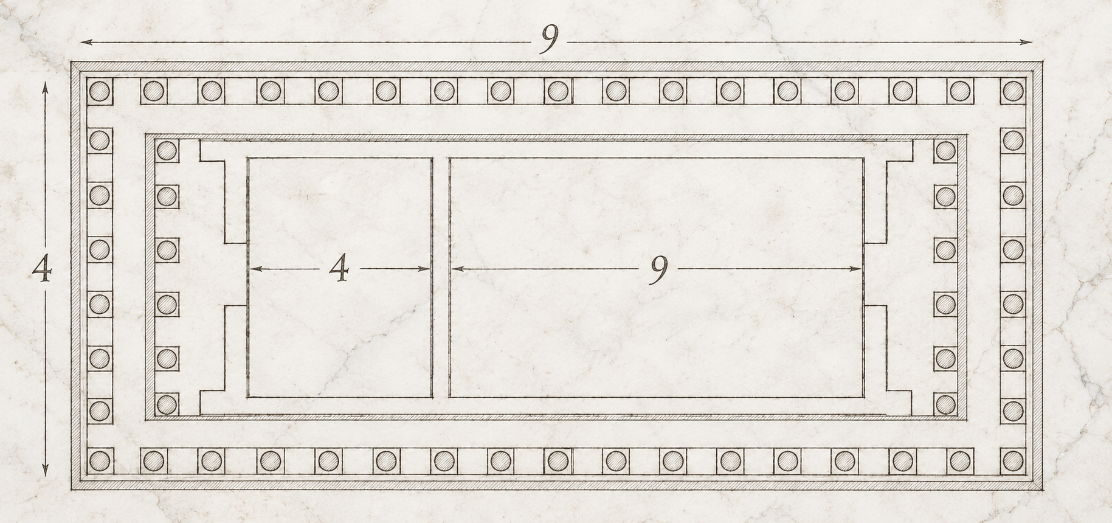
Figure 7: Plan of the Parthenon showing the relative lengths of the two internal rooms and the relative lengths of the stylobate. Generated using OpenAI’s ChatGPT image-generation tool from an original draft created by the author.
This, however, suggests that these two rooms contain another secret built into their dimensions. How do we extract that secret? Once again we will ask the stone itself. This time, let us ask the same question we asked the Station Stones of Stonehenge:
Q: How many times do the lengths of your internal rooms divide into the modern length of the equator?
| Dimension | Measured Length (m) | Division into equator |
|---|---|---|
| Parthenon Room | ||
| S+R | 13.354 | 3,000,975 |
| P | 13.107 | 3,057,528 |
| A | 13.2145 | 3,032,655 |
| D | 13.37 | 2,997,383 |
| Hekatompedos Room | ||
| S+R | 30.055 | 1,333,389 |
| P | 29.895 | 1,340,526 |
| A | 29.8 | 1,344,799 |
| D | 29.89 | 1,340,750 |
Table 6: Measured lengths of the internal rooms of the Parthenon taken by Stuart and Revett (S+R), Penrose (P), Angelopoulos (A) and Wilhelm Doerpfeld (D), and their divisions into the equator length of 40,075,014m.
We have now entered a completely new architectural reality. This simple exercise has revealed precisely the same pattern as we found at the Station Stone rectangle at Stonehenge. However, in this case, the divisions are clearly 3,000,000 and 1,333,333, which are in the ratio of 9:4. Now it is time to see if the unit length reveals anything of further interest. If we multiply the divisions by 4 and 9 respectively, then we obtain the following:
| Dimension | Division into equator | Multiplied by 4 | Multiplied by 9 |
|---|---|---|---|
| Parthenon Room | |||
| S+R | 3,000,975 | 12,003,900 | – |
| P | 3,057,528 | 12,230,112 | – |
| A | 3,032,655 | 12,130,620 | – |
| D | 2,997,383 | 11,989,532 | – |
| Hekatompedos Room | |||
| S+R | 1,333,389 | – | 12,000,501 |
| P | 1,340,526 | – | 12,064,734 |
| A | 1,344,799 | – | 12,103,191 |
| D | 1,340,750 | – | 12,066,750 |
Table 7: Divisions of the measured lengths of the internal rooms of the Parthenon taken by Stuart and Revett (S+R), Penrose (P), Angelopoulos (A) and Wilhelm Doerpfeld (D), and their values multiplied by 4 (for the Parthenon Room) and by 9 (for the Hekatompedos Room)
At Stonehenge, the unit length was the 6,000,000th division of the equator. We have now determined a clear signal of the unit length of the Parthenon being the 12,000,000th division of the equator.
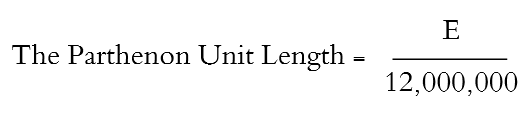
This reveals a deeply embedded ancient architectural principle at the heart of both the Parthenon and Stonehenge. This incredible result is illustrated below:
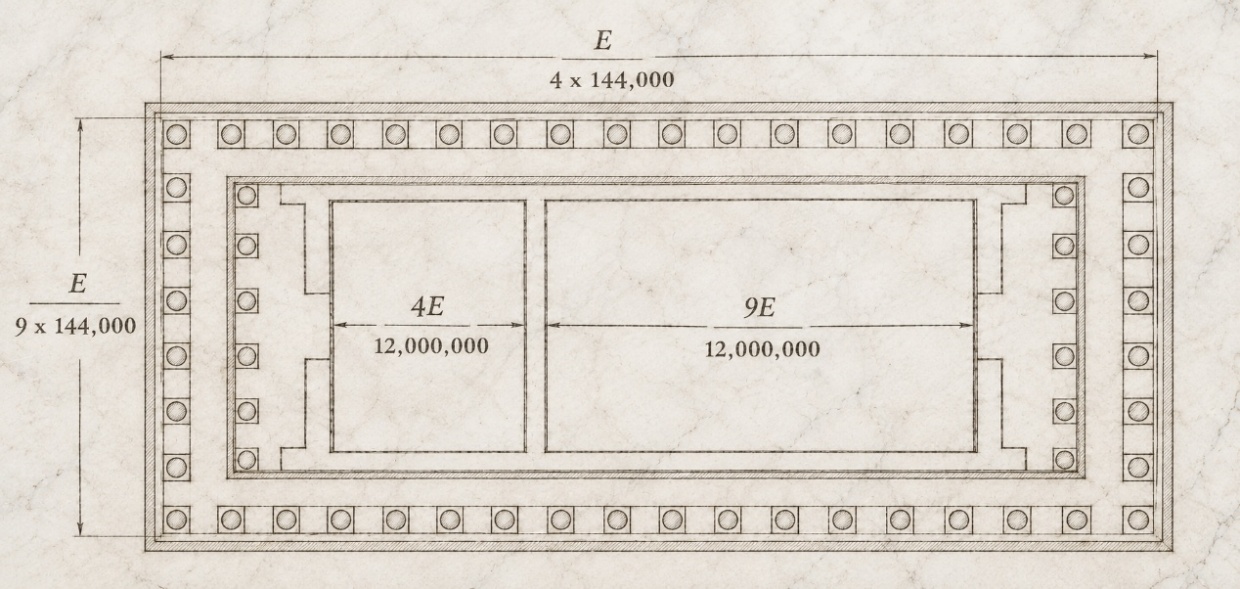
Figure 8: Plan of the Parthenon showing the lengths of the two rooms together with the dimensions of the stylobate as a fraction of the equator length, E. Generated using OpenAI’s ChatGPT image-generation tool from an original draft created by the author.
Final thoughts
We started this journey looking for evidence that the mensura perpetua is the equator of the Earth. It was shown by simple mathematical calculation to be unambiguously encoded deep into the architectural designs of two of the most famous international archaeological sites. Incredibly, the equator length was found in both the Station Stones and the stylobate of the Parthenon. Not only that, but the measure was encrypted together with other elements of the Quadrivium, allowing the encoded information to unravel itself once the cipher of the geometry and the length of the equator were inputted.
This led to the determination that the unit length at the Station Stone rectangle is the 6,000,000th part of the equator, whereas the unit length of the two rooms at the Parthenon is the 12,000,000th part of the equator, establishing a deep architectural correspondence between the two sites, as well as unambiguous proof that they are based on the equator as mensura perpetua.
In my view, the only possible conclusion is that the same legacy of a forgotten ancient culture shaped the building of both monuments, and that this ancient culture considered the length of the equator the mensura perpetua and the ultimate unifying origin of all measurement. One element of the architect’s message is clear: we left this for you so you can remember us.
References
1 Willett, C. (2026) Astrometrology: The Science of Ancient Metrology. Christopher Willett.
2 Hawkins, G.S. (1966) Stonehenge Decoded. London: Souvenir Press.
3 Dibble, W., 1976. “A Possible Pythagorean Triangle at Stonehenge.” Journal of the History of Astronomy 7: 141–2.
4 Atkinson, R.J.C. (1978) ‘Some new measurements on Stonehenge’, Nature, 275(5675), pp. 50–52. https://doi.org/10.1038/275050a0
5 Ranieri, M. (2003) ‘Geometry at Stonehenge’, Archeoastronomy: The Journal of Astronomy in Culture, 17, pp. 81–93.
6 Johnson, A. (2008) Solving Stonehenge: The New Key to an Ancient Enigma. London: Thames & Hudson.
7 Heath, R. and Michell, J. (2004) The Measure of Albion: The Lost Science of Prehistoric Britain. St Dogmaels, Wales: Bluestone Press.
8 Johnson, A. and Pimpinelli, A. (2008) ‘Pegs and Ropes: Geometry at Stonehenge’, Nature Precedings.
9 Stuart, J. and Revett, N. (1787) The Antiquities of Athens: Measured and Delineated. Vol. II. Edited by William Newton. London: John Nichols.
10 Doerpfeld, W. (1881) “Mitteilungen des Deutschen Archäologischen Instituts”, Athenische Abteilung 6 (https://doi.org/10.11588/diglit.35008#0001)
11 Penrose, F.C. (1888) An Investigation of the Principles of Athenian Architecture: The Results of a Survey Conducted Chiefly with Reference to the Optical Refinements Exhibited in the Construction of the Ancient Buildings at Athens. New and enlarged edn. London: Macmillan and Co. (https://doi.org/10.11588/diglit.2984#0022)
12 Orlandos, Anastasios K. (1977-1978) The Architecture of the Parthenon. Vols. II–III. Athens: Archaeological Society of Athens, Reprint, 2015.
13 Angelopoulos, A. (2003) Metron Ariston, Aeropos ISBN: 9789608286061 https://athang1504.blogspot.com/2011/01/parthenon.html