




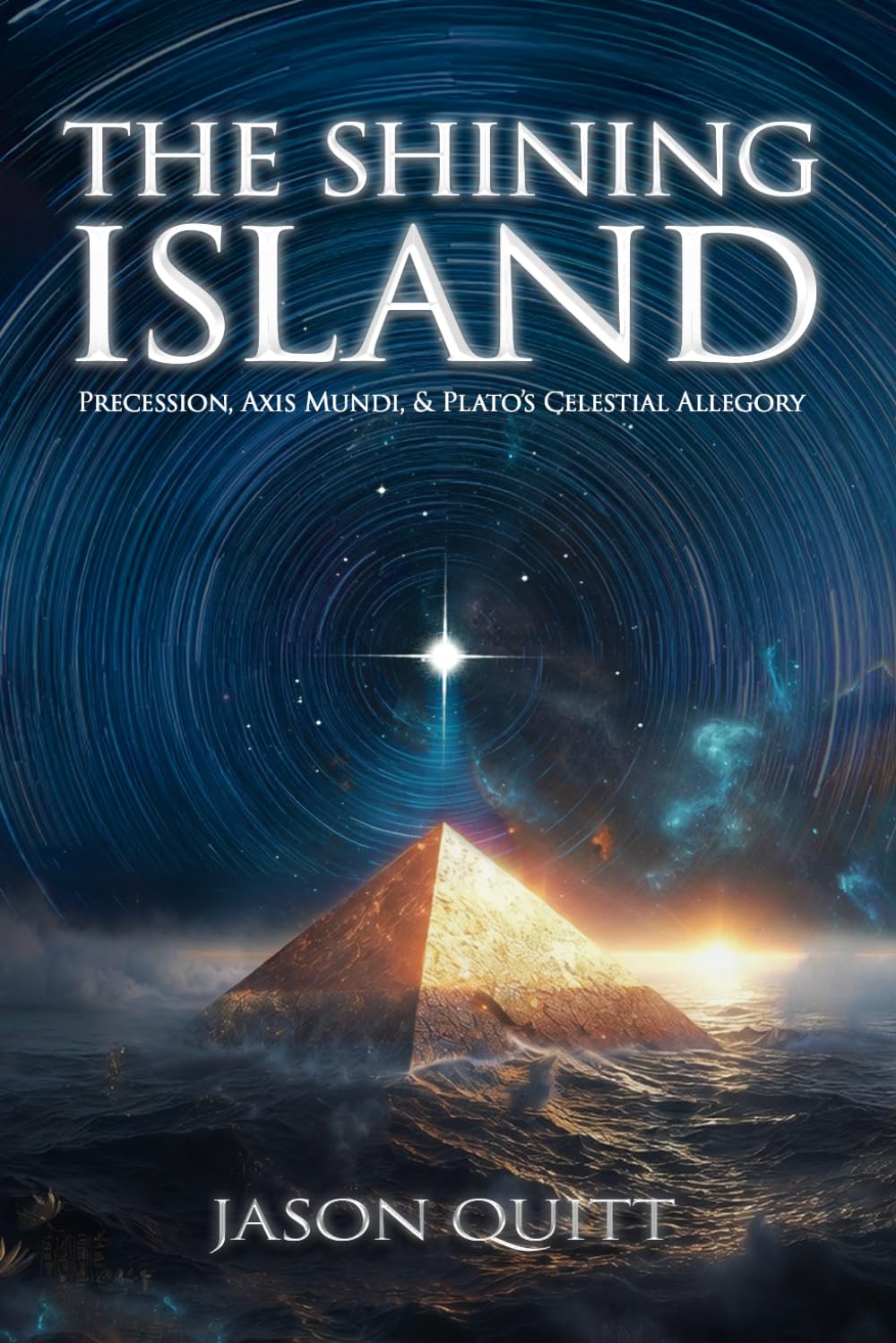
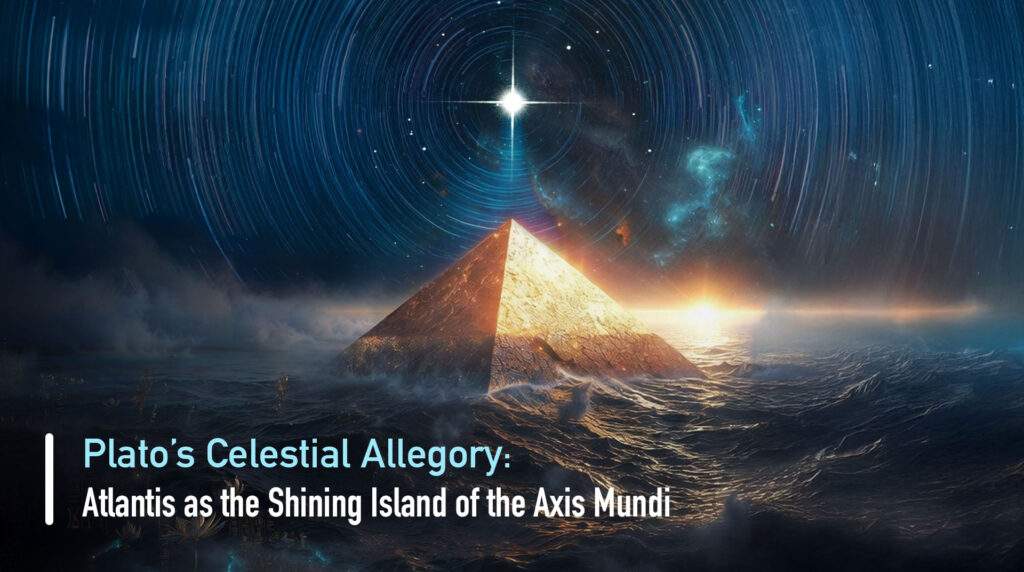
Image created by Jason Quitt using Photoshop & Grok xAI
We warmly welcome Jason Quitt, author of The Shining Island: Precession, Axis Mundi, & Plato’s Celestial Allegory, as our featured author this month. Jason is an esoteric author whose work explores the intersection of sacred geometry, archaeoastronomy, and spiritual science. In his latest book, Jason examines Plato’s Atlantis not as a sunken continent but as a creation myth written in the stars.
In his article here, Jason introduces readers to the celestial architecture behind that reading, examining the interpretive key Plato’s Egyptian priest offers Solon, and what those myths of catastrophe may really signify: a mirror of the heavens themselves.
Interact with Jason on our AoM forum here.
“But now the sight of day and night, and the months and the revolutions of the years, have created number, and have given us a conception of time, and the power of enquiring about the nature of the universe; and from this source we have derived philosophy, than which no greater good ever was or will be given by the gods to mortal man.”
— Plato, Timaeus 47a–b
Abstract:
Plato’s Atlantis narrative in the Timaeus and Critias has traditionally been interpreted as either a literal historical account of a lost civilization or a moral-political allegory about hubris and ideal governance. This article advances a third and deeper reading. Plato presents the story as a carefully crafted celestial allegory, an eikōs muthos or “likely story,” that encodes profound esoteric, symbolic, astronomical and cosmological motifs drawn from Egyptian temple wisdom and Hellenic philosophy. Specifically, the tale of Atlantis functions as a mythic map of the Axis Mundi, the still center of the turning cosmos as described in the cosmology of the World Soul in the Timaeus.
By synchronising the precise date given for Atlantis’s destruction with the observable mechanics of precession, the narrative reveals the stellar landscape of that epoch. The brilliant pole star Vega in Lyra shone near the North Celestial Pole around 12,000 BCE. It was later displaced during the cataclysmic transition as the pole drifted between the legs of the constellation Hercules circa 9,600 BCE. In this framework, Atlantis is the Shining Island, a luminous central archetype of polar stability and maritime mastery that ultimately succumbs to the inexorable turning of the cosmic wheel. This celestial reading does not negate the moral or political layers. Rather, it grounds them in the living architecture of the heavens, transforming Plato’s unfinished trilogy into an initiatory text that invites the reader to locate humanity’s true place at the immutable center amid eternal cycles of order and dissolution.
Before recounting the story of Atlantis to Solon, the Egyptian priest at the temple of Neith in Sais delivers the essential interpretive key. He explains that there have been, and will be again, many destructions of mankind, “the greatest [of which] have been brought about by the agencies of fire and water.” He cites the myth of Phaethon, who lost control of Helios’s chariot and scorched the earth, declaring that such tales “have the form of a myth, but really signify a declination of the bodies moving in the heavens around the earth, and a great conflagration of things upon the earth, which recurs after long intervals” (Timaeus 22c-d). The Atlantis narrative follows this exact pattern. What appears as a tale of earthly catastrophe by water and earthquake is, at its core, a veiled description of celestial mechanics. This framework is completed in the Timaeus through the cosmology of the World Soul, its crossed circles of the Same and the Different, joined at the cosmic chi (X), and the vast cycles of the Perfect (Great) Year. Together, these elements map the Atlantis story directly onto the observable, recurring phenomena of the stars.
Key mythic elements in the Atlantis account correspond precisely to this celestial architecture. Poseidon’s concentric rings of land and water surrounding the central hill evoke the polar axis and the ordered revolutions of circumpolar stars. The shining golden-bronze orichalcum pillar at the island’s center and the figure of Atlas embody the world axis that bears the turning heavens. The five pairs of twin kings born to Cleito on the primordial hill mirror Egyptian creation myths, particularly the emergence of the Benben mound and the first divine twins Shu and Tefnut.
These motifs do not exist in isolation. They resonate deeply with broader ancient traditions such as the primordial mound of creation, the world pillar or axis, the sacred western islands at the edge of Oceanus, and the recurring cycles of cosmic order and dissolution. By weaving together Egyptian temple cosmology, Greek Herculean and Hesperidean lore, and Platonic metaphysics, the unfinished trilogy becomes far more than a political or historical tale.
Keywords: Plato, Atlantis, celestial allegory, Axis Mundi, precession, World Soul, Vega, astrotheology, Neith, Great Year
Plato’s Celestial Allegory
“The gods were made in the form of a circle, which is the most perfect figure and the figure of the universe. They were created chiefly of fire, that they might be bright, and were made to know and follow the best… Thus, then the fixed stars were created, being divine and eternal animals, revolving on the same spot…”
— Plato, Timaeus 40a–b
What if Plato’s account of Atlantis, as recounted by Critias in the Timaeus and Critias, is not merely a tale of a mythic lost earthly civilization whose island sank beyond the Pillars of Hercules into the vast Atlantic? What if it represents something far more profound, an eikōs muthos or “likely story” in the authentic Platonic sense, carefully crafted to conceal a celestial wisdom? Encoded within its seemingly historical narrative lies a secret cosmology intended for those initiated in the interconnected disciplines of philosophy, astronomy, and mathematics. This hidden teaching, Plato suggests, was transmitted from the ancient priests of Neith at Sais in Egypt to Solon, one of the Seven Sages of Greece, around 590 BCE. It then passed through the family of Critias, who retold the story in the presence of Socrates, Timaeus, and Hermocrates, before being recorded and transmitted by Plato himself.
Plato (c. 428 to 348 BCE), the Athenian philosopher, student of Socrates and teacher of Aristotle, stands as one of the foundational figures of Western thought. Through his dialogues, he explored metaphysics, ethics, politics, cosmology, and the nature of knowledge itself with unmatched depth. Around 387 BCE, he founded the Academy in Athens, the first institution of higher learning in the Western world, which attracted scholars from across the Greek-speaking world and profoundly shaped subsequent philosophy and science for centuries. It is within two of his later unfinished dialogues, the Timaeus and Critias composed around 360 BCE, that the story of Atlantis emerges. These works form part of a projected trilogy, with a third dialogue called Hermocrates, never written, framed as a conversation among Socrates, Timaeus of Locri, Critias, and Hermocrates.
The narrative begins with Socrates requesting accounts of an ideal state in action. This request leads Critias to recount the ancient tale of primeval Athens’ heroic resistance against the mighty island empire of Atlantis, which ultimately succumbed to cataclysmic floods and earthquakes. The Timaeus, the sole complete dialogue of the set, provides the essential cosmological and metaphysical prelude.
It is within the dialogues themselves that Plato provides the essential keys for unlocking the grander vision transmitted from the priests of Sais to Solon. Before recounting the story of Atlantis, the Egyptian priest offers Solon, and by extension the attentive reader, the fundamental hermeneutic principle needed to interpret the tale correctly:
“There have been, and will be again, many destructions of mankind arising out of many causes; the greatest have been brought about by the agencies of fire and water… For the story told among you about Phaethon, son of Helios, who yoked his father’s chariot but could not drive it along his father’s path, and so burned up everything upon the earth and perished himself struck by a thunderbolt — this story has the form of a myth, but really signifies a declination of the bodies moving in the heavens around the earth, and a great conflagration of things upon the earth, which recurs after long intervals.”
— Plato, Timaeus 22c–d
In this pivotal moment, the Egyptian priest reveals the deeper method by which his people safeguarded the memory of recurring global cataclysms. Rather than preserving events in plain historical prose, the ancients encoded profound truths within mythic narratives and allegories involving the gods. By veiling cosmic realities in sacred stories they ensured that knowledge of vast celestial cycles, including the slow declination of the heavenly bodies and their dramatic consequences on Earth, could survive across millennia. These myths functioned as both a protective cloak and a key accessible on the surface to all, yet revealing their full meaning only to those initiated in the temple wisdom. The tale of Atlantis itself, the priest implies, is one such veiled teaching, a mythic vessel carrying the record of a mighty civilization’s rise and fall in harmony with the turning heavens.
This interpretive approach belongs to a broader ancient tradition now known as astrotheology, the encoding of profound astronomical and cosmological knowledge within mythic, religious, and symbolic narratives. By cloaking precise observations of the stars and the ordered revolutions of the heavens in the language of gods and heroes, the ancients ensured that this wisdom could survive cataclysms and cultural collapses. Plato’s Atlantis stands as a premier example of this tradition, a celestial allegory wrapped in mythical garb awaiting the attentive reader who recognizes the eternal cosmology of the turning World Soul reflected in the fate of the Shining Island.
The setting of Solon’s encounter, the temple of Neith at Sais, further deepens the symbolic layering. Neith, one of Egypt’s most ancient deities, was revered as the primordial weaver of the cosmos, spinning the fabric of reality from the waters of Nun, and raising the first sacred mound of creation from the primordial waters of chaos. She was said to reweave the world daily, determining the fates of gods and mortals.
This connects directly to Plato’s Republic, where the Myth of Er describes the Spindle of Necessity turned by the three Fates, Clotho, Lachesis, and Atropos, at the cosmic axis. The spindle’s whorls represent the planetary orbits revolving around the immovable cosmic axis, with souls ascending or descending according to their alignment with celestial harmony. Neith’s weaving thus mirrors this universal mechanism of fate as the turning of the heavens and cataclysm as the periodic unraveling and re-creation.
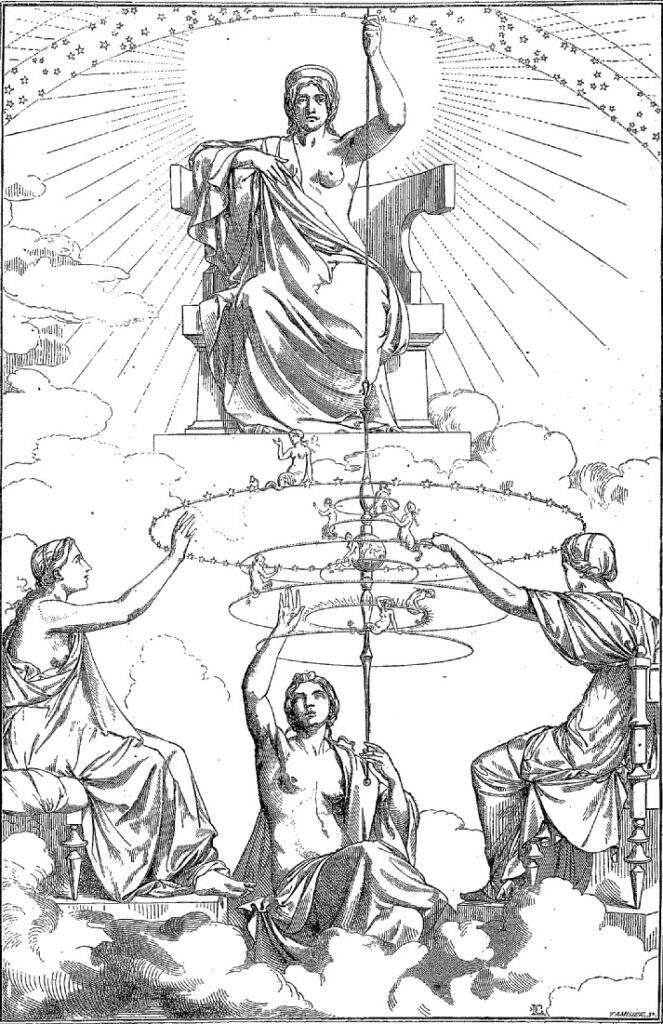
The Spindle of Necessity – Edmond Lechevallier-Chevignard (1825–1902), Engraving from Le Magasin Pittoresque, vol. 25, p. 389. 1857. (Public Domain)

Timaeus, portrayed as steeped in Pythagorean harmonics, astrology, and broader cosmological traditions, presents the creation of the universe by the benevolent Demiurge. This divine craftsman fashions the World Soul from a harmonious mixture of indivisible and divisible Being, Sameness, and Difference. He then divides this substance into two strips crossed at their centers like the Greek letter chi (Χ). These strips are bent into circles. The outer Circle of the Same represents the uniform, rational motion of the fixed stars around the polar axis, while the inner Circle of the Different embodies the irregular orbits of the seven planetary wanderers. These circles, joined in a dynamic cosmic Χ, establish the ordered revolutions of the heavens, blending uniformity with variety in perfect proportion.
This celestial framework, rooted in the eternal motions of the stars and planets, provides the metaphysical and astronomical foundation for the Atlantis myth that follows. The World Soul itself becomes the living mechanism through which the cosmos expresses both stability and change. Precession, that grand declination of the bodies moving in the heavens, is the subtle but inexorable influence manifesting over vast timescales.
“As for the other stars, humans have not taken note of their circuits… It is nonetheless possible to note that the perfect number of time would fulfill the Perfect Year at that moment when the relative speeds of all the eight circuits, having finished together, come to a head…”
— Plato, Timaeus 39d–e
The Perfect Year, or the later Platonic Year, refers to the approximately 25,920-year cycle caused by the precession of the equinoxes, during which the orientation of Earth’s rotational axis slowly shifts relative to the fixed stars. This phenomenon, observable through the gradual change in which star appears closest to the celestial north pole, was likely known to ancient astronomers and forms the backbone of the celestial allegory in Atlantis.
Notably, Plato describes this grand cycle in the Timaeus (c. 360 BCE), stating that “the perfect number of time would fulfill the Perfect Year at that moment when the relative speeds of all the eight circuits, having finished together, come to a head,” more than two centuries before Hipparchus of Nicaea (c. 190 to 120 BCE) is credited with the formal discovery of precession around 130 BCE. Plato’s reference, transmitted through Egyptian priests, suggests this knowledge may have already existed in a much older temple tradition, one that understood the slow axial wobble long before its Hellenistic mathematical formulation.
This slow observable movement is also alluded to in earlier writings by Herodotus (c. 440 to 425 BCE), again drawn from Egyptian priests. Herodotus reports that over eleven thousand three hundred and forty years the Egyptians observed the sun change its rising and setting positions four times, while nothing else in Egypt, neither earth, river, diseases, nor deaths, had altered. He states:
“Thus in the period of eleven thousand three hundred and forty years they said that there had arisen no god in human form… In this time they said that the sun had moved four times from his accustomed place of rising, and where he now sets he had thence twice had his rising, and in the place from whence he now rises he had twice had his setting…”
— Herodotus, Histories (Book II, 142), translated by G. C. Macaulay.
The Heavens as the Cosmic Waters
It is precisely within this vast, slowly turning cosmic order that ancient cultures envisioned the night sky not as an empty void but as a boundless cosmic ocean, a fluid realm of primordial potential from which order, light, and life periodically emerge and into which they might one day return. This archetypal image of the heavens as watery chaos appears across traditions. It reflects a shared perception of the celestial realm as both generative and destructive, its eternal cycles manifesting as floods and renewals upon the earth below.
In Plato’s account, this motif finds vivid expression through Poseidon, god of the sea and earthquakes, who receives the island of Atlantis by divine allotment after the gods divided the earth among themselves. On a low central hill lived the mortal woman Cleito with her earth-born parents. Enamored of her, Poseidon enclosed the hill with alternating concentric rings, two of land and three of water, each perfectly circular and equidistant from the center, “as though turned on a lathe.”
This act of divine engineering and sacred union transforms a simple mound into the generative heart of a civilization. Poseidon unites with Cleito, birthing five pairs of twin kings, demigods who rule in harmony. The eldest, Atlas, is named high king over the whole realm and the surrounding ocean, which thereafter bears his name, the Atlantic. This sacred marriage on the primordial mound and the generation of twins strongly parallels the Heliopolitan creation myth preserved in the Pyramid Texts. Atum, the self-created god, emerges from the primordial waters of Nun and settles on the first mound of creation, the Benben. In his initial act of differentiation he produces the first divine pair, the twins Shu (air) and Tefnut (moisture), who in turn give birth to Nut (sky) and Geb (earth). Shu, who separates and upholds the heavens, mirrors the Titan Atlas as an embodiment of that same polar axis. Both are condemned to bear the weight of the sky for eternity.
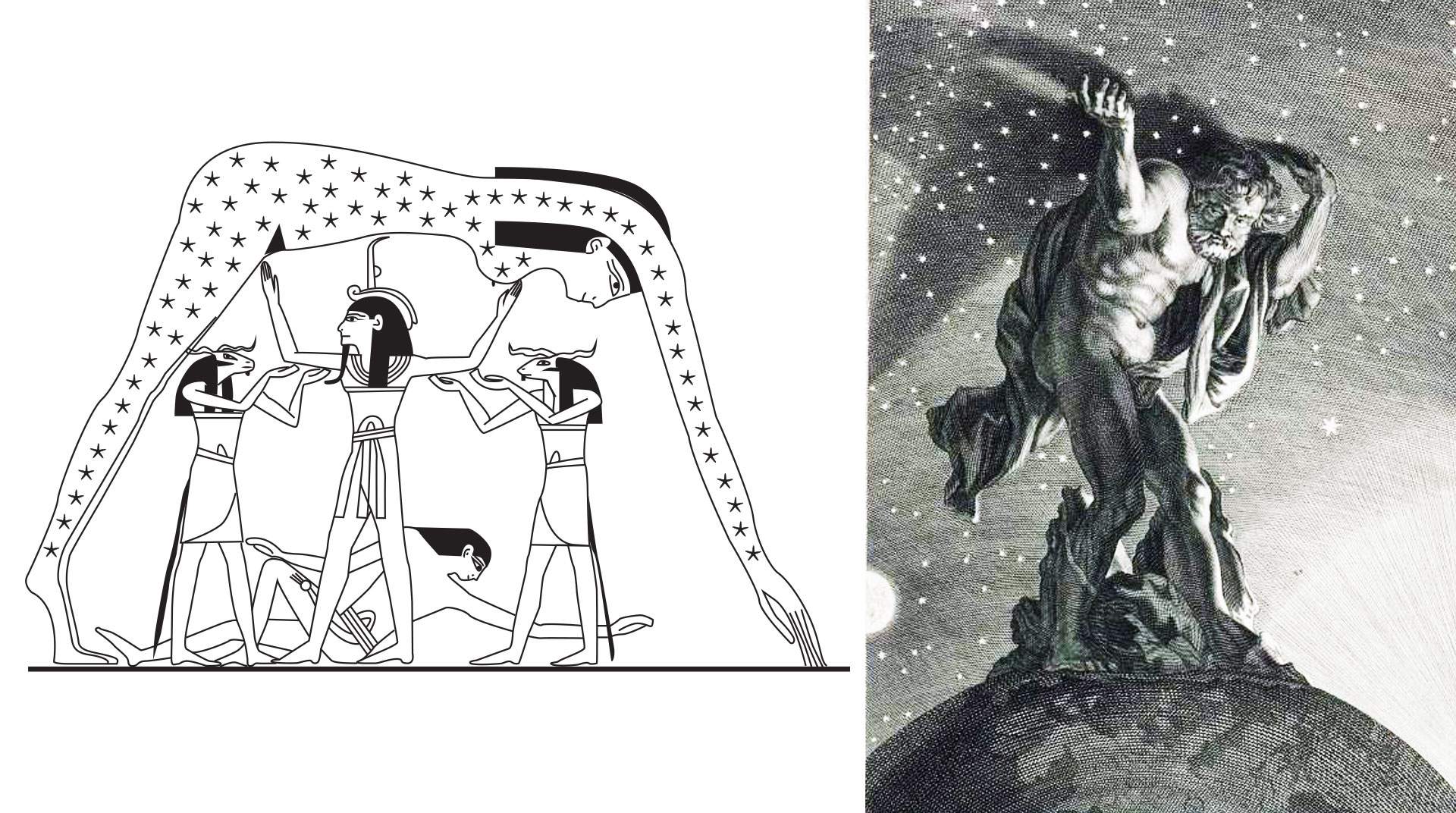
Illustration of Shu eternally separating Nut (heaven-stars added) and Geb (earth) from the Coffin of Nespawershefyt, 1,000 BCE. Illustration by Jason Quitt. Bernard Picart, Atlas in een berg veranderd (Atlas turned into a mountain), 1731. Engraving for Le Temple des Muses. Public Domain.

Initially harmonious, Atlantis’s divine bloodline gradually dilutes as a result of intermingling with mortals. Hubris leads the kings beyond their allotted boundaries, threatening those living within the Pillars of Hercules. Noble primeval Athens resists. Both ultimately fall in cataclysm. Atlantis sinks into the sea, and primeval Athens is swallowed by the earth, all in a single day and night of misfortune.
The motif of a splendid island or cluster of islands lying far to the west in the Atlantic Ocean, beyond the Pillars of Hercules, was already a well-established mythical archetype throughout Greek tradition. Hercules’ labor against Geryon on the red island of Erytheia, “red” evoking the sunset, takes him beyond these pillars into the western realm of death and immortality. In Greek cosmology, such mythical western islands, Erytheia, the Garden of the Hesperides, the Isles of the Blessed, and the Elysian Fields, were envisioned as lying in or encircled by the primordial river Oceanus, the great circular stream that bounded the known world (the true continent). Each day the sun god Helios sailed this encircling river, descending into the western waters at dusk in his golden bowl or cup, traversing the underworld by night, and rising renewed each morning in the east.
Geryon’s two-headed dog Orthrus, linked to Hades’ guardians like Cerberus, watches over thresholds to the underworld. The Garden of the Hesperides, with its tree bearing golden apples of immortality guarded by the serpent Ladon, echoing Draco around the pole, lies further west, another island paradise at the edge of the watery horizon. Hercules creates or reinforces the Pillars during his western labors, borrowing the solar bowl of Helios to sail the Ocean. This motif parallels the Egyptian solar barge of Ra, which journeys through the western Duat at night before rebirth in the east as Horus.
The passage through the western gate signifies a profound transition, sunset, death, immersion in cosmic waters, passage through the underworld, and resurrection. Hercules splitting Mount Atlas to form the gateway echoes the division of cosmic order, marking the threshold between worlds. The orichalcum pillar at Atlantis’s center, whose very name combines “mountain” (oros) and “bronze” (chalkos), shines like the sunset, evoking the sacred mountain bathed in the dying light of day. As a metal of the gods, it embodies the western mountain threshold, the symbolic gateway into the underworld.
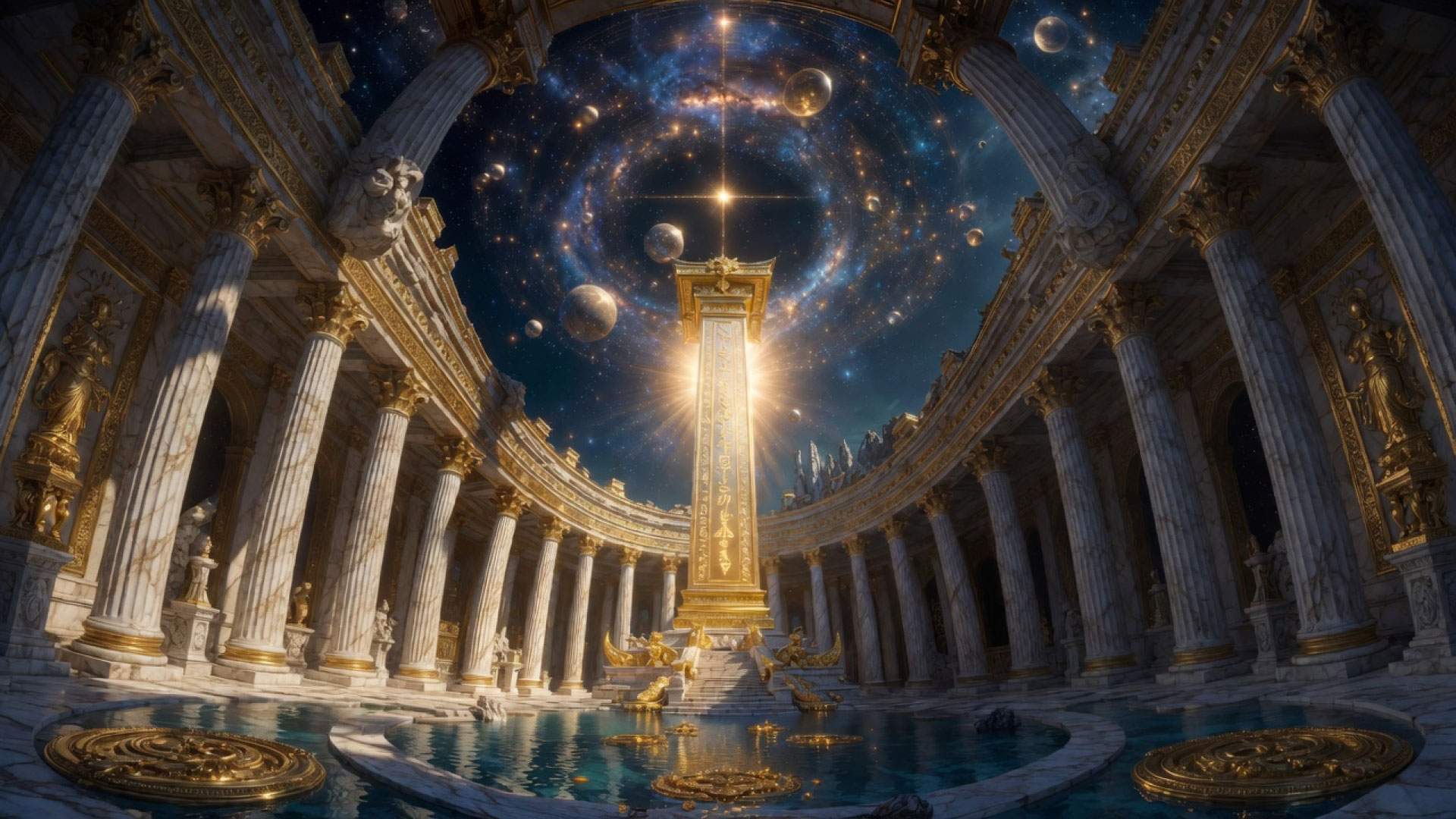
Pillar of Orichalcum at the center of the Atlantis – envisioned by Jason Quitt, illustrated by Grok xAI.
These western horizon motifs converge in death and rebirth symbolism. The Gate of the West aligns with the Egyptian goddess Hathor’s funerary aspects as “Lady of the West,” whose sacred western mound served as a personified entrance to the underworld, especially in the Theban necropolis. It also resonates with Gilgamesh’s journey, where he reaches the twin-peaked Mount Mashu, the mountain that guards the setting sun in the west, passes through its dark tunnel, and then sails by boat across the Waters of Death with the ferryman Urshanabi to reach the land of the gods and the immortal Utnapishtim. Souls or heroes sail the waters, Helios’ river and Ra’s barge, to the western horizon, join the northern imperishable stars, and achieve renewal or immortality.
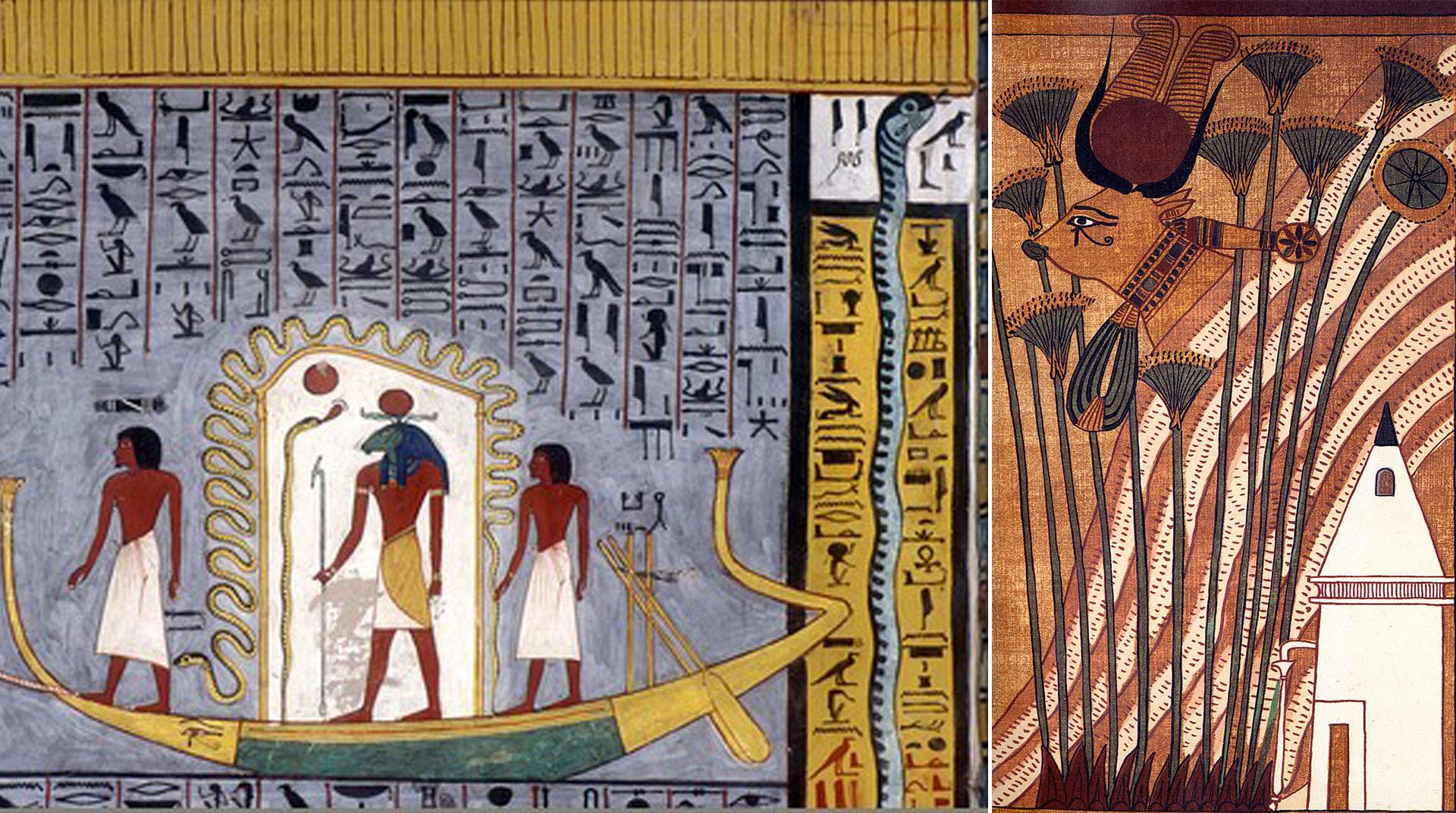
Ra traveling through the underworld in his barque, from the copy of the Book of Gates in the tomb of Ramses I (KV16). Hathor, as the Mistress of the West (a goddess of the afterlife) emerges from a hill representing the Theban necropolis. Budge, E. A. Wallis (1905): The Book of Gates. A foundational text translation of the underworld divisions. Freely accessible in the public domain via Sacred Texts. PD(1), PD(2)


This imagery points to a deeper archetype. Across ancient traditions, the sacred mound or central mountain serves as the Axis Mundi, the still point where celestial and earthly forces meet. Whether rising at the eastern horizon with the sun or marking the western gate of sunset and the descent into the underworld, these mounds frame the daily and precessional cycles of birth, death, and renewal. The parallels reflect a shared primordial understanding of the natural cycles and cosmic order.
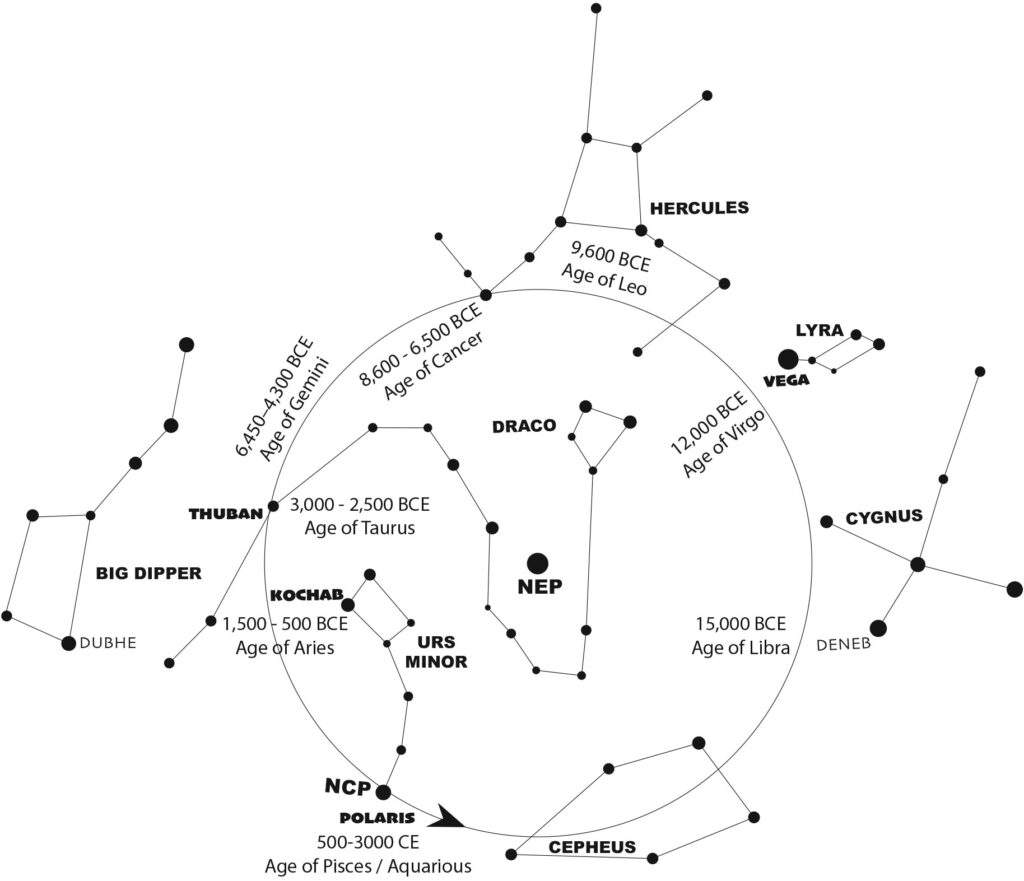
Illustration by Jason Quitt: Precessional Map of the Northern Constellations.
Mapping Atlantis to Northern Stars
Plato’s narrative, as conveyed through Critias, places the destruction of Atlantis nine thousand years before Solon’s visit to Egypt, around 590 BCE, situating the cataclysm around 9,600 BCE. At that time, the North Celestial Pole had drifted away from the brilliant star Vega in Lyra and was moving directly between the legs of the constellation Hercules. This celestial shift can be read as a direct allegory for the Atlanteans themselves. According to Plato, they had begun to move “outside their allotted boundaries,” overstepping the divine order originally granted to them and threatening the communities living within the Pillars of Hercules. Notably, this date closely aligns with the abrupt end of the Younger Dryas period, c. 9,700 to 9,600 BCE, a time of sudden global climatic upheaval marked by massive meltwater pulses, rapid sea-level rise, and widespread geological instability. This historical correlation lends further weight to the narrative, mirroring the cataclysmic destruction described for both Atlantis and primeval Athens.
If we shift the chronological lens backwards to an earlier era, roughly between 12,000 and 11,000 BCE, the Atlantean society in the myth would have been at the height of its power and harmonious order. At that time, Vega (α Lyrae) in the constellation Lyra stood approximately five degrees from the North Celestial Pole.
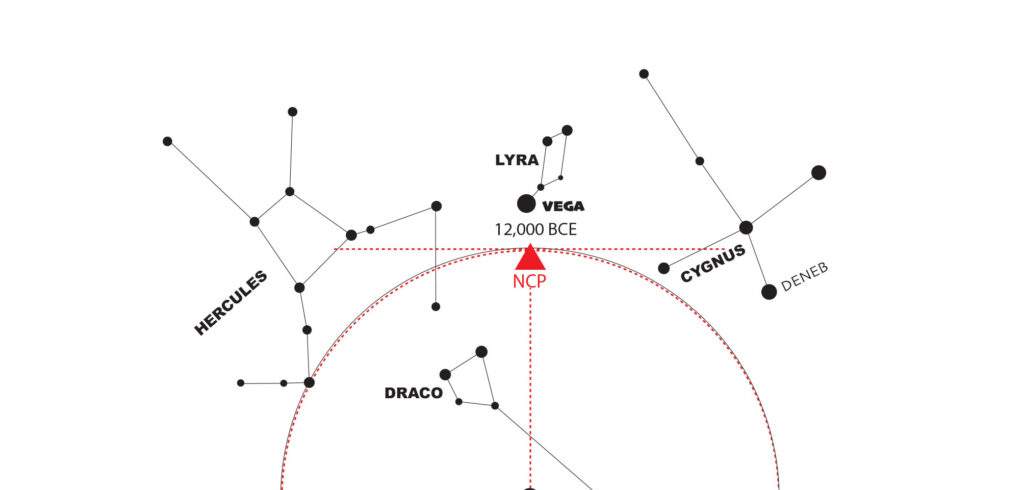
Illustration by Jason Quitt
Though never as precisely coincident with the pole as Thuban (α Draconis) would become in later millennia, around 3000 to 2500 BCE, Vega’s exceptional brightness, making it one of the brightest stars visible in the northern sky, would have rendered it a commanding and luminous anchor. The heavens appeared to revolve around this radiant point in near-perfect stability, evoking the image of a central, prosperous island encircled by ordered waters.
A stable pole star held profound practical significance for ancient seafaring cultures. Nocturnal navigation across open oceans relied on the circumpolar stars, especially a bright star near the celestial pole that provided a fixed reference for direction and latitude. For a maritime empire as powerful as Atlantis, one that commanded vast naval forces and projected power far beyond the Pillars of Hercules, exceptional astronomical knowledge was indispensable.
In this context, Vega, shining close to the North Celestial Pole around 12,000 BCE, would have served as the supreme navigational anchor, a bright beacon around which the northern heavens revolved in orderly harmony. Thus the “Shining Island” at the center of the cosmic waters becomes both a mythic symbol and a functional reality, the celestial foundation that underpinned Atlantis’s legendary maritime dominance.
Plato locates the island empire of Atlantis beyond the Pillars of Hercules, in the vast Atlantic realm “outside” the known Mediterranean world. This geographic placement carries potent symbolic weight when read through the ancient Hermetic principle of “as above, so below.”
In the northern celestial sphere, the constellation Hercules stands adjacent to Lyra, the region where Vega once shone as the luminous pole star. Just as Atlantis lay beyond the earthly Pillars of Hercules, marking the boundary of the familiar world, celestial Hercules occupies the transitional zone immediately beyond Vega’s bright polar domain within the cosmic ocean of the circumpolar heavens. Around the date given by the Egyptian priest to Solon, approximately 9,600 BCE, the North Celestial Pole lay directly between the legs of the constellation Hercules.
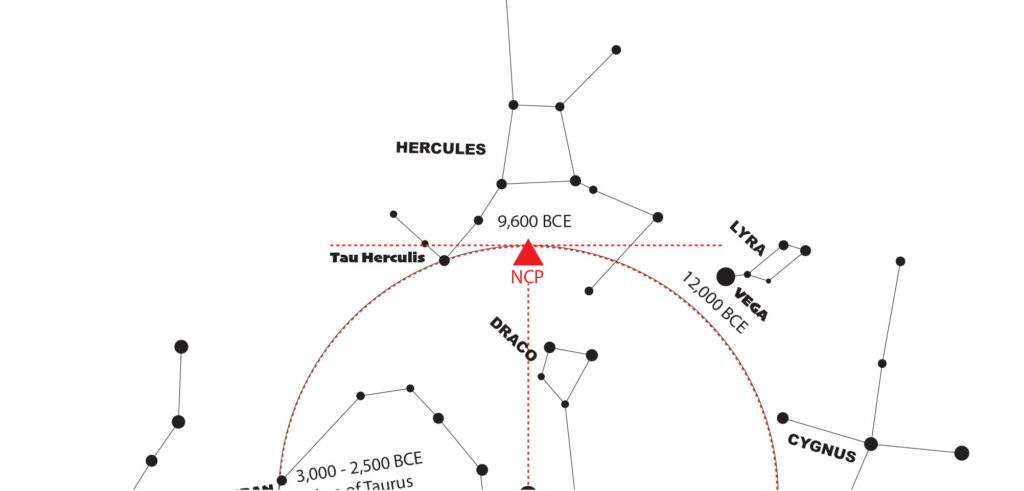
Illustration by Jason Quitt
In esoteric tradition, the two pillars frequently symbolize the legs of the divine or the supporting structure of the cosmos itself. This is vividly illustrated by the twin pillars of Solomon’s Temple, Jachin and Boaz. In Kabbalistic and Masonic interpretation, these pillars represent the legs of the divine anthropos, the cosmic man, serving as the foundational supports that uphold the temple of creation. The same motif appears in ancient Egypt. The Four Sons of Horus were identified in the Pyramid Texts with the arms and legs of the divine body, functioning as the four pillars that uphold the vault of the sky. Just as Atum’s first twins, Shu and Tefnut, separated heaven from earth, these four sons embody the quartered limbs of the cosmic man, anchoring the cardinal directions and sustaining the ordered world.
In similar fashion, the constellation Hercules is traditionally depicted as a kneeling hero in battle stance, arms raised, directly facing the bright lyre of Lyra across the sky. This stellar arrangement can be read as a celestial asterism symbolizing the heroic Athenians confronting the shining empire of Atlantis (Lyra/Vega), ultimately emerging victorious in their defense of cosmic order. Yet as the North Celestial Pole continued its slow precessional drift beyond the territory of Hercules, it entered a relatively empty region of the sky with no bright guiding star for roughly 6,500 to 7,000 years between the Hercules transitional zone around 9,600 BCE and the later prominence of Thuban in Draco, circa 3,000 to 2,500 BCE. This long darkness can be mythologically interpreted as the Deluge, an era of dark waters in which humanity was lost at sea without a guiding light, until the pole finally found stable ground on Thuban in Draco, allowing civilization to begin anew.
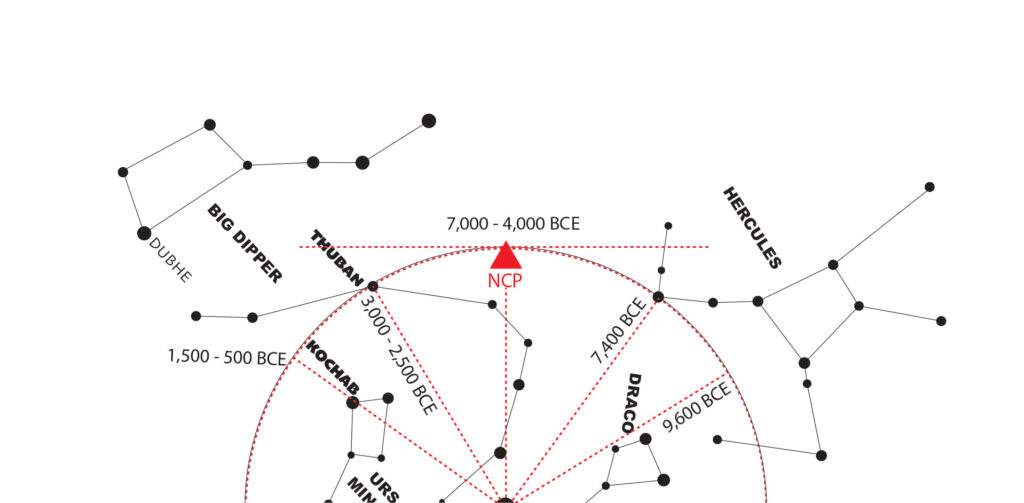
Illustration by Jason Quitt
The slow precessional drift of the North Celestial Pole from the brilliance of Vega into the sparser territory of Hercules thus mirrors, on a grand scale, the mythic movement from an ordered central island-empire to a realm of cataclysm and apparent loss.
The constellation Hercules adds symbolic resonance to this transitional phase. In Greek mythology, Hercules temporarily relieves Atlas of his burden by holding up the heavens, suggesting a laboring interlude in which the old axial order yields to change and reconfiguration. The pole’s drift into the territory of Hercules evokes this mythic handover, a period of cosmic labor during which the stable harmony of the bright polar anchor gives way to a more diffuse and challenging alignment.
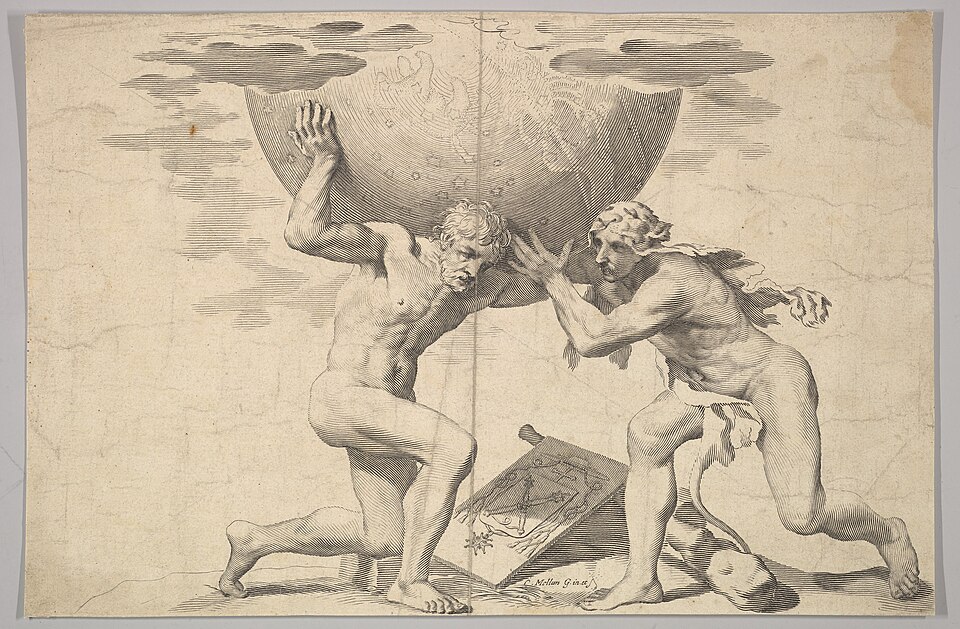
Claude Mellan, Hercules and Atlas, ca. 1630. Engraving. Bequest of George Campbell Cooper. CC0.

Neoplatonists like Proclus (5th century CE) read the Timaeus and Atlantis as layered allegory. The ideal Athens mirrors celestial order, the fixed stars and Circle of the Same, while Atlantis represents the sublunary realm of change and planetary wanderers, the Circle of the Different. Their conflict enacts cosmic opposition resolved through cyclical renewal. Proclus and his predecessors saw the narrative as encoding the World Soul’s dynamics, precession, and the soul’s journey, far beyond literal history.
In Plato’s own cosmology, this living quality of the heavens is made explicit:
“He wrought it into a round, in the shape of a sphere, equidistant in all directions from the center to the extremities, which of all shapes is the most perfect and the most self-similar. And on the outside round about it was all made smooth with great exactness. He spun it round uniformly in the same spot and within itself and made it move revolving in a circle. He made the universe a circle moving in a circle. And he gave dominion to the motion of the same and like, for that he left single and undivided; but the inner motion he divided in six places and made seven unequal circles having their intervals in ratios of two and three, three of each, and bade the orbits proceed in a direction opposite to one another; and three he made to move with equal swiftness, and the remaining four to move with unequal swiftness to the three and to one another, but in due proportion.”
— Plato, Timaeus 33b–d, 36c–d
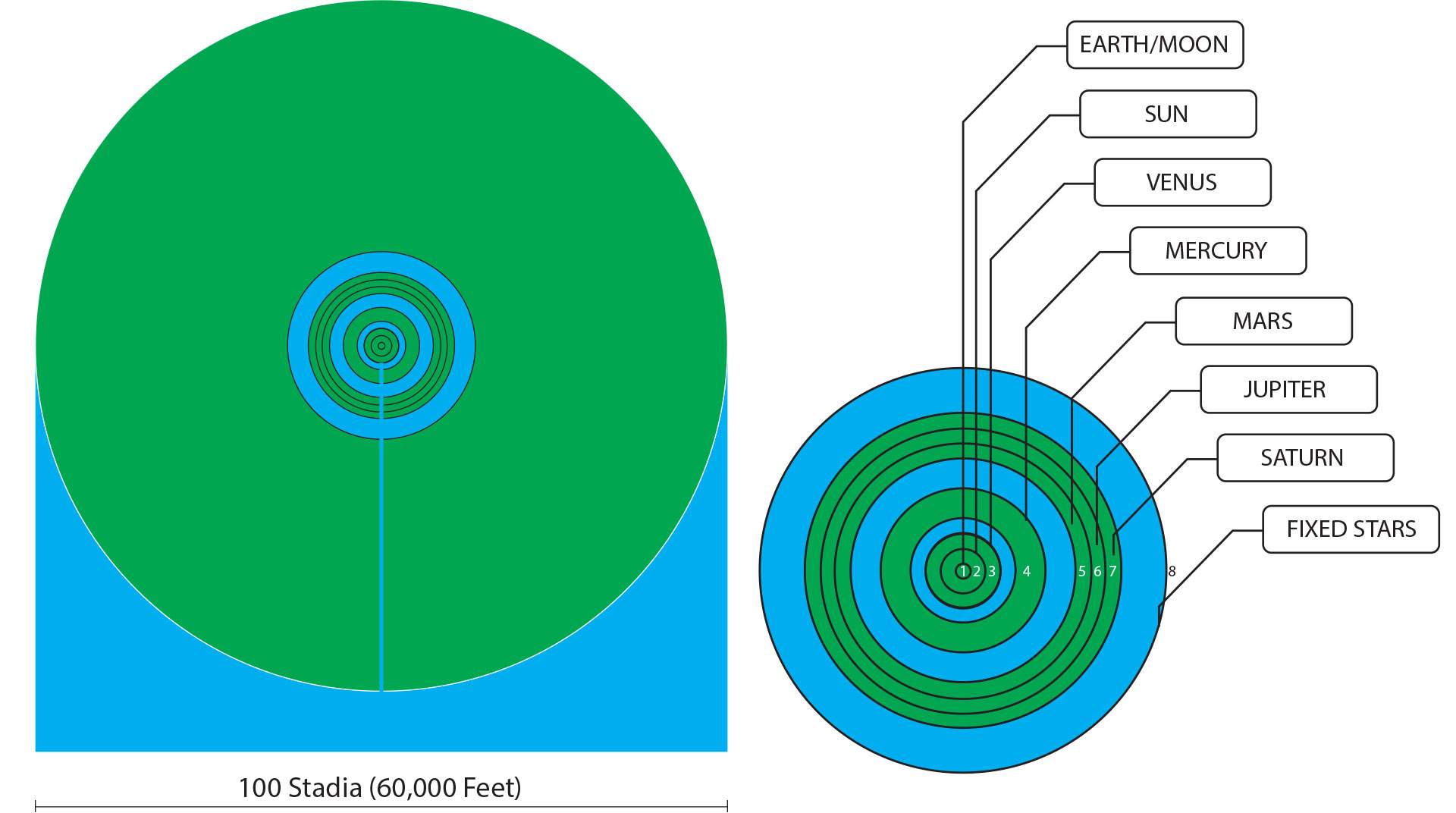
Illustration by Jason Quitt: Geometric design of Atlantis described in the Critias. Overlaid with the world soul circle of the same and the circle of the different planetary/star Platonic order found in the Timaeus.
The order of the planets and stars that appears in Timaeus 38c–d, immediately following the construction of the World Soul’s circles in 36b–d. Plato does not provide distances, only relative placement and differing speeds, because his emphasis lies on harmonic proportions and mathematical beauty rather than precise observational astronomy. This geocentric sequence, Moon, Sun, Venus, Mercury, Mars, Jupiter, and Saturn, became known as the “Platonic order” and profoundly influenced later ancient and medieval cosmology. Notably, the Earth itself is not counted among these seven circles; it remains stationary at the very center of the cosmos, around which all the planetary revolutions turn.
The same ordered pattern echoes directly in the architecture of Atlantis as described in the Critias. Poseidon encloses the central hill with alternating concentric rings, two of land and three of water. The ratios of two and three, the circular motion imposed upon primordial matter, and the measured revolutions around a stable central height replicate the Demiurge’s division of the World Soul into seven unequal circles with intervals in ratios of two and three. Atlantis thus becomes a terrestrial image of the cosmic order, its maritime empire a living reflection of the Circle of the Same governing the seven planetary circles of the Different.
The Atlantis narrative itself breaks off at its most critical moment, as does every age. The final word is never spoken by any single civilization or dialogue. In the Critias, Zeus, the god of gods, beholds the corruption of the Atlanteans and summons the divine assembly to his central abode, “which stands at the centre of the universe and looks out over the whole realm of change” (121c). This scene strikingly echoes the opening of Homer’s Odyssey, where the gods convene on Olympus while Poseidon, patron of Atlantis and lord of the sea, is absent among the distant Ethiopians. In the Timaeus, Critias had already framed Solon’s unfinished poem as potentially rivalling Homer and Hesiod themselves (21c–d).
By deliberately leaving the trilogy incomplete at the very instant Zeus begins to speak, Plato enacts the cosmic principle his story describes. The reader is placed at the still point of the turning wheel, invited to complete the tale within themselves, amid the eternal cycles of order and dissolution. While this celestial reading offers a rich interpretive lens that complements rather than replaces traditional moral, political, and possible historical approaches, Plato’s unfinished trilogy ultimately serves a higher purpose. It becomes an initiatory text that reveals humanity’s true place within the architecture of the heavens.
May our civilization, like Solon and the Egyptian priests, like Timaeus, Critias, and the unseen Hermocrates, navigate the shifting waters of the Different with the steady compass of the Same, so that when the next great turning comes, as it always does, we may meet it not with the hubris of a sinking empire, but with the illuminated wisdom passed down by those who saw the signs written in the stars.
∗∗∗
A more detailed reading of Plato’s celestial allegory can be found in my latest book, The Shining Island: Precession, Axis Mundi, & Plato’s Celestial Allegory.
The Shining Island | Precession, Axis Mundi, & Plato’s Celestial Allegory By Jason Quitt | Available on Amazon
Sources:
Plato. Timaeus and Critias. Translated by Donald J. Zeyl. Indianapolis: Hackett Publishing Company, 2000.
Plato. Timaeus and Critias. Translated by Benjamin Jowett. In The Collected Works of Plato, edited by Edith Hamilton and Huntington Cairns. Princeton: Princeton University Press, 1961.
Plato. Timaeus. Translated by R. G. Bury. Loeb Classical Library. Cambridge, MA: Harvard University Press, 1929.
Apollodorus. The Library of Greek Mythology. Translated by Robin Hard. Oxford: Oxford University Press, 1997.
Plato. The Republic. Translated by Allan Bloom. 2nd ed. New York: Basic Books, 1991.
Plato. Theaetetus. Translated by M. J. Levett, revised by Myles Burnyeat. In The Theaetetus of Plato, edited by Myles Burnyeat. Indianapolis: Hackett Publishing, 1990.
Herodotus, Histories, trans. G. C. Macaulay, Book II, 142.
Faulkner, Raymond O., trans. The Ancient Egyptian Pyramid Texts. Oxford: Oxford University Press, 1969. (Standard scholarly edition.)
Allen, James P., trans. The Ancient Egyptian Pyramid Texts. 2nd ed. Atlanta: Society of Biblical Literature, 2015.
Lichtheim, Miriam. Ancient Egyptian Literature. 3 vols. Berkeley: University of California Press, 1973–1980. (Contains key Pyramid Text selections and creation myths.)
Plutarch. Isis and Osiris. In Moralia, Volume V. Translated by Frank Cole Babbitt. Loeb Classical Library. Cambridge, MA: Harvard University Press, 1936.
Wilkinson, Richard H. Reading Egyptian Art. London: Thames & Hudson, 1992.
George, Andrew, trans. The Epic of Gilgamesh. London: Penguin Classics, 2003.
Jacobsen, Thorkild. The Sumerian King List. Chicago: University of Chicago Press, 1939.
Black, J. A., G. Cunningham, J. Ebeling, E. Flückiger-Hawker, E. Robson, J. Taylor, and G. Zólyomi. The Electronic Text Corpus of Sumerian Literature. Oxford, 1998–2006. http://etcsl.orinst.ox.ac.uk/.
” “Plato’s Atlantis stands as a premier example of this tradition, a celestial allegory wrapped in mythical garb awaiting the attentive reader who recognizes the eternal cosmology of the turning World Soul reflected in the fate of the Shining Island…”
I like it!
Great article, will look for the book.
All the Best,s
This idea of Atlantis to be Axis Mundi is highly possible and the ASTRONOMICAL PLAN IN Washington, D.C., absolutely supports it!!!
Looking for copies of Biblical Eden on Earth? There is a dozen well known copies of the Eden/ Paradise in Milky Way on Earth! New York City’s Lower Manhattan is justnone of them! Separated by Hudson and East rivers, copying the biblical Pishon and Gichon river-legs…Each famous copy has a local legend/ story with gold…That on Lower Manhattan gold story isnon Liberty Street 33, the so called ” Federal?” Gold Vault, 5 floors under, nearby the demolished Twin Towers, now Memorial and Ground Zero…In the Biblical Eden/ Paradise Garden Eve got her ” APPLE” to Adam to conceive twins…The New York City hot its nickname as ” Big APPLE”…Similar story to Avalon= Apple island in England based on astronomical myth…
Your comment is awaiting ” moderation “= it means CENSORSHIP!!!
Of course, it seems interesting book I had ordered and definitely researching it! But I am almost certain about the ” collaps” or ” destruction if you will” of Atlantis happened in 9,945 BCE, a date used and reused in freemasonry! First, it is in the Bible as a ” code” where 9x7x4x5= 1260 or Time+ Two Times+Half Time as 360+720+180 days, as 42 months x 30 days and 3,5 years of chaos and destruction…9,745 is used in the US Skyscrapers calendars, two calendars in 24 buildings, in the US National Geographic Magazine, February 1989, twin page of 156-157, as summary of the 3 + 2 demolished skyscrapers dates in their summary!!! Furthemore, it was used in 9/11 oficial Database, as the amounts of CREW MEMBERS of the 4 planes, minus 2 pilots in each plane, 11+9+6+7 crew members as 9+7+4+5 Crew Members without pilots! The 11+9+6+7 number pattern is on the US ” galactic flag” after 1962 with 11 columns+ 9 rows of stars and 6+7 stripes, a pattern of Sun rebirth!!! 9+11 stars one can see on the Codex Mendoza as the Bowl/ Jar/ Pot or Graal, etc, with 9 stars on the outside and 11 stars inside the Bowl/ Pot, the Mesoamerican symbol for our Galactic Center as ” Womb”…From ancient Egypt to China and 8 islands of Japan it is number 8, standing or laying flat…It is also the reason why most of the religious cathedrals or temples are Octagons ( 135°x8) or with 8 floors or roofs!!! St.Peter’s basilica in Rome/ Vatican is on the Octagonal foundations, and St.Paul’s cathedral in London has Octagonal roof! Both mosques in Jerusalem are Octagonal! So is Taj Mahal in India, and British cathedral based on the Cross architecture have Octagonal Chapter houses on the crossbar…This astronomical ancient knowledge was well preserved and is used until our modern times!!! The St.Basil’s cathedral in Kremlin, Moscow is central Octagon, surrounded by 8 other spiraling around Octagons, as number patterns of 9×8= 72, the basic Precessional number encoded even in us, human beings! And number pattern like 8×8= 64 I’ ching changes in the world during the Tao-Path of Heavens, or in Hindu Kamasutra or in chess field of 64 squared field in a game of chess…And one should remember the Prophetic Stzirways of Balam Jaguar in Copan with 1,260 hieroglyphic cubes- stones…With the 7 or 8 rulers of Copan, where Rabbit 18 was sacrified in neighboring Quirigua in 737 or 738CE, in time where 18° arc degrees remained to the Sun age precession, as 737+1296 years= 2033 as the Great Jubilee year of Christ, the Son and SUN!!! Similar fate had the later ruler of El Tajin, known as Rabbit 13, who was deposed in 1097to 1100CE, thus as 1097+936= 2033, the Great Jubilee Year of 2033CEof birth/ rebirth of our Sun, the ” Jaguar sun” in these years which may bring another “Cat+astro+phe”, hopefuly, no “cat a clysm”…We all know that the Rabbit is of “ill omen” and is seen in Washington, DC astronomical street and monuments layout of sun rises and sunsets on Winter and Summer solstices! The Rabbit head also considered as the Maya Muan White OWL is arounfpd the Capitol Hill building with the luni-solar Congress and Senat with red or blue ties to their cotton suit with allegiances to the Red Republicans or Blue Democrats, the ancient colors of the red East and blue West! The key to that astronomical plan is the right(Pennsylvania Ave.)leg and shift on the left ( Virgina+Maryland Avenues merging into the ” Virgin Mary” tunel as symbol of the Underworld, just like the Muan White OWL)leg, both by AIR DISTANCE FROM CAPITOL TO WHITE HOUSE AND CAPITOL TO JEFFERSON MONUMENT as 1.260 mile, or 2028 meters as the year of the END OF THE AZTEC 5th SUN! Since Christ,the Son & sun was born in the year 5BCE, during king Herod era, thus the year 2033CE, can be the year of 2028CE!!! And the two legs of the ” Campus ” in DC also creates a letter ” A “, it can stand for ” Atlantis” and Aztlan being there in Mesoamerica/ America!!! And this I call real “ASTRONOMICAL RESEARCH”, when you see the ties!!!
This dates, 745CE on the Pakal’s Lid, with the possible 9,745BCE and 11,745 BCE, when counting the ” candles” on the ” enlightened” Serpent on the Maya Tree of Life, brings us clearly to the Younger Dryas and the End of the Ice Age, where Sun may played also a huge role!!! These dates seems to have a plausibility, like the fact that after the death of the Solar king Janaab Pakal declared his son, Chan Ba-HLM ( Bahlam or Balam) 132 days of mourning x 24 hours to a day= 3168,the gematria number value of Greek Kyrios Iesous Christos( Lord Jesus Christ) who was allegedly ” born” in Beth-LHM, the solar,2nd stargate of Sun, located on 31.68° latitude North of Equator…Even the name value of Pakal is 132, as has the unfinished pyramid of Sekhemkhet 132 chambers…And we saw the 1+3+5 as 135 steps into the Pakal’s tomb with his one neckles consisting from 13 and 12 and 13 green jade beads, as math formula of 23x12x13= 2028! An accident! Even the US flag of 13 stars in zodiac circle x 12 EU flag stars x 12+1= 13 projected stars after the precession of heavens from America to Chi+na as 13 houses of zodiac??? Nothing happens by an accident! And one doesn’t to be ” Edgar Cayce” or Nostrodamus to see the current world, where is it heading to or toward to!!! Greetings to all readers from former Czecho-Slovakia, with similar ” astronomical dates and secrets”!
This current 5th Sun started at 4Ahau 8Cumku, 3113 BCE( Julian calendar= 3114 BCE Gregorian calendar date)…This number 48 is all over the world with its reverse of 84 as well! In Washington,DC astronomical plan of streets and monuments it is around the White House its borders of Wash.Mall park, 15th+17th streets= 32 sunrays of the Central sun (on Uruguay or Kazakhstan flags), and the 16th street heading from North as the ” Atlantis/ Aztlan Axis Mundi” to the center of White Jouse as 7 and 9 stars of ” Bolon Yokte Ku of 1+3+5 stars” as summary of 32+16= 48, new 4 Ahau 8Cumku…16th chapel of Vatican, except the deception in English langipuage as ” Sistine chapel”!!! A cube as Kaa’ba or cube in København, capital of Denmark, as Købe= Cube and Havn= Heaven! Perfect cube is New Jerusalem, in Apokalypse of John 21:15,16! ( The other perfect cube is ” holy of holies” in 1Kings 6:20, the Earh, where lives the saints and the devils…Note the cubes all over the world, like in Indonesia, “Pura Kebo Edan”= Pure or Purified Cube Eden…Cubenis also the symbol of Saturn…And cubed is the T-tav shaped philactery, usually tied on left arm with 7 or 9 stripes, seldom 8…So is the Menorah, 7 or 9 branched,seldom 8…The most important holidays of 7,8 and 5+4= 9 (Ennead) days…The ancient astronomy is all the time with us! It requiers deeper research..
And final taught: Bratislava, capitol city of Slovakia (Slovo= Word) is ” Philadelphia” in Greek language, and ” phila” is Womb in Greek…Philadelphia is freely translated as “Womb of female”…Bratislava has CUBE castle on the left bank of Danube/ Donau river, formerly known as “Ister=East” river, and in the amount of windows and doors is calendar…There are 3 towers same and one is different in the West side, as there are 3 synoptic Gospels, plus 1 different, of John,the Eagle…Across this beautiful city- Danube river is new Apollo( Sun) bridge…And the UFO looking like restaurant- observatory above Danube is 84 meters above the water level of the 2nd largedt river in Europe! Remember, Slovakia is located in the heart= center of Europe, in Central Europe and symbolismnis tied to the Galactic center, sometimes as cubical vessel or two, due to the Double center of our Galaxy…
And we know that the cubical temples were also in Mesoamerica, in Koba, Kabah and perhaps preFlood Cuba…How it got to Mecca? I have some answer to it…But there is “13 layers of heaven and 9 gods of the Underworld” as 13 houses of zodiac in Mesoamerica, as there is 13 children to Jacob/IsRaEl, with the daughter Dinah( Judgement) beside the 12- ve sons…He got them with 4 women (2 are wives, plus 2 concubines), making the 52 year cycle of Fire Drills…And that Jacob is zodiac, proves Spanish Santiago de CampoStella= campm of stars, which is the Zodiac in NW Spain…And I have a bunch of proves that certain books or chapters of the Bible have its origins in the Serpent cultures of Mesoamerica! The point that Egypt and Mesoamerica were related with most common symbols and numbers or architecture is the biblical storynof Joseph( Zapanath-paneah) and Benyamin, as the only two brothers, the oldest and youngest have as the only ones the same mother and father! And the stody with the Silver Cup confirms thdir descendancy from ” Atlantis= the previous civilisation”!!!Therefore, I gathered enough informations to have strong ” suspicion” that Atlantis was the Axis Mundi in previous civilisation!!! We aren’t the First civilisation, nor I hope the ladt one…And Göbekli & Karahan Tepe archeological discoveries from just 5% uncavered points to our Eden there!!! With the Serpentin the Garden of Eden, symbolising the black hole, Cygnus X-1!!! The spiritual and Light source influencing our Sun, planets and Earth foremostly, where we all live!
In Bible, Ham/ Cham is the father of Canaan= Serpent people of Mesoamerica and Anatolia who built the ” sacred tepeş hills in SE Turkey…Word ” tepe= hill or mountain” is also in Mexico and Mesoamerica as Hill/ Mountain and Creator= Tepeyac…These Canaanites either migrated from Mesoamerica to the Arabian peninsula and deserts, or from Anatolia and Levant to Mesoamerica! Contact was, definitevely! The bible records tells us that Ieru/ Yerushalaim was esteblished/ founded by Canaanites,Ezechiel 16:3 and 45, and Canaanite prefix Ieru/ or Yeru means ” Draco/ Dragon” and Yerushalaim means ” Dragon Dusks”( plural ” im”)! Definitively they were also founders of Jericho ( Dragon force) and Jerevan/ Yerevan, the “Dragon lake Van” settlement and city later…And we got the biblical book Jeremiah, and Lamentations of Jeremiah…In Jeremiah 52:4,5 is the biblical 9/11, and the age of 32…And I deeply believe that Canada is sort of modern Canaan…Canaan was nicked by the Greeks as Phoenicia, and their Carthago was destroyed by Rome…[ I just wish to kick down the doors of the Vatican Library archives, what they are hiding there in that Lodge]!!!Definitively, the ” Serpent cult” was global, and the Naga- royal cobra is in many cultures and their cities- names…The ” Feathered Serpent” of Ama-ruca/ America xymbolised the Cygnus X-1 black or wormhole with photon and spiritual energies, wher matter beyond the ” horizont of events” changes to Light and Spirit with some Gamma wave energies…Where the souls ascends and descends from, purified and rejuvenated…
The ” Olmecs” should be rather called Yama people after the Black hole, they often portrayed to us with the Ball game, or at least as Jaguar people with Fiery Dyes, as Yama god/ goddess of the dead!!! Unfortunatelupy, out history is full of lies, cover ups and deceptions to use and abuse the misled!
After reading in early 80’s Hamlet’s Mill from professors Santillana and Herta von Dechend, and Golden Baugh from Sir James Fraser, I went on long quest for the Higher truth about our world( Ultimate truth belongs to the Creator of our universe)! I had realised that all religions are mythologised ASTRONOMIES, and Santillana could not put them under a such scrutiny in mid and late 60’s…They allfollows hand in hand with the astronomiec and cosmic cycles! And as the religions controls the minds of its sheep in the ” spirital world”, so does the masonic lodges controls them trough politics, economy and material existence…No onerealy benefit, except the slaverors themselves! But humanity is crippled and lacking real progress to higher conscioussness!!! And I feel sorry for this world and Mankind… Their only hope is birth and rebirth, life after life and in perpetual slavery, to liberate their souls from this cycles…And I feel my soul is here for the last time…As a ” star teacher”, there is nothing more to gain from this world, only to return to the stars…