




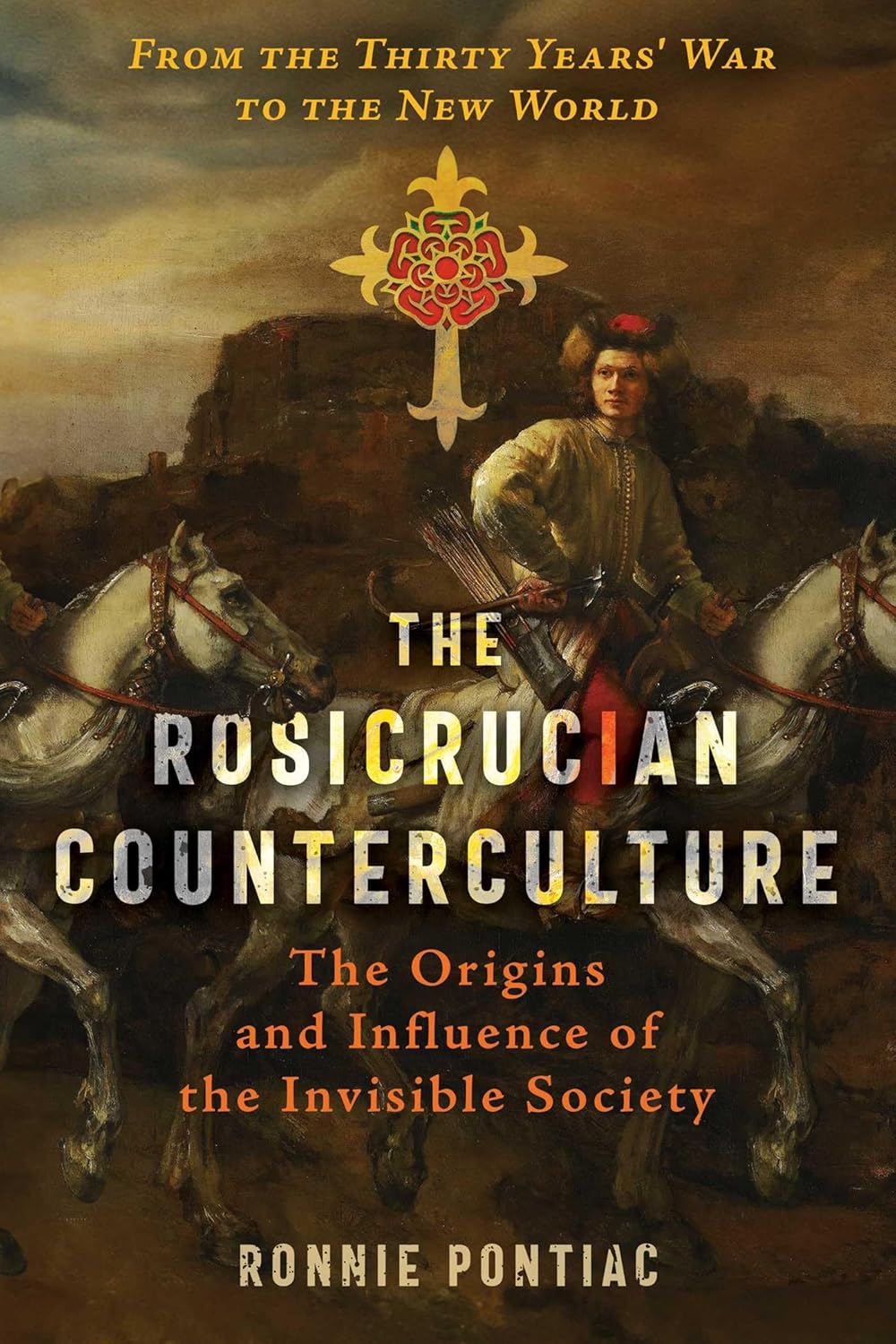
We warmly welcome Ronnie Pontiac, author of The Rosicrucian Counterculture: The Origins and Influence of the Invisible Society, as our featured author this month. His book explores the far-reaching esoteric influence of the Rosicrucian movement on the world and figures such as Descartes, Shakespeare, Newton, Goethe, and Jung, as well as its impact on Oliver Cromwell and the English Revolution. He traces the tradition across the Atlantic to colonial America, demonstrating how its spirit still echoes in modern pop culture and psychedelic circles today. He reframes the movement not as an order of superhuman masters but as a genuine counterculture, a recurring eruption of suppressed knowledge that surfaces whenever a stagnant status quo demands renewal.
In his article here, Ronnie introduces the reader to the Rosicrucian enigma itself: the panic it sparked, the surveillance state it quietly defied, the still-unsolved riddle of who wrote the manifestos, and the radical message at the heart of this movement, that the power to remake our world begins with us.
Interact with Ronnie on our forum here.
The Rosicrucian Enigma
Rosicrucian is one of the most misunderstood words in the esoteric world. A famous secret society that likely never existed. A viral idea that destabilized Europe yet inspired esotericism and countercultures for centuries. It’s been specifically defined in contradictory ways. A mirror in which many different reactions have been revealed, it triggered a widespread panic in Paris in 1623 when posters put up overnight declared the arrival of the Rosicrucians (probably a prank). It excited the admiration of English and colonial intellectuals like the celestial intelligencers of the seventeenth century, among whom Rosicrucian ideals were synonymous with free medicine, protection of the oppressed, alchemy, early science, and dedication to the betterment of society.1
The Rosicrucians were not just a 17th-century curiosity. They were an eruption of an enduring underground tradition of transformative knowledge that continues to shape Western culture. Though the word counterculture was coined specifically to describe the subcultures of the 1960s, as we shall see, it fits the Rosicrucians nicely. Countercultures arise when dominant traditions stagnate. Rosicrucianism exemplifies this recurring pattern. Reviving lost and suppressed knowledge, the Rosicrucian alternative intellectual lineage was born outside orthodox history.
Rosicrucianism influenced the lives and works of a wide range of influential thinkers and creatives, including René Descartes, William Shakespeare, Francis Bacon, John Milton, Isaac Newton, Johann Wolfgang von Goethe, Edward Bulwer-Lytton, French composers Erik Satie and Claude Debussy, Portuguese author Fernando Pessoa, Situationist International founder Guy Debord, Jorge Luis Borges, Carl Jung, Umberto Eco, and Dan Brown. Even ethnobotanist Terence McKenna explored Rosicrucian ideas in recordings featured in the video series Prague Gnosis: Terence McKenna Dialogues, filmed during the International Transpersonal Conference held in Prague in 1992.2
Inspired and liberated by Rosicrucian ideas about the importance of studying nature and by their devotion to the reformation of society, historical notables lived exceptional lives. In this and many other ways, the Rosicrucians planted the seeds for our modern world. For example, John Winthrop the Younger, the alchemist astrologer, was a founding father of Connecticut, and the son of the founder and twelve-term governor of Massachusetts Bay Colony. When he came to America, Winthrop the Younger brought with him books, manuscripts and alchemical laboratory equipment that had belonged to John Dee, the notorious astrologer and magus at the court of Queen Elizabeth I. The barrels they arrived in were marked with Dee’s famous occult symbol, the monas hieroglyphica. Winthrop the Younger’s Puritan father allowed him to conduct alchemical experiments in his home in Boston.3
A World Under Surveillance
Near the dawn of the seventeenth century, a supernova, comets, and the conjunction of Jupiter and Saturn in the heavens excited expectations of imminent world-changing events. In 1600, to demonstrate its commitment to dominating the new century, the Catholic Church burned Giordano Bruno, one of the favorite authors of future Rosicrucians, for refusing to renounce his beliefs in reincarnation, the ancient Egyptian origin of Western religion, and his theory that the Earth orbited the Sun. None of these beliefs would be allowed in the future the church envisioned. The Vatican was eager to end the Protestant revolution, to regain the parts of Europe it had lost to the austerity of Luther and his followers.4
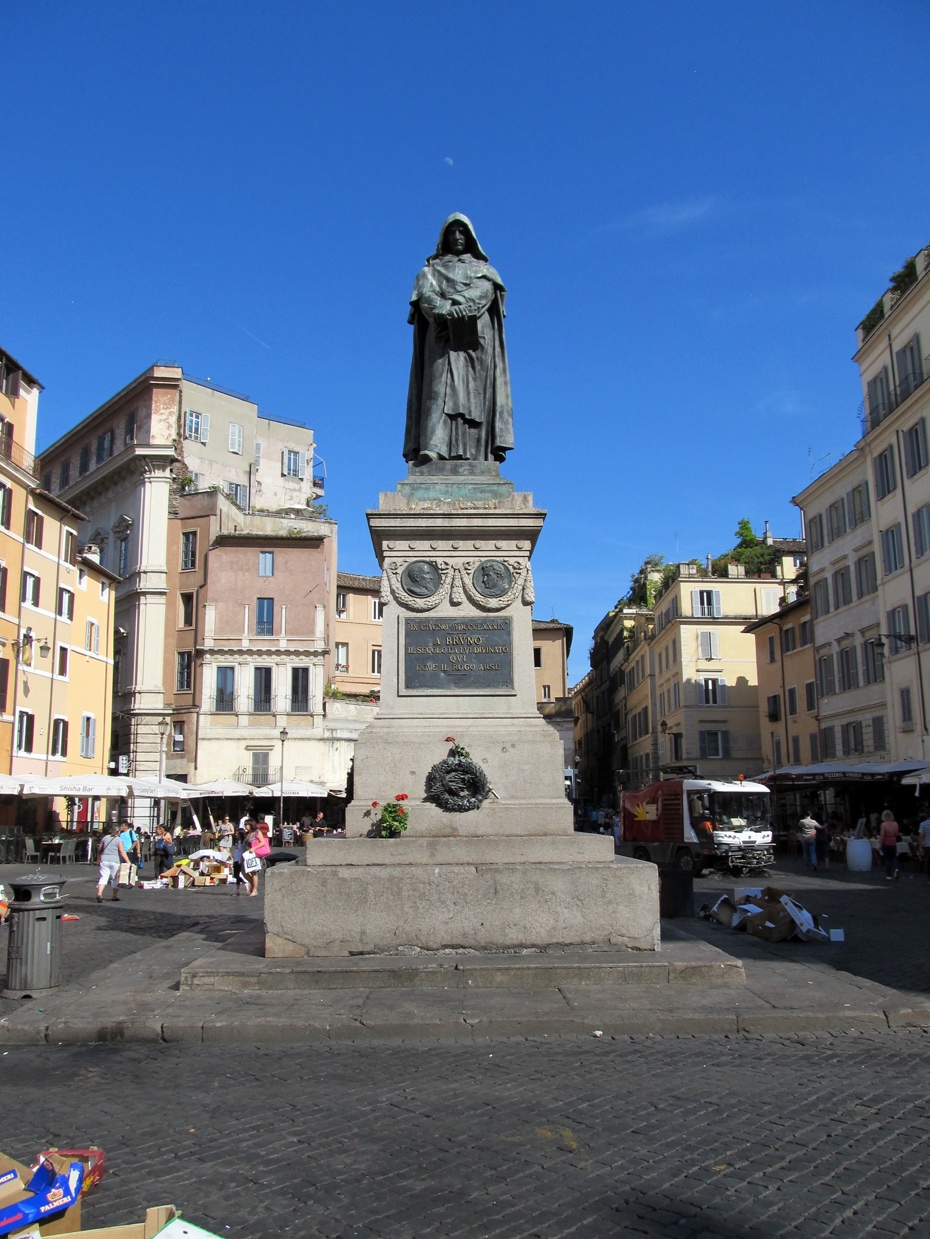
The monument to Giordano Bruno in Campo de’ Fiori, Rome, where he was burned at the stake in 1600. Image by Daryl Mitchell, CC BY-SA 2.0

The surveillance state that tech oligarchs have created today, their attempts to access and control all data, had its parallel in the world of the Rosicrucians. The confessional was the greatest surveillance device the world had seen. To lie about or neglect to mention a sin meant an eternity of agony in hell. Priests were obligated to report important information to their superiors. The pope could be said to have had spies in every confessional all over the continent. The inquisition enforced the dictatorship of the Vatican in its torture chambers. The Holy Roman Empire deployed the Spanish and Austrian armies to smash organized opposition. Printers, publishers and booksellers were often condemned for producing, distributing, or selling esoteric books.
Their contemporaries called the Rosicrucians “Protestant Jesuits,” or the Devil’s Jesuits, and even a trick of the Jesuits. The Rosicrucians have been blamed for throwing fuel on the fires that ignited the bloody Thirty Years’ War between Protestants and Catholics. That war, along with the plague and starvation it caused, killed roughly one out of ten Europeans. Some areas lost half their populations. On the other hand, the Rosicrucians have also been revered as the ultimate example of Christian spirituality. But what does any of that have to do with the more recent public Rosicrucian groups that, alongside their esoteric studies, have practiced good citizenship through public service?5
The most powerful ideas in history often operate covertly, not institutionally, and many Rosicrucian ideals were a direct challenge to the power and surveillance of the Church. According to the Rosicrucians, knowledge cannot be monopolized. It should flow through networks of dedicated seekers who recognize each other not by credentials but by the quality of their questions and by their commitment to truth. Instead of the distribution of wisdom from the top down, among the Rosicrucians, truth would travel across all distinctions of denomination and class, person to person, without any need for hierarchy or approval by authorities. Participants connected with each other and exchanged information in a kind of secret commons that united people who lived far apart by articulating their idiosyncratic philosophies and defining their vague intentions for the future. The Rosicrucians and their apologists used symbols, emblems, diagrams and allegories that bypassed censorship, transcending barriers of borders, dogmas and languages.
The Rosicrucian Revolution
Three small books started the Rosicrucian revolution and the furious controversy it ignited. The Fama in 1614, the Confessio in 1615, and The Chymical Wedding in 1616. Fama Fraternitatis Rosae Crucis (Report of the Brotherhood of the Rose Cross) announced radical ideas about the universal reformation of society through the liberation of both spiritual and scientific inquiry.6 Like the American Transcendentalist writer Ralph Waldo Emerson over two hundred years later, the Rosicrucians wanted more than old-fashioned religion. They wanted to experience revelations themselves.
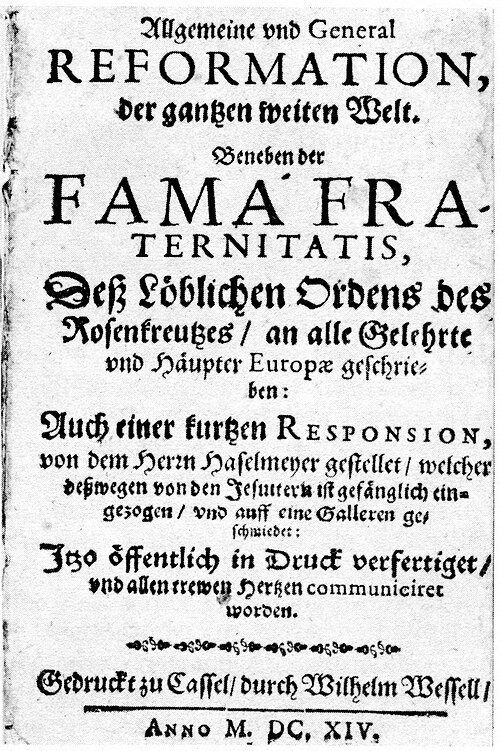
Fama Fraternitatis. (Public Domain)

In the world they proposed, science instead of being condemned as a dangerous heresy would be encouraged and celebrated as a means to reveal the grace of divine wisdom which could heal the world. Instead of priests mediating spiritual experience according to the Vatican’s rule book each individual could have a direct relationship with truth. Inventions, medicines, and freedom of expression would reform the world.
Like the Fama, Confessio Fraternitatis R. C. ad Eruditos Europæ (The Confession of the Fraternity of the Rose Cross, addressed to the Learned of Europe) and Chymische Hochzeit: Christiani Rosencreütz anno 1459 (The Chymical Wedding of Christian Rosenkreütz Year 1459) were a combination of revolutionary screeds, political tracts, and mystical texts, inspired by a sincere desire for universal reform, yet they were also satirical and even surreal.
The Confessio referred to the pope as the antichrist and “the mouth of those vipers.”7 It dismissed Islam and the Roman Catholic Church as blasphemy against Jesus. It offered the wealth of alchemical gold to occultist Holy Roman Emperor Rudolf II if he would declare himself the champion of the Rosicrucians and their defender against the dictatorship of the Vatican. Rudolf had no interest in taking such a radical stance. He was fed up with the onerous responsibilities of imperial bureaucracy, and believed in religious tolerance and peace not holy wars.
The author or authors of these manifestos were dismayed by the reaction of the masses to them. They felt the points they were trying to make were misunderstood by both critics and enthusiasts. Critics dismissed them as anarchists. Enthusiasts volunteered to join the order and trumpeted their qualifications, then published angry retractions because they were not contacted about membership. The Confessio declares the Rosicrucian’s “hatred of impostors.”8 Edgier quotes from the same book include: “Commonly the most sorry idiots made the loudest noise”9 and “I am still ready to vomit at it.”10
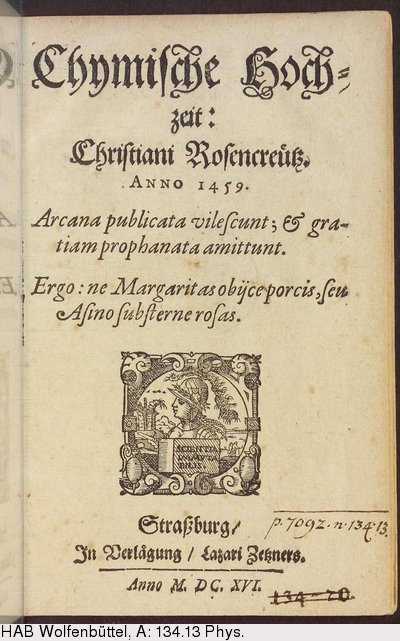
Chymical Wedding of Christian Rosenkreutz (CRC), by Andreä, Johann Valentin CC BY-SA 2.5

The Chymical Wedding includes a scene where the female narrator winks at the reader as she suggests Christian Rosenkreütz (CRC), who is depressed, might be cheered up if she slept with him. Unusually frank sexuality for German literature of that time, probably inspired by the bawdy musical comedy of touring English theatrical groups.
Most critics and enthusiasts took the metaphors in these manifestos literally. For example, in the Confessio we find this enigmatic paragraph:
“—ere it not sufficient for us to fear neither hunger, poverty, diseases, nor age? Were it not an excellent thing to live always so as if you had lived from the beginning of the world, and should still live to the end thereof? So to live in one place that neither the people which dwell beyond the Ganges could hide anything, nor those which live in Peru might be able to keep secret their counsels from thee?”11
Taken literally this paragraph seems to describe superpowers. More likely it refers to the attainment of a state of consciousness described in the Enneads of Plotinus, in the Chinese Daoist alchemical classic The Secret of the Golden Flower, and in many other mystical texts revered around the world, and found also in records of indigenous religions, and in the theories of Carl Jung. In 1901 Richard Bucke called it cosmic consciousness. The idea that deep consciousness exists outside of, and yet has access to, all space and time. But the Parisians who panicked when posters announced the Rosicrucians had arrived in their city believed the Rosicrucians were telepathic, and that they could literally become invisible at will. They were thought to have the powers of witches or wizards, gifts of the devil.
Symbolism & Authorship
What does the symbol of the Rose Cross mean? Some have argued it refers to the Rose of Sharon. Others have claimed that the rose is the blood of Jesus on the cross of Gethsemane. The Rose Cross has been compared to the Hindu jewel in the lotus. The Rose is the soul and the cross the material world. More recently the rose has been explained as a symbol for ros, Latin for dew. This dew is said to be the all important ingredient of the Philosopher’s Stone, the ultimate attainment of alchemy. Some have suggested it relates to human semen, and others to a bodily secretion attained only through deep spiritual dedication.12
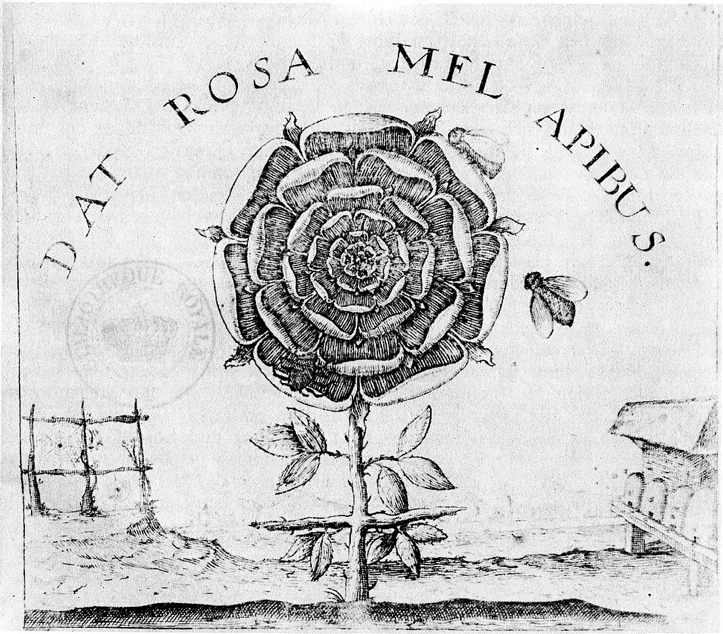
Rose Cross symbol from Robert Fludd’s Summum Bonum (1629) (Public Domain)

Who wrote the Rosicrucian manifestos? The question is still debated. The books themselves tell the story of an order of enlightened Christian monks inspired by Father CRC, a monk who travelled east to acquire wisdom. CRC’s seven-sided tomb is described, in which his body remained immune from decay, an immortal relic in a vault connected to eternity by means of alchemical symbolism and sacred geometry. It also contained the book M, a collection of all the knowledge of the world.
CRC, we are told, tried to share his wisdom upon his return to Europe but was laughed at by a generation of scholars anxious to preserve their status. Instead, he recruited eight loyal brethren who traveled to other countries where they were instructed to fit in while spreading healing and goodwill as catalysts of the hope for universal reformation. Like Socrates, CRC declared: “The height of knowledge is to know nothing.”13 False certainty is ever the enemy of wisdom.
Evolution of Rosicrucianism
In its long history, Rosicrucianism evolved in many ways the originators may not have recognized. Rosicrucian sympathizers were involved in Sir Walter Raleigh’s early colonization of America. Oliver Cromwell was influenced by the Rosicrucian ideal of utopia but believed it could be attained only through war. Rosicrucianism morphed into everything from a repressive political order behind the throne of a central European kingdom to a French salon of esoteric theater and the arts. Freemasonry does not appear to be a Rosicrucian invention, as often suggested, but certainly was influenced by Rosicrucian ideals. The Royal Society was inspired by the Rosicrucian vision of the Invisible College, a gathering of the greatest scholars in the world to further humankind.14
Almost three centuries after its first appearance, under the influence of Madame Blavatsky, rumors of Rosicrucian superpowers were combined with the Theosophical idea of ascended masters. The Rosicrucians were not typical human beings. They were more akin to the wise Chinese immortals, the Hindu masters of yoga, and characters of folklore who were said to have evolved beyond the limits of the human body and the laws of nature.
In the early 20th century, public Rosicrucian orders arose, many of which offered monthly lessons advertised in the backs of magazines. They furthered this mythologizing of Rosicrucian origins, as did my mentor Manly Palmer Hall, although near the end of his life, he regretted glamorizing them and told me that he had come to think of the Rosicrucians as the dedicated people in every generation who devote themselves to bettering our world as servants of divine love.15
Around 2000, academia in the English-speaking world finally realized that esoteric history deserved to be studied. Archives that had never been searched before divulged new knowledge that changed our views about these events. Biographies are being rewritten as a clearer picture of leading figures emerges. While the exact author or authors of the manifestos remains a subject of debate, a new narrative has emerged that reveals a true counterculture: college students under the influence of radical professors and forbidden books.
The name that comes up most often is Johannes Valentinus Andreae, born in 1586 in what we now call Germany. Sentences and paragraphs from the manifestos have been found in journals Andreae kept that predated them. Christoph Besold, another candidate for author of the Fama, left a note in his personal copy of the book indicating that he suspected Andreae was the author.16
The Fama originally circulated as a manuscript. It was published as a book by the nobleman Moritz the Learned, without the permission of the author or authors. Rosicrucians are mentioned by Ben Johnson in his comedy The Alchemist in 1610, so it’s likely he saw a manuscript copy.17 It’s been argued that the Fama could have been written no earlier than 1608 because it mentions a device that sounds like a multi-lens telescope, which was invented that year.
Adam Haslmyr said he had a manuscript copy in 1610. He wrote a tract supporting the Rosicrucians that was published with the Fama, but his timing was terrible. By then, the tolerant Emperor Rudolf II had been deposed by his severe younger brother, and Haslmyr wound up pulling an oar in a slave galley, illustrating the danger of being identified as a Rosicrucian.18 No wonder the order was invisible. If the Fama was written in 1608, Andreae was 21 years old when he wrote it.
In 1617, Andreae published Menippus or a Century of Satirical Dialogues, a satire about the kinds of fools and hustlers who misunderstood and trampled underfoot the Rosicrucian dream of universal reformation. One of the characters is named Fama. Names of Roman gods and goddesses are used to satirize types of people and their reactions. Historical characters like Alexander the Great and Socrates symbolize the sort of people who completely missed the point. Some of the types of scene killers are quite recognizable today, for example, the clueless art collector, the scholar of the vanities, the connoisseur, the politician, and the profiteer. As soon as they show up, a scene begins to die, as I experienced as a member of the Riot Grrrl movement and its commodification in the 1990s.
Andreae called the Rosicrucians a ludibrium, a Latin word for a fable, a joke, or a hoax. He mocked people who became obsessed with alchemy and secret societies and maintained that Christian values are better. Menippus serves the dual purpose of allowing him to vent about the mistreatment of his creations while distancing himself from them. Accusations that he was the author could be swept aside by pointing to his defense of Christianity and his dismissal of the Rosicrucians. Andreae took it a step further in 1619 when he published Christianopolis, a utopia that presented Rosicrucian ideas in safe and sober Lutheran terminology.
Rumors persist that the Rosicrucians are or were illuminati overlords, an elite dominating our world for their own benefit, human beings with supernatural powers that violate the laws of nature. But we find in the manifestos themselves the refutation of the idea that such domination was or is a Rosicrucian goal. At the beginning of the Fama, we read of the Rosicrucians that they are devoted to “the love, help, comfort and strengthening of our Neighbors, and to the restoring of all the diseased.”19 The Confessio states: “We hunt not after your goods with invented lying tinctures, but desire to make you partake of our good.”20 It promises: “then shall all deceit, darkness, and bondage of this world vanish.”21
The Counterculture Calling
Though some still defend the existence of the superhuman Rosicrucian masters, the idea that college students were behind the creation of this early modern expression of a much older stream of esoteric knowledge that repeatedly re-emerges as counterculture inspired my book The Rosicrucian Counterculture: The Origins and Influence of the Secret Society. It examines the latest research on the historical context that brought this enigma to life. We need no longer grovel before superhero initiates; the agency of mere human beings is restored to us. We have the power to effect widespread changes in culture if we dare to reject the conformity of the status quo.
As we take the long view of history, we can see how small groups of dedicated people with innovative ideas have put into motion events that changed the world. The Rosicrucian manifestos were the tearing of a veil, the full bloom of early 17th-century insight, the announcement of a radical rejection of a stagnant and oppressive status quo. Finding ourselves in a similar epoch now, we can take solace and inspiration from the historical recurrence of this social dynamic.
Countercultures have been symbolized as the phoenix, the miraculous bird of light that symbolizes individual and collective rebirth, a symbol dear to the Rosicrucians. While the longed-for universal reformation may seem unlikely, its inception is as simple and immediate as inviting this phoenix into our own hearts and having the courage to follow where it leads. The change we desire begins with us. That is the ultimate lesson of the Rosicrucians.
When the elusive facts and elaborate conspiracy theories surrounding Rosicrucianism beguile us, we may remember the wise advice Japanese haiku poet Basho attributed to Kukai, the Buddhist master of high attainment: “Do not seek to follow in the footsteps of the masters of old, seek what they sought.”22

By Arthur Charles Fox-Davies1909 (Public Domain)
.svg)
Bibliography
Anon. 2000. The Rosicrucian Manifestos: Fama Fraternitatis and Confessio Fraternitatis. Cincinnati, OH: Emperor Norton Books, p.21.
Pontiac, Ronnie. 2025. The Rosicrucian Counterculture: The Origins and Influence of the Invisible Society. Rochester, VT: Inner Traditions.
Rowland, Ingrid D. 2009. Giordano Bruno: Philosopher/Heretic. Chicago: University of Chicago.
Vaughan, Thomas. 1652. The fame and confession of the Fraternity of R.C., commonly, of the Rosie Cross : with a praeface annexed thereto, and a short declaration of their physicall work. London: Printed by J.M. for Giles Calvert.
Waite, A.E. 1887. The Real History of the Rosicrucians. London: George Redway
Woodward, Walter W. 2014. Prospero’s America: John Winthrop, Jr., Alchemy, and the Creation of New England Culture, 1606-1676. Omohundro Institute and UNC Press.
For a comprehensive bibliography of modern and historical books and articles about Rosicrucianism see The Rosicrucian Counterculture.
1 Pontiac, Ronnie. 2025. The Rosicrucian Counterculture: The Origins and Influence of the Invisible Society. Rochester, VT: Inner Traditions, p.3.
2 Ibid., p.149, p.63, p.118, p.175, p.119, p.184, p.183, p.126, p.107, p.133. p.203.
3 Woodward, Walter W. 2014. Prospero’s America: John Winthrop, Jr., Alchemy, and the Creation of New England Culture, 1606-1676. Omohundro Institute and UNC Press.
4 Rowland, Ingrid D. 2009. Giordano Bruno: Philosopher/Heretic. Chicago: University of Chicago.
5 Pontiac, Rosicrucian, p.3.
6 Ibid., p.110.
7 Vaughan, Thomas. 1652. The fame and confession of the Fraternity of R.C., commonly, of the Rosie Cross : with a praeface annexed thereto, and a short declaration of their physicall work. London: Printed by J.M. for Giles Calvert p.52
8 Waite, A.E. 1887. The Real History of the Rosicrucians. London: George Redway, p. 95.
9 Waite. Real History, p.116.
10 Ibid.
11 Anon. 2000. The Rosicrucian Manifestos: Fama Fraternitatis and Confessio Fraternitatis. Cincinnati, OH: Emperor Norton Books, p.21.
12 Ibid., p.2.
13 Pontiac, Rosicrucians, p.112.
14 Ibid., p.200.
15 Ibid., p.189.
16 Ibid., p.131.
17 Ibid., p.110.
18 Ibid., p.111
19 Anon., Rosicrucian Manifestos, p.2.
20 Ibid., p.26.
21 Ibid. p. 52.
22 Pontiac, Rosicrucian, p.211.
Endorsements for The Rosicrucian Counterculture
Ronnie Pontiac’s The Rosicrucian Counterculture brings to 21st-century life the most famous secret society that never existed. Who were the Rosicrucians? Not even René Descartes could find out. But when the mysterious Rosicrucian Manifestos turned up in a sleepy German town shortly after the great Hermes Trismegistus lost his street cred, an esoteric treasure hunt began with participants who are still at work today. Join in: you may discover that you were a Rosicrucian and didn’t know it.– Gary Lachman, author of Touched by the Presence, The Return of Holy Russia, and Maurice Nicoll
This work is simply dazzling. It follows a single Rosicrucian thread to unfold a vast historical tapestry of people and events made real through a prose that sings with life. Ronnie Pontiac describes himself as a storyteller, and it is with this special gift that he invites the reader to step from the past into the present, bearing the blessings of the phoenix: counterculture itself.– Naomi Ozaniec, priestess of Isis, founder of The House of Life, and author of Becoming a Garment of Isis
Ronnie Pontiac’s history of the Rosicrucian movement is learned, engaging, and remarkably breezy reading. He has done an enormous service in sifting what can be known about the Rosicrucians from speculation and fancy.– Richard Smoley, author of A Theology of Love and Forbidden Faith
With The Rosicrucian Counterculture, Ronnie Pontiac has crafted a unique viewfinder for the tradition of Rosicrucianism, whose history has long been clouded by various interpretations, myths, and mystery. Expertly navigating the murky waters of the historical record, while remaining engaging, exciting and invigorating, The Rosicrucian Counterculture resuscitates Rosicrucianism for a modern audience. Pontiac’s meticulous research is woven into a literary cloth that reads part history, part novella, methodically leading the reader through a thicket of pre-Enlightenment haute culture and politics by way of an intriguing series of intersecting byways. Approaching the subject with palpable wonder, while remaining intellectually honest, Pontiac has given us an invaluable resource in the study of esotericism in Western culture. Those interested not only in the history, but in the heart of the Rosicrucian phenomenon will find ample sustenance in these pages.– Ike Baker, author of Esoteric Mythology and host of the Arcanvm Podcast
The Rosicrucian Counterculture: Why Ronnie Pontiac’s New Masterpiece is the History We’ve Been Waiting For. From the very first page, Pontiac establishes himself not just as a scholar, but as a storyteller of the highest caliber. He possesses that rare gift (reminiscent of his mentor Manly P. Hall) of taking complex, dense esoteric lineages and making them read like a historical thriller. By linking the Fama Fraternitatisto modern occult revivalism, Pontiac validates the modern seeker. He shows us that if you are a weirdo reading about alchemy in a coffee shop today, you are part of a 400-year-old lineage of resistance.– Sarah Liénard, Esoteric Researcher and Documentary Filmmaker