



Abstract: March 2025 saw the announcement from the Khafre SAR Project of the apparent detection of a huge megastructure beneath Giza’s Second Pyramid. The story prompted intense debate on what really awaited discovery beneath the plateau at Giza. In this article, we provide a brief update on these claims before looking at how Giza’s underlying geology possibly influenced ancient Egyptian funerary traditions regarding the deceased’s navigation of a cave-like realm known as the Duat underworld. We show also that the alignment of the Milky Way with Giza’s underlying geology would appear to have highlighted the importance of its known cave complex, while at the same time influencing the spatial positioning of its main pyramids. Lastly, we speculate on who might have been responsible for the creation of any rock-cut structures at Giza and what their impact might have been on the emergence of dynastic Egypt.
Key words. Giza caves, Second Pyramid, Tomb of the Birds, Great Pyramid, Tomb of Hermes, Emerald Tablet, Shiva Lingam, Edfu Building Texts, bnnt-embryo, Duat underworld, Primeval Ones, Taş Tepeler, Western Desert.
by Andrew Collins1
In March 2025, the world was stunned when the Italy-based Khafre SAR Project announced the detection of an enormous megastructure beneath Giza’s Second Pyramid. Scans indicated it was made up of eight tubes, or cylinders, penetrating the bedrock to a depth of up to 640 metres (2100 feet) before connecting with two enormous square-shaped chambers 80 metres (260 feet) across (see fig. 1).
This earth-shattering announcement was derived from data downloaded from commercial satellites orbiting around 645 kilometres (400 miles) above the Earth. Utilising a technology known as SAR (Synthetic Aperture Radar), each satellite sends out electromagnetic pulses that hit the surface of the planet before returning to space. This data is then recorded by the satellite or satellites in question. The detection of underground structures becomes possible through noting contrasts in the correlated data caused by subtle variations in sound frequencies apparently coming from hollow areas beneath the earth.
Despite the compelling nature of the Khafre SAR Project’s claims, the Egyptian authorities, perhaps inevitably, condemned the Italians’ findings as meaningless (especially since they did not seek permission to carry out this work). What is more, various alternative-history researchers released YouTube videos dismissing the Italians’ claims as at best fanciful. They pointed out that at no time in human history have engineering projects of this kind ever been undertaken, meaning there was every reason to conclude that the team’s findings were little more than fantastical interpretations of raw SAR data that may or may not reveal the presence of underground structures at Giza.
Undaunted by criticism, the Italian team went on to use the same technology to map the entire Giza plateau, finding similar megastructures beneath all three pyramids, as well as beneath the Great Sphinx and Osiris Shaft. The Khafre SAR Project has sought to quantify their findings by seeking publication of a lengthy, peer-reviewed paper prepared by those involved in the study. They are also seeking confirmation of their work from independent academic sources, and we can only encourage them in this endeavour.
There can be little question that the raw SAR data utilised by the Khafre SAR Project could well show the presence of genuine underground structures beneath the Second Pyramid, at least. As far back as 1977, a remote sensing survey undertaken by the Stanford Research Institute, in association with Cairo’s Ain Shams University, detected several deep cavities beneath this same pyramid, some as much as 40 to 50 metres (130 to 165 feet) below the surface of the plateau.
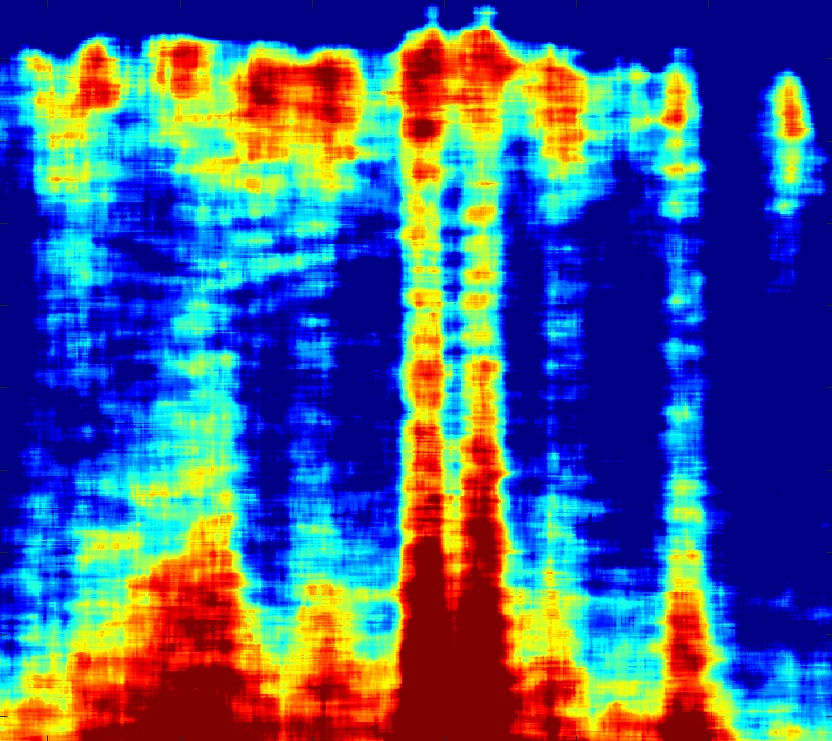
FIGURE 1. SAR-based satellite data obtained by the Khafre SAR Project interpreted as showing an enormous megastructure beneath the Second Pyramid at Giza (credit: Khafre SAR Project).
Giza’s Cave Underworld
It’s been a year and a half since these dramatic announcements were first made, and so, it seems like a good time to take stock of the situation and see where we are in the search for Giza’s subterranean world. As can be imagined, not only have the Egyptian authorities still not openly investigated the Khafre SAR Project’s findings, but in late January 2026 the present author saw that bricks had been used to seal up the entrance to the enigmatic Tomb of the Birds, the only known point of access to the Kahf el-Hanash cave system. This was done in response to speculation that if underground structures still exist beneath the Second Pyramid, then they were almost certainly connected to the caves beneath the Giza plateau, first explored in 2008 by the present author, working alongside my then wife Sue Collins and Egyptological researcher Nigel Skinner Simpson.
Even though at the time the caves were investigated only for a distance of approximately 120 metres before their existence was duly reported to Egypt’s Supreme Council of Antiquities, then under the control of Dr Zahi Hawass, a remarkable radar image of the Giza plateau taken in July 2007 using the TerraSAR-x satellite was afterwards found to show what appears to be underground caves and fissures (see fig. 2). Two curved shadow lines, orientated northwest to southeast, can be seen to run from the area of the Tomb of Birds all the way to the northwestern corner of the Second Pyramid where they vanish from view. These fairly thick lines do not match any known surface features, hinting strongly that they reveal the presence of caves and fissures in the bedrock.
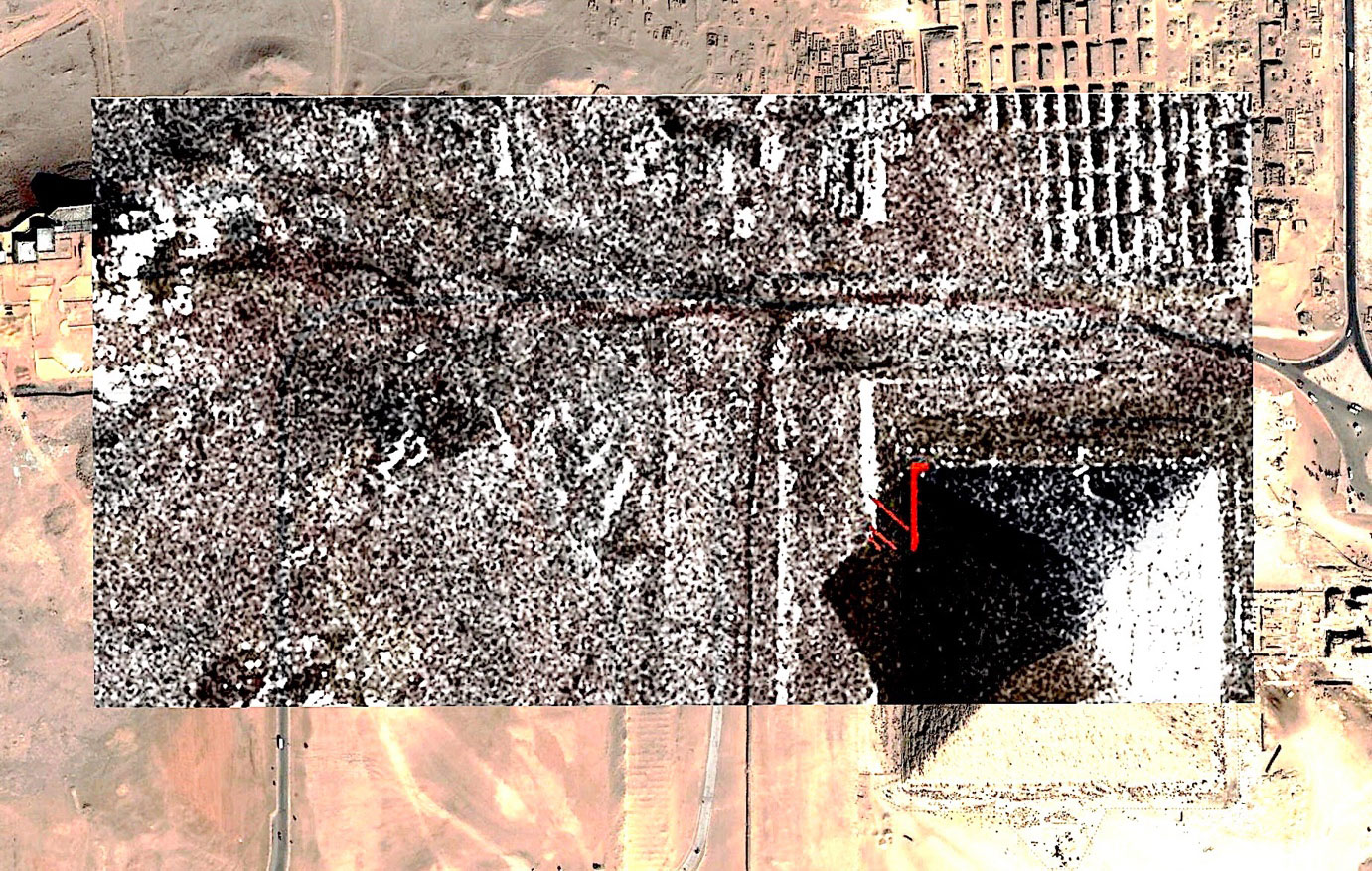
FIGURE 2. Reconstruction of part of the TerraSAR-X radar image of the Giza plateau overlaid on Google Earth showing the curved linear lines running from the Tomb of the Birds to the northwest corner of the Second Pyramid. The red lines show the position of underground fissures detected in 1977 by the Stanford Research Institute (credit: Rodney Hale/Google Earth).
Following the present author’s promotion of the TerraSAR-X radar image as potentially showing an extension of the caves explored in March and April 2008, interest became focused on the Second Pyramid. This, of course, is traditionally attributed to the pharaoh Khafre, who reigned circa 2500 BCE. Medieval Arab accounts speak of Sabian or Chaldean peoples coming all the way from what is today southeastern Turkey to venerate the Second Pyramid as the tomb of their founder Hermes Trismegistus. Some accounts say he still holds against his chest the original of the Emerald Tablet, on which are inscribed the secrets of creation.
Since Hermes Trismegistus is simply a Greco-Roman form of the Egyptian god Thoth, the ibis-headed keeper of records, this offers a potential connection with the concept of the Hall of Records. This is a secret chamber said to contain the physical records of a lost civilization, predicted as existing beneath the Giza plateau by America’s most famous psychic, Edgar Cayce (1877–1945). A physical search for the Egyptian Hall of Records was initiated in the 1950s and continues to this day.
Mouth of the Passages
So, is it possible now to glean a more concise understanding of what really awaits discovery beneath the plateau at Giza? One clue comes from the fact that the ancient Egyptian name for the Giza necropolis was Rostau, meaning the “Mouth of the Passages.” This apparently alludes to the presence of one or more cave entrances in the vicinity of the Giza pyramid field. Although the term Rostau was probably in use by the time of the Old Kingdom (circa 2696–2181 BCE), later funerary texts such as the Am-duat, the “Book of that which is in the Underworld,” allude to Rostau as forming part of what is known as the Duat, a word meaning “underworld,” or “neverworld.” This was a chthonic, cave-like environment full of evil spirits, monsters, and physical obstacles through which the deceased had to pass in order to reach the afterlife.
These same funerary texts make it clear that the Duat underworld can be seen as the interior body of the sky goddess Nut, who was identified with the Milky Way. In funerary art, the Sun is actually shown passing from her mouth down through her stomach and abdomen to her legs. This nocturnal journey was seen to take place across 12 symbolic “hours” of the night between sunset and sunrise.
Prior, however, to the New Kingdom (circa 1550-1181 BCE), it was the Pyramid Texts, written on the walls of Old Kingdom pyramids from around 2350 BCE onwards, that established the sayings, spells and instructions for the deceased to navigate the Duat underworld. These speak of a snake deity named Mehen, the “Coiled One,” that provided a protective barrier or cocoon around the deceased as he or she navigated this chthonic realm in a solar barque (see fig. 3).
From all this, it becomes clear that Mehen, the great snake, was probably associated with Nut’s interior body in its role as the Duat (underworld) and, through this, her visual form as the Milky Way. Such ideas likely stem from the fact that many ancient cultures identified the Milky Way as a cosmic serpent, with its head as the Galactic Bulge, which signifies the centre of our own Milky Way galaxy.
In this light, it seems certain that, as a representation of the Duat underworld, Giza’s cave complex was itself associated with a chthonic snake. This was something first hinted at when Nigel Skinner-Simpson, Sue Collins, and I first entered the caves in 2008. An old tomb guardian spoken to at the site stated very matter-of-factly that the caves were “haunted” by a great snake named el-Hanash, the reason why he himself would never venture inside them. This tradition surrounding el-Hanash (an Egyptian Arabic word simply meaning “snake” or “serpent”) is probably related to the Greco-Roman belief that a snake deity named Agathodaimon “reposed” beneath the plateau at Giza.
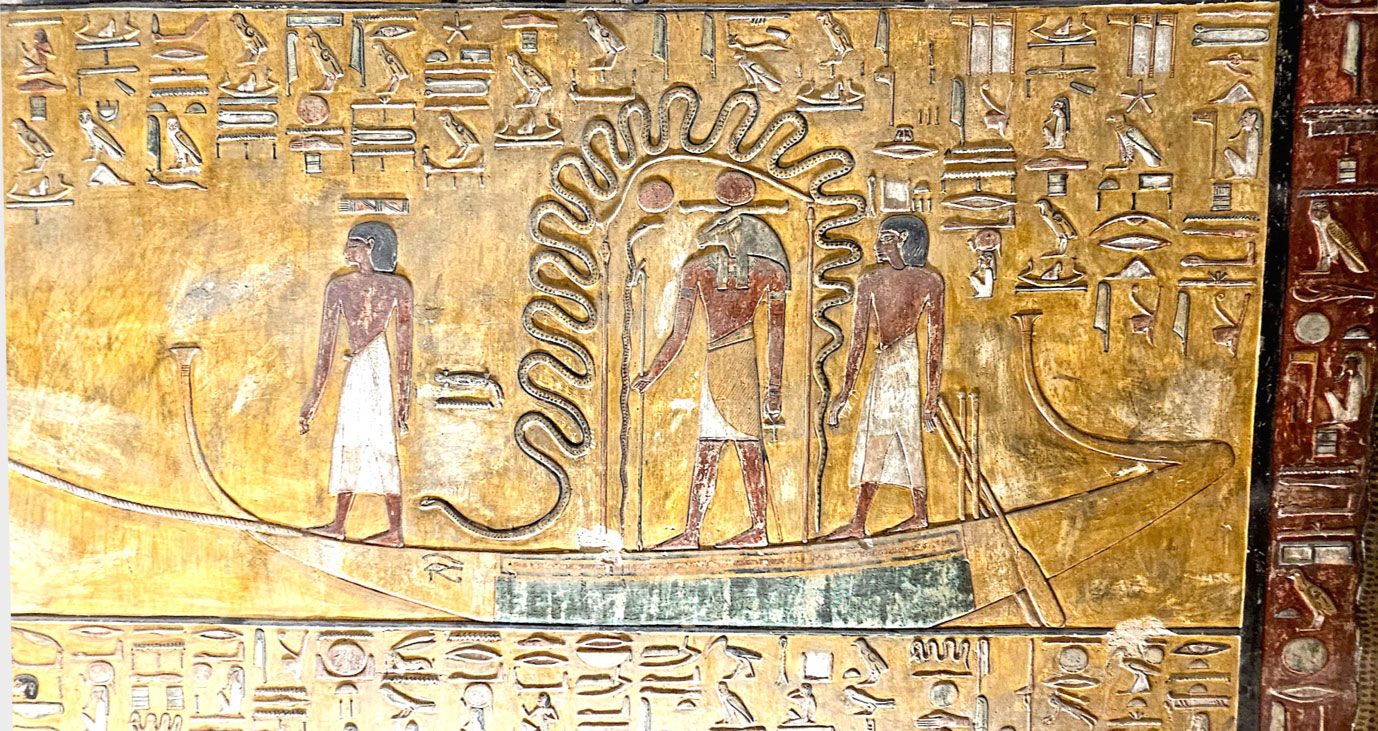
FIGURE 3. The snake Mehen surrounding the deceased in the form of the sun-god Amun-Ra from the tomb of Seti I in the Valley of the Kings, West Thebes (credit: Andrew Collins).
New research conducted during field explorations at Giza by the author working alongside Debbie Cartwright, an expert on totemism and shamanism, has tentatively identified the chthonic snake personifying the spirit of Giza’s cave underworld as a form of Mehen who, as we have seen, protects the dead as he or she navigates the Duat underworld.
Mehen is occasionally depicted in a circle biting its own tail, which is the manner it appears on one of the golden shrines that housed the sarcophagus found in the tomb of the boy-king Tutankhamun (see fig. 4). Mehen can thus be seen as an early form of Ouroboros, the snake that bites its own tail. It appears in various Greco-Egyptian magical papyri and was later adopted in Renaissance Europe as a symbol of cyclical regeneration and resurrection, which is why it is seen carved on old tombs and grave slabs. Almost certainly Mehen is the Egyptian form of the world-encircling serpent, anciently seen surrounding the physical world. This in turn can very easily be identified with the Milky Way in its role as the cosmic serpent.
Milky Way Alignment
The plateau’s orientation is determined, not only by the fact that it slopes towards the southeast, defining the direction of any underlying caves, but also through the presence of surface fissures like those shown in Fig. 5. Since the Duat underworld reflected the body of the goddess Nut, is it possible that this same influence was reflected in the night sky by the presence of the Milky Way?
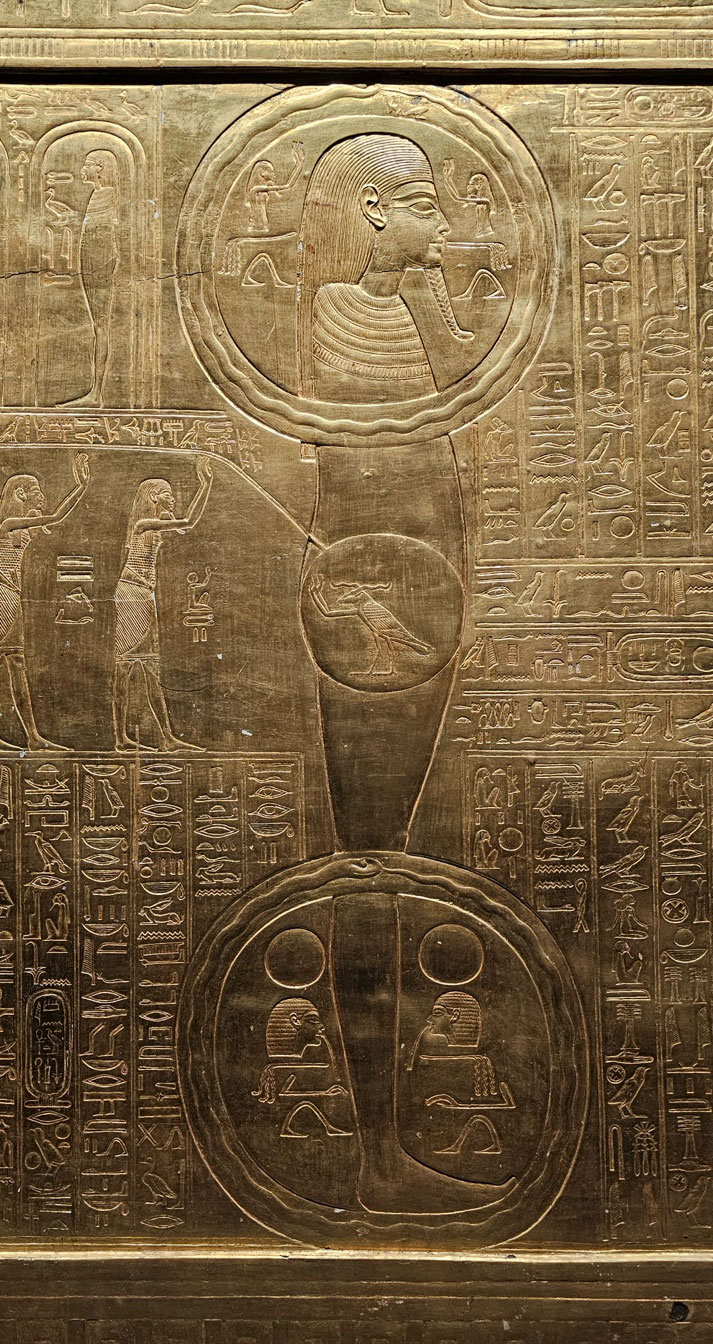
FIGURE 4. The snake Mehen as the Ouroboros serpent from one of the golden shrines found in the tomb of Tutankhamun (credit: Andrew Collins).
Sky programs such as Stellarium show that from the latitude of Giza in the epoch of 2600 BCE, the conventional time frame for the construction of the Giza Pyramids, the Milky Way would have arched overhead from horizon to horizon on many nights of the year at an angle of approximately 308º in one direction and 128º in the other (see fig. 6). As this happened the stars of the constellation of Cygnus, the celestial bird, would have been about to set alongside the Milky Way in the northwest while those of Argo Navis, the celestial boat, would have been rising with the Milky Way on the southeastern horizon.
In ancient Egyptian star-lore, the stars of Argo Navis corresponded with the funerary barque that carried Osiris, the god of the dead, into the afterlife.
American astronomer Ronald A. Wells identified the stars of Cygnus as corresponding with the womb of the sky goddess Nut in her role as the Milky Way. It was within her womb that the deceased, as her son, the god Osiris, achieved rebirth, which is the reason why in the Pyramid Texts the sarcophagus chamber, as well as the stone sarcophagus with its wooden coffin, are all described as symbolic of the womb of Nut.
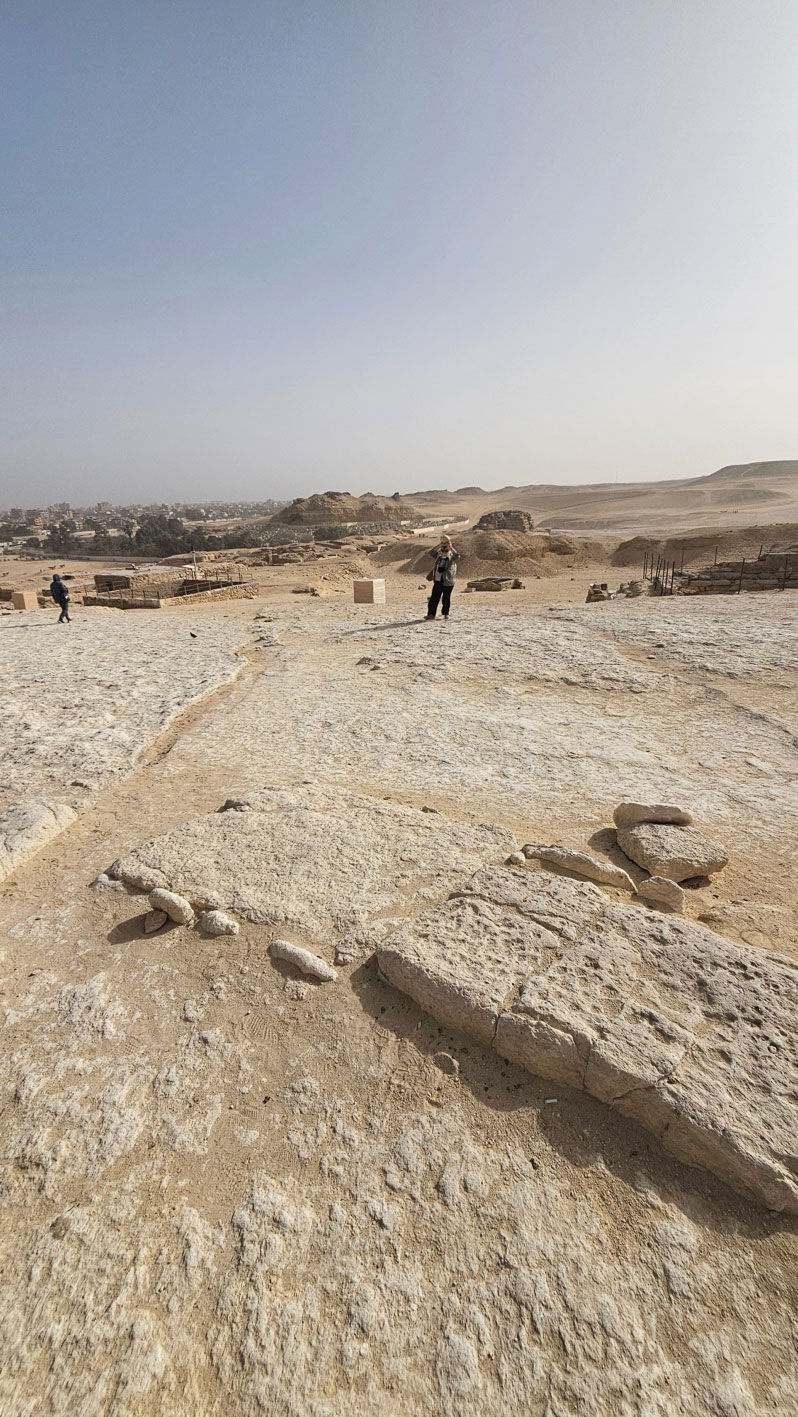
FIGURE 5. The “cart rut” like fissures on the surface of the stone causeway serving the Second Pyramid. They are aligned northwest-southeast, marking the approximate orientation of the plateau’s geology, which almost certainly determined its original orientation. (credit: Andrew Collins)
These realisations make sense of earlier theories expressed by the British engineer Rodney Hale and the present author proposing that the geographical layout of the three main pyramids at Giza mimic the astronomical positions of the three major “wing” stars of the constellation of Cygnus, both in the vertical plane, and in the horizontal plane (see fig. 7). (The present author acknowledges Robert Bauval’s Orion Correlation Theory, which similarly connects the spatial positions of the three Giza Pyramids with the astronomical positions of stellar objects, in this instance the three belt stars of the Orion constellation (see Robert Bauval and Adrian Gilbert, The Orion Mystery, 1993, and Robert Bauval and Graham Hancock, Keeper of Genesis, 1996. It is feasible that the two quite separate correlations, which relate to opposite ends of the Milky Way, are simply dual aspects of a more comprehensive picture of the night sky as it appeared at the commencement of the Pyramid Age.)
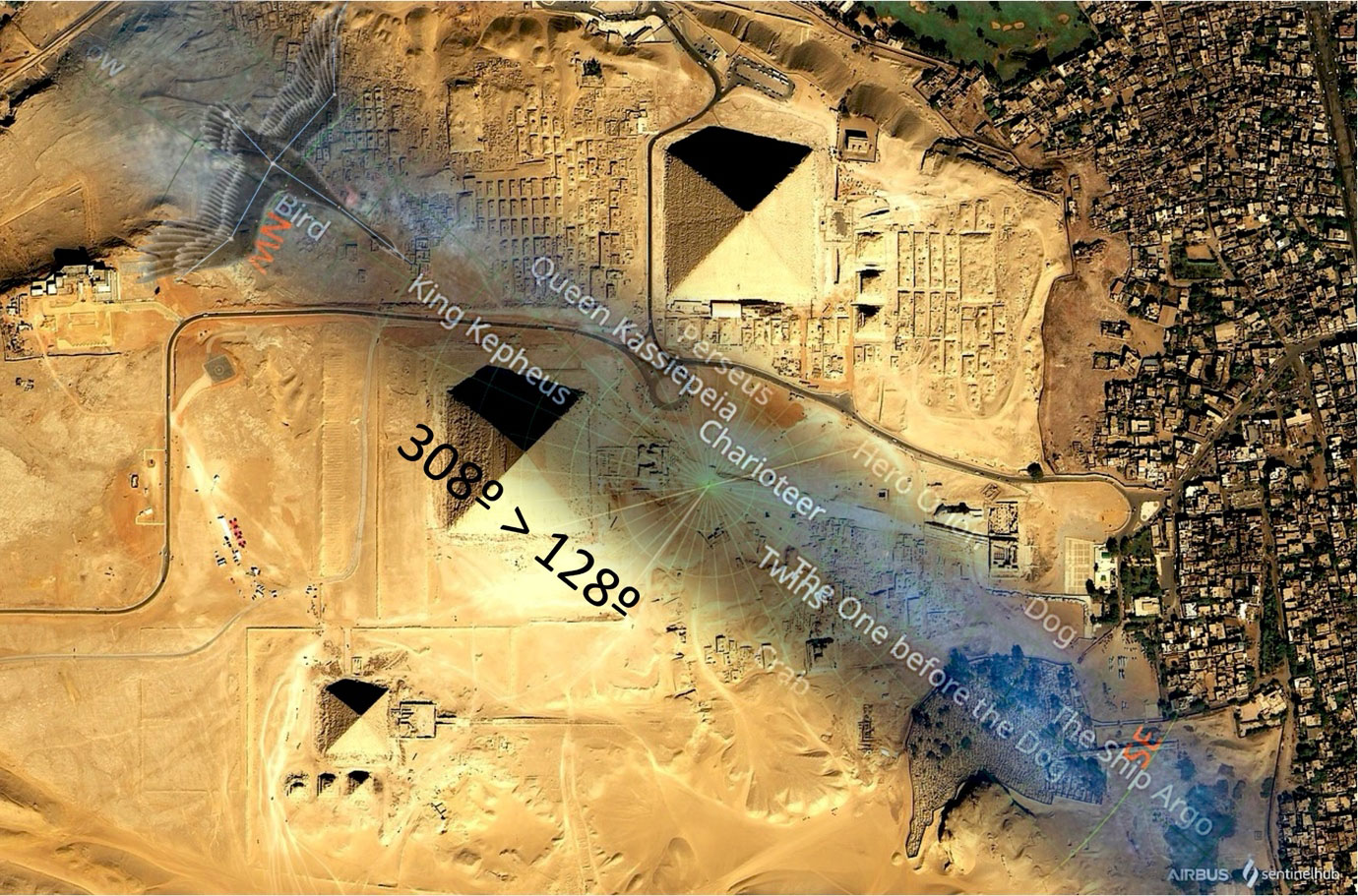
FIGURE 6. The path of the Milky Way as it would have appeared overhead Giza in the epoch of 2600 BCE at an angle of approximately 308º–128º. Note the stars of Cygnus setting in the northwest and those of Argo Navis rising in the southeast (credit: Andrew Collins/Google Earth/Stellarium).
The search for the location in the Giza-Cygnus correlation of Deneb, the brightest star of Cygnus, led Nigel Skinner-Simpson, Sue Collins, and the present author to the discovery of the Tomb of the Birds, which is located in the extreme northwestern corner of the plateau. In antiquity, the tomb was transformed into a multi-level sanctuary dedicated to a bird deity. Because of this, the present author became convinced that the presence at Giza of this avian cult, so close to the “Deneb spot” as we called it, echoed the fact that the stars of Cygnus have been universally seen as a sky figure in the form of a bird, usually one associated with either the transmigration of the soul or the concept of divine creation through the manifestation of a cosmic egg. Deneb also marks the northern opening of the Milky Way’s Dark Rift, known also as the Cygnus Rift, caused by dust and debris along the centre of the galactic plane. This dark region of the Milky Way was seen as the road or river to the sky world or lower world by various ancient cultures of the past.
In addition to being the womb of the goddess Nut, the stars of Cygnus can be indirectly linked with Sokar, a hawk-headed mummiform deity who represented death, resurrection and the darkness of the tomb. In the Am-duat text, which appears on the walls of many New Kingdom royal tombs, as well as in other similar funerary texts, Sokar (or Seker) is shown riding a winged snake through a section of the Duat underworld named Rostau. Since Rostau was the ancient name of Giza, there is every reason to conclude that Sokar was a guardian-protector of its cave underworld, something that convinced our team that the Tomb of the Birds was where we should start looking for a cave entrance; a hunch that proved to be one hundred percent correct.
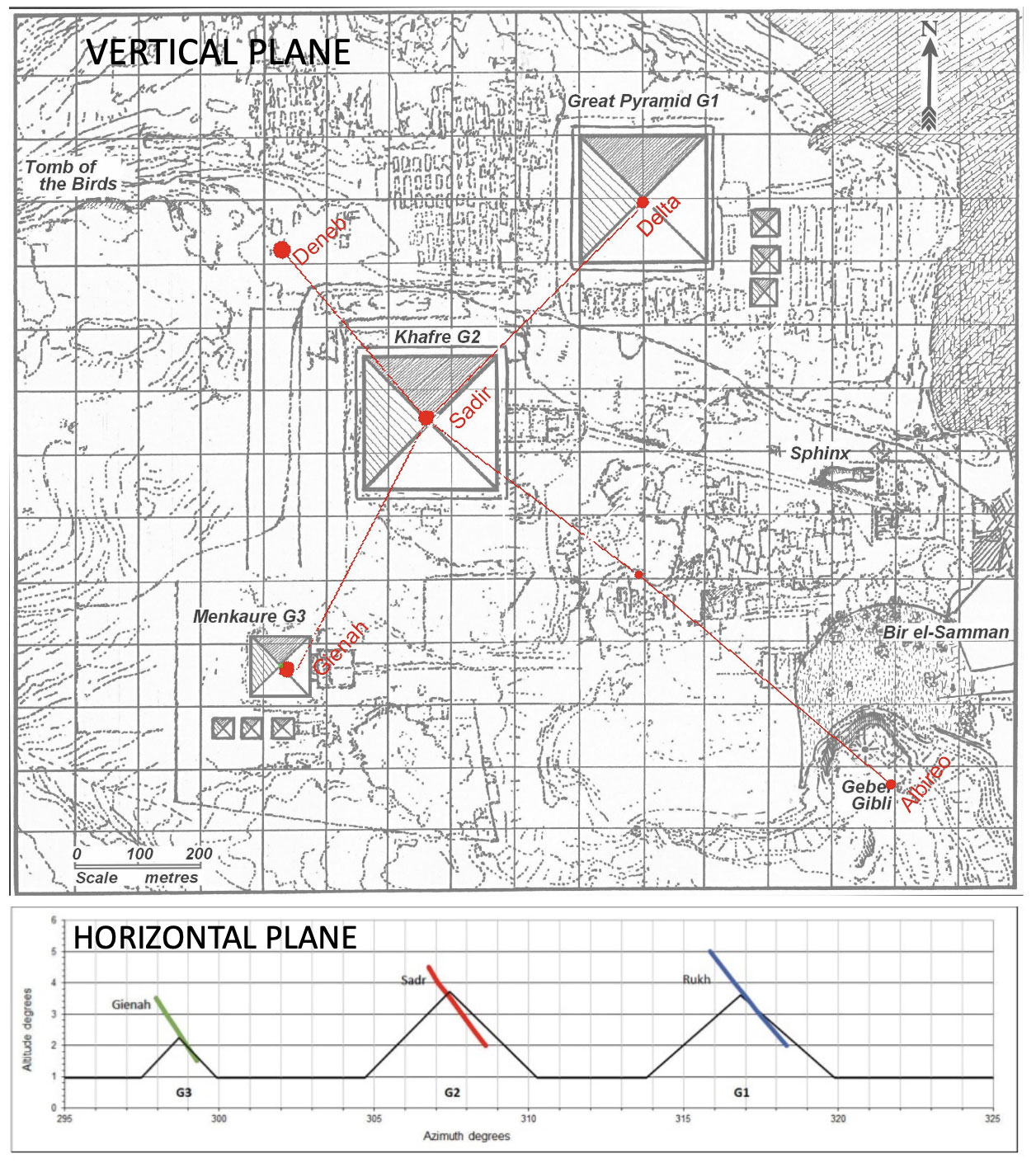
FIGURE 7. The Cygnus wing stars overlaid on the three Giza pyramids as seen in the vertical plane and the same three stars setting down into their respective pyramids as seen to the southeast of the plateau in the epoch of 2600–2500 BCE (credit: Rodney Hale/Andrew Collins/Google Earth).
The Great Diamond
One important matter remains to be discussed, namely what might await discovery beneath the plateau at Giza. A strange story told to the present author offers a major clue. According to an Arab Egyptian resident of Nazlet el-Samman, the village that has served the plateau for hundreds of years, the snake el-Hanash guards a great diamond in the “Hall of Records.” Should anyone attempt to enter this hidden realm, located somewhere beneath the plateau, the snake will spit in their eyes and blind them. One day, however, when the end of the world is upon us, a person will come along who will be blinded only in one eye. It will be this person that attains the wisdom of the great diamond.
Even with its use of the term “Hall of Records,” popularised by Edgar Cayce’s psychic readings and the 70-year quest to find its location, there seems to be a kernel of truth in this story. The blinding of only one eye to attain the diamond’s wisdom is clearly reminiscent of how, in Norse mythology, the god Odin is blinded in one eye so that he might gain wisdom and insight. According to Debbie Cartwright, the entire process can be explained in shamanic terms whereby the open eye sees the mundane world while the blind eye sees into the otherworld.
The great diamond of the el-Hanash story appears to refer to a power object known as the bnnt, or “embryo,” which in the building texts on the walls of the Temple of Horus at Edfu was associated with a subterranean realm known as the duat n ba, the “underworld of the soul.” According to Eva Reymond, the author of a full-length commentary on the texts titled The Mythical Origin of the Egyptian Temple (Manchester University Press, 1969), this apparently built structure probably existed in primeval times somewhere in the vicinity of Memphis, an area that included the Giza pyramid field.
If the bnnt-embryo is the ancient Egyptian name for the great diamond in the el-Hanash story, then what might this object have been, and does it exist today? The closest comparison to this type of power object is the Shiva Lingam of Hindu Vedic tradition, which is usually represented as round-topped conical objects ranging in size from a few inches to several feet. Many of the smaller lingams are made of river stones. Others are either meteoric in origin or made of gemstones. Some have been deliberately fashioned to look like faceted crystals.
Generally housed in a darkened central chamber or holy of holies beneath a main temple, lingams are revered as symbolic of divine creation through the coming together of Shiva (the masculine principle of consciousness) and Shakti (the feminine principle of energy). In the ancient Hindu faith of Shaivism, lingams act as interfaces between the mundane world and the realm or abode of Shiva. It is in this manner that the initiate is able to gain communication with the god and learn something of his wisdom.
It is likely that the bnnt-embryo of the Edfu Building Texts and the great diamond of the el-Hanash story both allude to a power object similar in appearance to the Shiva Lingam. Should this be the case, then it may also have been used for purposes of communication with a perceived source of divine creation. Most likely this power object did indeed take the form of a large polished stone or crystal, although what size it might have been remains unclear.
Incredibly, there is a very ancient form of Shiva Lingam known as the Maragatha (Emerald) Lingam (see fig. 8). Usually fashioned from emerald, a variety of the mineral named beryl, it is said to embody the highest frequency vibration rate among all the gemstones. In Shaivan tradition, the Maragatha (or Marakatha) Lingam is supposed to aid spiritual communication and, in doing so, enhance oneness with the god Shiva. The god Indra is said to have possessed seven Maragatha Lingams, which he worshipped to gain spiritual power.
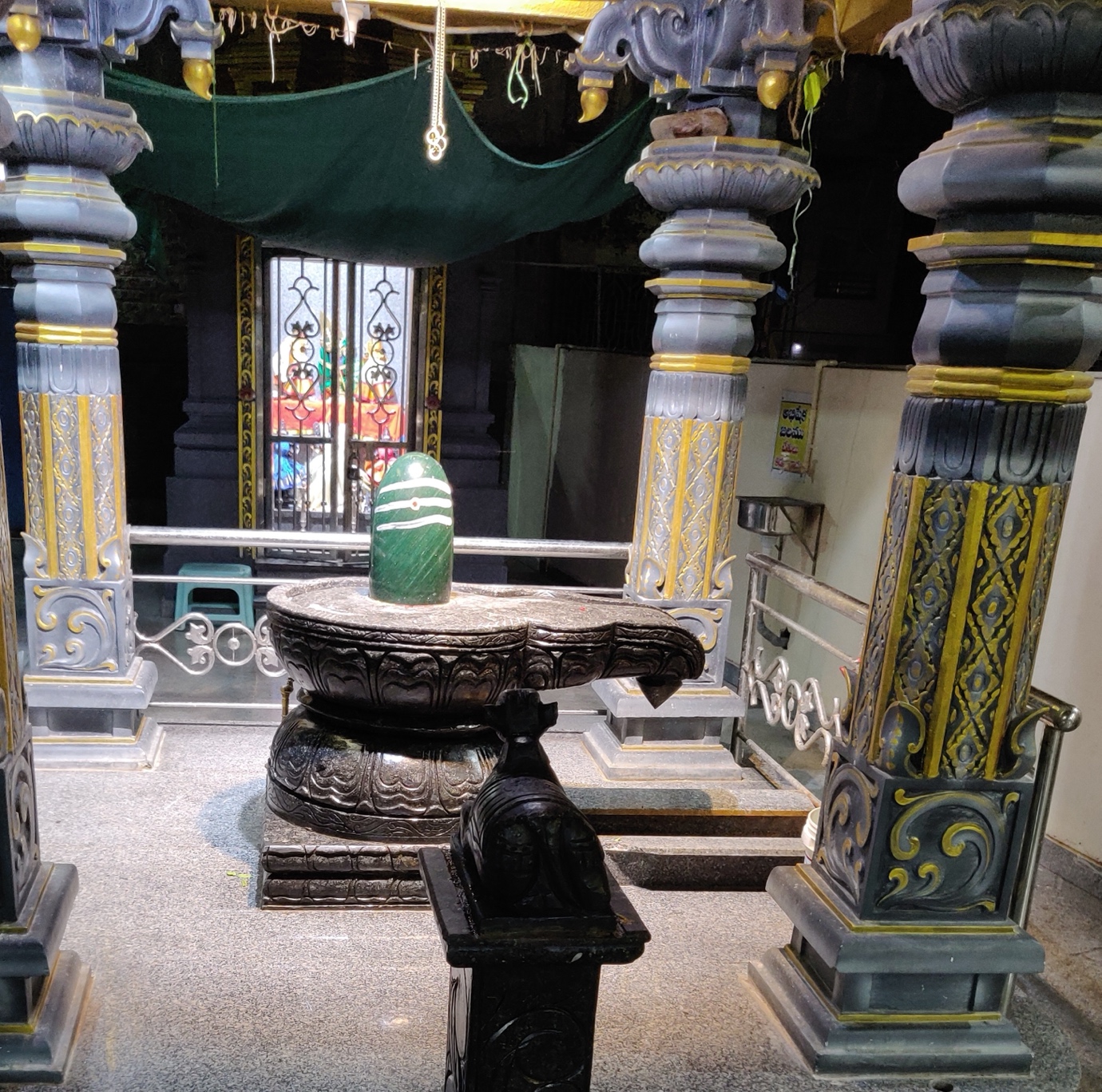
FIGURE 8. The Maratha Lingam at Sri Vijaya Ganapathy Temple in Khammam, Telangana, India (credit: Shrehar/CC BY-SA 4.0)

In the Maragatha Lingam, one is reminded of another similar power object—the Emerald Tablet of Hermes Trismegistus. In legend, the Emerald Tablet was considered a microscopic crystallisation of the macrocosmic universe, establishing the famous Hermetic axiom of “As above, so below.”
One legend, preserved by nineteenth-century French scientist and writer Louis Figuier (1819-1894) in his book L’Alchimie et les alchimistes (1854), records how Alexander the Great found the Emerald Tablet within the tomb of Hermes. This is said to have been located “in the depths of the Great Pyramid of Giza,” where it had been hidden “by the care of Egyptian priests.” This “emerald slab” apparently bore an inscription carved by Hermes’ own hand using “the point of a diamond.” (Figuier 1854, 40.)
Even though similar stories have the Emerald Tablet being found by Alexander the Great at Egypt’s Siwa Oasis in the Western Desert, Figuier’s account does provide credence to the idea that the Emerald Tablet is connected somehow with Giza’s subterranean world, and might thus be synonymous with both the bnnt-embryo of the Edfu Building Texts and the great diamond of the el-Hanash story. Remember, quite separate stories recorded in medieval times speak of the Tomb of Hermes existing somewhere in the vicinity of the Second Pyramid.
The other big takeaway from this realisation is that the subterranean structure spoken of in the Edfu Building Texts as the Underworld of the Soul seems to refer to some part of Giza’s cave underworld. The two are likely the same, and refer either to a unique artificial structure, or structures, located somewhere within the cave complex, or to the cave complex as a whole.
It is possible therefore to imagine that somewhere beneath the plateau at Giza in the deep past there existed a rock-cut structure (Cayce’s Hall of Records?) in which was housed a power object resembling the Shiva Lingam (arguably the Maragatha Lingam), which across time has been memorialised as the Emerald Tablet of Hermes (see fig. 9). Could such an object have been used by priest-shamans to create an interface between this world and the next, enabling communication with what might have been seen as a divine source of creation?
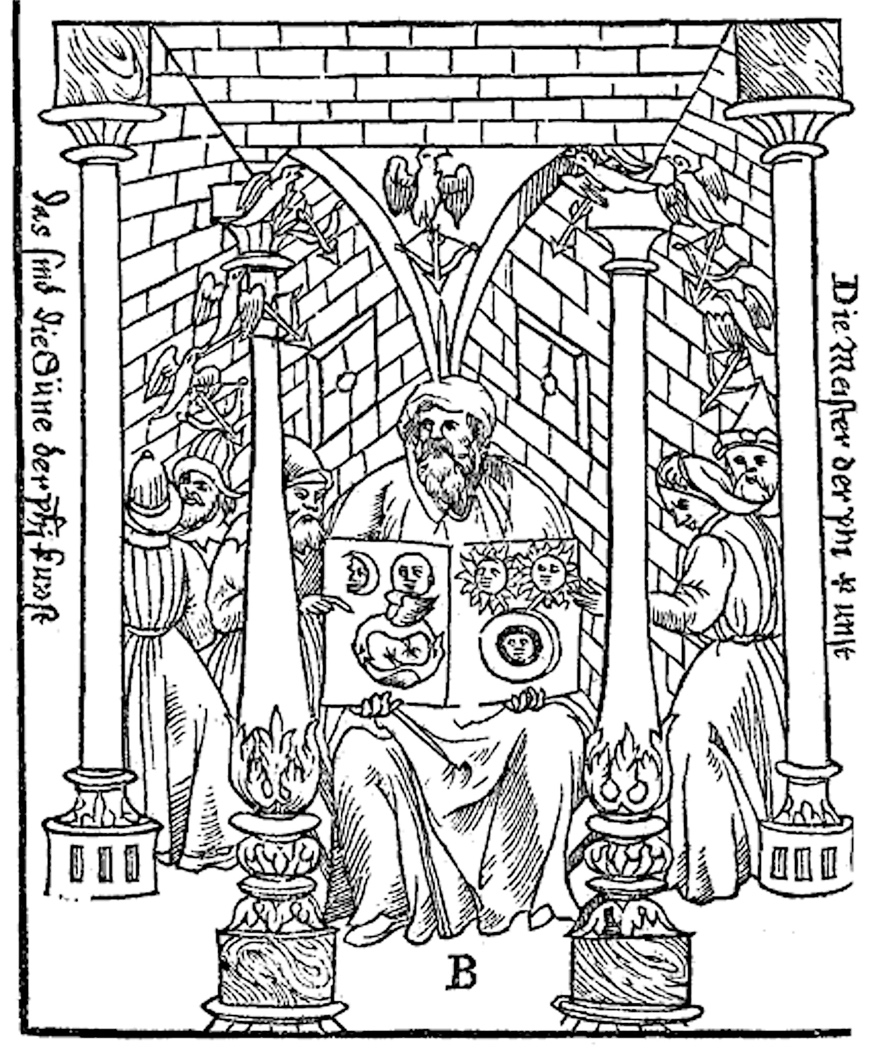
FIGURE 9. Woodcut showing Hermes Trismegistus holding the Emerald Tablet (from Pandora: das ist die edelst Gab Gottes by Hieronymus Reusner, 1582). Public domain
Who exactly these priest-shamans might have been, and where they came from, has yet to be properly established, although they do have their name; in fact, two. The Edfu Building Texts refer to them as p3wtyw, the Primeval Ones, and as wrw n wrw, the “Eldest of the Eldest,” or, simply, the Eldest Ones.
The Primeval Ones can thus be thought of as the first intelligent beings to have utilised Giza’s cave underworld (see fig. 10).
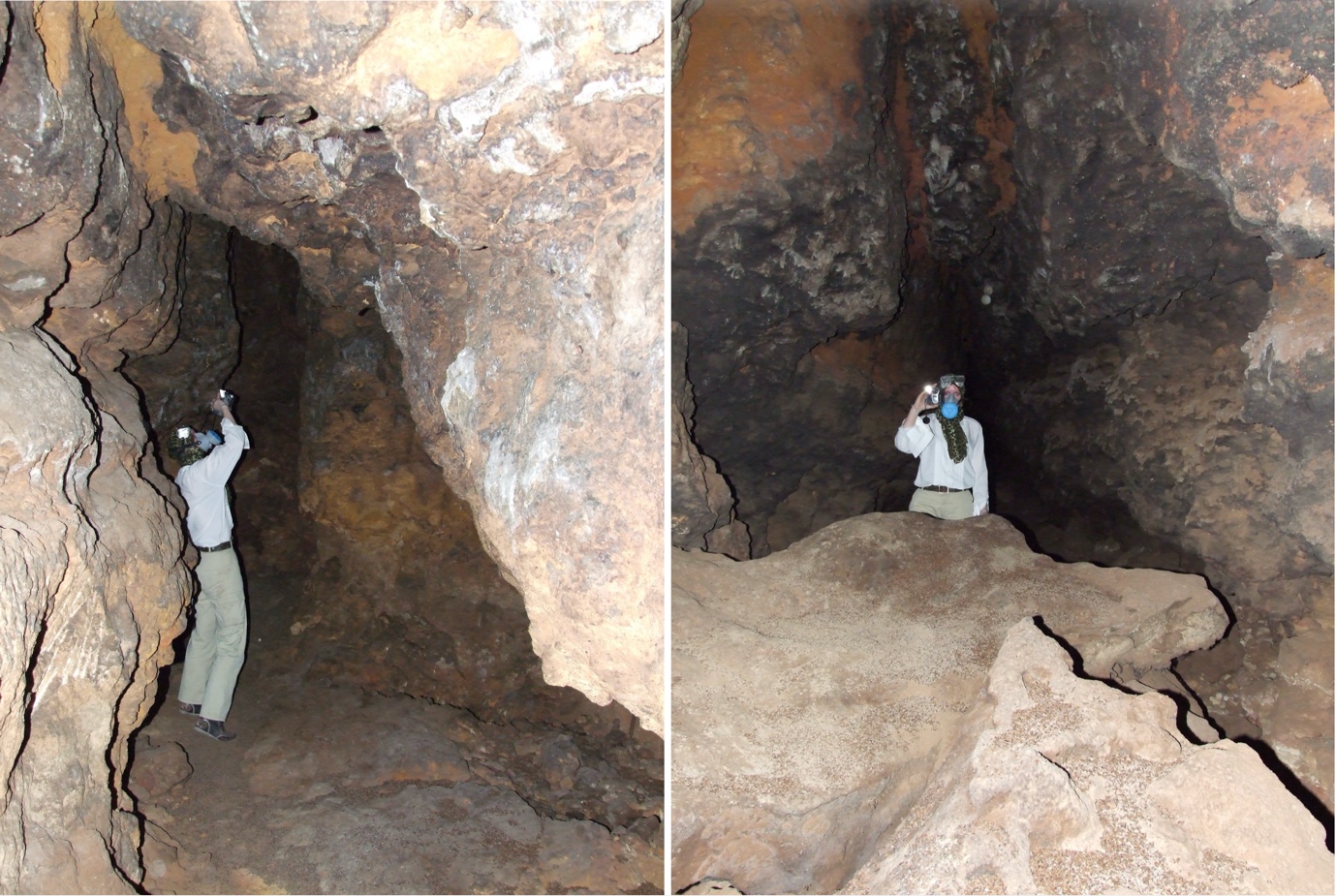
FIGURE 10. Two views of Giza’s cave world beyond the Tomb of the Birds (credit: Andrew Collins)
Whether or not they recognised the presence down there of a guardian snake like Mehen remains unclear, although in the Edfu Building Texts the Primeval Ones are indeed identified with an important snake known as irti, the Earth Maker. It seems possible therefore that the cave tunnels beneath the plateau at Giza were seen as the body of a snake that was itself an extension of the Milky Way in its role as the cosmic serpent. This connection would have been emphasised by the fact that, when situated overhead, the Milky Way traced the precise same angle as the caves and fissures that defined the original orientation of the plateau at Giza; a classic case of “As above, so below.”
Who were the Primeval Ones?
At times the Edfu texts speak of the Primeval Ones as divine, almost ethereal, beings, yet at others they have the mannerisms of flesh-and-blood human beings. If they were indeed human, they would have left a cultural footprint on the pages of human history, and this now becomes important to find. Tracking them down will require a comprehensive study of all Late Palaeolithic and early Neolithic societies that came to bear on early Nilotic cultures during the period known as the Later Stone Age, circa 33,000 BC to 6000 BC. This probably included members of the Taş Tepeler culture from places like Göbekli Tepe and Karahan Tepe in southeastern Anatolia, who almost certainly had links to key settlement sites such as Helwan, located on the east bank of the Nile, opposite the city of Memphis, and the Faiyum Oasis, situated in Egypt’s Western Desert around 60 miles (95 kilometres) southwest of Cairo. Both places supported advanced prehistoric societies as early as 8000 BCE, a topic discussed elsewhere by the present author (see, for instance, The Cygnus Key, 2017, and The First Female Pharaoh, 2023).
The Search for Lost Zerzura
Other human groups would, so Debbie Cartwright and the present author now suspect, following an investigation of key sites in the southern part of Egypt, have entered the Nile Valley from the Eastern Sahara, journeying via key sites such as Gilf Kebir and Jebel Uweinat in the southwestern corner of the country. Their point of origin was likely even farther west in the region of the Ennedi Massif in what is today Chad. There we find incredibly sophisticated rock art, including enigmatic human forms, that seem to have direct comparisons with other examples in Egypt’s Western Desert.
Such crucial genesis points of Nilotic culture would appear to have been memorialised in myth and legend as lost oases or lost cities such as Zerzura, which even today is said to exist somewhere in the Eastern Sahara.
Very likely Zerzura is an abstract memory of the fact that prior to 6000 years ago the Eastern Sahara was still green and fertile with lakes, rivers and wildlife. Only after this time did its inhabitants begin the long migration eastwards into the Nile Valley, where they would go on to shape the emergence of dynastic Egypt, especially in the south at places like Abydos and Hierakonpolis (known in antiquity as Thinis and Nekhen, respectively).
Understanding the evolution of all these sites, and the early human societies associated with them, will allow us to better understand not only what might await discovery beneath the plateau at Giza, but also how it might be interpreted when found. These then are the goals ahead of us as we move into a new generation of understanding regarding the primeval origins of ancient Rostau.
Postscript—October 2026
Since writing this article, a major development has occurred with regard to the use of SAR-based technology on the Giza plateau. A peer-reviewed research paper titled “Synthetic Aperture Radar Doppler Tomography Reveals Details of Undiscovered High-Resolution Internal Structure of the Great Pyramid of Giza” by Italian researchers Filippo Biondi and Corrado Malanga, detailing their findings regarding the potential discovery of previously undetected structures inside the Great Pyramid and published in the academic journal Remote Sensing in 2022, has been officially retracted. (1)
Serious concerns were raised regarding the methodology and interpretation of the SAR (synthetic aperture radar) data presented by its authors, with an investigation by the publication’s editors leading them to publish the following statement:
“In accordance with standard journal procedures, the Editorial Office and Editorial Board conducted an investigation that confirmed serious methodological flaws and statistical errors that were deemed to undermine the scientific conclusions of the article. As a result, the Editorial Board has decided to retract this paper as per MDPI’s retraction policy.” (2)
Biondi and Malanga have formally written to the journal disagreeing with the decision to withdraw their paper, citing reasons why their findings remain valid. (3)
Personally, I do not possess enough intimate knowledge of raw SAR data processing to fully comment on the technical decisions made by the journal, but I feel it is important to bring them to the attention of the ancient civilizations community.
What I will say, however, is that the publication’s editors were likely pressured into withdrawing Biondi and Malanga’s paper—four years after its initial publication—by skeptical detractors of their work (most likely the same type of establishment figures who police Wikipedia and refuse to allow researcher-writers like myself to maintain independent Wikipedia biography pages).
There is little question that the decision to formally retract Biondi and Malanga’s paper is going to have a serious impact on the validation of their highly publicized use of SAR data to detect underground structures beneath the Giza pyramid field. Journals are going to be extremely reluctant to accept papers for publication by the Italian team in the future.
So where does this leave their claims? Were the Khafre SAR Project, as Biondi and Malanga billed themselves, really able to detect deep underground structures beneath the Giza plateau, and the Second Pyramid in particular?
As already cited in the above, there are unquestionably deep underground features beneath the Second Pyramid. They were originally detected in 1977 by the Stanford Research Institute working in concert with Cairo’s Ain Shams University. The joint team was able to detect anomalies as much as 40 to 50 meters (130 to 165 feet) below the southeast corner area of the pyramid, as well as further voids directly beneath Belzoni’s Chamber and also below the monument’s northwest corner. (4)
Malanga and Biondi could thus very easily have detected either the same or similar structures using their own interpretation of available SAR data gained from commercially available satellite companies. What also seems clear is that an entire cave system exists beneath the monuments at Giza, accessible, at least in part, to those who came to occupy the plateau during dynastic times. These caves—formed by the actions of water across a period of hundreds of thousands, if not millions, of years—would appear to have been altered by human hands across an extended period of time.
As you know, I can affirm these facts, as my colleagues Nigel Skinner Simpson, Sue Collins, and I were the ones who rediscovered this cave system and put its official entrance—the Tomb of the Birds (NC2), located in the northwestern corner of the plateau—back on the map in 2008. (5) There are almost certainly other entrances to this cave complex, and arguably further subterranean structures, which in the coming decades will hopefully come to light.
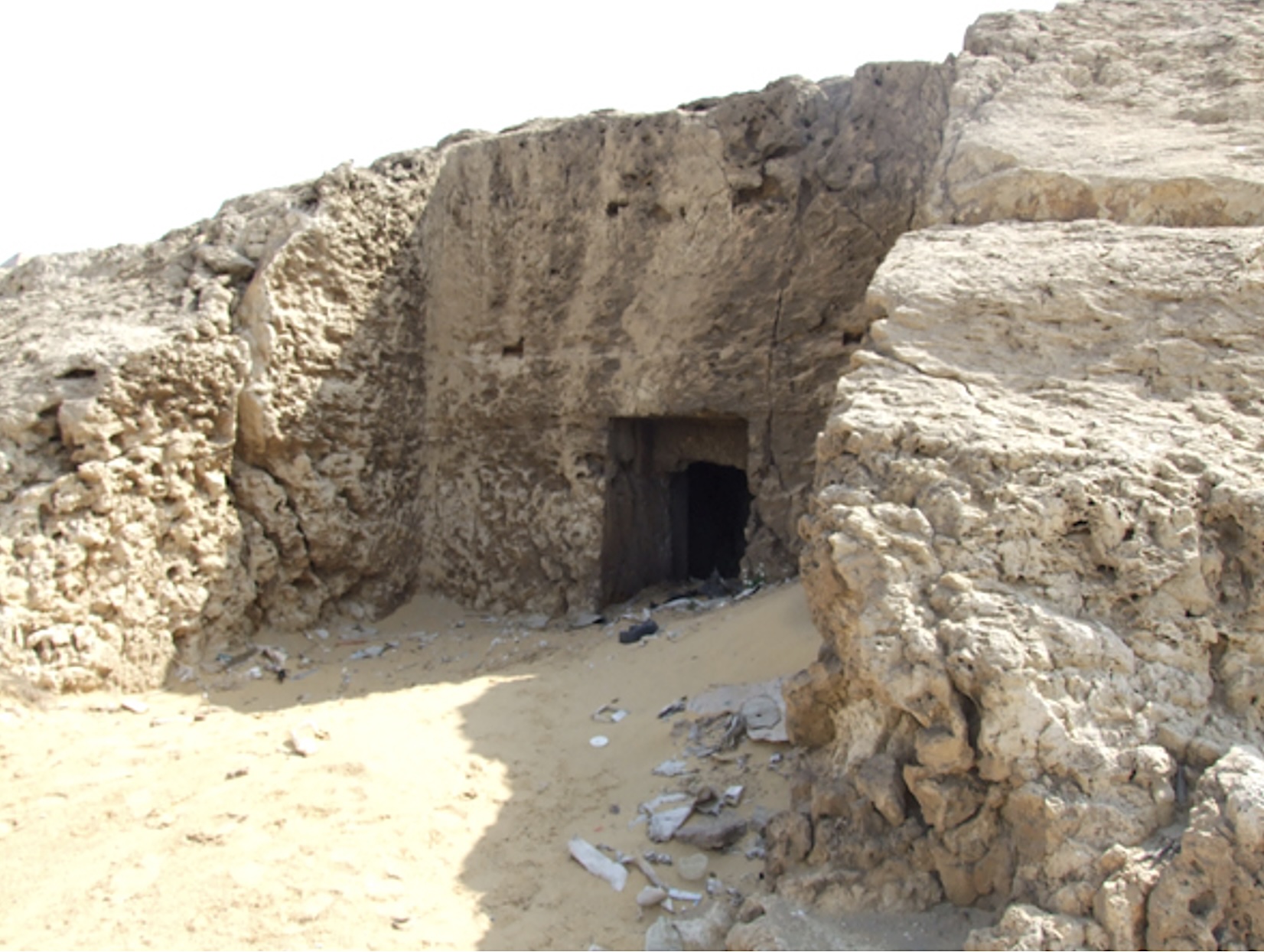
Figure A. The Tomb of the Birds, the only official entrance into Giza’s cave underworld, recently sealed off from public inspection by Egyptian authorities. (Credit: Andrew Collins).
Regarding Biondi and Malanga’s research on underground features at Giza, it is crucial they get their revised work peer-reviewed and published before their findings can be taken seriously again. In addition to this, their methodology and findings must be vigorously tested, validated, and replicated by independent scientific teams.
For now, let’s continue to debate this matter with a healthy skepticism, and encourage further research regarding what really awaits discovery beneath the plateau at Giza.
Bibliography
Figuier, Louis. 1854. L’alchimie et les alchimistes: Essai historique et critique sur la philosophie hermétique. Paris, France: Victor Lecou.
All other references related to the contents of this article are to be found in the book Beneath the Pyramids by Andrew Collins, published by 4th Dimension Press in 2009 with a fully updated edition released in 2025. It is available now to purchase from Amazon.
Acknowledgments
The author would like to acknowledge the following for their help and inspiration in the creation of this article: Debbie Cartwright, Nigel Skinner-Simpson, Greg and Lora Little, Nick Davies, and John van Auken.
1 Private researcher. Email [email protected]
Postscript Footnotes & References
1. RETRACTED: Synthetic Aperture Radar Doppler Tomography Reveals Details of Undiscovered High-Resolution Internal Structure of the Great Pyramid of Giza. See Remote Sensing (August 22, 2026) 18 (16), 2679. https://www.mdpi.com/2072-4292/14/20/5231
2. “RETRACTED- Synthetic Aperture Radar Doppler Tomography reveals details of undiscovered high-resolution internal structure of the Great Pyramid of Giza.” University of Strathclyde website. https://pureportal.strath.ac.uk/en/publications/retracted-synthetic-aperture-radar-doppler-tomography-reveals-det/
3. King, Jordan. 2026. “Bombshell Great Pyramid of Giza Study Retracted.” Newsweek website (September 07, 2026). https://www.newsweek.com/bombshell-great-pyramid-of-giza-study-retracted-12412886
4. Moussa, A. H., & Dolphin, L. T. 1977. “Applications of modern sensing techniques to Egyptology: A report of the 1977 field experiments.” Stanford Research Institute. https://www.ldolphin.org/egypt/egypt2/index.html
5. Collins, Andrew. [2009] 2025. Beneath the Pyramids. Virginia Beach, VA: Fourth Dimension Press. https://www.amazon.com/dp/0876049900
Excellent article , I believe Biondi and Malanga‘s SAR is correct, since there are caves beneath the 3 pyramids, just the shear weight of the pyramids would require something (platform with cylinders) to hold them , especially since the caves extend very deep under the pyramids, again , great article, its a shame the truth always has to be hidden from us.
no one likes this hypothesis.. I dont know why… 🙂
out of Africa is true for humans, the Black, Asians, sub Asian continent humans ARE from earth, but the white humans called caucasians because because of the Caucasus mts where I have decided the Story of Noahs Arc “landed” originates back in the mist of time.. this Arc with its flaura and fauna species of 2 x 2, male and female, was in fact a space shuttle bringing maybe a dozen or two dozen white human scientists escapeing from their destroyed climate changed planet, through Sun activity, or maybe they predicted an asteroid from the same batch that destroyed the dinosaurs here comming their way, or they destroyed their own atmosphere themselves, .. eitherway inhabital Venus was heading to what it like now totally uninhabital, as this shuttle likely crashed maybe some or more of the scientists suvived a pocket of white venusian humans on an alien world which also had a primative human culture… stuck in the Levant region of earth..so called cradle of civilization. their knowledge introduced farming etc, but obviously with that few a people the gene pool would be to low to survive. but maybe there were many shuttles as they fleed their destoryed planet.. after all this is only a hypothisis based on word of mouth tales, sagas, stories told down over maybe hundred thousand years before the first form or writing was introduced leaving what we see today…stories around the world of gods from the sky, or like the one in central/south america…. the bible also being an alegorical book of the precession of the equinoxes…. starting at gemini with Adam and Eve, isaac and Esau and all the other dual aspects , followed by the main character Abraham.. from UR of the Chaldees ended child sacrifice and introduced bovine sacrifices (beacuse the equinox era of Taurus had started), and so it was until the next main character Moses came along lived studied in Egypt told the israeli eygptians to sacrifice lambs and put blood over their doors for the pass over (as the equinox was passing from from Taurus to the ram Aries), then later at mount Sinai, he went up the mountain to get the law, comes back and find they reverted to the old way religion of bull worship casting a golden bull, Moses being annoyed cast the tablets down on the ground causeing the ground to split apart, then saying “those who want to stay in the past die there those who want to live in the future follow me”.. and so the age of Aries came about (due to that contellation at the equinox arising), and so lambs were then sacrificed untill the last lamb of god appeared.. Jesus.. who introduced fishers of men and the age of Pisces that had begun at the eqinox, then as he is standing on aquarious,with the fishermen in their boatnot catching any fish beacuse the fishermen were fishing on the Sagitarrius side of Aquarious, so werent catching fish, so jesus said cast your nets to the other side… the side of Aquarious that is pisces, and they caught an abundance of fish, he chose 12 disciples to represent the 12 constellations then the feeding of the 5000 with 2 pisceian fishes and the 5 great ages of loaves of bread, representing in order in the bible, they recorded from Gemini, Taurus, Aries, Pisces.. and forward to Aquarious for the last supper.. “follow the MAN WITH THE WATER PINCHER” Jesus says answering the question “where will we have the last supper”….. 5 great ages 5 loaves of bread, in the age of pisces the 2 fishes….
Indigenous tribes didnt care about any this, they just lived.., Australian Aboriganies, South American rainforest tribes.. sub continent Asians all very happy for millenia after millenia, no need to mess about,if it aint broke no need to fix it, DNA does what DNA does… the dinosaurs existed for over 100million years from around 140million years ago to 65million years ago, and if the meteor hadn’t hit maybe they would still be here today.. in all that time dinosaurs never evolved to invent the steam engine, or split the atom, in a 100million evolution years nothing, while white humans have only been around for about 500,000 years with robots and drones on MARS… to destroying the earth climate hmmm…
its a hypothisis that can only be rejected when Venus is properly explored… they destroyed their world, now we are here destroying this world… makes you wonder
enjoy..
thank you for your time
geoff
Cool. Thanks Geoff.
an addendum to my previous post….
I was the 1st and only student to be exemp from the religious instruction classes of the time in an all boys grammer school that was very strict in all ways.. before comprehensive education.
I had pondered this since i was 9 years old, yes.. as a 9 yr old choir boy since i was 7 yrs old, now at 13 I decided RE was not for me, so I used that lesson time to join others in what was known as free priods in the main hall supevised by various teachers… I got away with it for a while till the RE teacher found me and dragged me licking and screaming by the ear to the headmasters office for a caneing.. yep we were caned in those days… So there I explained all this to the headmaster, and he was well impressed at the age of 13 I’d come to this conclussion from really reading the bible to get to it..
So he said to my teacher I think this young boy doesnt ned RE, but I must emphasis that the free period be dedicated to other school work”… ! couldnt believe it, my teachers face was a picture .. and so i was excempt from RE…
at that time tho’ I did have a niggleing doubt.. I had never heard of the PRECESSION of the EXINOXES, because at that time I noticed in my dads newspaper open at the daily horoscope page.. the constellations zodiacs were the wrong way to my theory, they were Aquarious, Pisces, Aries, Taurus, Gemini etc… I didnt mention that to the headmaster for obvious reasons, So I shevled the theory in the back of my mind for years.. untill the internet started and i came across Graham Hancocks web site… so read his books, then came across robert bauvall and read his books.. and learned about precession of the equinoxes 30years later.. I thought …. hang on a minute… where’s that box…. in the attic.. dug it out .. all my years of collected stuff.. sort of things we humans tend to do for some reason, and there is was, my scrap book with it all in… I had inadvertently discovered precession of the eqinoxes at 11years old without knowing it … then i thought .. how come no one else has thought this aswell.. am I that unique…I was so chuffed.. I did post it on Grahams web site message board over 20yrs ago.. doubt if its around now..
anywway…there it is…
Geoff
Great work guys
Considering, the letters in “Bnnt’, it almost certainly refers to ‘Bennu’, the Heron which symbolized the Ba (soul) of the Sun God. Is the ‘Bnnt’ the same object as the ‘Egg of the Bennu Bird’ (Bnbn-stone) which was the cental egg-shaped stone that stood in the center of Heliopolis?
really intersting work Andrew
what do you make of this?
https://www.scribd.com/document/49692446/The-Chambers-of-the-Deep-Jim-Hurtak
It would be great if we could have some kind of articulate response by the Khafre team themselves to the retraction of their paper by the journal. I agree that the retraction is sabotage by pressure groups of the usual idiots. However that happened in August and it is October and there’s nothing on their or Trevor’s channel responding to the situation. Four years is absurdly long for a journal to let something sit as peer-reviewed and then suddenly retract it simply because further discoveries were made that changed the world. Surely all the testing and investigation IS the peer-review process itself? If not, then what the fuck is it for? How shabby for a journal to let something in, let it sit four freaking years, and then act like it’s somehow not their fault in the first fucking place for not detecting the problems DURING THE REVIEW PROCESS FOUR YEARS AGO AAAARGH academia is so fake and gay
Who were the “peers” that “reviewed” the paper four years ago? Clearly their reviewing skills suck!
and what is their excuse for initially missing the supposed issues that only just now caused the paper to be retracted? What is the peer review process if not definitive scrutiny? Out to lunch or what?
It’s actually much worse for the journal than for the Khafre team as it exposes the pretentiousness of the entire peer-review system (a system designed at least in part by Ghislaine Maxwell’s dad, apparently – I wonder if the academics complaining about the Khafre team’s paper are on that team, or have shall we say, leverage over the journal editors, for one reason or another? ).
It’s just another priesthood.