




INTRODUCTION
Zep-Tepi: The Binding of Time and Space is an inquiry into the origins of metrology that poses a key question: Where and when did our system of metrology first originate? (in particular, the 360° circle, longitude/latitude and the common divisions of space and time). What might appear at first to be a simple question, however, involves challenging several well-held beliefs, particularly in the field of Egyptology, Abrahamic scripture and mythological interpretation. At present, this knowledge is still attributed to supernatural or semi-mythological beings: For example, in Sumerian myth, Enmenduranki is given it by “the Gods” after flying to the heavens on a giant Eagle; whilst Abrahamic scriptures speak of the “Watchers”, revealing it to Enoch as emissaries of god. These explanations are obviously insufficient with a clear absence of scientific fact, so the question remains: How and where did the knowledge first originate?
The First Time
The title itself provides the first clue to the central proposition. The term Zep-Tepi is associated with the ‘First Time’, when the ‘Builder Gods’ occupied pre-dynastic Egypt and established cosmic order. While this has traditionally been understood as describing a mythological epoch, the book proposes a more literal interpretation, referring to the introduction of an astronomically based system of metrology, which actually ‘bound’ time and space together. While conventional thinking credits the ancient Greeks with creating our present system of longitude and latitude, this investigation suggests that the ancient Egyptians, in particular, had adopted the same system far earlier.
The narrative follows a journey of discovery through the ancient world, revealing the presence of the same ancient metrological system in architecture, mythology and religion, all of which appear to contain remnants of an identical scientific framework. The synthesis of varied disciplines such as modern archaeology and DNA studies alongside the ancient chronologies and historical records offers a new and testable model for how the origins of this ancient knowledge led to the creation of the first Axis Mundi at Giza/Heliopolis from its earlier source rooted in the megalithic culture at Göbekli Tepe, also home to the Biblical prophets.
The book’s beginning leads with the proposal that the Nile Delta (Heliopolis) was deliberately chosen as the Axis Mundi or central pivot to ‘bind’ or ‘anchor’ time and space together using a pre-existing system of metrology. This theory is supported by the dimensions, alignments and proportions of the pyramids, which arguably reflect a deeper metrological and cosmological purpose. While the idea of Giza as an ‘axis mundi’ is not a new one, recent studies have shown that the Nile Delta pyramid complexes were positioned in relation to Heliopolis (from which certain stars in the ‘Decan’ would have been observed setting behind the pyramids, creating a celestial ‘clock’ along the horizon). As such, it must now be considered that the placement of these pyramid complexes along the Nile was part of a larger design centred on Heliopolis and not Giza. This intellectual shift opens the way for a new understanding of the original function of the Nile Delta landscape and begins to explain why it was selected in the first place.
The potential presence of surveying in whole degrees dates back to a period long before the Babylonians and Greeks, and it remains a subject of great contention. However, the origins of Giza and Heliopolis both trace back at least to the 1st dynasty, suggesting that an original design was being followed from this time and possibly earlier. However, when attempting to determine the origins of Egyptian astronomy and mathematics before this, we encounter a wall of resistance from the establishment narrative. Regardless of this, the ‘spontaneous’ explosion of knowledge between the 1st and 5th dynasties (along with the introduction of Isis and Osiris) remains of particular interest as whoever it was that selected the 30th parallel for their creation, did so at the same time that Sirius had its heliacal rising on the summer solstice at Giza/Heliopolis. The importance of Sirius is repeatedly emphasised throughout this book and is proposed to lie at the heart of the system of metrology still used to this day.
Central to the theme of the book is the 45° axis that runs between Giza and Heliopolis, or rather the continuation of it to Baalbek (also called Heliopolis), then Mt. Ararat. The extension to Baalbek offers one of the best proofs for applied cartography/surveying in ‘prehistoric’ times as the distance between the sites creates an almost perfect 4:5:6 triangle (Fig. 1). While this finding might be pushed aside as coincidence by some, other ancient texts specifically connect the two sites such as Macrobius who said: ‘The Assyrians too in a city called Heliopolis worship the sun … The statue of a god was brought from the Egyptian town, also called Heliopolis…’ (Saturnalia, 1.23.19). The connection between regions is also echoed in the mythologies of Isis and Osiris (whose decapitated body was washed on the shores of Byblos, where a temple of Isis once stood), and the numerous references to both Gods at Giza ‘The House of Rosetau’. However, it is the discovery of Serekh’s with Narmer’s cartouche from the same geographic region that is of most interest, as these greatly strengthen the argument for an Early Dynastic Egyptian influence at this otherwise isolated and enigmatic monument.
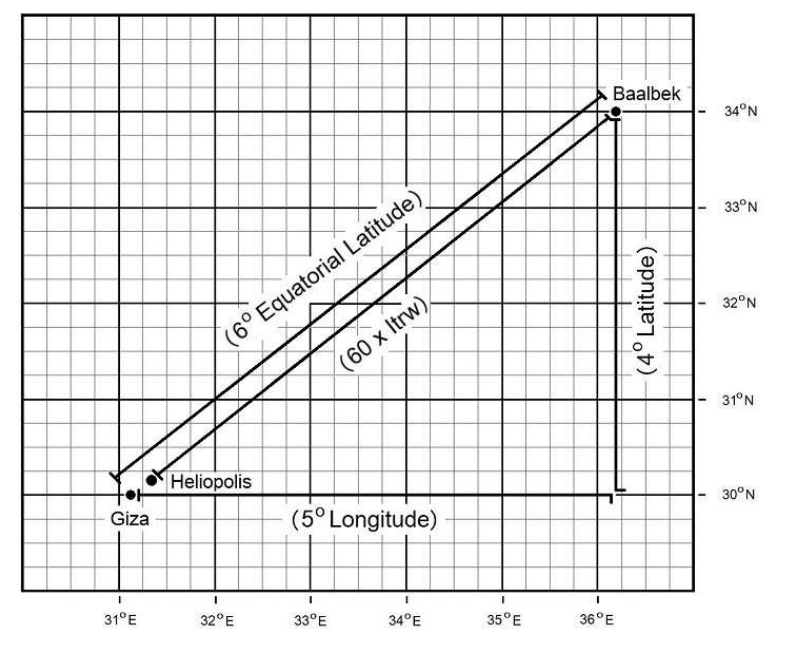
(Fig. 1) Illustration of the 4:5:6 triangle between Giza and Baalbek.
When this same 45 ° alignment is projected further, it reaches Mt. Ararat (Mt. Mashu), where the oldest Sumerian, Egyptian, and Abrahamic mythologies first converge, mirroring themselves through the Epic of Gilgamesh, the Egyptian Book of the Dead, and Abraham’s journey to Egypt. Recent archaeological discoveries in the region of Harran (i.e., Gobekli Tepe, etc.) have revealed the significance of a previously lost megalithic culture, from which the book concludes that the first true system of metrology was produced by a priestly caste of ‘star-watchers’. How this system evolved, then came to Egypt and why it took the final form it did is considered in this tapestry of mythology, cosmology and modern archaeology, through which a new narrative emerges converging next in Egypt at the time of Nimrod (as a composite of Narmer and Etana). This secondary unification of the Old Testament with the Egyptian and Sumerian chronologies not only reinforces the significance of the alignment but also exposes a tradition of associating the most important patriarchs with significant moments in the Sothic and Zodiac cycles.
What emerges from the multitude of mythologies is the proposal of a single underlying narrative in which the same record of events is described, but from different cultural perspectives. It is through a comparison of these ancient chronologies that one finds the synchronisation of the major patriarchs to the Sothic and zodiac cycles. These occur at an almost perfect 3:2 ratio with the Sothic cycle repeating three times over the duration of two zodiac symbols, in this instance Taurus and Aries, symbolised by Enoch (Enmenduranki) c. 4,320 BC when both cycles were synchronised, followed by Abraham, until the emergence of Christ (Pisces the fish) when both cycles synchronised again. This number (4,320) is the same as the ratio of the Great Pyramid to the northern hemisphere, the age of Enmenduranki in the Sumerian chronologies, the number of seconds in an equinoxial day and the same number is found in the mythologies of several other ancient cultures around the world. The conclusions of this book raise several questions over the Greek origin of both the zodiac (precession) and metrology, the proscribed chronology and purpose of Giza and how we interpret mythology. In addition to challenging the traditional views, it provides a combination of religious, astronomical, mythological and cultural references which all point to the region of Harran – home also to the Gobekli Tepe culture, the biblical patriarchs and the ‘Sabian Star Watchers’ who made their annual pilgrimage to Giza for thousands of years.
Key claims and observations
- Zep-Tepi as a Metrological reference: Zep Tepi (zp tpj) is mentioned in the Edfu texts, beginning with an homage to “Horus of the first time” that leads to the creation of the first temple. This places Zep-Tepi in the Egyptian mythic era when the “Builder Gods” and the “Lords of Light” were said to have dwelt among humans. Whilst mainstream Egyptology prefers to relate this ‘first time’ directly to the period of creation, the book proposes a more literal definition of Zep Tepi not as a mythical time but as an actual merging of time and space with a real-world system of metrology, introduced into Egypt at the same time that Isis and Osiris were placed into the creation myth and the Sothic cycle made its first official appearance.
- Origins of 360° Metrology: A key claim of the book is that longitude and latitude (or their conceptual precursors) were in use before the Greeks. It has long been noted that the dimensions of the Great Pyramid at Giza reflect a 1:43,200 scale of the northern hemisphere. These dimensions also produce a circumference of ½° of latitude at the base of the pyramid and represent the number of seconds in an equinoxial day, with the same number appearing in mythologies around the ancient world. Whilst these facts are certainly suggestive of an ancient system of metrology, it is the finding that an extension of the alignment from Giza to Heliopolis (now commonly known as the ‘Giza-axis’) continues to the other ancient Heliopolis or ‘City of the Sun’ called Ba’albek in Lebanon, simultaneously creating a 4:5:6 triangle in whole degrees, which provides the strongest evidence for the recognition of latitude/longitude and a knowledge of spherical geometry in a pre-Greek setting. Whilst the use of longitude and latitude is still credited to Greeks such as Eratosthenes and Plato, the presence of this 4:5:6 triangle suggests a far earlier application.
The book traces this advanced metrological system back to the megalithic region of Göbekli Tepe in modern-day Turkey, where the first suggestions of Sirius ‘worship’ can be found. The same region is later recognised as the home of the Biblical patriarchs and the Sabian Star worshippers from Harran. This suggests an older locus for the most primitive origins of the Zep-Tepi tradition, not just in observations of Sirius, but also in megalithic architecture, symbolic carvings, alignments, cosmology and mythic associations. These connections lay the foundation for the argument that an ancient culture of ‘priestly star-worshippers’ influenced multiple early civilisations. Drawing on archaeology and recent excavations, along with population genetics / DNA studies, the book shows how migrations/settlement patterns could have enabled the transmission of such knowledge from deep prehistory — particularly from Anatolia to the Near East to Egypt, and the Levant.
- Mythological Convergence Around Nimrod: The book identifies similarities between certain key characters in Sumerian, Egyptian, and Biblical texts, leading to the proposal that these mythic figures are more archetypal expressions of a shared tradition rather than distinct historical figures in different cultures. Correlations between Sumerian and Biblical chronologies for example show a convergence in the pre-diluvian period with Enmenduranki and Enoch, who were both initiated into the ‘secrets of the universe’ then ‘ascended’, followed by Utnapishtim and Noah who survived the ‘Great Flood’ in an Ark. As already noted, the 45° SW-NE alignment from Giza ultimately extends to Mt. Ararat (Mt. Mashu) where the Sumerian, Egyptian and Abrahamic mythologies are mirrored in the Epic of Gilgamesh, Osiris’ journey in the Egyptian book of the Dead and Abraham’s journey (from his early years spent with Noah) to Heliopolis in Egypt.
The figure of Nimrod becomes the focal point for the second proposed mythological convergence. Whereas the Old Testament mirrors the Sumerian texts in the pre-diluvian period, after the ‘Flood’, it moves to an Egyptian setting, placing great emphasis on the activities of Abraham. It is here that we are introduced to Nimrod, described as a mighty hunter who unites the nations and eventually challenges God’s supremacy. Nimrod is, however, an exclusively biblical character, yet the Egyptian and Sumerian texts provide equivalent counterparts with an abundance of specific references to similar events (such as Etana and Nimrod both flying to heaven on an eagle’s back), suggesting another convergence of their chronologies at this time.
The Egyptian equivalent of Nimrod is identified as Narmer/Menes, who was a follower of Horus and is best known for uniting Upper and Lower Egypt. The book elaborates on the potential relationships between Narmer, Etana and Nimrod, proposing a second convergence which can be dated to the 1st Dynasty. The idea that Nimrod is a composite of Narmer and Etana lends to the idea that while each provides a different perspective, they all refer to the same major geographical and religious shifts that occurred during this time. This single-narrative approach links seemingly disparate mythologies into a unified cultural thread. Rather than dismiss these as pure myth or allegory, it is argued that these legends deserve a re-examination of figures such as Nimrod, Narmer and Etana for the possibility that these may be names for the same person or same archetypal character (builder king or culture founder), who, it is noted, were all posthumously associated with Orion after their deaths.
- The Chronologies and Astronomic Cycles: The book explores how mythological chronologies align with astronomical cycles, specifically the timing of the Biblical patriarchs in relation to Sothic and Zodiac cycles. The synchronisation of religious figures with astronomical events is central to the book’s larger focus on archaeo-astronomy and its role in ancient metrology. From the time of Enoch (before the flood) to the appearance of Christ (after which time was reset to zero), covers a period of 4,320 years or two astrological symbols (Taurus and Aries) in the precessionary cycle (the same figure is found in the proportion of the Great Pyramid). It is suggested in conclusion that this date marks the true moment of Zep-Tepi, when Heliopolis was first selected to mark the synchronisation of the Sothic cycle with the astrological.
Should these traditions be shown not as isolated but rather reflecting a common framework of timekeeping rooted in celestial observation and encoded in myth, then the timing of the Biblical patriarchs to astronomical cycles reveals a means of record keeping that standard historiography has long neglected. This idea, in itself, is not new, but rather a composite of theories proposing associations between the astrological cycles and the Egyptian and Biblical chronologies. All of which lends credence to the idea that ancient civilizations possessed a sophisticated understanding of astronomical cycles, using them not just as curiosities or annual markers, but as anchors for a greater understanding of spatial and temporal measurement, which was eventually expressed in the form of a single universal system of metrology based on observation of the Sun and Sirius.
- The Geometric relationship between major Abrahamic sites. The initial 45° SW-NE alignment from Giza to Heliopolis, then Ba’albek and finally Mt. Ararat introduces another unexpected element to the investigation as it reveals a pattern of association with the biblical Abraham. Indeed, the alignment itself appears to follow Abraham’s life journey from Mt. Ararat (where he ‘learned the ways of the lord’ from his time with Noah) until his pilgrimage to Heliopolis, where he is said to have ‘Taught the Sciences’ to the Heliopean priesthood. Both these locations share ancient reputations as apobaterions where mankind emerges from a watery chaos, suggesting an archaic origin. Following on the Abrahamic theme, a similar 45° SE-NW alignment can be seen to run through Giza from Mecca to the Vatican City, both of which are also Abrahamic centres of worship. The result is a vast geometric, inter-cardinal ‘Abrahamic-axis’ centred on Giza. (Fig. 1) How these traditions became entwined and percolated through the Greeks into modern times is still largely a mystery, but the existence of such geometry, hidden in the oldest mythological settings, strongly challenges the idea that the Greeks were the first to understand longitude and latitude.
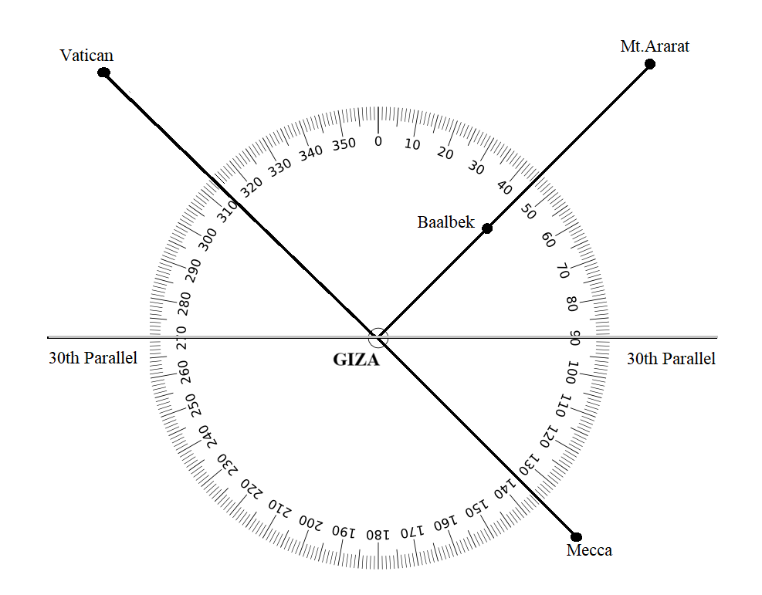
Fig. 2) Illustration of the Intercardinal ‘Abrahamic-Axis’ centred on Giza.
The extended SW-NE alignment simultaneously marks the azimuths of the Summer Solstice at Giza and the Winter Solstice at Ararat, extending for almost exactly 15° equatorial or one hour in solar time. Echoes of this alignment are found in the Sumerian ‘Epic of Gilgamesh’ and the ‘Egyptian Book of the Dead’, as well as in the long-standing records of pilgrimage by the Harranian star worshippers, as well as through the biblical emphasis on Abraham’s journey to Heliopolis.
Concluding Thoughts:
Zep-Tepi is a book that invites dialogue within varying disciplines such as Egyptology, theology, archaeo-astronomy and metrology, creating a new framework for understanding our past through a synthesis of measurable data and mythological comparison. It challenges conventional archaeological interpretations and invites a rethinking of humanity’s earliest astronomical and intellectual achievements.
Ultimately, the book offers the proposition that ancient civilizations possessed a symbolic and functional understanding of geometry, orientation, and metrology, which they encoded in myth and architecture. This knowledge was neither mystical nor supernatural, but scientific in its own terms — rooted in astronomical observation, measurement, and symbolic representation. Rather than dismissing ancient myths as mere stories, they are regarded as encoded knowledge systems, capable of revealing insights into humanity’s earliest attempts to understand and organize the world. The book challenges readers to reconsider the origins of science, the meaning of sacred space, and the possibility that ancient wisdom may still hold relevance today.
The suggestion from all these findings is that an observational experiment was initiated at Heliopolis c. 4,320 B.C. when the Sothic cycle was first synchronised with the astrological cycle, which continued from the time of Enoch/Enmenduranki (who lived for 43,200 years) until their predicted re-synchronisation (at the time of Christ). This same number is found in several world mythologies, the proportions of the Great Pyramid (in relation to earthly dimensions) and the number of seconds in an equinoxial day, giving it a unique symbolism which the book traces back to a moment the Egyptians called the ‘Start time’ or ‘Zep-Tepi’ (as a common measure of both time and space).
In this description, Zep Tepi is more than just a myth or poetic origin story; it is a memory of a worldview in which time, space, geometry, astronomy, myth and site architecture were deeply intertwined, with each reinforcing the same underlying system of metrology. The book argues that our modern understanding of prehistory often strips away this interconnection: separating myth from “real” history, astronomy from religion, geometry from architecture. Zep Tepi invites us to recover that integral vision and shows how site alignments and mythic cycles may offer insight not only into ancient metrology, but also the likelihood that our prehistoric ancestors already recognised the intimate association between humans and the cyclic nature of the universe. Where we are now in that cycle is one of the pertinent questions of this age.
I have tried the coordinates, they don’t actually match 45°. Could their be something am missing