




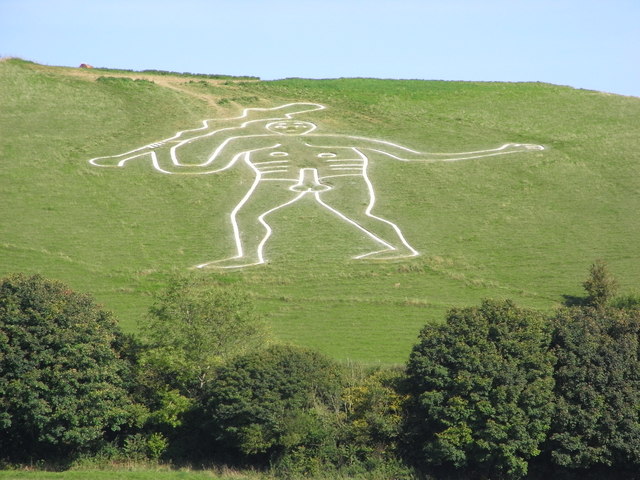

In the county of Dorset in South-West England, there is an enigmatic figure which has been carved into the side of a hill. Known as the Cerne Giant, it is a 55-meter (180-foot) tall depiction of a naked man wielding a raised club and sporting a noticeable erection. The figure was created by digging shallow trenches in the ground and then filling the trenches with crushed chalk. There is evidence that the giant has been reworked and refurbished over the centuries, making it difficult to determine the original layout. Analysis reveals that the giant’s erect penis may have been enlarged and that he may have held on his upraised left arm an animal skin or possibly a cloak. It has also been posited that the left hand may have once held a severed head.
As far as the Giant’s identity is concerned, many have sought to link him with Hercules, and this is a compelling interpretation, as Hercules was often depicted as a naked man wielding a club. Unfortunately, the Hercules theory fails to account for any fertility association, as the conspicuously erect phallus of the figure is not explained via that paradigm. Another theory posits that the image functions purely as a fertility symbol, although why such a figure should be armed with a club remains a mystery.
Local folklore suggests that the image is the outline of a once-living giant who allegedly came from Denmark. Some have speculated that the Cerne Giant was a pagan response to the building of Cerne Abbey, in the Late Anglo-Saxon period, while others have theorized that the image is a sardonic representation of Oliver Cromwell, who was mockingly referred to as England’s Hercules by his enemies.
The explanations for the Cerne Giant are many and varied, running the gamut from the whimsical to the spiritual, but they all suffer from the same principal defects: (1) they are all speculative, and (2) they do not take into consideration all of the salient details manifest in the image. Is there another way to interpret the giant, one which accounts for all of the compositional aspects of the image? Yes, there is!
If we are seeking a credible explanation for the Cerne Giant, the first thing we must acknowledge is that the size of the image makes it apparent that it is best viewed from the air, thus indicating that the Cerne Giant was meant to be an appeal to a divine entity, rather than being aimed at impressing a terrestrial audience. If this notion is a reasonable starting point in our investigation, then we are searching for a divine or celestial entity that will serve as a template for further analysis.
Which heavenly/celestial figure best matches the Cerne Giant? The answer is Orion. The club which the Giant wields is a weapon which marks him as a hunter. The constellation of Orion is also known as Orion the Hunter, so a tentative connection between the two figures has been established. If the identification with Orion is accurate, then we should expect to find evidence which corroborates and enhances the link between the two figures.
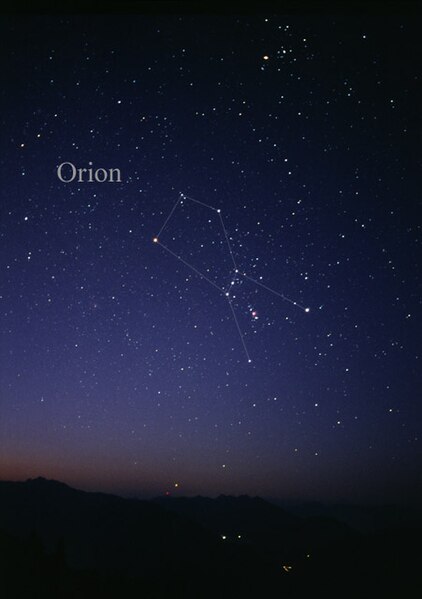
Till Credner (CCBYSA3.0)

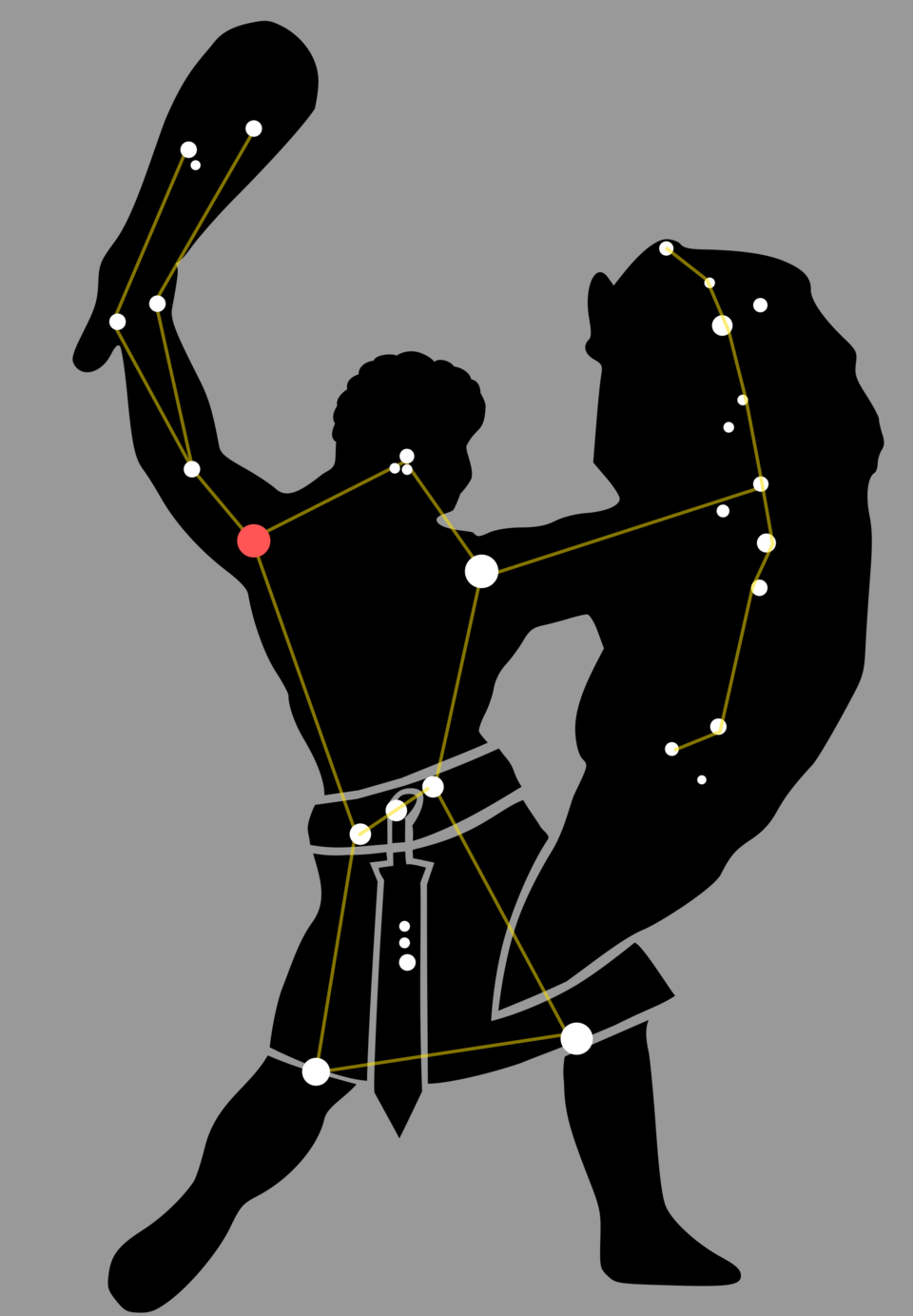
Sanu N (CCBYSA4.0)
_Art.png)
The constellation of Orion is typically depicted as a striding man, and an examination of the Cerne Giant reveals that, although the figure is facing the viewer, his legs are apart and his feet have been depicted in profile, thus indicating that he is walking or striding. Orion is also commonly depicted as having an arm raised and bent, and it is apparent that both of the Cerne Giant’s arms are likewise positioned. So far so good. But what about the erect phallus?
The Cerne Giant’s conspicuous erection represents a definite link with fertility, but what is the appropriate context for this symbol? The answer lies in a connection between the constellation of Orion and Osiris, the Egyptian pre-Christian god of Life, Death, Resurrection, Agriculture, and Fertility. Orion was considered the abode of Osiris after his resurrection.
Myth records that Osiris was murdered by his brother Set, who coveted Osiris’s throne. Isis, Osiris’s wife, recovered the body; however, Set stole it and tore the corpse into fourteen pieces, which he then scattered all over Egypt. Isis recovered her husband’s body parts and then restored Osiris to life long enough to copulate with him, ultimately bearing him a son named Horus. Osiris’s life is restored only temporarily, however, and after his brief return to the land of the living, he is afterwards referenced only as the ruler of the Duat, the Egyptian realm of the dead.
It should now be apparent that an effective case has been made for the Cerne Giant being a representation of Osiris-Orion. There is, however, one final matter to consider. Who authored this striking visual offering, and what was their aim in creating it? Are we to conclude that ancient Egyptians visited Britain and sought the influence of that particular figure? And if they did, then to what end?
Evidence of an Egyptian presence (or at least influence) in the British Isles comes to us in the surprising form of mummies. Embalmed corpses very similar to those common in Egypt have been found in Yorkshire in Northern England. One can choose, however, to reject the notion that Egyptians had any central role in the creation of the Cerne Giant, reasoning that it would be highly unlikely that they would have needed, let alone, sought, the intervention of such a deeply spiritual figure in, what for them, would have been such a far-flung corner of the world.
Who then should we consider as a candidate for the construction of such an alien cultural figure? Was the Cerne Giant a by-product of Roman enthusiasm for all things Egyptian? In the year 30 B.C. the Emperor Augustus defeated Mark Antony and Cleopatra and Egypt became part of the Roman Empire. In the years that followed, Egyptian beliefs and practices were absorbed into Roman spiritual life. A stone temple to Isis and Serapis was built in York and coins depicting Mark Antony on one side and an Egyptian deity on the other have been discovered in Yorkshire, Northern England.
Is the Cerne Giant a result of Roman promotion of Egyptian spiritual culture? Possibly. But there is one last group who may have authored the image. The Celts. Despite their common association with Britain, the Celtic peoples were a collection of tribes inhabiting Europe and Anatolia. They were united by a common tongue and other shared cultural similarities but they should not be regarded as one distinct group. The presence of Celts in Egypt is well-known and well-documented. Beginning around 260 B.C. Celtic warriors formed part of the Egyptian armed forces. In one instance, during the reign of Ptolemy II Philadelphios, 4000 Celtic warriors from the Balkans were recruited to serve.
Did former Celtic mercenaries migrate to Britain and create the Cerne Giant? It is certainly possible. However, there is a greater likelihood that the Celts, who were already native to Britain, were the ones who created it. If they had learned of Osiris and his celestial analog Orion, then it is reasonable to conclude that they had also learned of other aspects of Egyptian culture. Did they know of Egypt’s incredible antiquity? Had their souls been stirred and their imaginations fired by stories of the grand monuments and god-haunted temples of the land of Khem? Were they aware that Egypt’s megalithic layout was literally a form of ‘heaven on earth’, a star-driven engine fueled by endless cycles of birth, death, and resurrection?
It is certainly possible. Egypt, despite the ravages of time and nature, still possesses the power to captivate. It must have been an even more impressive place when it bustled with the priests, pharaohs, and faithful, who comprised the bulk of Egyptian society. And with their casing stones still intact, the pyramids must have shone in the sun like bright stars, while ancient temples offered their chance of communion with the gods and the whispered promise of eternal life.
The Cerne Giant is a plea for something, and since people generally do not ask for what they already have, then it must be a request for something they didn’t have. The term propitiate means to win or regain the favour of a god or a person by doing something which they will regard as pleasing. The Cerne Giant is clearly a propitiatory gesture, so it is not difficult to imagine that local Celts, after having been made aware of the grandeur of Egyptian civilization, crafted an image of Osiris-Orion in an effort to win the favor of that god.
Mapping out the Cerne Giant’s image on that Dorset hillside was clearly a community effort. The image is too large and detailed for it to be the by-product of one eccentric individual’s obsession. The desire to win the favor of the gods is a universal pursuit which has occupied every society and played out in every culture since people first conceived of the idea of higher powers and omniscient beings. Plants, animals, treasure, and humans, have all been sacrificed, or otherwise offered, in order to realize that goal, so why not the Cerne Giant?
There is one last thing to consider, where the association of the Cerne Giant with Osiris-Orion is concerned, and that is that although the outline of the giant has been created with white chalk, inside those lines, owing to the presence of grass, the giant would appear green. It is interesting to learn that Osiris was depicted as a large, green-skinned, figure. The color green symbolized fertility to the ancient Egyptians, and Osiris, with his connections to fertility and resurrection, embodied those aspects via his color.
A green god that was buried and grew again from the earth was memorialized on a hillside in the green and pleasant land of England. The Cerne Giant is a clear representation of a celestial figure and also demonstrates the migration of spiritual concepts and cultural influences which have their origin in ancient Egypt. Two thousand years ago, an unknown people sought the influence of a divine entity by creating a large image of that entity out of chalk and grass. Two thousand years later, those people remain unknown, but the god finally has a name. Osiris-Orion.
Fascinating. Any connection to the Green Man, perhaps?
Dear Andrew,
Thank you for this informative piece of research. We visited Cerne Abbas last year because it is one of those monuments I have often felt is way older than is currently posited. My overall impression agrees with your suggestion of Orion. I don’t know a great deal about Osiris but gazing into the constellation, I often feel a strong godlike presence of power, giant-like size and strength, fertility and helping to shape early humans somehow. With regards to the chalk giant and the idea of a plea to the gods, the monument strikes me as more affirmative. For example expressing the sentiment “Orion was here”. There are a number of monuments around the world which seem to be constructed as a sort of abode or point of consciousness for a deity, or ancestor to manifest part of themselves in. Eg. Easter Island statues, possibly stones in henges etc. I may now disappear into some kind of rabbit hole pondering the history of supplication and please to the gods, and how much of that idea persisted before Christianity.
Best wishes and thanks