





Can imperfection itself reveal hidden truths about the nature of reality, including evolution and reincarnation?
Abstract: Every attempt to pin reality down with exact numbers, whether in music, calendars, astronomy or physics, leaves a small leftover error. This essay proposes that those leftovers are not flaws but the engine of how reality unfolds, an idea I call Quantum Aliasing (aliasing is the signal-processing term for the distortion that appears when something is sampled too coarsely to capture it fully). I follow it through the equation of time and the precession of the equinoxes to two Pacific locations, Wolf Volcano and the Tonga Trench, and then into the 3-6-9-12 pattern linking gestation to the solar year, arriving at a speculative template for reincarnation in which one lifetime is the dream of a future fetus.
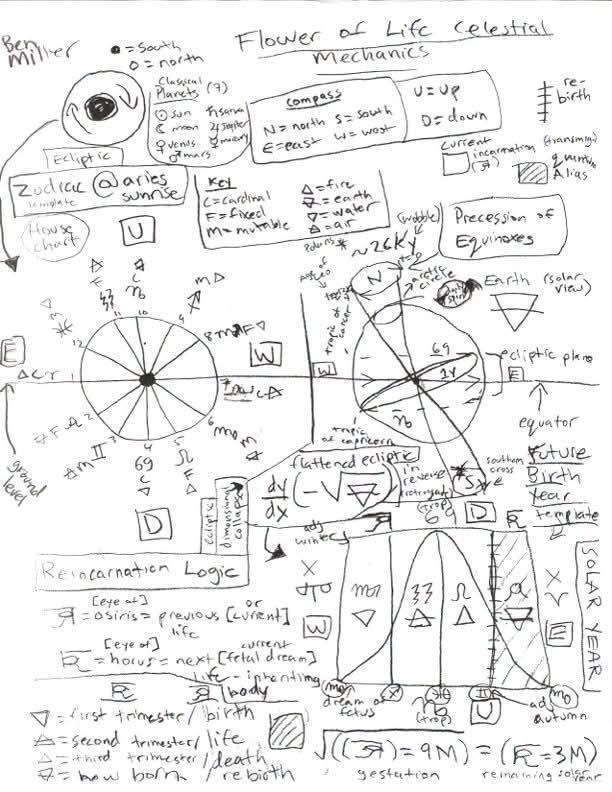
Flower of Life Celestial Mechanics
Sketch by Ben Miller (CC BY 4.0)

Both Pythagoras and Plato taught of a sensible, material world that emanates in successive stages of degradation from a perfectly ordered unity, or mathematical substrate. Plato referred to this conceptual unity as a “realm of form.” He distinguished every manifested object or being from its ideal blueprint within this realm, which we refer to as its “Platonic form.”
“All is number” – Pythagoras

Sacred Geometry
Flower of Life Construction by Mikeoprisco (CC BY-SA 3.0)

Sadly, we live in a world of examples, where nothing is truly its exact Platonic form. Everything that appears precise becomes approximate under scrutiny. Since the definitions of even the most foundational building blocks of reality, like the perfect circle and golden mean spiral, invoke irrational constants that can never be rendered with full precision using finite calculation, many of our intuitions about reality are riddled with inconsistencies when compared with our observations. In musical tuning, as we search for precise alignment, we end up with “commas,” or discrepancies between progressions and tunings derived geometrically, harmonically, and arithmetically.
The mathematical struggles of musical intonation reveal a tension that runs through life itself. Perfect harmony, or any system having ideal balance leading to predictable and favorable alignments, requires an infinite degree of fidelity and focus, which can never be fully rendered or realized within any given limited perceptual bandwidth. As finite beings searching for a unified explanation of reality through math and philosophy, we are thus left with Heisenberg’s uncertainty principle, quantum chaos, fine-tuning problems, and Gödel’s incompleteness theorems, each of which, in its own field, points to a similar understanding: nothing can fully explain itself using only its own rules.
Quantum Aliasing
My flagship theory, Quantum Aliasing, attempts to resolve this problem by demonstrating how the inescapable incompleteness is not our enemy, as some Gnostics have believed, but the necessary seed of the unfolding of our reality. I posit that consciousness itself, by limiting itself to only that which is observable in any given frame, unwittingly embarks on an endless journey of refinement, perpetually seeking unreachable primal unity like a long division problem while expanding its boundaries of scope and precision through contact with reality. In other words: we can only ever take in a slice of reality at a time, so our picture of it is always a slightly rough copy of the whole. Each time we notice what the copy missed, we sharpen it, and the gap that can never fully close is exactly what keeps the sharpening going.
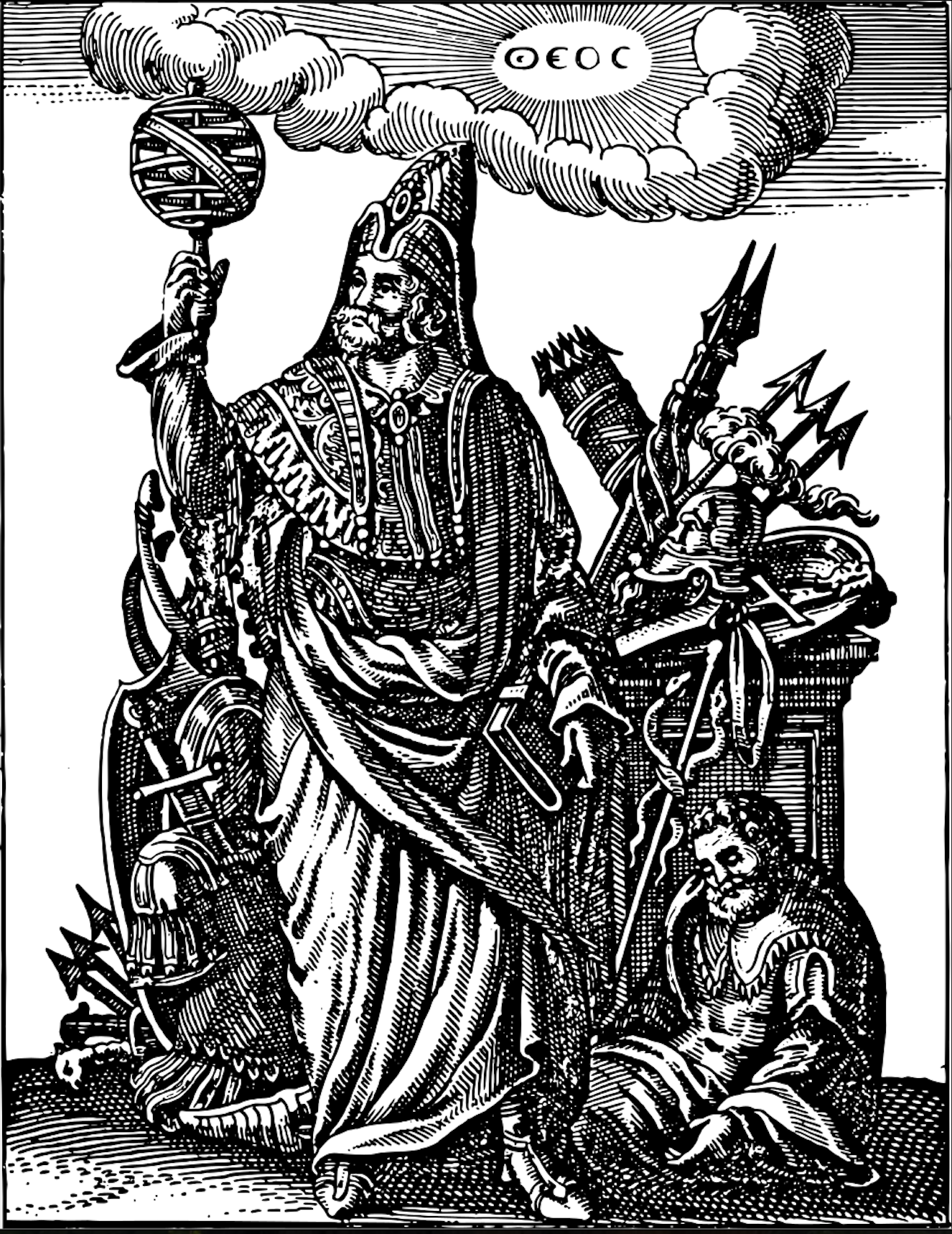
Hermes Trismegistus
Illustration by Jean-Jacques Boissard (Public Domain)

From the reliable, fixed constellations to the unpredictable “wandering stars,” or planets, the tapestry of time is hidden within the complexities of the celestial and subatomic worlds, requiring prolonged attentive study and uncovering a mix of attributes ranging all the way from the seemingly pure harmonic elegance of Kepler’s laws to the fractal chaos and uncertainty of the quantum scale. For this reason, the cosmic clock was often described by ancient sages as “wheels within wheels,” or an arbitrarily long series of cyclic relationships that relate long stable recursions to the ever-shifting realities we experience here on Earth. The ancients cleverly attempted to map these relationships using symbolic systems such as astro-theology and alchemy (including the Hermetic tradition attributed to Hermes Trismegistus) [1], and created calendars for both agrarian and spiritual matters. Natural philosophers like Newton and Leibniz concerned themselves with the subtleties of periodicity (predictable patterns or cycles) found in the material world, breaking waves down into both their twelvefold and sevenfold natures, as in the solar year, the colors of the rainbow, the seven alchemical metals, the visible planets, musical tones, and the days of the week, fusing insights from calculus and astrology to weave together an esoteric cosmology.
Yet, with as much insight as we have been able to gather through the millennia, we can still never reliably calculate periodicity without error. We normally regard each year as consisting of a set number of weeks containing a set number of days, each of which consists of exactly 24 hours of 60 minutes, and so on. But the history of our calendar and timekeeping efforts shows that our reliance on tracking recurring celestial movements to anchor ourselves in time is always imprecise and messy. When we track celestial movements over long spans, we are always eventually met with divergences and corrections, signaling small rounding errors at every step. Each time we think we’ve arrived at a perfect grid of time, we end up having to invent some fudge factor, which created a lot of homework for many ruling classes, including those of the ancient Indian and Mesoamerican peoples.
For instance, an ideal year for mathematical purposes would be 360 days, so the ancient Egyptians represented the five intercalary days with deities to account for them. [2] Later ceremonial texts spoke of the relationship between 5 and 72, since together they multiply to 360, as symbolized by the pentacle (pentagram inscribed within a circle) having 5 points each separated by 72 degrees. The Exodus section of the Bible deliberately conceals 72 names of God used by Kabbalists, echoing this principle. [3] Mystic diagrams also relate this to the 72 years it takes for each degree of axial precession in the Platonic Great Year of about 25,800 to 25,920 years. [4]
Despite such powerful geometric connections, we are not left with a convenient year of 365 days, but one that is actually 365.2422 days, and even that is an approximation. Leap years only partially seal the gap.
Axis Convergences and Phase Drifts
When deciphering the geometry of celestial mechanics, one becomes increasingly aware of cosmic axes and belts such as Earth’s rotational axis, the ecliptic, the galactic plane, the equator, and the prime meridian, and we use them all for measuring the flow of time. But looking back throughout history, we seem to always drift out of phase with the calculations we derive from these axes of recurrence.
Aware of this, I set out to see if I could find a precise geometric convergence tied to the equinox itself. My question was simple: at the moment the Sun sits directly over the prime meridian at solar noon in Greenwich, where on Earth is it experiencing sunrise?
At the equator, on the equinox, sunrise is perfectly due east. Using Greenwich as the reference — the moment its own clock reads solar noon — simple rotational math places the sunrise line exactly 90° of longitude away: 90°W.
But the real sun does not track a perfectly uniform clock. Because Earth’s orbit is elliptical and its axis is tilted, the sun’s true position in the sky runs slightly ahead of or behind mean solar time throughout the year — a discrepancy astronomers call the equation of time. Near the March equinox specifically, this amounts to roughly 7–8 minutes, which translates to about 1.75–2° of longitude. [5] Correcting the idealized 90°W by this real, physical drift shifts the sunrise line to approximately 91.75–92°W.
Wolf Volcano, in the Galápagos, sits on the equator at 91.3–91.4°W [6] — landing within a fraction of a degree of this corrected figure, using nothing but the sun’s actual, checkable position on any given equinox. No ancient epoch, no assumption about precession, no uncertain historical correction is required — this is a timeless calculation, true this year as much as any other.
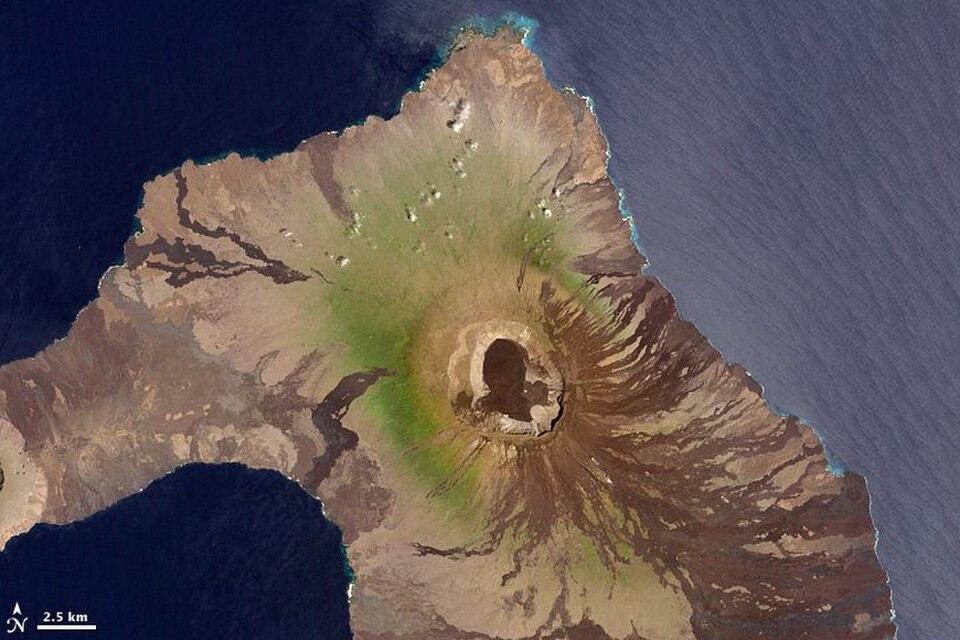
Wolf Volcano
Isabela Island, Galapagos by NASA Landsat 7 (Public Domain)

What’s notable is that the very thing responsible for closing this gap — the equation of time — is itself a “comma” in the same sense as the musical and calendrical commas I opened this piece with: a small, structural residue, arising because a perfect circle and a perfectly uniform clock can never quite be rendered onto Earth’s actual elliptical, tilted motion. The imperfection doesn’t obscure the convergence — it is the convergence, expressed as drift.
Put more simply: a clock keeps perfectly even time, but the Sun doesn’t, because Earth’s orbit is an oval rather than a circle and its axis is tilted. Near the March equinox, the two drift apart by about seven or eight minutes, and since Earth turns one degree of longitude every four minutes, that small drift is what nudges the sunrise line from the tidy 90°W to roughly 91.75–92°W. In music, a comma is the small leftover gap when two ways of calculating the same thing don’t quite match. Here the leftover gap between the ideal clock and the real Sun plays the same role, and it is what carries the calculation onto Wolf Volcano.
There are very few active volcanic rupture nodes anywhere near that exact latitude beyond the cluster it belongs to – the Galápagos Islands. That got my attention because it fit too cleanly into the logic of a cycle declaring itself through a rupture point.
So I asked a broader question, treating this equinox-axis logic as a symbolic key rather than a fixed coordinate: if the same equinox-Aries axis is projected back through the precessional cycle to the start of the Age of Aries — around 2160 BCE, roughly 4,200 years ago, if the Great Year is divided into twelve equal ages — what does that broader picture suggest?
Here the astronomy itself gets genuinely uncertain, and it’s worth naming that plainly rather than glossing over it: converting an ancient date into a specific longitude requires knowing ΔT — the historical drift between Earth’s actual rotation and a uniform clock — and around 2000-2200 BCE, ΔT is estimated at roughly 12–14 hours. [7] Applying that correction moves the calculation dramatically from where it started: not a small nudge, but a swing of well over half the globe. I computed the moment of the equinox around 2160 BCE, converted it to Earth-rotation time by subtracting ΔT, and found the location on the equator where local time was 6 a.m.
What’s striking is where it lands. The drift-corrected calculation for the Age of Aries points to a longitude near 172–175°W (at the central ΔT estimate of about 13 hours; the full 12–14 hour range spans roughly 172°E to 158°W) — the Tonga Trench, the second-deepest point in any ocean on Earth, where the Pacific Plate subducts faster than anywhere else on the planet, feeding one of the most volcanically active arcs in existence. [8] This wasn’t a location I was aiming for; it’s simply where the corrected math landed, regardless of what I hoped to find there.
So the pattern holds across both a precise, present-day calculation and a drift-corrected ancient one — each pointing, independently, to a place of real geological extremity: Wolf Volcano in the present, the Tonga Trench in deep time.
Around the pre-drift node — Wolf Volcano itself, the anchor the modern calculation gives with no epoch or correction required — sits a wider constellation of related rupture geology: the Nazca Trench (12° away), the East Pacific Rise (33° away), the Equatorial Atlantic Fracture Belt (42° away), and the Mid-Atlantic Ridge’s hydrothermal vents (57° away), where the black smokers central to origin-of-life research are found. These aren’t derived from the drift calculation — they’re simply what surrounds the precise anchor point itself, a secondary spread worth noting on its own terms.
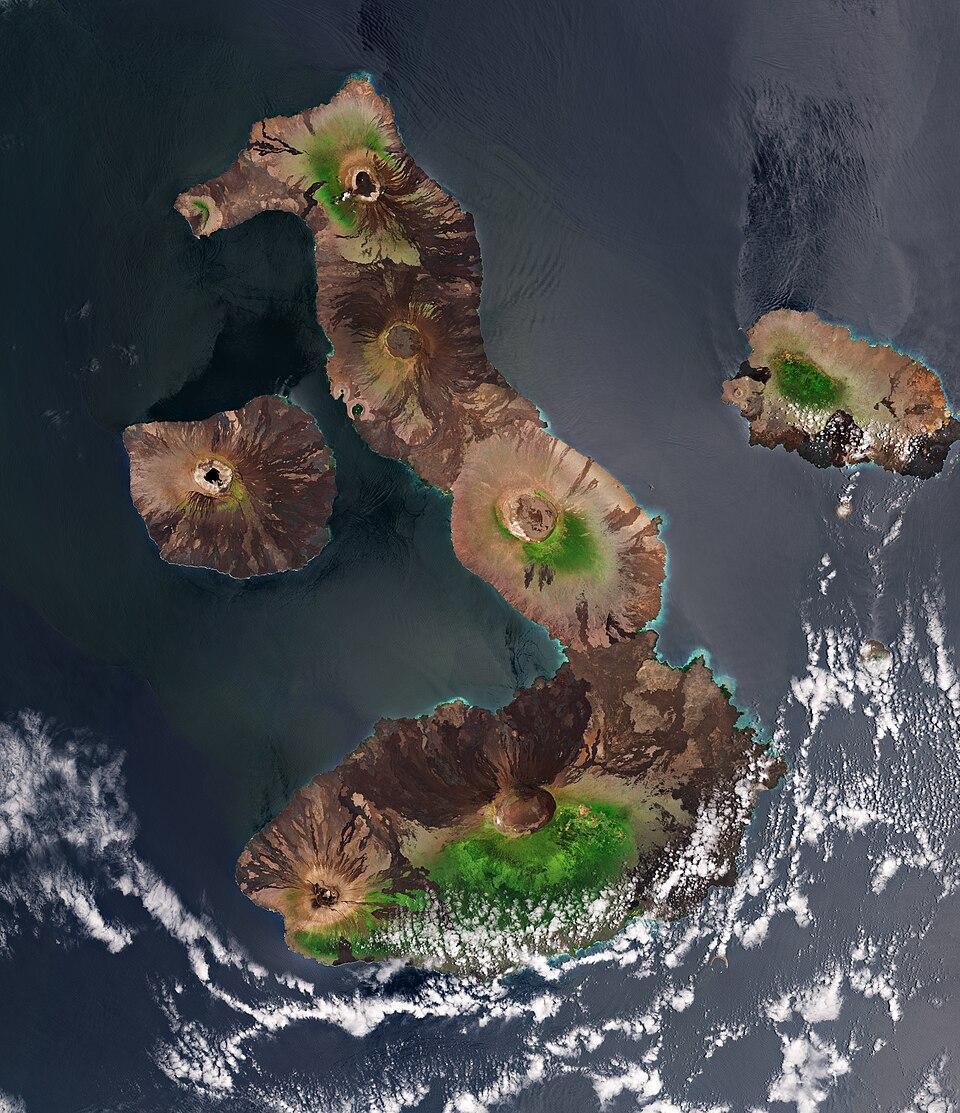
Galápagos Islands
Galápagos Islands ESA23188644 (Isabela) by European Space Agency—contains modified Copernicus Sentinel data 2020 (Wikimedia Commons)
.jpeg)
There’s a natural next question this logic invites, even if it can’t be answered with the same precision: how far back does this cyclical convergence go before it exhausts the very idea of a calculable position? The equinox point itself completes a full circuit of the zodiac roughly every 25,772 years — the Great Year [4] — and at one specific moment in that circuit, the equinox point aligns not with a zodiac sign but with the galactic plane itself, a genuinely rare event, distinct from the ordinary twice-yearly crossing the Sun makes with that same plane. Tracing the current precession rate backwards, that alignment last occurred roughly 20,200 years ago — around 18,200 BCE. At that depth, ΔT is no longer just uncertain; it exceeds any value that could meaningfully anchor a longitude, so I’m not claiming a location here, only a horizon. What’s worth noting is where that horizon falls: 18,200 BCE sits within the broad, multi-thousand-year era of the Last Glacial Maximum — the coldest, most transformative climatic period of the last Ice Age, when sea levels, migration routes, and the survival of entire species were being reshaped worldwide. [9] I don’t offer this as a precise date-match, the way Wolf Volcano is, but as the logical far edge of the same cyclical reasoning: the deepest convergence the method can gesture toward, landing in the same broad epoch as the last time Earth’s biological and climatic order was fundamentally rewritten.
Darwin found early evidence of biological divergence (when one shared ancestor group splits into two or more different species over time) at a volcanic emergence point on the equator. [10] I arrived there by following equinox geometry — a precise version of it in the present, a wider corridor of it in the mid-distance, and only the faintest, unmeasurable outline of it at the furthest reach of deep time. We approached the same node from opposite directions: he through biology, I through time mechanics.
The Submerged Earth-Sun Axis
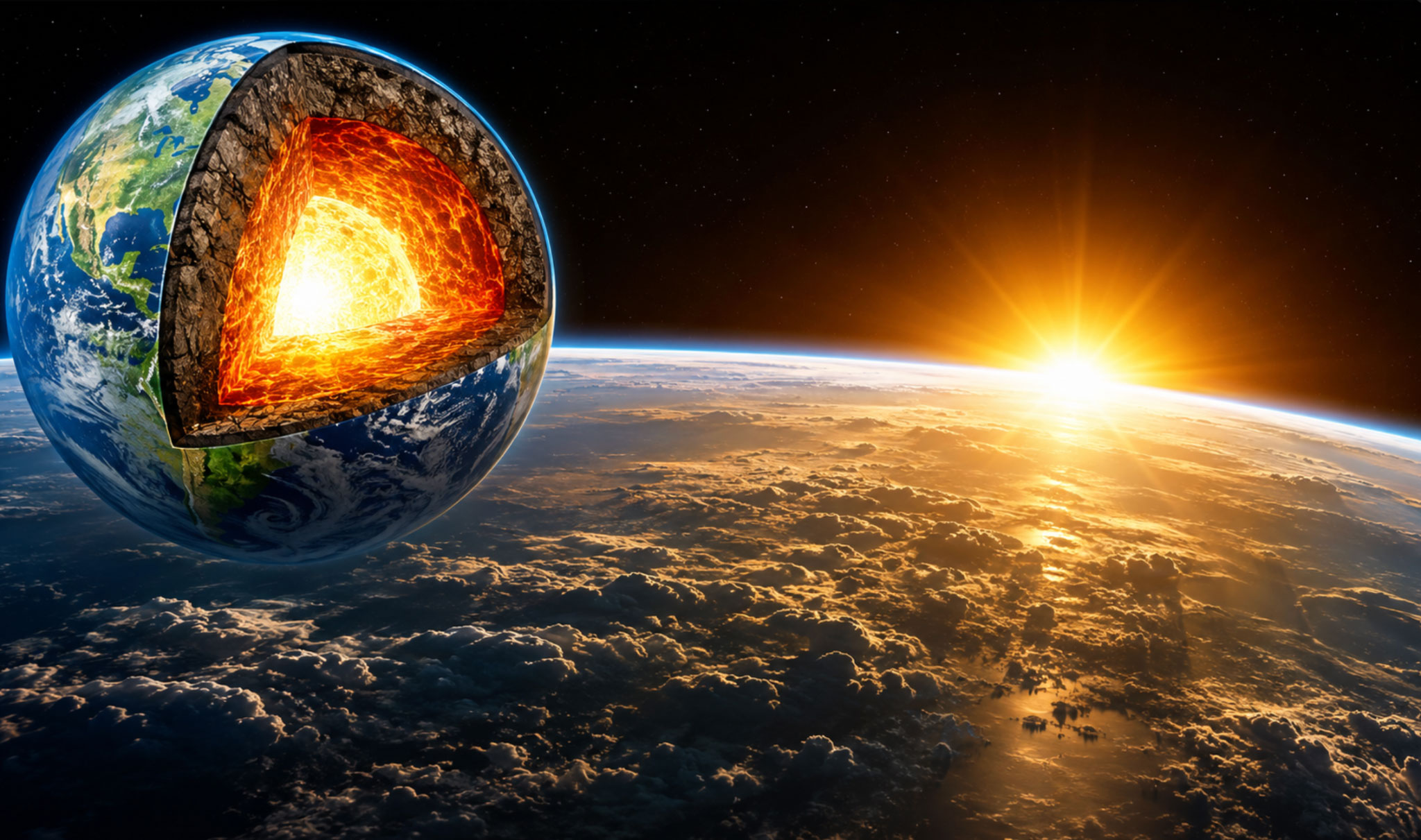
AI generated
When one body orbits another (like Earth around the Sun), the connection between them isn’t just distance in space. I think of their shared motion as creating a wave function that centers on the line between their cores—a kind of tension axis that the system “locks” onto.
You could call that axis an entanglement line, borrowing the term physicists use for two objects whose quantum states stay correlated regardless of the distance between them — not as a literal claim of the same mechanism, but because it’s the closest existing language for what I want to propose here. Every point in space — including Earth’s own core — sits inside two real gravitational fields at once: Earth’s own, which we experience as ‘down,’ and the Sun’s, the far weaker pull that keeps us in orbit. They don’t cancel or replace each other; they’re simply superimposed, one overwhelming the other at any scale we can feel. What I want to propose is that Earth’s core isn’t just a point where two forces happen to coexist — I think of it as a hinge, the place where the locally dominant vector gives way to the cosmically dominant one, an axis along which ‘down’ quietly becomes ‘toward the Sun.’
So, here’s the point: we live on the surface layer, a roughly 3D existence atop a roughly 2D surface, but the real connection between Earth and Sun runs straight through the interior, perpendicular to the 2D surface, and rupture points (volcanic bands, life-origin nodes like Galápagos) are where that deeper axis breaks through our plane of experience.
That’s why I’m treating those spots as more than geological accidents — they’re contact points between a hidden core-link and the surface dimension life emerges on.
If rupture points mark where a larger cycle breaks through into physical space, the same logic should hold at smaller scales too — including the scale of a single human life, and the moment consciousness itself first breaks through into a forming body.
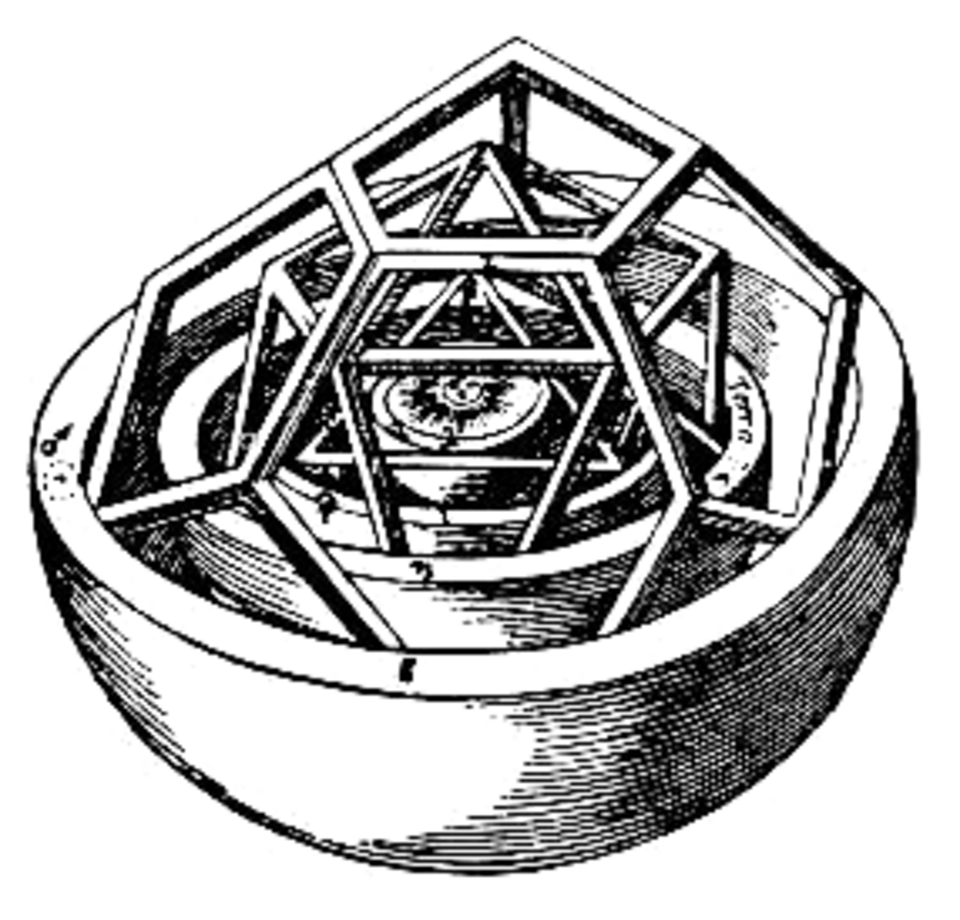
Kepler’s Solar System
Mysterium Cosmographicum diagram by Johannes Kepler (Public Domain)
Observed Cyclic Patterns Relating Lifetimes to Gestational Cycles
Large-scale cosmic rhythms sync with consciousness in unexpected ways that are reflected in the pattern of the solar seasons. Drawing parallels between the progression of the seasons and mystic systems like the classical elements and the Kabbalistic Tree of Life (Etz Chaim), I treated the three trimesters of gestation as a supernal triad, with the remaining three months of the solar year representing an aliasing residue. From the perspective of the newborn, this residue is the material realm projected from the previous life it just dreamt as a fetus, the accumulation of aliasing errors from the rendering of higher dimensions and previous life memory represented by the triad.
Through symbolic overlap, I was able to tie together the human experience both before death and after rebirth using intrinsic mathematical links between long-term life processes (full lifespan) and fetal development timing (9-month harmonic). The harmonic relationship between the 9-month gestation and the remaining 3-month portion of the solar year acts like a nesting window within a dimensional collapse (3 being the square root of 9 and the seed of another 3-fold division into months). These insights, while perhaps hard to accept or understand at first, will be explained below. I believe that they paint a new theory of reincarnation based on one’s current lifespan simply being the dream of a future fetus waiting to be born.
The Dream of Gestation and the Mechanics of Reincarnation (3-6-9-12)
In other words: the numbers in this section are stages of one cycle. Three is compression, the smallest unit of pattern that can fold back on itself. Six is the stable ring that forms around a center. Nine is the point where a structure becomes a space with an inside, which is why it maps to the nine months of gestation. Twelve is the full solar year, in which the remaining three months turn that inner world outward. The rest of this section shows how each step builds on the one before.
A note on method: if our world is an aliased copy of the Platonic realm, we can’t observe that realm directly. What we can do is look for patterns that repeat across scales, like the 3-6-9-12 rhythm in gestation and the solar year, and infer the template behind them. What follows is that template, suggested by observation, inference, and analogy, not proven.
The materialistic assumption that a fetus is simply waiting inside a womb, blank and inactive, is incorrect both biologically and phenomenologically. Consciousness does not appear after birth; it enters by degrees through a patterned process. What we call a “lifetime” is not the origin of awareness but rather the expression of an already-present organizing center that begins structuring itself through the fetal body. From a higher vantage of recursion, a human life is to a larger cycle what nine months of fetal development are to this one—an interior phase of identity assembly experienced from the inside as a linear story.
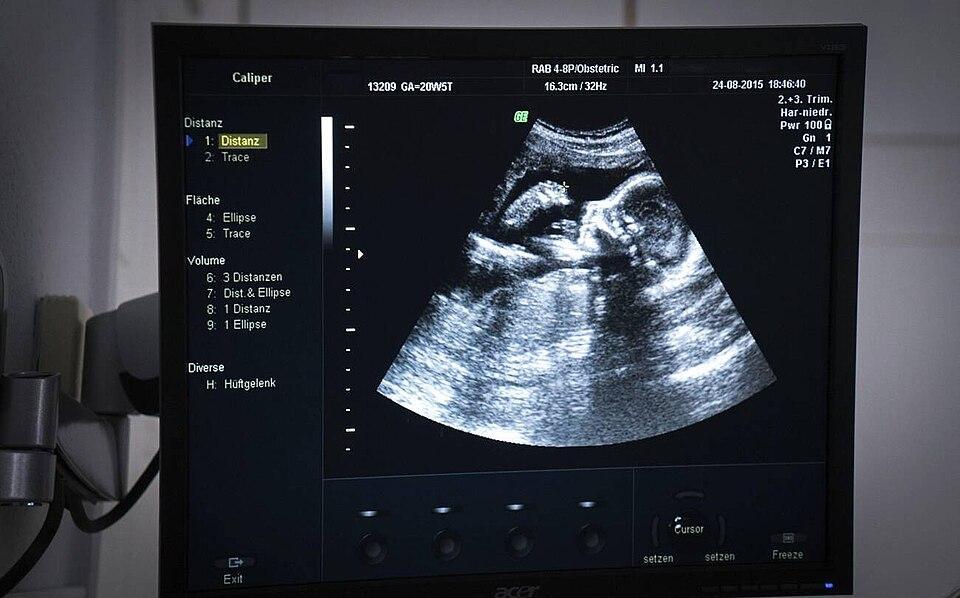
Pregnancy Ultrasound Scan
Obstetric ultrasound scan monitor showing 20-week human fetus profile in Navi Mumbai 2015 by Goleisureintl (CC BY-SA 4.0)

The Vesica Piscis—two overlapping domains forming a shared interior zone—is not just a mystical symbol but a diagram for transitional consciousness. When two domains intersect, an overlap zone forms where information flows in both directions. Dreaming is a daily Vesica event: the body remains here, but a secondary world ignites without locomotion. This demonstrates a principle we rarely apply metaphysically—that consciousness can occupy a second frame of reality without abandoning the first. In esoteric models, a silver cord is said to tie the dreamer to the body; in technical terms, this means a continuous point of identity persists through multiple environments.
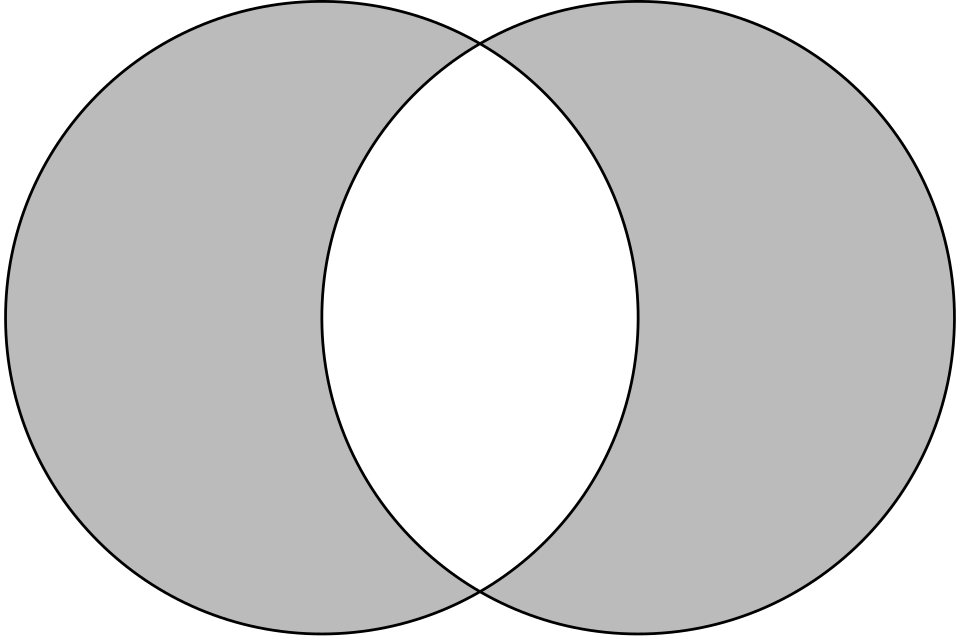
The Vesica Piscis—a symbol made from two circles of the same radius, intersecting in such a way that the center of each circle lies on the circumference of the other. (Public Domain)

Crucially, dreaming does not wait for birth. By around the sixth month of gestation, ultrasound studies record bursts of fetal eye movements suggestive of REM sleep, and thalamocortical connections are forming. [11] I interpret this as the moment when consciousness begins to inhabit the body, not merely shape it. Before this threshold, the organism forms its vessel; after this threshold, the vessel becomes capable of hosting an interior point of view. In other words: the pattern (3) stabilizes into a field (6) at the moment I take the fetus to begin dreaming. The “self” arrives as rhythmic coherence.
By extension, if a fetus can host dreams while still forming its neural structures, one must consider that what we call life may itself be the dream hosted inside a greater cycle of gestation. Under this lens, reincarnation is not the soul leaving and then re-entering reality but a continual process of compressing one life-phase into a transferable identity-seed that enters the next. This compression is timed according to a nine-month harmonic—the same template human gestation uses.
It is significant that human gestation spans roughly nine calendar months (clinically counted as about 40 weeks, or ten lunar months, and often running longer), whereas a solar year is twelve. The remaining three months outside gestation correspond to a phase of outward projection rather than inward formation. It marks a dimensional shift. Nine months completes the interior—the lived, first-person dimension of selfhood. The following three months tune that interior to the Sun’s timing-field—the world’s external rhythm. In harmonic terms, three is the square root of nine. What happens across nine months is an inward build. What happens in the remaining three is a trajectory outward.
Classical elemental sequences accidentally preserved this mechanic: the inward trimesters—Fire, Water, and Air—encode gestational phases of ignition, fluid shaping, and breath-patterning. The final three-month segment, symbolized as Earth, represents aliasing: the waveform locking into fixed density so that the cycle can interact with an external world. Thus, Earth is not a primal element but a boundary encoding, the artifact created when a completed identity meets its environmental limit.
In this light, three is not merely a number but a function—compression. It is the smallest unit at which a pattern can fold back onto itself. Six is the minimum symmetry that can stabilize a ring around a center—six equal neighbors holding one point in equilibrium (you see it in crystals, honeycombs, orbital packing, and the way fields settle around a mass). Nine is the moment of dimensional interiority: the point at which the structure is no longer a flat pattern but a space with an inside.
Compress → structure → complete.
That is the dynamics of a gestational loop.
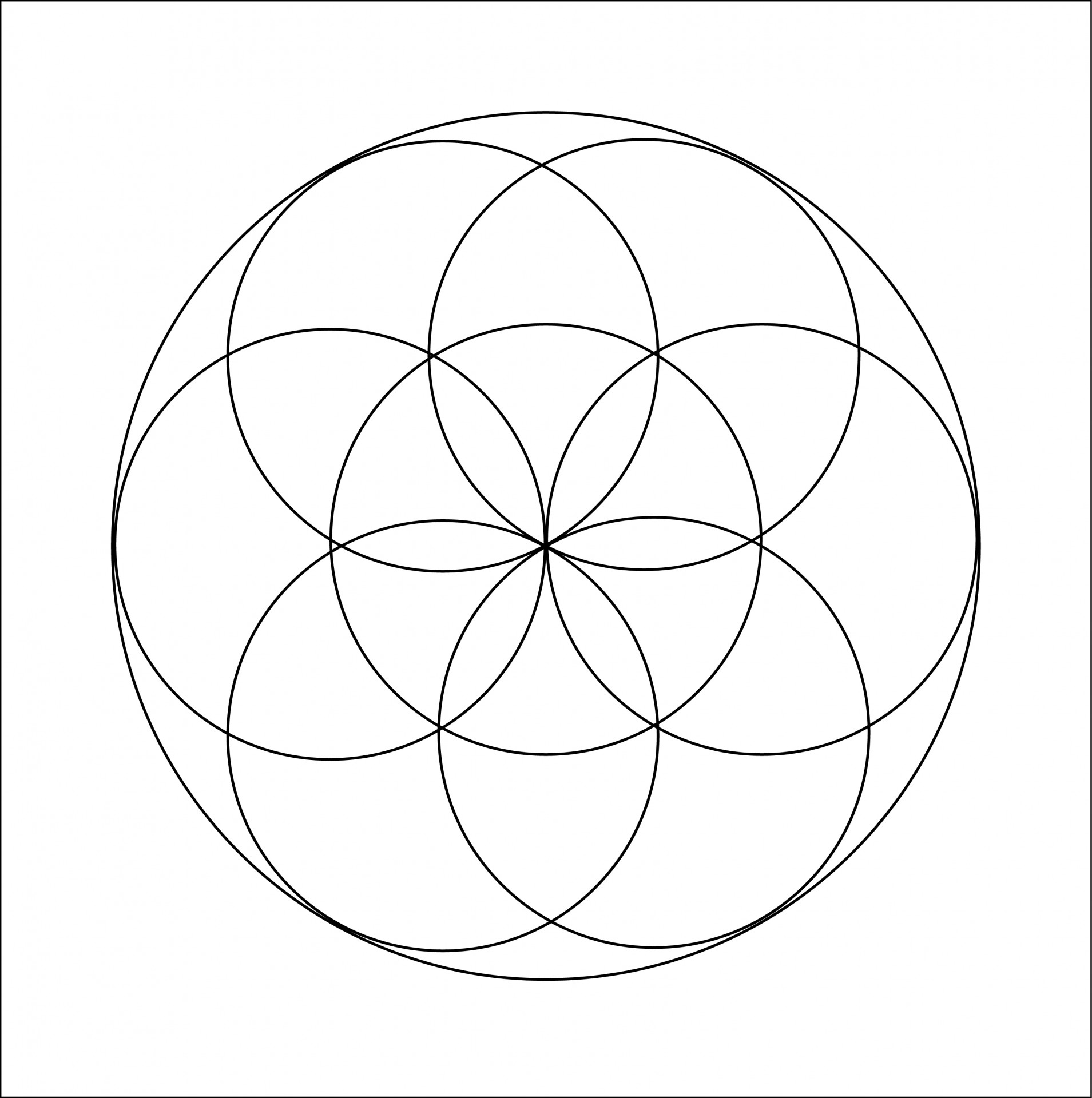
Seed of Life (ancient sacred geometry)
Samen des Lebens Gliederung Malvorlagen herunterladen (Public Domain)
The Seed of Life, the seven-circle core of the ancient Flower of Life symbol in sacred geometry, visually encodes this: one central circle surrounded by six of equal size. That is the sixfold ring. But the center circle is not “empty.” It is the same form as the others, representing a latent unit of identity—the witnessing center. The six around it are the structural petals of identity. The form remains two-dimensional until something else occurs: an axis emerges. This axis is what John Dee—an Elizabethan mathematician, astrologer, and geometer—coded into his Monas Hieroglyphica (1564), where the Cross may stand for either the ternary (three) or the quaternary (four) (Theorem VI). [12] Read this way, three base points define a plane, but the fourth is not an extension along the plane; it is an axis that rises from it, representing direction rather than addition.
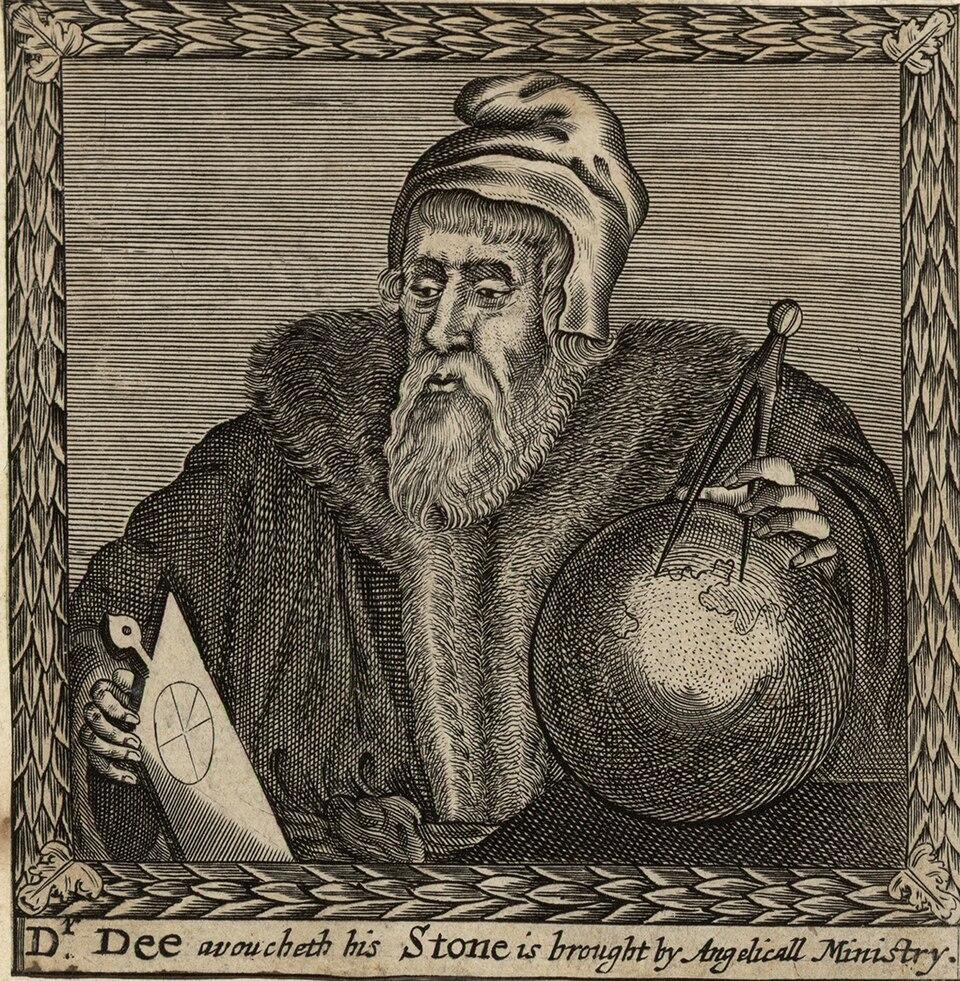
Dr. John Dee
Dr John Dee 02355 by Thomas Pennant (Public Domain)

This same relation appears between 3 and 1 in fractal structures such as the Sierpiński triangle: three triangles appear, leaving a central “gap” that is a latent triangle, identical in form but not yet expressed. That latent center is the axial potential concealed in planar symmetry. Just as one invokes a fourth direction from three, three invokes a fourth direction from nine—both are square-root compressions that produce a seed capable of lifting from the plane. Each time a cycle compresses into its root, it generates an axis. Axis is what dimension means in practice—not a mystical realm, but an added degree of motion emerging from compression. The image below shows the three-dimensional version of the same pattern, the Sierpiński pyramid, in which the central gap opens inward through the solid instead of lying flat on a plane.
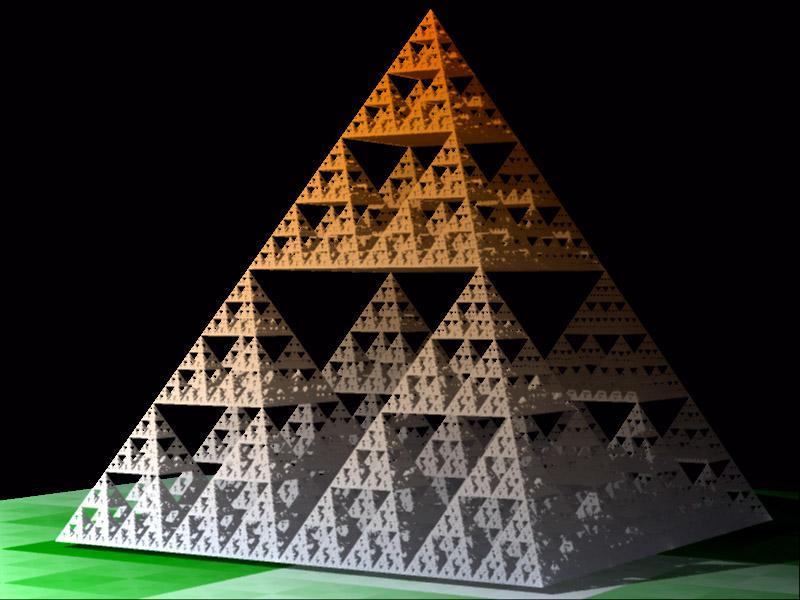
Sierpiński Pyramid
Sierpinski pyramid by Solkoll~commonswiki (Public Domain)

When the ninefold interior of a life compresses into a threefold seed, an axis rises. Traditionally, this is named Horus emerging from Osiris—not as myth but as a descriptor: the lived life (Osiris) collapses into a seed, which becomes the basis of a new directional identity (Horus). When that axis meets the boundaries of the cycle—birth and death—it snaps into a world-grid. Birth and death are not metaphysical extremes but boundary conditions. They seal the interior nine and generate stability for the seed. These two boundaries plus the center (axis/witness) form the remaining three that complete the twelve.
So the full count is not arbitrary: 3 harmonic functions (compression, structuring, closure) + 6 structural petals + 1 center seed + 2 boundary limits = 12. When the axis turns, the twelve become doors of expression—sectors, houses, signs, months, archetypal arenas where the same interior geometry engages external motion. Every zodiac, disciple circle, clock face, and twelvefold system is a reflection of this single mechanic: interior coherence rotating under boundary conditions.
This is why reincarnation is better described not as “returning” but as compression and re-expression. Each life becomes a dataset. At completion, the cycle folds, the nine become three, the three yield axis, and axis meets twelve. The fetus dreaming life was the first demonstration of this pattern: inner world first, outer synchronization later. From here, life feels linear. From the next tier, it is nine months of formation before axis ignition. The Vesica is the overlap between life and dream; the Flower is the structure of identity around a center; the Cross of Dee’s Monas is the axis emerging from closure; the twelvefold grid is the rotation of that axis through existence.
Thus: compress → pattern → complete → rise → turn.
These are the mechanics and cadence of resurrection described through number and geometry. On this template, every reincarnation is a gestational dream. Every dream is a rehearsal for departure. Every axis is born from compression, not expansion. And every world you wake into is the rotation of a seed through a grid it generated by closing.
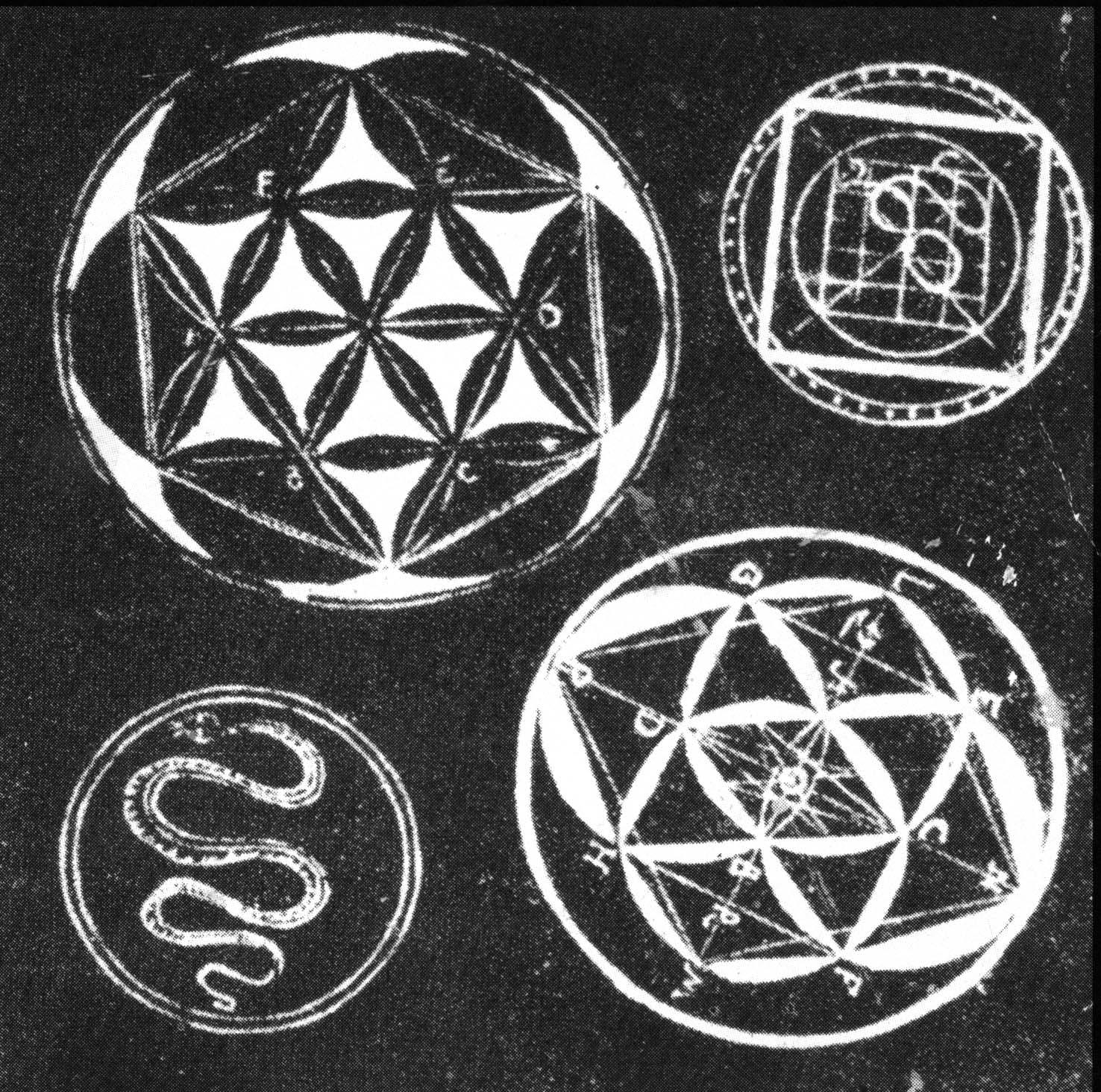
Sacred geometry in a Renaissance woodcut
Flower of Life Woodcut by Giordano Bruno (Public Domain)

References
1. Copenhaver, B. P. (1992). Hermetica: The Greek Corpus Hermeticum and the Latin Asclepius in a New English Translation, with Notes and Introduction. Cambridge University Press.
2. “Epagomenal Days (Egypt).” St Petersburg State University encyclopedia. https://anefest.spbu.ru/en/articles/ancient-minor-asia/140-epagomenal-days-egypt.html
3. Exodus 14:19–21. On the 72-name tradition drawn from these verses, see “72 Names of G-d,” Kabbalah Online. https://www.kabbalaonline.org/kabbalah/article_cdo/aid/1743696/jewish/72-Names-of-G-d.htm
4. “Precession of the Equinoxes,” Universe Today. https://www.universetoday.com/articles/precession-of-the-equinoxes; “Great Year,” Wikipedia. https://en.wikipedia.org/wiki/Great_Year
5. “Equation of time: Why times vary for your high noon,” EarthSky. https://earthsky.org/earth/equation-of-time-why-times-vary-for-your-high-noon/
6. Smithsonian Institution, Global Volcanism Program. Wolf (volcano no. 353020). https://decade.earthchem.org/d/353020
7. Morrison, L. & Stephenson, F. R. (2004). Historical values of the Earth’s clock error ΔT and the calculation of eclipses. Journal for the History of Astronomy, 35(3), 327–336. https://doi.org/10.1177/002182860403500305
8. “Tonga Trench,” Wikipedia. https://en.wikipedia.org/wiki/Tonga_Trench; University of Hawaiʻi ScholarSpace, GPS study of plate convergence in Tonga and the New Hebrides. https://scholarspace.manoa.hawaii.edu/handle/10125/6903
9. Clark, P. U., et al. (2009). The Last Glacial Maximum. Science, 325(5941), 710–714. https://doi.org/10.1126/science.1172873
10. Darwin, C. (1839). Journal of Researches (Voyage of the Beagle), Galápagos chapter.
11. Okawa, H., Morokuma, S., Maehara, K., Arata, A., Ohmura, Y., Horinouchi, T., Konishi, Y., & Kato, K. (2017). Eye movement activity in normal human fetuses between 24 and 39 weeks of gestation. PLoS ONE, 12(7), e0178722. https://doi.org/10.1371/journal.pone.0178722; Taymourtash, A., et al. (2023). Fetal development of functional thalamocortical and cortico-cortical connectivity. Cerebral Cortex, 33(9), 5613–5624. https://www.ncbi.nlm.nih.gov/pmc/articles/PMC10152101/; Kostović, I. & Judaš, M. The development of the subplate and thalamocortical connections in human fetal brain. https://www.bib.irb.hr/458361
12. Dee, J. (1564). Monas Hieroglyphica. Antwerp: Willem Silvius. Theorem VI. English text: https://esotericarchives.com/dee/monad.htm
Here, the team invoked one of the most profound results in mathematical history: Gödel’s incompleteness theorem. Proposed by mathematician Kurt Gödel in 1931, the theorem states that in any logical system complex enough to describe arithmetic, there will always be true statements that cannot be proven within that system. In other words, computation—no matter how powerful—will always encounter truths it cannot reach. There will always be facts that are true but impossible to derive through step-by-step logic.
https://www.sciencenewstoday.org/scientists-prove-the-universe-isnt-a-simulation-and-the-reason-will-blow-your-mind
Was wondering what you thought of this. As many, like David Icke propose the simulation hypothesis.
Thanks Hayden! Yeah, Gödel is definitely relevant here, although I only touched on incompleteness in passing. Penrose’s use of Gödel was actually one of the things that first got me interested in this general territory.
As for simulation theory, I tend to look at it a little differently. I’m not necessarily convinced that reality is a simulation in the literal sense of being run on some external computer by other beings. I think the resemblance may go deeper than that: computers simulate through mathematics and number, while nature itself also seems to be deeply mathematical. So perhaps computation resembles reality not because reality is secretly running on a computer, but because both computation and physical reality share some of the same underlying numerical structure.
In that sense I do think simulation theory brushes up against what I’m getting at here, just from a somewhat different direction. Thanks for reading and for the thoughtful comment!
By the way, here is something I wrote a while back on the topic:
https://www.benjaminmillermusic.com/post/the-simulation-farce
Cheers for the reply, David Icke’s view on the world is full of negative connotations, based on one sect of gnostic thought. Also, there is no hard proof that these Reptilians and yaldaboath even exist, just as the gods of all other religions.
I have heard David Icke say this reality is a trap run from entities that feed of us from the lower realms of the 4th dimension.
Personally, I haven’t read any of his books but have seen him speak a lot on YT; and his analysis is very sharp a lot of the time. However, if I had to guess, he is one of those people who has made the grave error of taking symbology too literally. To me, “giants” are men of renown and “reptilians” are symbolic of cold-blooded, reptilian-cortex-driven, controlling lower consciousness.