




Why it’s time to recognize the Mapuche people as heirs of a spiritual legacy as ancient and profound as that of Egypt or Göbekli Tepe.
There is a reason why the Mapuche people have remained invisible in the global conversation about ancient civilizations. We left no pyramids, no megalithic temples, no glyphs carved in stone. And yet, we endured. We resisted first the Spanish empire, then the Chilean state, and today we still stand—not as a museum piece, but as a living, breathing, dreaming people.
The Mapuche are not extinct. We are not a footnote. We are a continuity.
In this article, I invite you to expand your perspective. The Mapuche people deserve a seat at the same table where scholars and seekers discuss the legacies of Egypt, Sumer, Rapa Nui, and the Andes. Not because we built monuments of stone, but because we cultivated monuments of spirit.
I. Omitted from History: No Pyramids, No Civilization?
Graham Hancock’s work has opened the door to reconsidering what defines a “civilization.” In Fingerprints of the Gods, Magicians of the Gods, and America Before, he offers compelling evidence of a pre-cataclysmic, global civilization whose fingerprints remain in megaliths and myths around the world. The Mapuche are missing from that narrative. Understandably so: we left behind no stone temples, no star-aligned cities.
What we did leave behind are the chemamüll—anthropomorphic wooden sculptures, carved from sacred trees, erected to guide the soul of the dead toward the spiritual realm known as Wenu Mapu. Though ephemeral in material, these figures are gateways between worlds. They share a purpose with the Moai of Rapa Nui, the megaliths of Sulawesi, and the statues of Göbekli Tepe.
Only we built them from wood, not stone. Not because we lacked knowledge, but because we chose to keep our connection alive through the living beings of the forest.
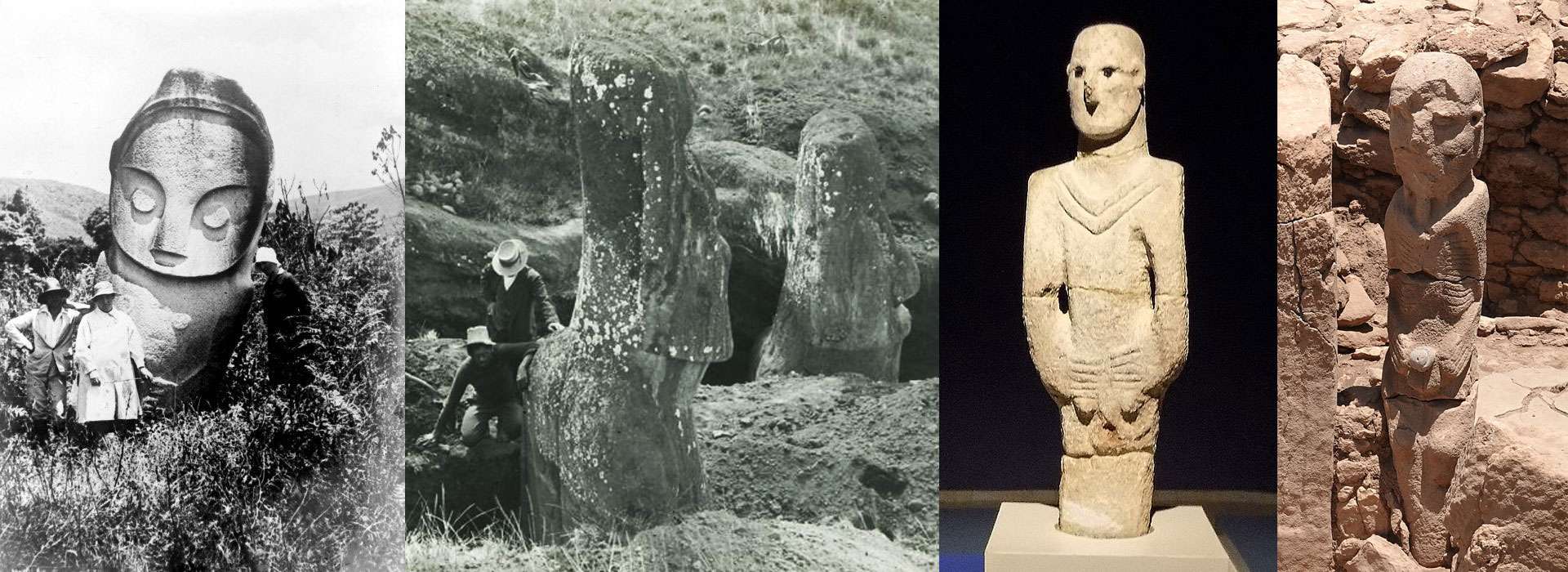
Image 1 by Collectie Wereldmuseum (v/h Tropenmuseum), part of the National Museum of World Cultures (CCBYSA3.0)
Image 2 Mana Expedition to Easter Island (Public Domain)
Image 3 Urfa man, photo by Cobija (CCBYSA4.0)
Image 4 Karahan Tepe standing man, photo by Marco Restano (CCBYSA4.0)


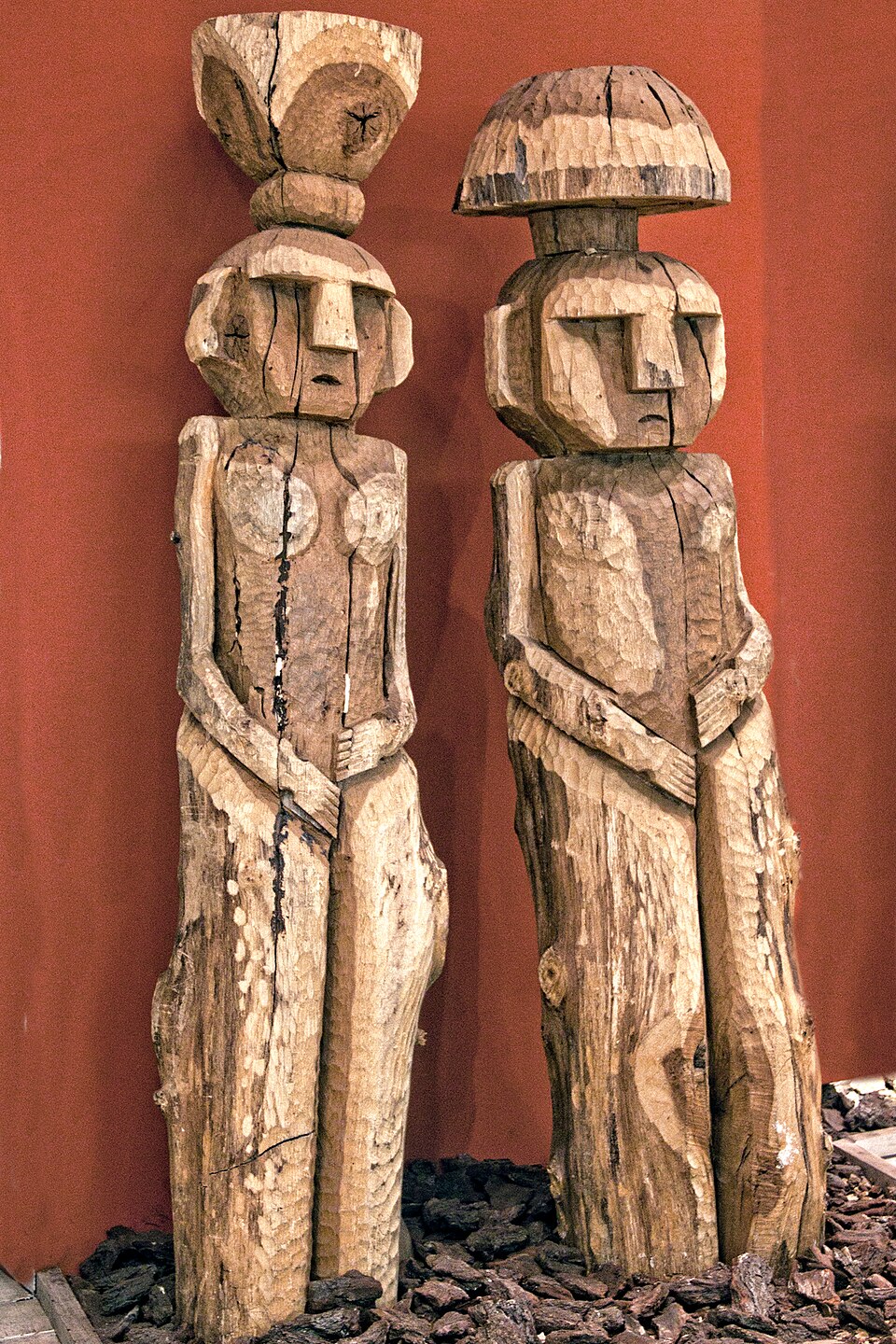
Chemamüll, Santiago, Chile. (CC-BY-2.0)
.jpg)
II. Chemamüll Today: Between Sacred Guardians and Public Sculptures
Although the chemamüll were never meant to endure like stone monuments, their meaning has never disappeared. In certain Mapuche communities, they are still remembered and, in some cases, reinstated in ancient cemeteries (eltuwe) as guardians of the dead. In 2016, for instance, the Mallekoche community in southern Chile re-erected a chemamüll in their ancestral cemetery, not as nostalgia, but as an act of spiritual continuity and territorial defense. These wooden beings are not relics—they remain active participants in the dialogue between the living and the ancestors.
At the same time, many chemamüll—or their replicas—have been relocated to museums and public spaces. The Museo Chileno de Arte Precolombino in Santiago, the Museo Mapuche in Cañete, and the Museo de Historia Natural in Concepción all host pieces once placed on burials. Even the Ethnologisches Museum in Berlin holds chemamüll collected in the twentieth century. Such displays, while offering visibility, raise questions: can a funerary guardian removed from its cemetery still perform its role, or has it been stripped of its agency?
In plazas and parks, the dislocation is even sharper. Replicas stand in Santiago’s Cerro Santa Lucía and Parque Araucano, in Talca’s riverside monument, and in Galvarino’s main square. Here they are presented as symbols of regional identity but disconnected from their funerary origin. To the unknowing eye, they become exotic sculptures—ornaments of a culture still struggling for recognition.
This shift—from cemetery to park, from sacred guardian to touristic icon—illustrates how cultural memory can be diluted. In Mapuche cosmology, the eltuwe is not merely a burial site but a threshold between worlds, where the püllü (soul) begins its journey to the Wenu Mapu. The chemamüll stood there as protectors, ensuring the dead were not abandoned. Displaced into urban spaces, they cease to be doorways and become decorations.
And yet resilience persists. Each chemamüll in a museum now sparks dialogue with Mapuche communities, who increasingly demand that exhibitions respect their spiritual dimension. In Concepción, elders have worked with curators to reframe the display, recognizing that a chemamüll is not just wood—it is presence, spirit, memory. Likewise, when communities reclaim cemeteries and raise new chemamüll, they reassert sovereignty over both land and the invisible worlds tied to it.
The tension between continuity and appropriation mirrors the larger Mapuche struggle. Our people have always defended not material wealth, but spiritual integrity. Just as forests, rivers, and mountains cannot be reduced to resources without consequence, chemamüll cannot be reduced to statues without loss. They are sentinels of the soul.
III. A Spiritual Technology Without Enteogens
Where Hancock speaks of Ayahuasca as a portal to supraconsciousness, the Mapuche say: yes, but not only. We have long accessed expanded states through breath, ritual, dreams, and language—without visionary plants.
The wüño kütral (inner fire, akin to Kundalini or Chi) rises from the earth through the body, connecting Minche Mapu (underworld), Nag Mapu (this world), and Wenu Mapu (upper world). This is not metaphor; it is a lived energetic reality, experienced in ceremonies, dreams, and trance.
The pineal gland, known to modern science and ancient Egypt alike, does not awaken solely through molecules. It is activated through vibration, intention, and alignment. The Mapuche awaken it through song (ül), dreams (pewma), the sound of the kultrun drum, and communion with sacred territory. Our cosmovision is designed to sustain this connection.
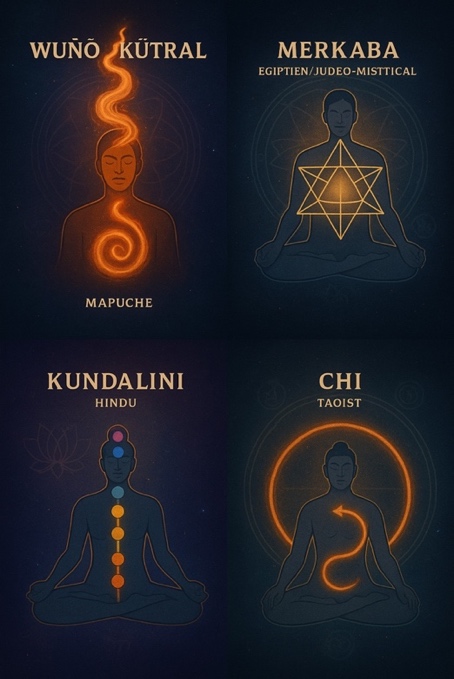
Image generated by ChatGPT.
IV. The Great Flood Also Reached the South
The Mapuche also preserve a flood myth: the legend of Trentren and Caicai. It tells of the sea rising to swallow the earth, and the land lifting up to save its children. Survivors became birds or stones, echoing the same cataclysm Hancock places around 10,500 BCE.
If wisdom was passed down from the survivors of a global flood, then the Mapuche are not peripheral to the story. We are its bearers.
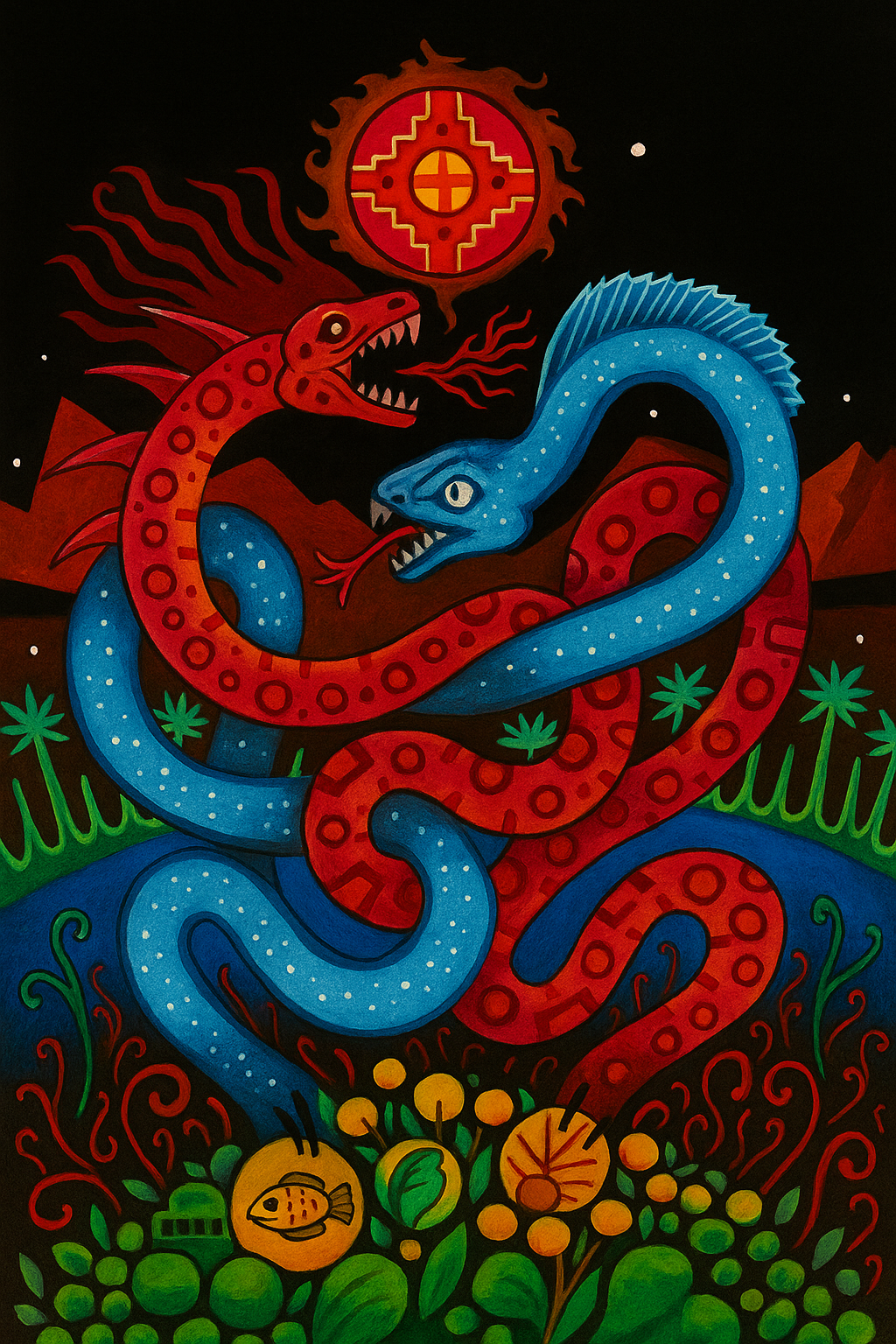
Tren Tren y Cai Cai – Image generated by ChatGPT
V. Resistance as Evidence of Value
What kind of people can resist for 500 years?
The Mapuche are the only Indigenous nation in Latin America to inspire an epic poem from their conquerors: La Araucana. We signed treaties with Spain as a sovereign people. We held our territory south of the Bío-Bío River for centuries. And when the Chilean Republic broke those treaties, we resisted again.
We resisted not to conquer, but to defend something sacred: paradise. As philosopher Gastón Soublette said, the Mapuche were not defending land or gold, but the wisdom of how to live in harmony with the Earth. That is more than a monument—it is a way of being.
VI. A Call to Expand the Circle
Mr. Hancock, your work has inspired millions to question the official story. You have shown us stars and stones, frequencies and forgotten pasts.
But let us also look south.
The Mapuche have preserved a spiritual technology older than conquest, older than the Andes, perhaps older than the flood itself. We do not seek to replace anyone in the narrative—only to be included.
Not all fingerprints are carved in granite. Some are whispered in dreams. Others are sung to the forest. And some still burn as fire in the soul.
We are that fire.
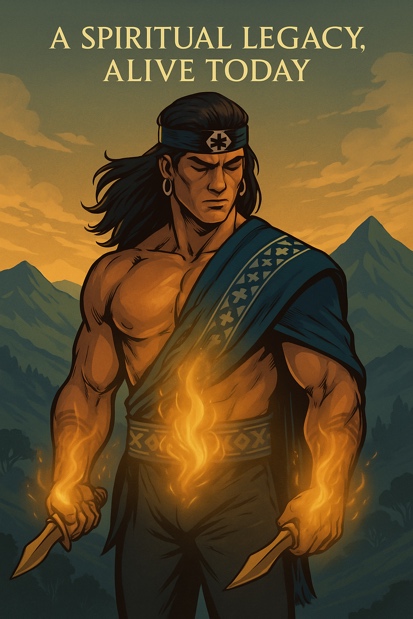
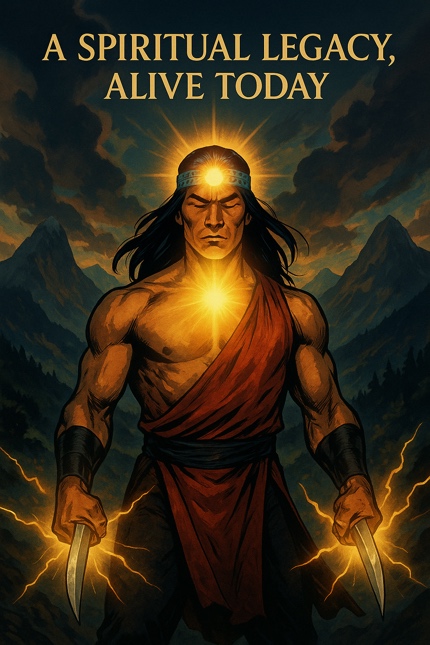
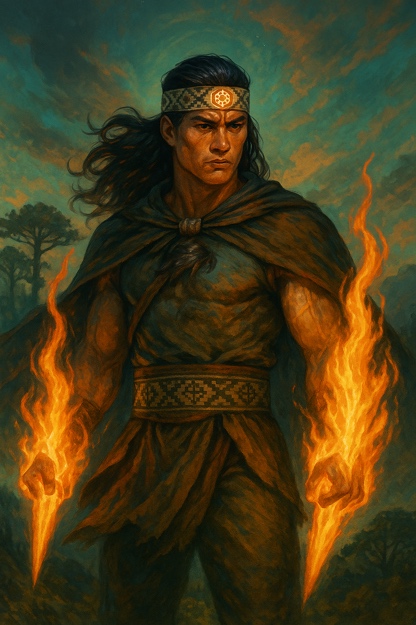
Image inspired by Galvarino: The Warrior Without Hands. Image generated by ChatGPT.
Galvarino was a Mapuche warrior who, after being captured by the Spanish, had both hands brutally amputated as punishment. Refusing to surrender, he returned to battle with knives strapped to his wrists, becoming a living symbol of resistance and fury.
His courage ignited the spirit of his people, showing that dignity can burn brighter than pain. Galvarino is the embodiment of the wüño kütral—the inner fire that no sword can extinguish.
VII. Voices of the Mapuche
The Mapuche worldview is transmitted not through monuments or written texts, but through words—concise, luminous expressions that hold layers of meaning. These sayings and definitions open a deeper understanding of our culture. Below, I share a few examples of this living language, which are also explored in my book Konas of Light.
Here are three sayings that reveal the depth of our spiritual civilization:
Their war cry was “Inche Kae Che” — I remain a man, I remain a person.
Before entering battle, Mapuche warriors would raise their voices together in this cry. On the surface, it was a declaration of strength, but at its core, it was a vow of humanity. Battle meant blood, rage, and the possibility of losing oneself to hatred. In that crucible, the greatest danger was not death, but dehumanization —becoming a beast. The cry of Inche Kae Che was a shield against that descent. It was the warrior’s reminder: I will fight, I may kill, I may bleed, but I will not stop being human.
In those three words lives the essence of Mapuche spirituality: resistance without losing dignity, power without abandoning compassion. It is not simply a war cry. It is a philosophy, a declaration that even in the darkest moments, the fire of humanity must remain unextinguished.
“Kiñe pu che, kiñe pu mapu, kiñe pu küme mogen.” – One people, one land, one good life.
This phrase encapsulates the principle of küme mogen, the “good life” lived in balance with community and territory. It is not wealth or domination that defines well-being, but harmony among people, the earth, and the unseen worlds. It is both an ethical compass and ecological wisdom.
“Mapu mew ta inchiñ, mapu mew ta müley ta kuyfi ta che.” – In the land we are, in the land are all our ancestors.
For the Mapuche, the land is not property but kinship. It holds the memory of the dead and the presence of the living. To speak this phrase is to acknowledge that identity is rooted in place, and that every step connects us to those who walked before.
In the Mapuche cosmovision, kizu ngünewün—freedom—is not a natural state nor a right granted by others, but a faculty cultivated through willpower, discipline, and inner sovereignty. To be free is to govern oneself, to master one’s own destiny instead of being mastered by it. Unlike the Western notion, which often emphasizes the absence of external constraints, Mapuche freedom requires inner conquest. It is not given—it must be earned. No one is truly free until they have achieved it within. The purpose of the book Konas of Light is to get closer to kizu ngünewün. When we introduce meditation as part of the Kona of Light path, we develop this principle, showing how inner freedom is the foundation for any authentic transformation.
As Ziley Mora writes in Filosofía Mapuche (2019), kizu ngünewün is less about external circumstances and more about spiritual development.
In the Mapuche cosmovision, words are not arbitrary labels; they are living keys that reveal the essence of existence.
Wentru – Man
Formed from wen (sky) and tru (to be thrown, contracted), wentru means “a sky contracted into a body.” Man is understood as a preexisting spirit from the heavens, cast into the Earth and clothed in flesh. He is not simply matter—he is an incarnated spirit, echoing the biblical idea of humanity as divine breath in mortal form.
Zomo (Domo) – Woman
Woman is “she through whom we are more.” Beyond being the giver of life and fertility, she is also the awakener: the one whose mission is to stir man from his sleep and guide him toward his higher faculties. In myth, where her footsteps touched the barren Earth, trees and grass sprang forth. She is both companion and creative force, a living embodiment of renewal.
Püllü – Spirit
Literally “the smallest,” the term refers to the essence that contracts into form, a point of pure being. The püllü is not matter but belongs to another plane. Life’s spiritual task is to refine the am (soul, psyche) until it becomes püllü, the awakened spirit. Thus, man and woman, together, participate in a noble partnership: to awaken one another into higher consciousness.
Kona – Warrior of Spirit
In Mapuche thought, kona names the warrior, the one who throws himself into the heart of conflict with courage and strength. Its roots speak of entering (ko) and fighting (na), but its echoes reach deeper: it is also tied to the wild feline of Araucanía, the kod-kod, whose fearless stance became a metaphor for vitality and defiance.
Yet to call someone kona is not only to name a fighter. It is to recognize an inner fire—one who dares to enter the struggle, not for conquest, but for dignity. A kona is the one who stands upright against chaos, who protects community and spirit alike.
This is the meaning behind Konas of Light. We are not warriors of iron or empire, but warriors of illumination—men and women who step into the battle of our time with the same courage as their ancestors, yet wielding a different weapon: consciousness. They fight not to destroy, but to awaken. They do not march into war, but into the human soul, carrying light where there is shadow.
Kimwentrulan – Virginity
In Mapuche thought, virginity (kimwentrulan) is not a biological condition but a state of knowledge and receptivity. The word is built from kim (“to know, to intuit”), wentru (“man”), and lan (“death” or “eclipse”). It literally evokes an eclipse of knowledge: the temporary veiling of the wisdom that the man—its masculine energy—may bring.
Virginity, then, has several layers of meaning. It can describe the woman who has not yet received the knowledge of a man; or the one who, even if physically initiated, still preserves her intuitive wisdom untouched. At a higher level, it refers to the woman who rejects the ordinary wentru—the mere man—in order to open herself only to the füta (big, great man), the noble husband who awakens her deeper faculties.
Thus, virginity is not about the loss of a physical seal, but about the relationship between woman and wisdom. It can be eclipsed, preserved, or transfigured depending on her openness to knowledge. Ultimately, kimwentrulan names a task: to discern when to let the light of true understanding enter, and when to guard it.
Through these words, Mapuche philosophy shows its non-materialist core: human beings are not accidents of matter, but incarnations of spirit on a journey of awakening.
VIII. Where to Learn More about the Mapuche
For readers who wish to go deeper into the Mapuche worldview, there are several resources that offer more than surface-level history. They open doors into the spiritual dimension—cosmology, ritual, and guardians such as the chemamüll—that define Mapuche civilization as a living legacy.
Online Resources
- Cultura y Cosmovisión Mapuche – UC Berkeley
A curated digital collection from the University of California, Berkeley, that introduces the Mapuche worldview through oral histories, audiovisual material, and intercultural perspectives. It is one of the best gateways for English-speaking audiences to encounter Mapuche spirituality directly.
https://exhibits.lib.berkeley.edu/spotlight/mapuche/feature/cultura-y-cosmovision-mapuche-mapuche-culture-and-worldview
- Wikipedia – Mapuche Religion
While simple, the English-language entry on Mapuche religion offers a structured overview of the cosmological realms (Wenu Mapu, Nag Mapu, Minche Mapu), the concept of the püllü (soul), the role of the machi (spiritual guide), and the ancestral spirits known as Pillan. It is a concise point of entry into the spiritual universe.
https://en.wikipedia.org/wiki/Mapuche_religion
- The Chemamüll: Sacred Tradition and Symbol of Resistance
An academic essay exploring the chemamüll as a funerary guardian, its survival in Mapuche communities, and its transformation into a symbol of cultural resistance. It provides detailed context for understanding why these wooden figures cannot be reduced to museum pieces or park sculptures.
https://dialnet.unirioja.es/descarga/articulo/7159094.pdf
Books
- Bacigalupo, Ana Mariella.Shamans of the Foye Tree: Gender, Power, and Healing among Chilean Mapuche.
A landmark ethnography that explores the role of the machi, blending gender, spirituality, and political resistance. It is both rigorous and deeply human. - Course, Magnus.Becoming Mapuche: Person and Ritual in Indigenous Chile.
An insightful exploration of personhood, ritual practice, and cosmology among contemporary Mapuche communities, showing how identity and spirituality remain inseparable.
Documentaries
- The Ceremony (2019, Dir. Carolina Adriazola & José Luis Sepúlveda).
A powerful film following the struggles of Mapuche spiritual leaders as they confront both political conflict and the defense of ancestral rituals. - Wallmapu (2002, Dir. Jeannette Paillán).
A classic documentary by a Mapuche filmmaker that presents the people’s worldview, history, and resistance directly from within the culture, weaving together spirituality and political survival.
Together, these resources form a constellation: academic, popular, and artistic voices converging on a central truth—that the Mapuche are not a forgotten fragment of the past, but a civilization of the spirit whose wisdom still burns today.
Javier M. Ramírez Chacón is a Chilean entrepreneur, author, and spiritual guide of Mapuche descent. His book, Konas of Light, weaves together Mapuche wisdom, Taoist practices, and pineal gland activation to offer a path to physical, mental, and spiritual awakening.
Names and practices vary among cultures, but Spirit is the same everywhere. It is remembered and experienced, not learned. If deeply desired, anyone can access cosmic energy, connect to Higher Self, and perceive/travel in non-physical realms without drugs. The human body is designed to do this. Mankind had spiritual technology before material technology. Thanks to Messrs. Chacón and Hancock for the reminder.
Thanks for you comment!
No hay que disculpar a las drogas. Son parte de la religión y el cerebro la compaginó estupendamente con los seres superiores. De hecho es posible que estos sean los humanos drogados. Una puerta o la misma estancia. Es un factor de supervivencia, al menos consumida con libertad. La miel no está hecha para la boca del asno y lo otro no está hecho para un cerebro cerrado. Hasta el más libertino de hoy en día sabe que está más cerca de Dios. En este caso, el consumismo es un problema.
Gracias por tu comentario German!
Hello Javier,
I believe Robert Temple, as of lately, has been casting this Western concept of illumination with his latest book, “A New Science of Heaven,” and it has much to do with Mapuche cosmology. It has pulled me into this contemplation because, through my own research into patterns of mysticism and mechanistic science, there are themes that stand out. Plasma research, gravity, Lagrange Points, how consciousness operates, and how plasma creates atomic matter via dust from nothing connects spirituality to science. I think the Mapuche shared and protected this knowledge and the rest of global society is finally catching on.
Hello Anthony, many thanks for your comment. I will review the work of R. Temple. How can I connect with you?