



A short story by Matthew Cantley based on a real and tragic personal event.
I’m staring at a child’s drawing. Garish, gorgeous, and hilarious, it used to be on our fridge. I kept my hand from throwing it, but he’s just a kid, and this is so messed up.
*
We sit Haym down, my wife and I, both of us on the couch beside him. He’s only six. I hate this so much.
Light through our window blows up sprawling Lego and his younger brother is already in our midst, desperately needing bits torn apart.
‘Wait a bit, mate. Give us a sec,’ I tell him. ‘Don’t use teeth, Jack,’ I’m forced to add.
Jack’s indefatigable mischief, a tightly compressed extract of his mum, Zoe.
Our floor-bot chokes on something in the kitchen. Haym is eyeing the Lego. I’m certain, despite our best efforts, he’s noticed life is out of tempo; if not here, then at kindy. He’s a clockwork mechanism. His own metronome.
‘Haym, we have something we need to tell you,’ begins Zoe.
Distracted by the Lego, Haym tries, ‘Can you tell me after five o’clock?’
‘It’s sad news, baby. Something terrible happened.’ His little face meets hers intensely. ‘There was an accident, a landslide. Do you know a landslide?’
‘I know!’ yells Jack. ‘It’s like lava!’
‘Be quiet, Jack,’ scolds Haym.
‘It’s sort of like that,’ I say, ‘but it’s fast and it’s mud. You need to let us talk now, bud – with Haym.’
‘There was a landslide,’ says Zoe, ‘and many people died in it. And your friend, Wawa, and her family, they were there and – I’m so sorry, baby – they all died.’
‘No,’ chirps Haym, shockingly unfazed, ‘she didn’t.’
Zoe takes his face in her hands.
He huffs a little protest. ‘Mummy…’
Zoe finds his hazel eyes, shrinking herself to peep under the hard-set brows of his doll face. ‘Baby, I’m sorry. Lao Shi just sent me a message. They found her body.’
His teacher’s words are his absolute truth and he stands to face us. He’s rigid with frustration, clamping up limbs like a toy robot. When kiddie problems best him, he’s always retreated into defiance, but this isn’t child’s play. I never had to deal with this—not as a kid. It sucks so bad I might vomit.
‘Can I give you a hug, bud?’ I manage.
‘No!’ He points at me with all the ferocity he can muster; he only looks a bleeding cherub. He reminds me icily, ‘You said kids don’t die. She can’t be dead.’
I probably did. I don’t know when.
His cogs crunch. He turns to his mum.
‘Mummy, can I play my Lego now?’
Life is out of beat and he needs time to recalibrate – like us.
But we don’t have a lot of time. That’s our fault: our hope.
When Wawa’s mother and the baby were found, maybe – we’d hoped – Wawa got away with her dad. But near half the people camping on the slope were located that first day. When her father was found alone, this morning, I still suggested we hold off on telling Haymish. Confirmation that her body was found way outside the main excavation, shrink-wrapped in their tent, came hours later.
I’d given up when her father was found, spiriting away the drawing on our fridge.
Behind us, shrill fury belts out an ajar door, forcing Haym to await Zoe’s answer. His littlest brother’s cries climb my spine like a shudder, given where my heart is at.
‘I’ve got Flynn,’ announces Zoe, getting up. ‘Yes, you can play.’
She catches him in a big hug and he limply allows it.
Jack’s adding a pool to his fortress. ‘Does that mean she’s a ghost, Daddy?’
Haymish huffs, plonking himself inside the plastic rubble. ‘You’re stupid.’
‘Da-ad… he called me stupid,’ reports Jack.
‘She’s in heaven. She has her whole family with her,’ I answer. ‘They’re altogether, mate – and they’re happy.’
How are they happy pops into my head.
Jack gasps with excitement. I worry. I should shut him down; Haym is me.
‘Haymish! Haymish! That means –’ he gasps again, ‘Wawa –’ he tries hard to contain himself, to spell out the revelation slower, ‘Wawa –,’ his hand on his brother’s knee, ‘can play with Nunu!’
Our dog, Nunu, died a year ago – and I’m too slow there.
Haym thumps him and it’s blood and terror in the living room.
*
Haymish is our eldest, not our first.
Our first child took about a year of trying and god-awful traditional medicine. We were told it would be tough. Zoe’s heard that since she was a teenager, though, and we’d do whatever it takes. That medicine stank the whole house out. But, it must’ve sorted things out.
We were giddy, going in for the second ultrasound. We thought we’d learn our kid’s gender, and straightaway, well, kids don’t grow backwards of a sudden.
It was Zoe’s immune system. Hard at it already, we were told. Felt cruel of Nature, making it cuter like that. An all-round surreal moment, like a TV show within a show, like watching myself watching a black and white screen that was a picture where a video was meant to be.
When I found it, I’d forgotten we had a printout. I suspect I was numb when I shut it away. It looked like a teddy bear. That blasted out my heart. My thoughts collapsed into a desolate place so damn quick, I swear I heard the darkness of the gurgle.
I hid that last ultrasound in the trash and then I did away with the others. I never wanted Zoe to feel that. I have to do so much better this time – for Haym.
So the drawing stays. If only, in hiding. I return it reverently to my office drawer.
We’re going to the funeral.
*
Parents are not meant to inherit their children’s houses.
The living room is well lit as ever it could be. All the downlight bulbs are alive, yet it’s permeated with the dank of misery. Their old furniture is gone, stowed in a trance, probably in the bedrooms or smashed to pieces, but with a cold feeling, I’m certain there would’ve been rolled up playmats, a couch where they all nestled in together to watch shows, probably share some wine when the kids were asleep, and toys, lots of toys where they shouldn’t be. Because they were like us, my family. It seems so. And Wawa – what little I knew of her – she was a cheeky monster like my Jack; that much was readily apparent.
Their new furniture has the palm-sugar-sheen of gula Melaka. Its ornate, beautiful, and terrifying. It’s the shape. It allows no imagination to be anything different, a shape known to me since Scooby-Doo. The tiny one could be quaint, cute even, matching the two larger, if not for that shape’s insistence: herein lays a child.
In the numbness of ritual, this quiet pace of little tippy-toe steps in cartoon socks, I’m momentarily confused. Three caskets laid out for a family of four? But as we all filter around the shrine and into the house, Haym becomes the first child directly after a procession of teachers. They’re stopping short at a table of flowers and photos, and what I momentarily take to be a vase gains sharp perspective. It becomes an urn before bouquets and it’s dread and tragedy in the living room.
She was one of the last to be uncovered. Too many days in the clutch of the earth. Her body went from the earth, straight to the fire, and into this urn.
Yes, I’m reasoning about heaven and children like mad to maintain my composure, and I gently, but evenly, meet Haym’s eyes and ask if he’s ready.
The principal and teachers move aside, standing by a man not much older than me. He’s in a suit, stoic of face and rigid as the carved door gods that guard temples and homes. A true professional.
How does he deal with this?
We approach the urn and I stand there, dumbfounded, my six-year-old son in hand. His six-year-old friend in a dove-white jar is unrecognisable to him and I realise open caskets with old people in them are, too, the entirety of his experience with funerals. He lifts his earnest, determined, perplexed face to meet mine and asks, ‘Where’s Wawa.’
I feel a massive wave of woe spill into us silently. It’s like it washed my soul away and I’m suddenly exhausted under its pressure. I grasp this man in a suit, while a young man by my eye, he’s not a funeral director. Within these few heartbeats without breath, I get it. This man is strapped into a tight-fitting suit he never expected to wear a week ago. His belt and seams, fastened around deep fractures, make for the world a shade of solemn professionalism.
Her grandfather chokes, like inhaling water, like drowning in unshed tears – but only once – and it’s buried under a thud in the sutras on loop in the background.
‘She’s there,’ I say, ‘right there,’ conscious of her grandfather’s suffering, delaying the justification Haym needs for this outrage; his friend, singled out, alone, made into ash. ‘In the photo…’ My hands turn him slightly by the shoulders, directing his attention to the sweet, mischievous face of his little friend, her fringe on her eyebrow, cheeks made red and chubby by her roguish smile.
He looks on her as I keep my hands on him. I feel his sadness wick up my arms.
‘Say goodbye to your friend,’ I reassure.
He’s quiet, and I’m not sure if he needs more or is saying goodbye.
I creak, ‘It’s ok; it can be in your heart.’
Haym, setting his flower in front of her photo, folds into me, his face in my belly as I squeeze him and take a gasp of comfort in his life. Her grandfather’s shape crumples as I do, and his wail winds upwards in a siren of searing anguish. It’s the most horrendous sound I’ve never imagined. My instinct is to turn and pull him into us, yet my thoughts snare me. He doesn’t want some Mat Salleh, some random white bloke from somewhere, grabbing him. He falls into the principal’s arms, and her body shields none of us. It’s fingernails down a chalkboard deep inside, where all the rules are written. Scratching them out, trying to gather them preciously together in hand, just as he now claws his face, the wail through bars of fingers.
I wince and feel my eldest’s hand firmer in mine, because I’m squeezing it. It’s a pitch to shatter ritual, and even Haym, who squeezes back, knows it’s pointed toward heaven.
It’s her name he yells, and my gut understands it’s his bereft, helpless apology for not preventing the unpreventable.
Regret and fear overwhelm my compassion, swamp it under incalculable weight like mud that suddenly gives way to smother happy families one weekend. I dread the damage this is doing to my kids. I think we’ve messed up big-time taking them here.
Jack’s laughter peals out, churned in with the tormented wail. ‘Funny! Right? Dad? He’s funny!’
I can’t remember when I ever cried like this. It’s a silent flood. I’m walking normally, breathing normally, speaking normally, but the tears are prolific as I leave with my family.
*
Things seem normal for a bit. Her grandfather’s agony haunts me, as does the worry it festers in both my sons, as it does in me. I expected Haym to be sad; it’s so raw and close to the surface for all of us. I expect it takes time, fine layers of day upon day. He can’t just get black-out drunk and isn’t yet crafty enough to cram it all away.
I find him alone on the couch. Its early morning and he’s already awake as I walk the few metres from our bedroom. He keeps his rounded back to me, even as I put an arm around him. I know what he has, but he keeps it under the shell of his body, locks it and his face away. Gently I prise him back up against my chest and circle him in arms.
‘She was a little sweetie,’ I say. ‘I’m sad too, mate, and you don’t have to be embarrassed or shy about it.’ He turns his head upon my chest. I can see quiet tears and swollen eyes. ‘We can all think about her together. Can I look too?’
He holds his kindy graduation photo out for me and we stare at the line of children in their little blue robes. It was taken a little while back; the actual ceremony’s next month. I’m looking at Wawa and her bright, cheeky smile. Within a daisy-chain of classmates and teachers, Haym has her hand. I grin, recalling a song she taught him, one about their teacher blasting off the toilet into space – that little ditty made an instant fan of me – and I suddenly feel my guts swimming like a chain off a pulley, yanked by the child we lost. We weren’t told, but Zoe is adamant it was a girl.
Haym asks quietly, ‘Why did she have to die, Daddy?’
‘Mate. She didn’t have to die, bud. No one tried to make it happen or wanted it to. Not the rain, not fate – I don’t think so.’
‘What’s fate?’
‘It’s like destiny; you know that?’
His cheeks shrink his wet eyes smaller while he considers it.
I add, ‘Like a planned part of your life by God or Nature, or something that can’t be changed.’
‘Why?’
‘It doesn’t matter; that didn’t happen. I think just everyone was doing normal things, and it was a horrible accident. Wawa and her family went camping because they liked camping and go camping. The farmer made a campsite on a slope because it was a pretty place. It rained because everything needs rain. Sometimes the soil isn’t tight enough to hold much water, so it slides down the hill without eyes to see or arms to catch itself. It just comes…’
Haym scoots from my arms and onto his knees. ‘But it’s still not fair. She’s just a little kid, like me.’
‘Yep,’ I agree solemnly. ‘It’s not fair, and she didn’t have to die.’
*
We wake up to his screaming; he’s a tiny fire engine racing straight up the gullet of our house.
My wife and I spring awake and fall out of our bedroom doorway. Adrenaline has our hearts roaring. Mine’s thrashing its cage, those first few seconds of darkness, and Flynn is shrieking.
‘Help me!’ desperately punctures the small pause before a second scream erupts. Zoe and I breach the baby’s room. The scream’s an eye-searing explosion as Zoe bashes the switch, and there’s Haym with a twisting, furious infant half-over the high rail of his crib.
My hands are pulling Flynn back without a thought. In the fog of it, Haym yanks desperately against me.
‘Babe!’ I yell, but Zoe is already with her arms around Haym, and he’s thrashing, he’s lashing out for his life. She gets a squeezing hug around him and drops to her bum, keeping him engulfed.
Flynn is back in the cot and mighty displeased, and it’s such a clamour in the little room as Haym fights against everyone to escape and be heard.
‘Please! Please!’ he roars, desperate, his face awash with tears and his eyes waxing with terror. ‘We gotta get out of here! It’s on fire!’
I’m in his face, and he’s in a cocoon of his mother and me.
‘Let me go! Why aren’t you doing anything? Pleeease!’ He rails against our bodies like on a donjon’s walls.
Jack arrives, groggy with sleep and a look too incredulous for a four-year-old in a onesie with a dinosaur tail.
‘Honey. Honey. Look at me,’ tries Zoe, ‘You just had a dream. It’s a bad dream – there’s no fire.’
‘Go back to bed, buddy,’ I quickly tell Jack as an aside. ‘Everything’s fine – just a nightmare.’
Jack dutifully waddles away in his baggy PJs.
‘No…’ whines Haym, ‘I saw it out my window.’
‘There’s no smoke, mate,’ I begin, ‘no one else is worried. Jack’s back in bed. Look, look.’ I take a few ridiculously intense sniffs. ‘No smoke. Can you smell smoke?’ I press him, frantic.
He tries a little sniff, ‘It’s smoke!’ and starts to writhe in panic. ‘Jack’s dead!’ he wails. ‘Let me go; we’re gonna burn.’ He’s sobbing now, just a small puddle of resigned misery, but as much as it hurts me, I feel a rash of frustration prickling my neck.
‘Let him go, hon,’ I ask, and Zoe does, and Haym inflates. He’s off to the door in a moment. I help him with the tricky lock and keep up with him as he breaks out. He hesitates at the road, and I bring him round to look back at the house. I squat with him, an arm about him as he takes it all in. No fire. He can’t believe his lying eyes and takes a bunch of big sniffs.
‘I think I smell something…’ he says meekly and goes to the side of the house.
The streetlights his window look upon glow orange. I notice it for the first time, despite the years.
*
It goes on every night. The sunset is a wildfire rolling towards us, cruelly intent on burning everyone alive. The streetlight behind our house is the neighbour’s rooftop ablaze. He hears fire, he smells smoke. My wife and I wake to the sound of the front door latch; it has a knack to it, needing a jiggle first, and it’s that jiggle that alerts us every time he’s sneaking out, the dead of night, for a safety inspection.
By week’s end, it’s bled into a twenty-four-hour vigilance. Random background clicks and pings stand the hairs of his neck and have him rushing about, begging to know what happened. We could take him to the local shops at first, provided the sprinkler pipes were our uncompromising tramline. He won’t leave home now.
The longer this goes on, the more it’s making me nutty, too. There’s no spark in his eyes anymore, and it poisons everything. His face is ashen. Kids shouldn’t get this. It’s not fair. I can’t help but lose my temper with him, hating myself for being so useless.
Broken sleep or no sleep, it’s messing with me big-time. I catch myself staring in rooms, and I can’t remember what I went in for. I feel half in this bag of meat, half the time behind myself in neutral, like microsleeps on stoplights, bouncing awake to Haym in the night and crunching into human gear. Thank God Zoe has organised something called ‘play therapy’. I wouldn’t let her, at first. I just didn’t want someone writing he’s mental in a record like I’ve probably got.
*
I knew something of it – not this – but as a hum behind the noise of life, everywhere, like an air conditioner’s purr. I place my phone down, screen down, because it’s let me down, bringing that up. He’s a mess. He’s making us all a mess. Poor kid. I can’t fix my son’s problem. What can I do about this? I just want a few giggles as my hideout. Not to hide from my very own eyes’ reflection.
Because he wakes me so soon after the time before, for blocks of hours, I don’t bother going back to bed. It’s better this way. I moved Jack to our room, and Flynn is usually in our bed, suckling; it wakes him too, and I can get in faster. I’ve a better chance of containing the explosion.
That’s why I’m at the kitchen table, my last scotch looking like chrysanthemum tea. Yeo’s Teh Krisantimum. You’ll find boxes and boxes of it everywhere you go this time of year. But we’ve skipped the big family gatherings: no firecrackers and lion dances, no Jom! Balik Kampung! – visiting the hometown. No, not this Chinese New Year.
It’s also school holidays. I’m dreading Haym’s first week of primary school. Hopefully, the therapy ends up helping.
He had one just before the holidays. As the door closed on Ms Rei’s room, I was expecting to scoop up a mess of a boy later. It was elating to instead meet light in his eyes, a skip in his trot. By night, well, he’d waned with the day. Today’s the worst I’ve ever seen him. He was nasty, even cruel to us. He invented every one of his violent outrages. It sure does strain the sympathy, and I feel guilty about that, here in this quiet. Ms Rei warned us kids often get worse before they get better, but she’s so damn young, and I can’t help this fear she doesn’t know what she’s doing.
It’s because I understand him. My wife thinks I’m projecting, but his ego’s his jester and his tyrant, even at six years old. My parents were younger, doing it tougher, so they had me on meds earlier than six. I won’t stand for little red triangles in his lunchbox. No way. Ms Rei will have to make magic with Lego and Uno. But we came to her, and I’ll give it a chance.
‘No.’
I pack as much self-loathing as I can into the whisper. I’ve got myself too worked up. I’m not with it; not looking what I’m doing. I’ve stamped a ring; it’s bang-on the picture Wawa drew for Haym. I mustn’t’ve noticed where I sat the glass one time. I might’ve dozed off for a bit. Zoe found me like that a day or so back, so I’ve done it before.
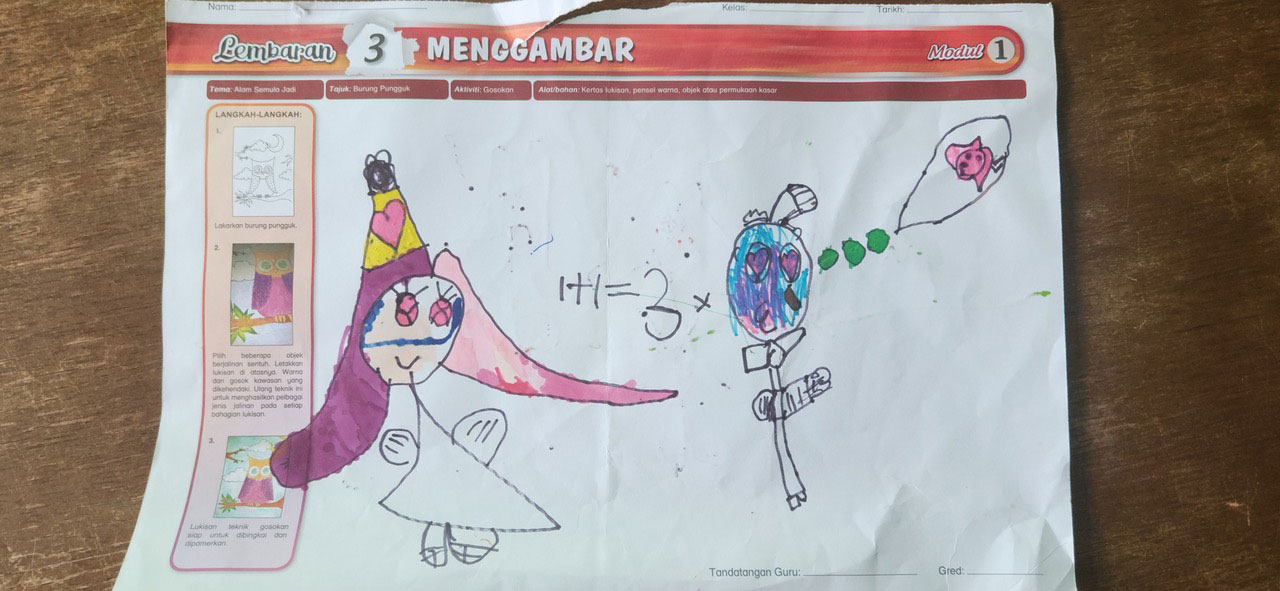
I shouldn’t’ve taken it out, that’s what it comes down to, should’ve just let it lie safe in my office with stuff from my kids. But I needed a bump. Patience for the small boy whose suffering is communal punishment. I hold up the picture, too afraid to dab a circle see-through as rice paper, and again find myself absorbed by its chunky Texta.
Here lives a girl with a love-heart hat, her pink eyes enormous, her lashes impossibly long. She smiles at a boy, or maybe she’s smiling at the big, messy bundle he holds.
My wife and I secretly chuckled over it, back when it was funny. Zoe couldn’t believe it. A six-year-old thinking about children? Then I’d pointed to the 1+1=3 scrawled between the figures.
‘It’s a baby,’ I’d insisted, laughing, tapping on the sum.
‘Oh, my god! It’s got a face – look!’ marvelled my wife. ‘Kids these days!’
It’s a looking glass. A blueprint to build a better me. I knew it when I hid it away.
What luck, I must remember. What luck I have.
I take up my phone. I have to. I wind through my lock pattern. 4% Gazans Slaughtered, Wounded, punches through the screen like a horrid jack-in-the-box.
In the wee hours, with a glass of scotch, my mess is scattered Lego compared to scattered suburbs, and I am thankful. Before I can ignore the gratitude, before this month-old clip can finish, before Haym wakes up in terror and it’s washed away in screams: determined to know, I search for a four-letter word.
I swipe the list, blurring flesh and stone, scraping more out from under my phone. Tiny, ashen feet peek from a slab as crowbars scratch away; giant, armoured bulldozers scrape life back to primordial dirt. In my gut, nuzzles the helplessness of history. It’s written. Already done. Unstoppable. A twelfth-century sacking in the twenty-first century. Medieval methods with modern potency. Plastic bags and donkey carts for body parts. A child, held in hand: the precious ball of meat is double-bagged. I pause the video and stare. I steep in it. Old as she is, her hand keeps the leftover child still as a plumb bob. Day and night peel their neighbourhoods down, but not their devotion. It’s a searing recognition; it makes my eyes burn, and I don’t dare blink. The dignity of her devotion is the most human thing I’ve ever seen.
My heart bows to her, gutted. It recognises the anaesthesia of distance – and the drugs are strong. The loss of a child I hardly knew, taken by Nature’s blind-eyed innocence and Chance’s indifference, hurts harder than this take-away container casket and the many-thousand others buried in manufactured landslides. Because two doors down, no-one knows the desperation in this house, and I don’t know theirs. More’s the pity, two countries, two continents down.
I take a healthy slug and shatter an ice cube between molars. The crack of it or a facade, one of them bangs the gearstick of my being out. My mind redlines before I crunch into the fact: They shut down the world for a one-percent fatality rate.
We entrusted our Everything to our good governors for grandma’s sake, didn’t we, to be good people? They spin our countries like they’re on power steering. But they’re saying here, showing it, soldiers left infants to die, left them in their very incubators to bloat with maggots. Even now, they’re dying like criminals on gibbets, wrapped in webs of concrete and rebar.
How are they getting their play therapy?
And I come across a Kia in Tel al Hawa – and dear God – there’s a decomposing six-year-old girl in it.
Wawa.
Not just in age, but her face. It’s her joyous grin that makes them sisters; an innocent abundance uncoupled to approval, to the future. It blasts from her photograph. She’s in a kindy graduation outfit with a pink bowtie. Her name was Hind.
She’ll never get her 1+1=3, or four, or would it have been five? The thought echoes in a growing hollowness, her sweet smile continues to scoop. Never a mother, never a grandmother. Never a possibility to choose to be neither – every possibility to never have had to die.
‘Come, take me. Please. I’m scared. Come quick,’ her little voice pleads bravely.
She tells the Red Crescent operator she’s scared of the coming dark, even as a machine-gun sputters from a nearby tank, guns that left her wounded amongst her corpse kin.
Her pretty photo becomes a video of the only help she had: two heroic paramedics cremated alive. I see the mangled shell of their ambulance made their urn, then I see Hind’s mother approaching a flowery bedsheet-body-bag. She peels it back.
She screams, ‘I told the world, “Go get Hind!”’
It sounds so much like Wawa’s grandfather, yet it’s not gouging inwards, not stabbing upwards. It’s a mother’s promise.
‘I will ask you, in front of God on the Day of Judgement, about my girl!’
There’s much louder screaming now: terrified, confused, incessant. My son. I turn the screen blank with a pinch and rush to grasp him. His eyes and mouth belong on a day-old catch. Even in my clutch, the shrieks gush out like he’s an unpluggable silo of horror.
‘The roof is on fire!’
I want to pull him to his feet, jump on the bed with him. I want to laugh and sing ‘The roof is on fire!’
Because he is so damn lucky to only be terrified and traumatised, to only have one dead school friend.
Raw and heart rending. I feel the pain weaving through his words of a young family’s tragedy and the inevitable ripple effect on all who knew and loved them.