





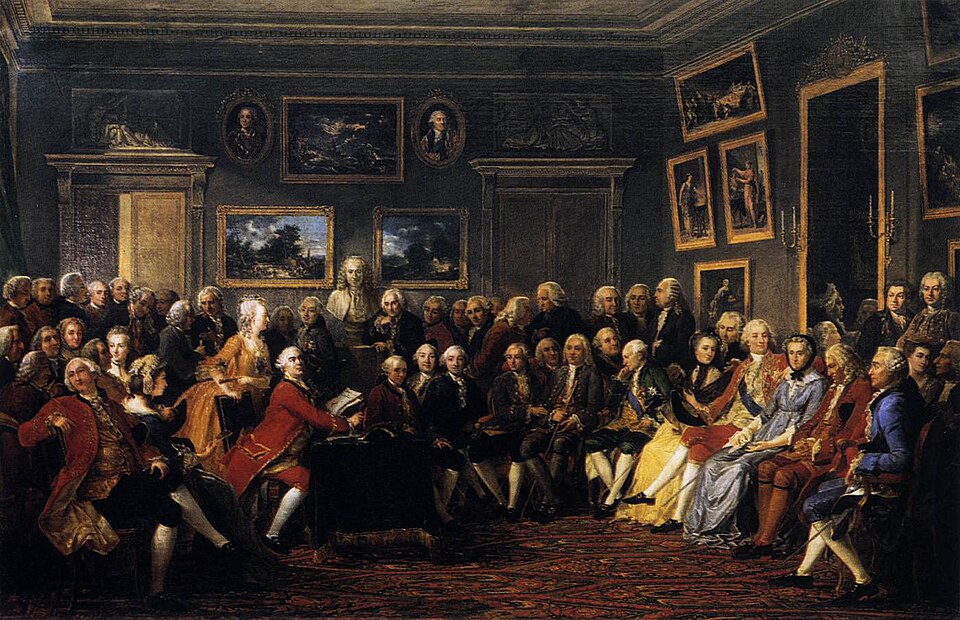
A Reading in the Salon of Madame Geoffrin, 1755″ by Anicet Charles Gabriel Lemonnier. The Enlightenment salon was a space where ideas, however radical, were debated openly. Public Domain

I have been taking a cool look at people who are coming to new ideas with the intention of snuffing them out – particularly ideas which challenge the down-to-earth common-sense consensus.
I am thinking here about UAPs, otherworldly beings such as angels or the pre–Ice Age civilisations researched by Graham Hancock would, if true, turn most people’s worldview inside out.
These sceptics typically present themselves as ‘pro-science’, (nothing wrong with that, of course!), but more often than not, their agenda might more accurately be described as ‘scientism’. This is the belief that empirical science and its methods are the only valid sources of knowledge and truth about reality, that the guidance offered on other aspects of human existence by religion, philosophy, ethics and art is flawed because of its subjective elements.
They pride themselves on being anti-wu-wu and supremely rational.
But what they say, the phrases they use, often shows that EITHER they do not really understand how science works OR that they do understand but are choosing to be intellectually dishonest.
Here are some red flag phrases:
‘There is no evidence’
To understand the potential for intellectual dishonesty involved, we need to be clear right away about what evidence is, how it works and where to find it. Evidence isn’t something like atoms floating around in space. Evidence isn’t an object or a quality or feature of the universe. Evidence is a mental construct, an element in discourse about the universe.
‘I like to stick to cold, hard facts’
There is likewise a danger of dishonesty in this sentence. Facts are being presented as if they have the qualities of a physical object – coldness, hardness – that make them in some sense tangible. But facts—like pieces of evidence—are mental constructs that only make sense or have value in the context of a complex and constantly evolving system of ideas.
So if you want to find evidence, you must first consider a claim (in scientific terminology, a hypothesis or theory) about what’s going on. Second, you must find data that either fits or doesn’t fit that claim. If this data fits, then it is evidence for and makes the hypothesis more likely to be true; if not, it is, of course, evidence against.
Evidence only comes into play when you are trying to establish whether a hypothesis or theory is true or not.
On the other hand, facts only come into play when a theory is unquestioned and universally accepted as true. Facts are data or information that fit with and confirm a particular truth.
But if you are involved in an argument in which you are questioning the established narrative and your opponent starts saying things like ‘these are the facts’, he is probably being intellectually dishonest, because what facts are, what counts as facts, is precisely what is at issue.
By trying to undermine your claim with his ‘facts’, the person you are arguing with is smuggling in an assumption that what he is arguing for is unquestionably true. His argument is circular. It assumes what it purports to prove.
What is key when you are questioning the consensus opinion is not facts but evidence.
To say there is ‘no evidence’ for the claim that aliens have visited Earth is either unbelievably ignorant — you would have had to have lived in a cave without access to media for decades — or breathtakingly dishonest.
The evidence in support of this claim includes:
- the testimony of countless individuals who have encountered anomalous craft and strange creatures
- the testimony of highly trained witnesses in the forces and among astronauts
- increasing corroboration of these testimonies in the form of multiple sightings, radar readings, photographs and films of UAPs
- the contributions of top scientists in academia who have devised explanations for these puzzling experiences and endorse their authenticity
- and the contributions of high-level whistleblowers, people in a position to know in the government, military and intelligence services who put their reputations and careers at risk.
‘There is no proof’
Sometimes when people say ‘There is no evidence’ — when the evidence is plain for everyone to see — they seem to mean ‘There is no proof’. And of course, sometimes people do say outright that there is no proof.
The problem here — and what makes it almost always an intellectually dishonest thing to say — is that they are seeking to dismiss out of hand what might otherwise be a perfectly reasonable claim worth considering. They are doing this by setting an impossibly high bar.
It was the eighteenth-century Scottish philosopher David Hume who pointed out that deductive reasoning can be certain and therefore admit of proof. Mathematics is a type of deductive reasoning. In other words, it is closed-circuit reasoning where, for example, the value of what is on either side of the equals sign is plainly the same. We can be certain, he said, that 2+2=4.
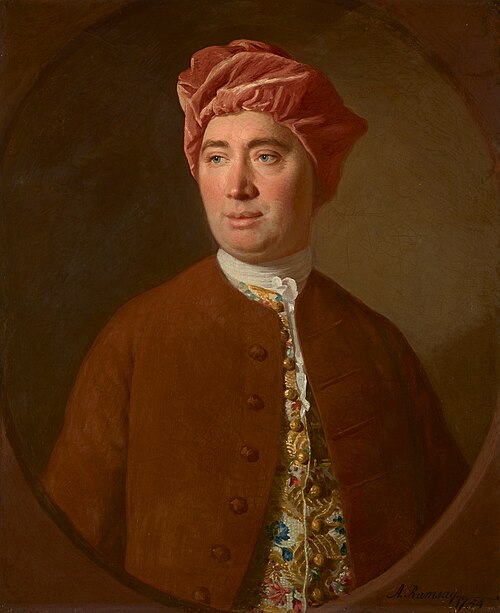
Painting of David Hume (Public Domain)

He distinguished between this deductive reasoning and ‘inductive’ reasoning, which makes claims about what happens not in the realm of abstract ideas, but out there in the real world. The same certainty isn’t possible there. Just because one event has always been seen to follow another event, said Hume, it doesn’t make the connection certain, only likely. Just because the Sun has risen in the sky doesn’t mean that it always will. That isn’t certain; we cannot be said to know it, and we cannot prove it.
To ask for proof of aliens, angels or Atlantis is therefore to set an unrealistically high bar. Even the best-tested scientific theories are never ultimately provable, and every sensible scientist knows that his pet theory will eventually be superseded.
Modern philosophy of science grew out of Hume’s deductive/inductive distinction. It asked the question ‘How do we make claims about what happens out there in the world so likely to be true that, even if they can’t be proven, they are ‘true’ for all practical purposes?’
The criteria that evolved were:
- that the theory should be ‘materially adequate’, which is to say that it should account for all the available relevant data
- that it should be coherent and make sense
- that it should be as simple and elegant as any universal truth should be
- that it should have predictive power, which is to say, you should be able to conduct experiments to predict results which would otherwise not be predictable
- that it should have explanatory power, which is to say that it should enable you to understand the way the world works at a deeper level.
- A sense also grew that it should fit in with or resonate with the other leading theories of the day.
The model has long been debated and refined, but there is a clear direction of travel, and this philosophy of science’s great contribution to science has undoubtedly powered the spectacular advances in science and technology in modern times.
In the twentieth century, a lot of thought was put into showing how these criteria work in practice, how a dominant theory — a ‘paradigm’ — is overturned and replaced by a new one. Leading thinkers have determined that what happens is that data keeps coming to light, which is inconsistent with the prevailing theory, thus making it ‘materially inadequate’. Defenders of the old paradigm keep devising inelegant little appendices to accommodate these exceptions until eventually they accumulate so much that they threaten to topple the whole thing.
History shows that at that point a new theoretician tends to come along with a brilliant new theory that accounts for both all the old data and the new ‘anomalous’ data in one simple theory that explains the whole lot.
What is key here is that in order for a ‘paradigm shift’ to take place, there has to be an accumulation of data, which then becomes evidence for a new theory. It is never a case of one piece of evidence — or even a few pieces — overturning a paradigm.
So in the case of Graham Hancock’s building the case for a pre–Ice Age civilisation, it is intellectually dishonest to demand that scratching the surface of the Sahara should, for example, uncover a pottery shard marked Made in Atlantis or finding a signpost off South Beach Miami saying Atlantis city centre 200 megalithic yards that way. Identifying that kind of physical evidence of an Atlantean city or civilisation is unlikely given the 11,500-year timescale, geological changes and the probability that any such sites lie under deep marine sediment.
What is important is that he has gathered together and integrated a vast and coherent amount of evidence contradicting the old paradigm, which asserts that human civilisation only began sometime after the end of the Ice Age.
This evidence includes:
- Ancient stories that have come down to us tell of a lost civilisation. These stories are either in mythological or legendary form or have survived in what purport to be historical records.
- Geological records, which point to a global catastrophe caused by a comet or comet storm, resulting in a great flood which would have destroyed this advanced ancient civilisation as the myths and legends have it.
- Ancient maps, which show lands in large areas now covered by seas and oceans, and which seem to preserve ancient traditions
- Archeological evidence, which points to highly advanced mathematical, astronomical and engineering knowledge and abilities which caused a sudden leap forward from hunter-gatherer societies to cities. One way to explain this sudden leap is that these technologies resulted from newly rediscovered relics of a lost civilisation.
There is evidence, for example, in the form of carved stone blocks at Baalbek in Lebanon and elsewhere, some weighing more than a thousand tons. These blocks have been moved and put in place at a time when, according to the conventional narrative, humans lived as hunter-gatherers and had no notion of any technology that might have made those feats possible.
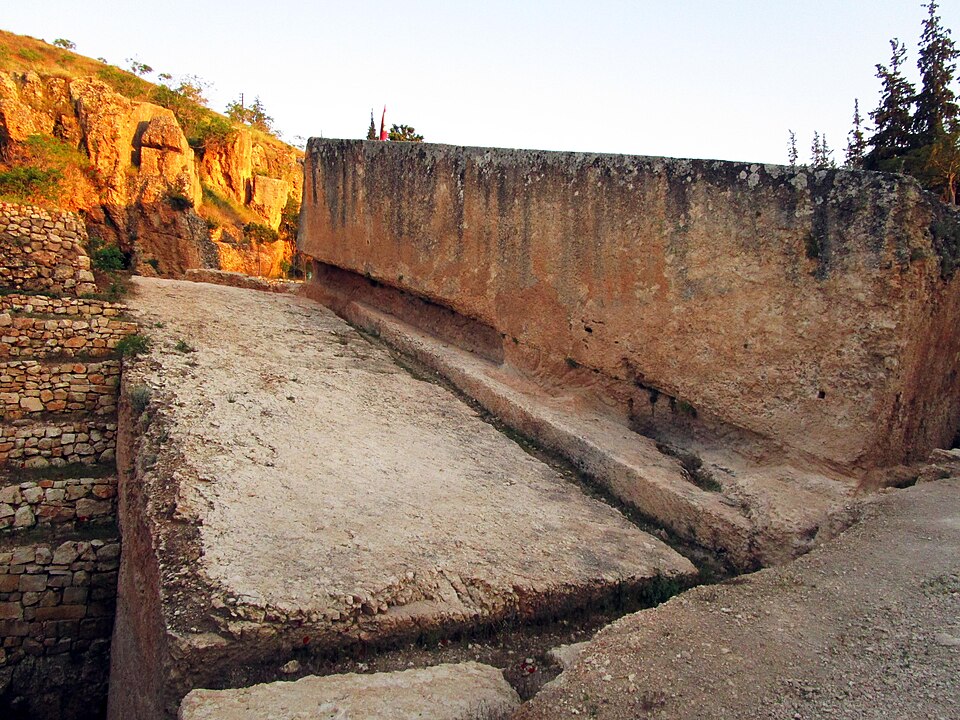
Megaliths in Baalbek quarry, Baalbek, Lebanon
Image by Lodo27 CC BY-SA 3.0

Water erosion visible on the walls enclosing the Sphinx at Giza seems to suggest that the monument was built in the time of the hunter-gatherers, in about 10500 BC, not in 2500 BC as the conventional chronology has it.
Graham Hancock is not saying that enough evidence has been accumulated to topple the current paradigm, but he is quite legitimately pointing to a direction of travel.
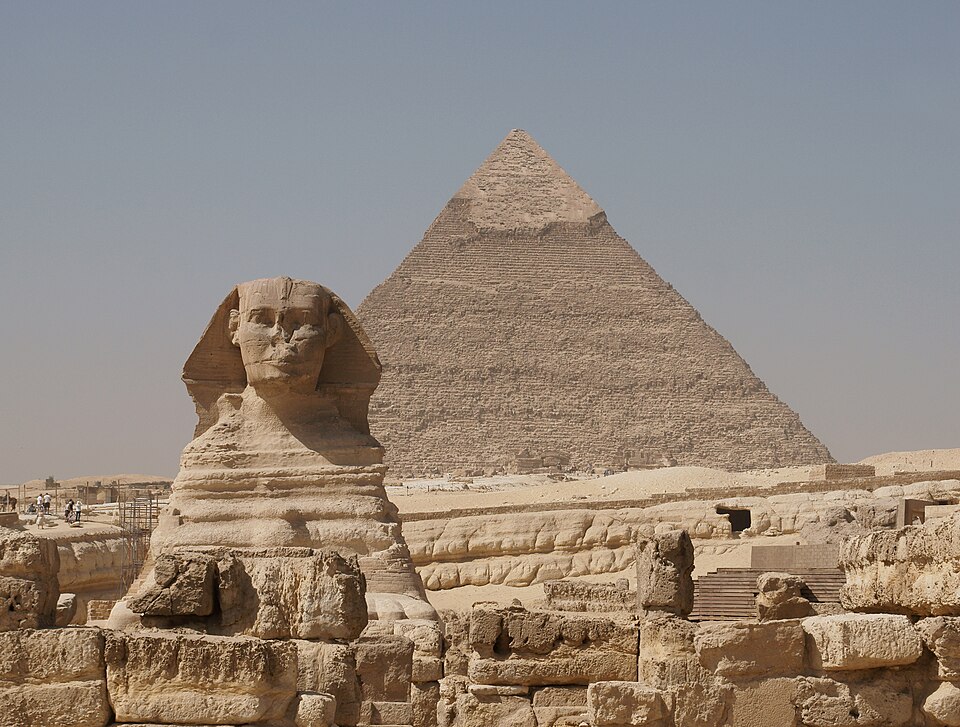
The Sphinx against the Pyramid of Khafre
Image by Kallerna (CC BY-SA 4.0)

‘Extraordinary claims demand extraordinary evidence’
This line, famously coined by Carl Sagan, and much repeated by rancorous sceptics, is plain wrong. It is special pleading and, as such, another symptom of intellectual dishonesty. ALL claims about what is happening in the world, if they are to be scientifically verified, require the same evidence treated with the same discipline. It’s called the scientific method.
‘These claims are unscientific’
The scientific method, to which David Hume, along with Francis Bacon and Isaac Newton, made crucial contributions, gave rise to the scientific and Industrial Revolutions. They discovered that if you looked at the world in as objective a way as possible, trying to discard all superstitions, hopes, assumptions, and biases, then you could achieve astonishing breakthroughs. We have touched on the way that the scientific method they forged involved collecting data measurable in mathematical terms and testing it against hypotheses and theories. Using this method, the ‘natural philosophers’, who would in the late nineteenth century come to be known as scientists, threw a web of metal and then electricity around the world, making human life longer, healthier, safer and more comfortable.
But there was a price to pay. Valuing the objective elements in human experience involved devaluing the subjective side. As a result, many intellectuals grew suspicious of subjective experiences, which are by definition not amenable to testing by the scientific method. Experiences such as premonitions, for example, or feelings that you are following your destiny or meant to be with your lover or visions, or meaningful dreams, experiences of prayer working, along with mystical and spiritual experiences which had been understood as highly significant in earlier eras, were devalued. People were being conditioned to disregard them, even screen them out.
As the objective method took a firmer hold, an extreme materialism began to filter down from academic circles. It proposed that material objects are the only real things, the yardstick of reality. In the second half of the twentieth century, this materialism – this scientism – spawned a new kind of atheism. It decreed that any report describing an event which seemed to break the laws of classical physics could not be happening. Anyone making claims to have experienced such phenomena had to be deluded or lying.
Once used as a tool to discredit religious belief and experiences, such as encounters with spirits or angels, the objective method is now also used to discredit reports of encounters with aliens, whether from elsewhere in the universe or other dimensions or other anomalous creatures such as cryptids or the Tall Man.
Typically, and as we have seen, these sceptics do not feel they even have to begin to consider or engage with the evidence (‘there is no evidence’) because their extreme materialist worldview tells them that these phenomena are, in principle and by definition, impossible.
Typically, too, these sceptics, if they are scientists at all, tend to work in the soft sciences, and sometimes it is hard not to suspect that they have not always kept up with developments in hard science. They sometimes give the impression that they are unaware that the classical physics paradigm has been toppled by a new physics.
This new physics gives a different account of the fabric of the universe and suggests we are entangled in it, that we participate in it, and that we are part of the same information continuum in ways not understood by classical physics. The old picture of the universe and our place in it looks increasingly lo-res.
To put it another way, new physics has moved away from the old objectivism. Together with new computer science, it suggests that there are other ways of knowing beyond the objective method. Study the history of modern physics, and you see that these other ways of knowing — including dreams, visions and mystical experiences — have driven many of the great breakthroughs in modern mathematics and science.
Astonishing new acts of scientific imagination are perhaps bringing us to the very brink of new insights into the nature of the universe and aspects of the human condition, including those which are all of a piece with angels, aliens and Atlantis.
The old guard may scoff, but as the Sufi mystic Rumi said: He who has not tasted does not know.
(Many of these ideas are covered in The Secret History of the Universe. It’s interesting to note here, as regards Hume’s distinction between deductive and inductive reasoning, that in the 20th century Kurt Gödel showed that not all mathematical propositions are provable either! I discuss this in chapter 4. An account of testing new mathematical patterns to see if they fit into a ‘world map’ of mathematical ideas is explored in relation to the work of Paul Dirac and Robert Langlands in chapters 11 and 14. The leading thinkers in the field of scientific paradigms are Thomas Kuhn and Karl Popper: see Endnotes, pages 414-4.)
Endorsements for The Secret History of the Universe:
‘What we have been taught to define as ‘reality’ will never look quite the same again once the implications of this breakthrough book are taken on board.’ Graham Hancock
‘Mythology and ancient esoteric beliefs are now finally found in cutting edge science.’ Rick Rubin, record producer and author of The Creative Act
‘Every now and then some independent thinking is needed to draw together the strands of multiple disciplines and set up the foundations for the next round of thinking.’ Professor Jordan Giddings, University College, London
‘Weaving a tapestry between physics, art, literature, philosophy, mysticism and our immediate world, Jonathan Black beautifully articulates the mythic dimension in historical events.’ Daniel Kramer, theatre and opera director, former Artistic Director of English National Opera and faculty member at Harvard, Brown and NYU
‘You have written the most brilliant book I have read for a long, long time.’ Jeffrey Mishlove, New Thinking Allowed
Hi,
Short comment based on my experience. The neglecting of ‘fringe’ scientists through a twisted line of reasoning is brilliantly described. Facts are discredited thereby that an established scientist fabricates a claim attributed to a fringe scientist in order to refute it as nonsense. Alternatively, the established scientist refutes a claim that has nothing to do with the one in question. It’s as if we were in mathematics. With a single counterexample, he refutes everything and everyone. Strangely enough, it works.
The most tried-and-true approach, of course, is to simply ignore the inconvenient facts and the people behind them. After all, what cannot be must not be. Let’s wait and see how things turn out. Ultimately, denial will reach a point where too many facts make it impossible. See the case of UAP for an example of this. Suddenly, they officially exist!
Stay tuned, and don’t let yourself be swayed.
Aloys Eiling
hello
your book the secret history of the world has got to be one of the best books i have ever read.
waiting for payday and i will purchase your lastest book
Beliefs are fascinating. So too is the willingness to suspend disbelief. I have been saying for a very long time that the Journalist’s Six Questions are missing “The 7th Question.” No, this is not a question about what is, or isn’t science. Or who is right, and who is wrong. Or who is being wise, and who is being foolish and narrow-minded. Here it is: So what?