





We warmly welcome F.K. Sterling, author of Ancient Ozarks: Giants in the Caves, Star People in the Stone, and the Underground Worlds That Rewrote American History, as our featured author this month. Drawing on two decades of personal fieldwork alongside folklore archives, archaeological data, and long-overlooked nineteenth-century investigator reports, Sterling’s book makes the case for a deeper, stranger, and more significant Ozark prehistory than the textbooks have allowed. F. K Sterling examines accounts of giant skeletons, underground-world traditions, and star-being stories as data worth taking seriously rather than dismissing them as ancient fiction.
In his article, he introduces the reader to the strange and persistent mysteries of the Ozarks, from giant skeletons unearthed in Missouri caves to reports of nocturnal beings who haunt the region’s limestone hollows, the quartz-rich geology found within the caves, and his bold new theory linking the Ozarks to other great ceremonial centres of ancient North America.
Interact with F.K. Sterling on our AoM forum here.
“These hills are older than the stories we tell about them. Before the first cabin smoke rose, something ancient walked here — and the land still remembers.”— Anonymous Ozark oral tradition (adapted)
Tucked away in the rugged highlands of Missouri and Arkansas, the Ozark Mountains rise like an ancient backbone through the center of the continent. While mainstream archaeology shines a spotlight on coastal sites or the grand mound complexes of the Mississippi Valley, a quieter, stranger story has lingered for centuries in these misty hollows and limestone bluffs. Though these accounts of giants, hidden beings, and lost civilizations are controversial and often debated by scholars, their persistence invites a closer look. It is a tale of towering giants whose bones once made headlines, of shadowy beings who shun the daylight, of places where the veil between worlds seems thin, and of a lost civilization that may have found refuge—and established its headquarters—on this high plateau when cataclysm swept the ancient world.
The Ozarks are North America’s hidden heartland, a place where stories of giants, night beings, strange lights, and even whispers of Atlantis just won’t go away. When I look through old newspaper clippings, listen to Native stories, and consider the modern reports that keep surfacing, I can’t help but feel that this region is much older and stranger than we’ve been led to believe. If we start connecting the dots between the Ozarks and the great ceremonial centers of the Southeast, or the astronomical cities out West, a new picture starts to form. Maybe the Ozarks weren’t some forgotten backwater after all. Maybe they were the center of it all.
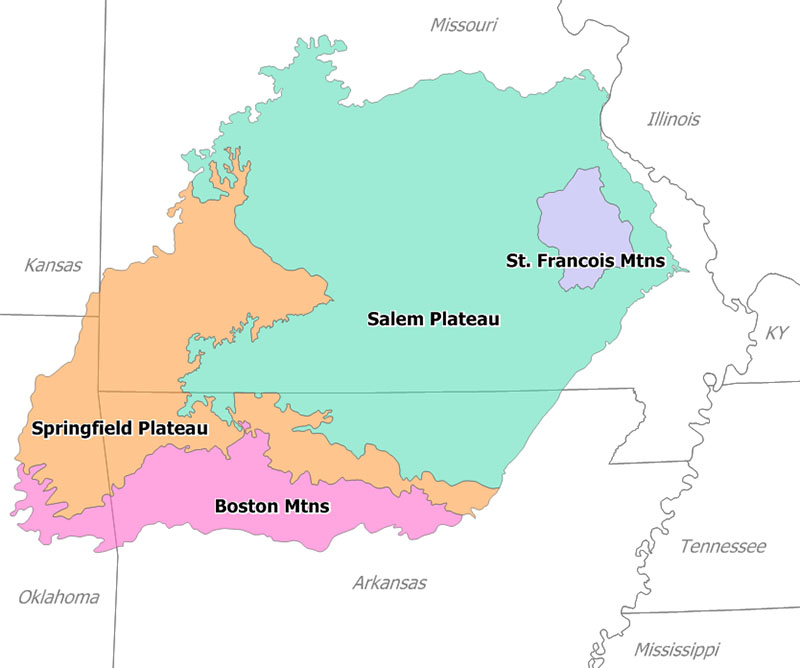
Map of the Ozark plateau’s four sub-regions (St. Francois Mountains, Salem Plateau, Boston Mountains, Springfield Plateau) by Tosborn (Public domain)

Giants in the Mounds and Caves
In May 1933, a teenage boy named Billy Harman was hunting for arrowheads along the Meramec River near Steelville, Missouri. Exploring a cave on the Puckett farm, he reached into a hole and pulled out human bones far too large to belong to any ordinary person. He and his father dug deeper, eventually unearthing a complete skeleton. Local physician Dr. R. C. Parker examined the remains and laid them out in his office hallway. A photograph published in the Steelville Ledger on June 11, 1933, showed the skeleton stretched beside a six-foot-tall local man, Lane Eaton, for scale. The giant measured 8 feet tall.
The paper reported that from the ancient accumulation of ash and limestone debris, a complete skeleton of an eight-foot giant had been turned up, brought to Dr. Parker, and laid out in the hallway of his office, described as the most startling exhibit Steelville had ever seen. The bones were reportedly packed up and sent to the Smithsonian Institution for study. After that, the trail goes cold.¹ Despite sporadic inquiries in the decades since—including those by local historians and amateur researchers—no official records or remains have ever been produced by the institution. The Smithsonian has consistently stated that it has no record of receiving or retaining these remains, which has contributed to ongoing speculation and debate within both academic and alternative circles.
Just a year later, in 1934, a similar discovery rocked the Lake of the Ozarks area. Farmer J. D. Crain was clearing a mound on his property. Beneath flat rocks, he found seven skeletons. Six were of normal size. The seventh stood eight feet four inches tall, with immense jaws and a skull more than half an inch thick. Seven stone objects shaped like human hearts lay beside the bones.²
In 1913, near Beaver Lake in the Arkansas Ozarks, an old recluse named “Dad” Riggins spent ten years digging in a shelter cave. At a depth of more than three feet, he uncovered several giant skeletons, including one nearly ten feet tall. Hieroglyphic-like markings were reportedly found on nearby palisades. The site was later flooded by the creation of Beaver Lake, but the 1913 account in The New Age Magazine preserves the story.³
Across the late 1800s and early 1900s, newspapers from Missouri to Arkansas carried dozens of similar reports. Native American oral histories add weight. The Osage, whose ancestral lands included much of the Ozarks, spoke of their own early ancestors as “Little Ones” who came down from the spirit world — a curious inversion of the giant narrative that may point to earlier, taller inhabitants they encountered.⁴
The Ozarks as a Genetic Sanctuary
One of the most provocative new frameworks for understanding the Ozark giant phenomenon lies not in folklore, but in ancient DNA science. Over the past decade, paleogenomics has identified a genetic ghost population known as Ancient North Eurasians, or ANE. These people — tall, lightly built, and phenotypically distinct from later East Asian-descended migrants — contributed significant ancestry to the earliest Americans. While ANE ancestry was largely diluted or replaced over millennia of migration and admixture, isolated refugia could theoretically have preserved pockets of this genome for far longer than anywhere else in the Americas.
The Ozark plateau is uniquely suited to serve as exactly such a refuge. Its karst limestone geology has produced one of the most elaborate cave systems in the world. These caves maintain stable year-round temperatures, provide reliable water from underground springs, and offer near-perfect isolation from surrounding populations. For a small ANE-descended group arriving in North America, the Ozarks’ cave networks would have functioned as a natural genetic sanctuary: a time capsule sealed by geography.
This idea of genetic isolation might help explain the old stories of giants in the Ozarks. The ANE people, as far as we know, were taller than the groups that came after them. If a small group of their descendants managed to survive in the Ozark caves, cut off from everyone else, it’s not hard to imagine they would have looked very different, perhaps taller, heavier-boned, with skulls that stood out enough to get people talking. Of course, I must stress that this is just a hypothesis for now. There’s no direct proof linking ANE ancestry to the Ozark giant skeletons yet. But it’s a framework that might help us make sense of the strange patterns in both the archaeology and the old stories. Maybe future discoveries will prove it right—or wrong.
Crucially, the Ozarks sit at the geographic center of the North American giant-skeleton cluster. Reports of oversized remains thin out rapidly as one moves toward the coasts or into the Great Plains. This regional concentration is precisely what one would expect from a localized genetic pocket rather than a continental phenomenon. No ancient DNA has yet been extracted from confirmed Ozark giant remains, primarily because most physical specimens were removed from the region in the late nineteenth and early twentieth centuries and subsequently lost. The application of modern aDNA techniques to any surviving material could transform this proposition from a mere hypothesis to testable science within a single research season.
The Night Dwellers and Little People
Deep in the limestone caves and hollows of the Ozarks, another set of beings is said to make its home — beings who avoid the sun. Cherokee tradition, carried into the region after the Trail of Tears, speaks of the Yunwi Tsunsdi, the Little People. These small, well-proportioned beings live in rock shelters and caves. They can be helpful, mischievous, or even dangerous to those who disrespect them. ⁵
Related legends tell of the Moon-Eyed People — pale, bearded beings who could not tolerate daylight and only emerged at night. Cherokee stories say their ancestors drove these nocturnal people from the Appalachian and Ozark foothills. Some accounts link them to stone walls and fortifications found on mountaintops, built under moonlight.⁶ Modern residents still report shadowy figures slipping between trees at dusk, vanishing when approached. Hikers report hearing voices or drums echoing from deep, hollow places where no one should be.
Quartz Resonance Portals and the Natural Grid
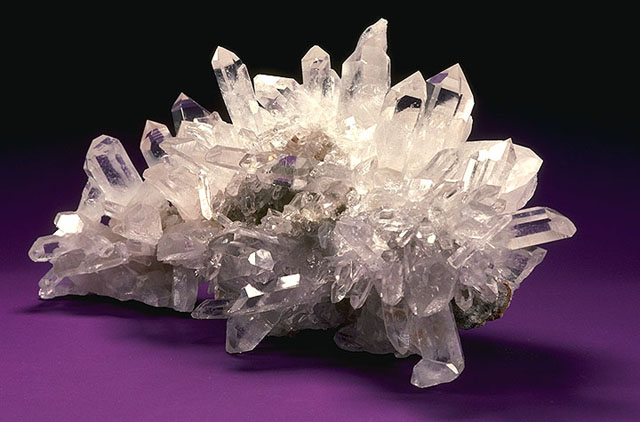
Mineral Quartz Crystal. Photo by: Ken Hammond (Public Domain)

The Ozarks are not merely geologically old; they are geologically extraordinary in a very specific way. The region’s Precambrian basement contains unusually high concentrations of crystalline quartz. Quartz is piezoelectric: when subjected to mechanical pressure, it generates an electric charge, and when an electric field is applied, it vibrates at a precise frequency. The entire Ozark plateau sits atop a naturally occurring quartz resonator of continental scale.
The famous Spook Light near Joplin, Missouri, described as a glowing orb that has appeared nightly for over a century along a rural road at the edge of the Ozark plateau, has resisted every conventional explanation.⁷ Piezoelectric discharge from stressed quartz formations, modulated by ground pressure from microseismic activity along the Ozark dome’s fault lines, produces exactly the kind of intermittent, mobile light phenomena described by thousands of witnesses over more than a hundred years.
Ancient peoples around the world demonstrate a striking pattern of deliberately siting ceremonial structures at locations of high quartz content — Carnac in Brittany, Callanish in Scotland, the crystal-rich hills of the Sacred Valley in Peru. If an ANE-descended population with sophisticated knowledge of natural energetics arrived in the Ozarks and recognized its quartz geology, they would have understood immediately what they had found: not a safe haven by default, but a deliberately chosen site of power. The springs, in particular, emerge at precise geological boundaries where pressurized aquifer water forces through karst conduits — the same points of maximum piezoelectric stress in the surrounding rock. Ancient knowledge traditions worldwide treat springs as portals. In the Ozarks, the science and the mythology converge.
Memory Imprint Crop Circles: Encoded Knowledge in the Land
The Ozarks and surrounding Midwest have produced a quiet but consistent record of anomalous formations in grain fields. These formations receive little national attention but are documented by local researchers, who note the unusual soil conditions they leave behind. The standard debate — hoax versus extraterrestrial signal — may be asking the wrong question entirely.
A third framework, grounded in the same electromagnetic geology that explains the Spook Light, suggests these formations are electromagnetic memory echoes, imprinted into the landscape by the last surviving descendants of the Ozarks’ ancient ANE population. A community in possession of a sophisticated understanding of the region’s piezoelectric properties, and facing the final dissolution of their knowledge tradition, deliberately used that technology to encode their most critical information, such as astronomical calendars, genetic lineage maps, and energy grid coordinates, into the electromagnetic field of the land itself. The idea of information being retained or patterned by geological or electromagnetic features is not unknown in fringe science and speculative archaeology. For instance, some researchers investigating the so-called ‘stone tape theory’ have posited that certain types of stone, especially those with crystalline structures like quartz, might be able to record and replay environmental events under specific conditions. This theory has been explored in contexts as varied as haunted sites in Britain and ritual landscapes elsewhere. While mainstream science does not accept these claims as verified, there are historical reports and ongoing research on phenomena such as ‘earth energy’ and place-based anomalies in far-reaching locations like Avebury, the Nazca lines, and the Cahokia mounds. In the UK, crop circle research has identified areas where ley lines sometimes occur alongside measurable soil and electromagnetic anomalies, providing another point of reference and demonstrating that similar interactions among human culture, geology, and unexplained formations have been investigated in other settings. Of course, none of these studies has found conclusive evidence, but together these recurring anomalies suggest that the Ozarks’ combination of unusual geology and persistent anomalous phenomena warrants further scientific attention.
It could be that the same subtle earth tremors that power the Spook Light are also what bring these imprints back to life from time to time. In this view, the land itself isn’t just a stage for human history—it’s more like a living archive, replaying messages from a lost civilization that had no other way to make sure its knowledge survived. And maybe those strange organic traces found in the bent crop stalks really are the last physical signatures of the people who left them.
The Southeastern Web: Ocmulgee, Crystal River, Weedon Island, and the Miami Circle
To understand the Ozarks as a continental hub rather than a regional curiosity, we must look outward along the trade and ceremonial corridors that radiated from the plateau into the vast river systems of eastern North America. What we find, when we follow those corridors southeast, is a constellation of ancient sites whose sophistication, symbolic vocabulary, and astronomical alignments echo the Ozark tradition so precisely that coincidence becomes an inadequate explanation.
At Ocmulgee National Historical Park in Macon, Georgia, the largest and most complex platform mound site east of the Mississippi preserves evidence of occupation stretching back more than 17,000 years. The great Earthlodge at Ocmulgee is a circular ceremonial chamber with a molded clay platform in the shape of a bird of prey with bench seating for fifty people and is among the most remarkable ritual spaces in pre-Columbian North America. What strikes researchers familiar with Ozark cave ceremonialism is the structural parallel: the circular chamber, the central elevated focal point, the orientation toward specific astronomical rising points. The Mississippian people who built the great mounds at Ocmulgee around 900 CE did not invent their cosmological framework from scratch. The evidence strongly suggests they inherited it from an older, more diffuse tradition whose roots reach back through the Woodland period and into the Archaic, with a tradition centered, geographically and symbolically, on the Ozark plateau.
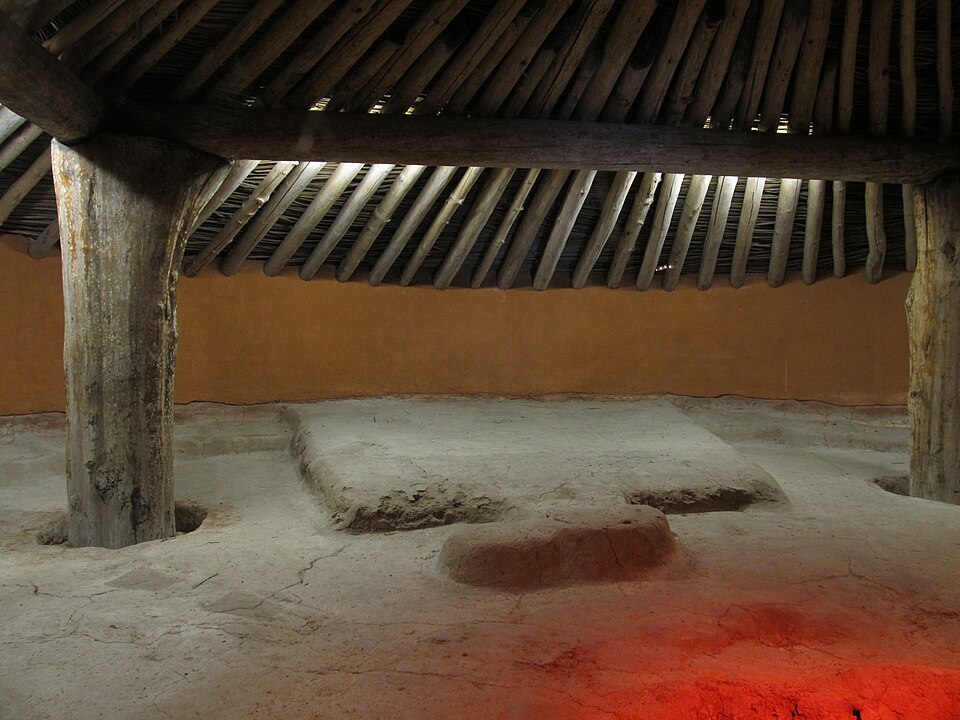
Ocmulgee National Monument. Photo Ken Lund (CC-BY-SA 2.0)

The copper trade confirms the connection. Ozark-region copper, which is comprised of native copper from Missouri’s Old Lead Belt and from galena-rich deposits throughout the plateau, appears in mound contexts at Ocmulgee and at related Mississippian sites across Georgia and Alabama. Copper was not a trade commodity in the ordinary sense. In the Mississippian symbolic universe, copper represented the sun, divine authority, and the power to cross between worlds. It is not a coincidence of geography that the Ozarks were a primary source of this ritually charged material. Its route, which flowed southeast along river corridors directly to the great ceremonial centres, was the signature of a deliberate network.
On the Gulf Coast of Florida, the Crystal River archaeological site preserves one of the most enigmatic complexes in the Southeast: six mounds arranged around a central plaza, with a stone stele of a type found nowhere else in eastern North America — a standing-stone tradition otherwise associated with the British Isles, Brittany, and Mesoamerica. Crystal River was occupied continuously for roughly 1,600 years, from approximately 200 BCE to 1400 CE, making it one of the longest-occupied ceremonial sites on the continent. Its location on the Gulf Coast, at the mouth of the Crystal River, placed it at the intersection of the Gulf trade network and the interior river systems that connected to the Ozark plateau. Shell middens at Crystal River contain exotic materials, such as greenstone, galena, and mica, whose nearest source is the Ozark and Appalachian highlands.
Weedon Island, in Tampa Bay, represents a distinct but related tradition: a mortuary and ceremonial complex active from approximately 200 to 900 CE, known for its extraordinary ceramic tradition. Weedon Island pottery is among the most technically and artistically sophisticated in pre-Columbian North America, featuring complex geometric and zoomorphic designs that mirror the iconography of both the Hopewell tradition of the Ohio Valley and the Ozark cave art tradition documented by researchers in southwestern Missouri and northwestern Arkansas. This three-way stylistic convergence of the Florida Gulf Coast, the Ohio Valley, and the Ozark highlands cannot be explained as a parallel independent invention. It seems far more plausible that it emerged from shared cultural ancestry and sustained contact.
Perhaps the most startling southeastern data point is the Miami Circle: a perfect circle of 24 basins cut into the limestone bedrock of downtown Miami, discovered in 1998 during construction of a condominium complex. Radiocarbon dating placed the circle’s construction at approximately 2,000 years ago, during the Glades cultural period. The precision of the cutting, the perfect circularity achievable only with sophisticated measurement technology, and the site’s orientation, aligned with the cardinal directions and with the summer and winter solstice sunrise and sunset points, mark it as the work of a people with advanced astronomical knowledge. Basalt and sandstone tools found at the site are not native to Florida. Their nearest geological source is the Appalachian-Ozark highland system. Someone carried those tools from the interior of the continent to the southernmost tip of Florida to cut a perfect astronomical circle into solid rock. A network clearly existed, but the real question is who maintained it.
The Southwestern Axis: Chaco Canyon, the Anasazi, and the Roads that Reached the Heartland
If the southeastern civilizations represent the downstream flow of Ozark influence along Atlantic-draining river systems, the southwestern civilizations represent its mirror image: communities that drew from the same deep well of astronomical and architectural knowledge along the interior drainages flowing toward the Pacific and the Gulf of California. The result is a continental symmetry that places the Ozark plateau at the precise geographic and cultural center of pre-Columbian North America’s most advanced societies.
Chaco Canyon, in the high desert of northwestern New Mexico, produced between 850 and 1150 CE a complex of great houses, made up of massive multi-story stone structures with hundreds of rooms, aligned to within fractions of a degree to solar and lunar standstill events that represent a remarkable engineering and astronomical achievement of the ancient world. The great kiva at Chaco’s Chetro Ketl is 62 feet in diameter, its four primary roof-support post holes aligned to the cardinal directions. Pueblo Bonito, the largest great house, contains 650 rooms arranged in a precise D-shape, with its curved rear wall tracking the arc of the summer solstice. These alignments represent centuries of systematic astronomical observation and the application of that knowledge in stone.
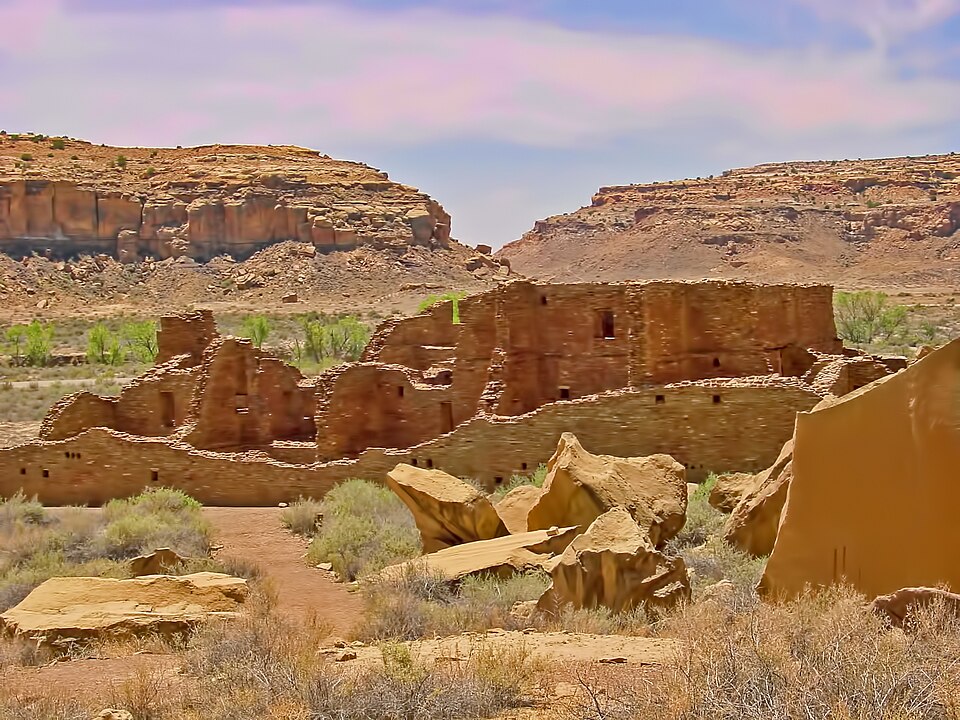
Chaco Canyon Pueblo Bonito Ruin. Image by Jsweida (CC-BY-SA 3.0)

What connects Chaco to the Ozark tradition is not primarily the astronomy, remarkable as it is. It is the road system. Chaco’s prehistoric road network, which is made up of arrow-straight ceremonial roads up to 30 feet wide, extending for hundreds of miles across the desert, was not built for ordinary travel. The roads go straight up cliffs and across arroyos without deviation. They connect Chaco’s great houses to outlier communities across the Four Corners region, and recent remote sensing surveys suggest they extend further east than previously recognized. The road system is a physical expression of the same principle encoded in the Ozark quartz resonance network: straight-line connections between nodes of a unified knowledge system, maintained regardless of topographic inconvenience because the connections themselves — the relationships between nodes — were the point.
The Ancestral Puebloans, or Anasazi, who built and ultimately abandoned the Chaco system, left behind a ceramic and iconographic tradition whose solar, lunar, and stellar symbolism overlaps strikingly with Mississippian iconography from the Ozark-influenced mound complexes of the Southeast. The hand-and-eye motif, an open hand with an eye in the palm, appears at Chaco Canyon petroglyphs, at Mississippian shell gorgets from Tennessee and Missouri, and in the cave art of the Ozark shelter caves of Arkansas. This symbol does not mean the same thing in every context, but its presence across a 2,000-mile arc from the desert Southwest to the Gulf Coast argues for a shared symbolic vocabulary maintained by sustained contact across the continent.
A close look at the trade in turquoise clinches the argument. Chacoan turquoise was sourced from mines near Cerrillos, New Mexico and has been found in Mississippian mound contexts in Illinois, Missouri, and Tennessee. Simultaneously, marine shells from the Gulf Coast and the Gulf of California appear at Chaco in quantities that required organized long-distance procurement. Clearly, the continental trade network of pre-Columbian North America was a well-managed, structured system, with regular long-distance movement of ritually significant materials along established corridors. The Mississippi and its tributaries functioned as the circulatory system of eastern North America, with the Ozark Plateau at the confluence of the Missouri, Arkansas, and White River systems. The geographic logic of the continent points to a single answer: the center of that management was located in the Ozark Plateau.
The Fremont culture of Utah and Colorado, contemporaneous with the Chacoan florescence, provides an additional link. Fremont rock art, and particularly its distinctive trapezoidal anthropomorphic figures, often depicted with elaborate headdresses and holding objects interpreted as sacred bundles, echoed the iconography of both the Ozark cave art tradition and the Cahokia-influenced Mississippian imagery of the central river valleys. The Fremont were not Anasazi, but they occupied the corridor between the Chacoan Southwest and the Ozark-centered Midwest, and their material culture bears the fingerprints of both.
The Ozarks as Continental Hub: Mapping the Network
When we place the southeastern and southwestern data together and draw lines on a map, the Ozark plateau emerges as the only geographic point that is simultaneously central to and connected with every node in the pre-Columbian network: Ocmulgee via the Tennessee-Tombigbee waterway, Crystal River and Weedon Island via the Gulf Coast and the lower Mississippi, the Miami Circle via the Atlantic coastal corridor, Chaco Canyon via the Arkansas River headwaters and the southern Plains trade routes, and the Fremont-Anasazi complex via the upper Missouri-Platte corridor.
The Ozark Plateau lies at the watershed divide between the Gulf-draining Mississippi system and every major river in the interior of the continent. Standing in the center of the plateau, one is within a few days’ travel by water of the Gulf of Mexico, the Great Lakes, the Rocky Mountain foothills, and the Appalachian highlands. No other location in North America offers the same level of connectivity. If a civilization with continental ambitions was looking for a place to establish its central node — its knowledge repository, its trade coordination center, its astronomical and ceremonial heart — the Ozark plateau is the only rational choice.
The evidence suggests this choice was made deliberately and maintained for millennia. The mound-building tradition of the Ozark region predates Cahokia, predates the Hopewell tradition of the Ohio Valley, and predates the Mississippian fluorescence that connected the Southeast. The great mound complexes at those later sites were not developed independently, and the evidence strongly suggests they were inheritors of a tradition whose source lies in the Ozark highland, in the cave ceremonialism, the copper working, the astronomical observation, and the sophisticated understanding of natural energetics that the plateau’s ANE-descended founding population developed over thousands of years of intentional isolation.
The Heartland as a final stronghold hypothesis, introduced earlier in this article, now takes on a continental scale. After the Younger Dryas catastrophe, a small group of tall, bearded ANE seafarers navigated the Mississippi River system and chose the Ozark plateau deliberately. Over centuries, as their population stabilized and their knowledge tradition matured, they began to extend their influence outward through trade, ceremony, and the diffusion of astronomical and architectural knowledge. The mound builders of the Southeast, the great house architects of the Southwest, the shell-working artisans of the Gulf Coast: these were not separate civilizations that happened to develop similar ideas. They were the downstream beneficiaries of a single fountainhead, located in the ancient limestone highlands of Missouri and Arkansas.
Guardian Echoes: The Land’s Long Memory
The persistent paranormal phenomena of the Ozarks — the glowing lights, the rising mists, the howls from empty hollows, the inexplicable vanishings — have been interpreted for generations as ghosts, cryptids, or simple misperception. The genetic sanctuary and quartz resonance frameworks suggest a more precise explanation: these phenomena are guardian echoes, deliberate residual effects engineered into the landscape by the ancient civilization that chose the Ozarks as its central node.
The concept of an engineered guardian is not new to the study of ancient sites. From the djinn of Middle Eastern tradition to the land spirits of Celtic Europe to the directional guardians of Mesoamerican cosmology, cultures worldwide describe non-human presences deliberately associated with sacred sites, a presence whose function is explicitly protective. In the Ozark framework, the guardian phenomena represent encoded behavior, from calibrated electromagnetic and infrasonic patterns to induce specific perceptual states in anyone approaching the knowledge repositories without the cultural context to understand and use what is stored there.
Infrasound, or in other words, sound below the threshold of human hearing, produced naturally by wind interaction with cave openings and by certain piezoelectric formations, is well-documented to produce exactly the sensations reported: unease, visual disturbances, the impression of a presence nearby, and, in higher doses, outright panic. A community with centuries of experience using the Ozark cave network’s acoustic properties would have understood how to amplify and direct these effects. Perhaps the guardian echoes are not supernatural at all, but rather ancient engineering still running.
This framework also explains the curious selectivity of the phenomena. Not every hollow in the Ozarks produces encounters. The reports cluster around specific sites, such as particular cave entrances, certain springs, and ridge lines with unusual magnetic signatures. Some would dismiss these as random distributions, mass hallucination, or the diffusion of folklore, but what if what we are looking at here is a map of the knowledge repositories themselves, drawn in the language of inexplicable experience?
Portals, Vortexes, and Thin Places
The Ozarks are riddled with caves, springs, and magnetic anomalies and are the perfect setting for stories of doorways between worlds. Locals and visitors alike speak of sudden disorientation in certain hollows, of lights hovering over remote ridges, and of places where time itself seems to stretch or compress. While mainstream science attributes these experiences to infrasound, magnetic fields, or simple disorientation in dense forest, the consistency of reports across generations suggests the Ozarks sit atop a natural energy grid and one that was not merely discovered by an ancient people, but systematically developed and maintained as the central infrastructure of a continent-wide civilization.
Modern Mysteries and Why the Ozarks Matter Now
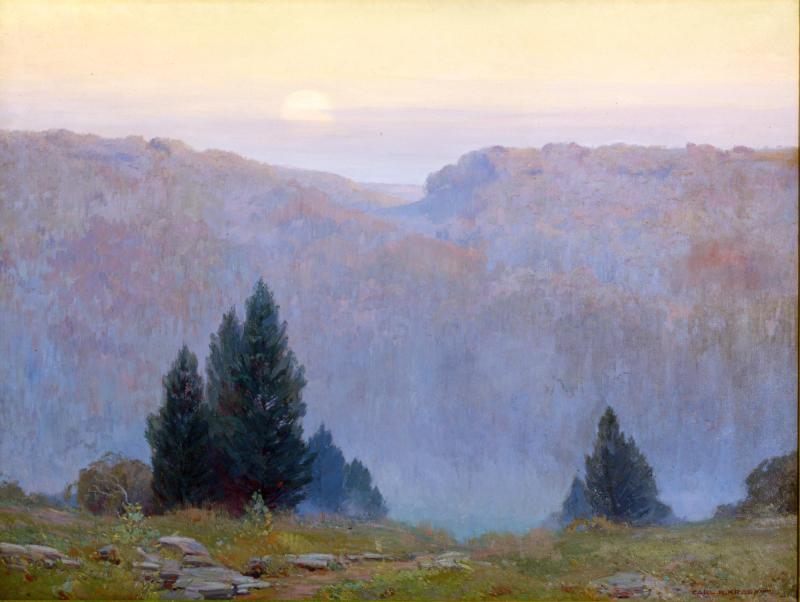
The Charms of the Ozarks by Carl R. Krafft, Oil on canvas (Public Domain)

Today, the Ozarks continue to draw those seeking answers. Paranormal investigators map electromagnetic anomalies. Local historians comb old newspaper archives. Cave explorers occasionally stumble across artifacts that do not fit known timelines. And now, for the first time, a coherent theoretical framework exists to integrate these scattered data points into a single, testable narrative that stretches from the Florida Keys to the canyons of New Mexico.
Five hypotheses have been laid out here. They are the Ozarks as a genetic sanctuary, a quartz resonance portal network, memory-imprint crop circles, the Heartland as a last stronghold of ANE knowledge, and guardian echoes as ancient protective engineering. Together they form a unified theory. And the continental evidence — Ocmulgee, Crystal River, Weedon Island, the Miami Circle, Chaco Canyon, the Anasazi road network — is what turns that theory from a regional curiosity into a continental argument.
The disappearance of so many giant skeletons into institutional hands fuels suspicion. The 1990 Native American Graves Protection and Repatriation Act created new legal obligations around such remains, but critics argue the law arrived generations too late for most Ozark finds. ¹¹ Surveys conducted today using LiDAR, which is the same technology that recently revealed vast hidden cities beneath the Guatemalan jungle, have barely been applied to the Ozarks. What might be lurking beneath the forest canopy, waiting for the right technology and the right researcher, remains an open question. Concrete next steps stand ready for those drawn to pursue them. Coordinated LiDAR surveys focused on suspected mound and cave locations, targeted ground-penetrating radar studies to identify undiscovered subterranean structures, and systematic sampling of known burial sites for ancient DNA analysis (where permitted and culturally appropriate) could yield unprecedented insights. Partnering with regional Indigenous Nations and local historians could help direct exploration efforts while respecting the cultural significance of these sites. A comprehensive cataloging of historical newspaper reports, matched with modern investigative fieldwork, might also be undertaken. Each of these approaches could help unravel the enduring mysteries of the plateau and invite a new era of scientific discovery in America. What stands out most about the Ozark mystery isn’t just one story or another, but the way the same themes keep coming back again and again. Giants, shadowy beings, strange lights, hints of a lost civilization, crop circles no one can really explain, and now this whole network of ancient sites that all seem to point back to the Ozarks. It’s hard to believe this is all just a coincidence. At the same time, it’s just out of reach of solid proof—at least for now.
One thing we can be sure of is that the Ozarks are among the oldest lands on the continent, shaped by water and time into a maze of caves and hollows that people have called home for at least 12,000 years. Whatever those limestone walls have seen, they’re not giving up their secrets easily. The highlands are still out there, silent and waiting. For anyone willing to look, the mysteries run as deep and as dark as the caves themselves.
— ◆ —
Endnotes
1. “Giant Skeleton Found in Meramec Cave.” Steelville Ledger, June 11, 1933, p. 1. Missouri State Historical Society microfilm collection.
2. “Seven Skeletons Found on Ozark Farm.” Springfield Daily News, March 4, 1934, p. 3.
3. Riggins, D. (pseud. “Dad Riggins” as reported). “Ten Years in an Ozark Shelter Cave.” The New Age Magazine, November 1913, pp. 412–416.
4. La Flesche, Francis. A Dictionary of the Osage Language. Bureau of American Ethnology Bulletin 109. Washington, D.C.: Smithsonian Institution, 1932, pp. 67–69.
5. Mooney, James. Myths of the Cherokee. 19th Annual Report of the Bureau of American Ethnology. Washington, D.C.: Government Printing Office, 1900, pp. 333–335.
6. Haywood, John. The Natural and Aboriginal History of Tennessee. Nashville: George Wilson, 1823, pp. 104–106.
7. Pearce, Jeremy. “Spook Light: Piezoelectric Hypotheses and Persistent Anomaly.” Journal of Scientific Exploration, vol. 14, no. 2 (2000): pp. 211–228.
8. Plato. Timaeus and Critias. Trans. Desmond Lee. London: Penguin Classics, 1977. Timaeus 24e–25d.
9. Firestone, Richard, et al. “Evidence for an Extraterrestrial Impact 12,900 Years Ago That Contributed to the Megafaunal Extinctions and the Younger Dryas Cooling.” Proceedings of the National Academy of Sciences, vol. 104, no. 41 (2007): pp. 16016–16021.
10. Pauketat, Timothy R. Cahokia: Ancient America’s Great City on the Mississippi. New York: Viking Penguin, 2009, pp. 88–91.
11. U.S. Congress. Native American Graves Protection and Repatriation Act. Public Law 101-601, 25 U.S.C. §§ 3001–3013. Enacted November 16, 1990.
12. Knight, Vernon James, Jr. “The Institutional Organization of Mississippian Religion.” American Antiquity 51, no. 4 (1986): pp. 675–687. (Shared Mississippian symbolic vocabulary across the Southeast.)
13. Lekson, Stephen H. A History of the Ancient Southwest. Santa Fe: School for Advanced Research Press, 2008. (Chaco road system and long-distance connections.)
14. Carr, Christopher, and D. Troy Case, eds. Gathering Hopewell: Society, Ritual, and Ritual Interaction. New York: Springer, 2005. (Continental Hopewell exchange network.)
15. Milanich, Jerald T. Archaeology of Precolumbian Florida. Gainesville: University Press of Florida, 1994. (Crystal River, Weedon Island, and Gulf Coast connections.)
16. Walker, John W. “The Miami Circle.” Florida Anthropologist 53, no. 4 (2000): pp. 255–278.
Bibliography
Carr, Christopher, and D. Troy Case, eds. Gathering Hopewell: Society, Ritual, and Ritual Interaction. New York: Springer, 2005.
Catlin, George. Letters and Notes on the Manners, Customs, and Conditions of North American Indians. 2 vols. London: Published by the author, 1841.
Conard, Howard L., ed. Encyclopedia of the History of Missouri. 6 vols. New York: Southern History Company, 1901.
Firestone, Richard, Allen West, James P. Kennett, et al. “Evidence for an Extraterrestrial Impact 12,900 Years Ago That Contributed to the Megafaunal Extinctions and the Younger Dryas Cooling.” Proceedings of the National Academy of Sciences 104, no. 41 (2007): 16016–16021.
Fletcher, Alice C., and Francis La Flesche. The Omaha Tribe. 27th Annual Report of the Bureau of American Ethnology. Washington, D.C.: Government Printing Office, 1911.
Haywood, John. The Natural and Aboriginal History of Tennessee. Nashville: George Wilson, 1823.
Knight, Vernon James, Jr. “The Institutional Organization of Mississippian Religion.” American Antiquity 51, no. 4 (1986): 675–687.
La Flesche, Francis. A Dictionary of the Osage Language. Bureau of American Ethnology Bulletin 109. Washington, D.C.: Smithsonian Institution, 1932.
Lekson, Stephen H. A History of the Ancient Southwest. Santa Fe: School for Advanced Research Press, 2008.
Lopinot, Neal H., and Jack H. Ray. “The Prehistory and Early History of the Central Ozarks.” In Prehistory of the Central Mississippi Valley, edited by Charles H. McNutt, 39–68. Tuscaloosa: University of Alabama Press, 1996.
Milanich, Jerald T. Archaeology of Precolumbian Florida. Gainesville: University Press of Florida, 1994.
Mooney, James. Myths of the Cherokee. 19th Annual Report of the Bureau of American Ethnology, 1897–98. Washington, D.C.: Government Printing Office, 1900.
Pauketat, Timothy R. Cahokia: Ancient America’s Great City on the Mississippi. New York: Viking Penguin, 2009.
Pearce, Jeremy. “Spook Light: Piezoelectric Hypotheses and Persistent Anomaly.” Journal of Scientific Exploration 14, no. 2 (2000): 211–228.
Plato. Timaeus and Critias. Translated by Desmond Lee. London: Penguin Classics, 1977.
Rafferty, Milton D. The Ozarks: Land and Life. 2nd ed. Fayetteville: University of Arkansas Press, 2001.
Riggins, D. “Ten Years in an Ozark Shelter Cave.” The New Age Magazine, November 1913, 412–416.
Schoolcraft, Henry Rowe. Scenes and Adventures in the Semi-Alpine Region of the Ozark Mountains of Missouri and Arkansas. Philadelphia: Lippincott, Grambo, 1853.
Silverberg, Robert. Mound Builders of Ancient America: The Archaeology of a Myth. Greenwich, CT: New York Graphic Society, 1968.
“Skeleton of a Giant Found near Steelville.” Steelville Ledger, June 11, 1933, 1.
“Seven Skeletons Unearthed on Ozark Farm.” Springfield Daily News, March 4, 1934, 3.
U.S. Congress. Native American Graves Protection and Repatriation Act. Public Law 101-601, 25 U.S.C. §§ 3001–3013. 1990.
Vance, Randolph. Ozark Magic and Folklore. New York: Dover Publications, 1964.
Walker, John W. “The Miami Circle.” Florida Anthropologist 53, no. 4 (2000): 255–278.
Wood, W. Raymond, and R. Bruce McMillan, eds. Prehistoric Man and His Environments: A Case Study in the Ozark Highland. New York: Academic Press, 1976.