




Abstract: At the time of the Spanish Conquest, Cusco’s Coricancha, the building marking the center of the Inca Empire, contained a gigantic gold plaque on which the Incan cosmic schema was outlined in a series of symbolic devices and signs arranged in three separate columns. Sadly, this extraordinary monument did not survive, but a near-contemporary drawing of its design was made, complete with brief notes on each component. This interpretation of the Incan Altar has remained relatively unaltered since that time, although some Western commentators have offered additional or alternative ideas regarding some parts of it. We examine the plaque’s symbolism with particular emphasis on its middle pillar, which seems to provide information about the celestial environment on which the Incan Altar was based. This appears to reflect an interest not only in the dark cloud and star-to-star constellations of the southern hemisphere, but also in celestial elements of the northern night sky. These, as we see, were viewed by the Incas not only as equal in importance to those of the southern night sky, but also as the domain of the creator god Viracocha, from whose realm emerged the sacred river of life in the form of the Milky Way.
Keywords: Inca, Cusco, Coricancha, Incan Altar, Milky Way, dark cloud constellations, Viracocha, Amaru, Amaru Muru.
When the Spanish, led by Francisco Pizarro, first arrived in Cusco, the Inca capital, in November 1533, they entered the Coricancha, the building complex representing the center of the Incan Empire (now contained within the Convent of Santo Domingo). There, they came across an enormous golden plaque affixed to a wall. Made of 70 percent gold, 18 percent copper, and 12 percent silver, it was apparently 10 metres high and as much as 8 metres in width. In raised relief on its front face was a series of symbolic images representing the Inca cosmic schema. Tragically, the Incan Altar, as it came to be known, was not allowed to survive. The plaque was melted down, and its resulting gold shipped off to Spain.
Mercifully, the various different components of the Incan Altar were recorded by the indigenous Peruvian chronicler Juan de Santa Cruz Pachacuti Yamqui Salcamaygua in a manuscript written in 1613 titled Relación de antigüedades deste Reyno del Piru (see Santa Cruz Pachacuti Yamqui Salcamaygua, 1613). (See fig. 1) Each sign or device bore a brief description of its meaning partly in Quechua, the language of the Incas, and partly in Spanish. His information was presumably derived from surviving traditions among the Quechua-speaking inhabitants of Cusco, even though eighty years had now passed since the Altar’s destruction. Despite this, what Salcamaygua managed to preserve of its detail provides an extraordinary insight into the cosmological world of the Incas.
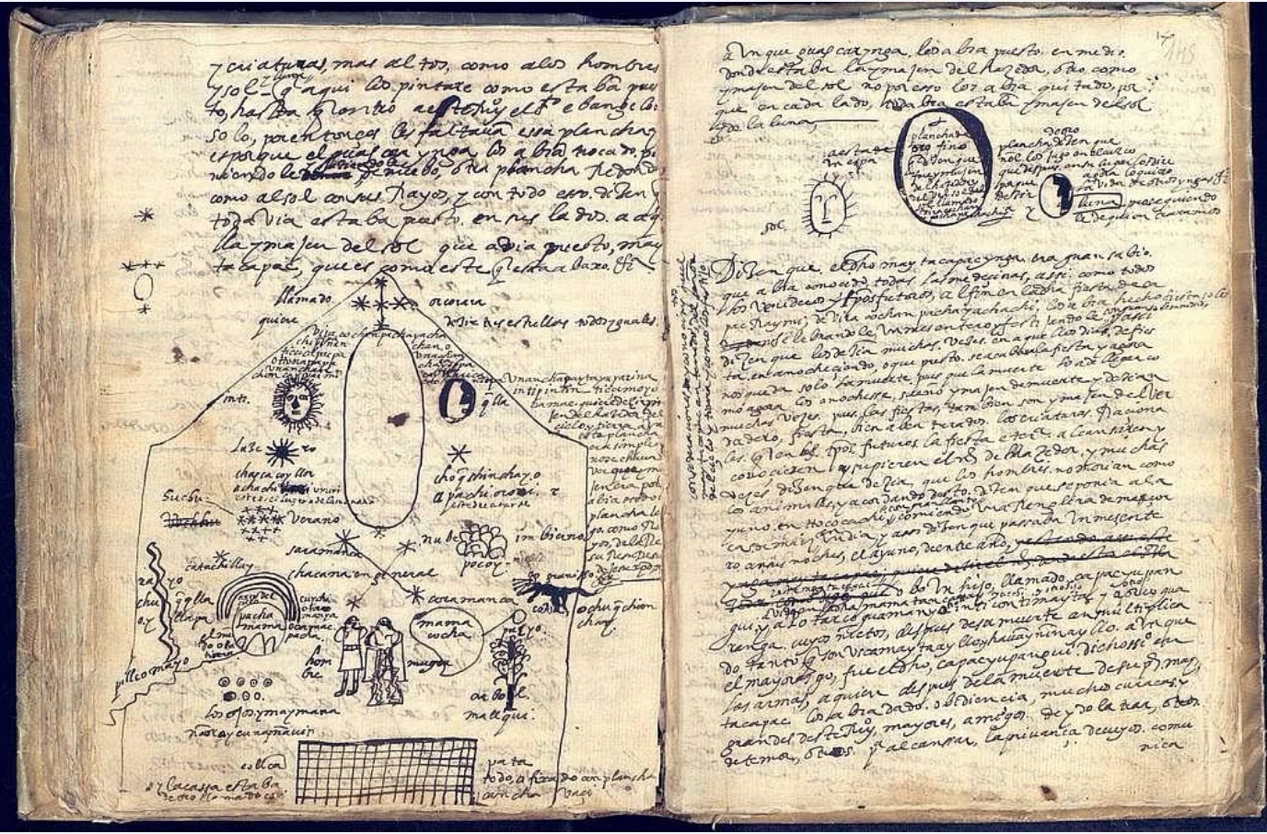
Figure 1. Pages from Juan de Santa Cruz Pachacuti Yamqui Salcamaygua’s manuscript from 1613 titled Relación de antigüedades deste Reyno del Piru. On the left-hand page, we see his detailed drawing of the Incan Altar, formally located in the Coricancha at Cusco. By Inca Garcilaso de la Vega, 1609 (Public domain).
The Incan Altar Described
Salcamaygua’s representation of the Incan Altar (see fig. 2) shows that it possessed three columns of symbolic devices, with the left-hand column assigned the Spanish word “verano,” that is, “summer,” with the right-hand column marked “invierno,” or in English, “winter.”
The highest device in the left-hand column represented the Sun (Inti), and in the right-hand column, opposite the Sun, was a device representing the Moon (Quilla); the Moon being the keeper of female mysteries among the Inca.
Two stars are seen in the left and right columns below the Sun and Moon. As part of the legend accompanying the star on the left are the words “lucero” and “este es el lucero de la manana,” which are Spanish and essentially mean “Morning Star,” indicating that it is the planet Venus in this role. The star in the right-hand column has as part of its legend the words “este de la tarde,” which is again Spanish and translates as “this of the afternoon”, showing it is a reference to Venus now as the Evening Star (Venus was seen by the Incas, as was the case with so many other ancient cultures around the world, as two separate planets).
Beneath the Sun and Venus, as the Morning Star, is a cluster of thirteen crosses seemingly representing stars. These are generally seen to represent the Pleiades star cluster, although this seems wrong since the Pleiades is universally considered to have seven stars (hence the asterism’s widespread appellation as the Seven Sisters).
Below this, we see a series of four concentric curves over a circle, which contains three humps. The circle is a symbol of Pacha Mama, the Incan Mother of Life, with the three bumps inside it signifying the three mountains that feed the Willkamayu, the sacred river of life. In physical terms, this is the Urubamba River, which flows northwards through Peru’s Sacred Valley. This is shown as a wavy line coming away from the circle towards the left of the column. The mountains in question are the Salkantay, the Veronica (referred to as the “wife” of the Salkantay), and the Ausangate. As for the concentric curves, they bear the legend “arco del cielo,” that is, “arc of the sky.”
Even though modern Quechua-speaking guides say this is a rainbow, the term “arc of the sky,” is more likely to be an allusion to the heavenly vault or firmament and even the arch-like Milky Way, especially since it lies directly over the circle representing Pacha Mama, in other words the Earth itself.
To the left of the “arc of the sky” is a lightning bolt apparently signifying the rains that feed the sacred river of life, the Willkamayu, or Urubamba.
There is a second star in the left column above the “arc of the sky,” which bears the legend “catachilly,” usually spelt katachilla, which is Quechua-Spanish and means “southern cross,” a reference to the constellation of Cruz, the Southern Cross, which is a group of four stars in a diamond pattern close to the southern celestial pole.
In the lower part of the right-hand column is a four-legged creature with a bushy tail and four lines that emerge from its head and end in small balls. Salcamaygua, in 1613, named this creature “Chuqe chinchay” or the “Jaguar de oro,” that is, the “jaguar of gold.” Its identification as a jaguar is not in doubt, there being an ancient altar to “Chuqe chinchay” at the 3000-year-old archaeological site of Chavín de Huántar in northern Peru.
Above the creature is the Spanish word “granizo,” that is, “hail” in English. This presumably relates to the changing seasons, and what we can see immediately below the jaguar, which is a grouping of ten overlapping blobs, marked with the Spanish legend “nube pocoy niebla,” which translates as “little (pocoy) clouds (nube) [and] fog or ground-level clouds (niebla).” The idea of clouds probably signifies the start of the planting season, heralded by the coming of the rains, which begin in the Andean region around September. This growing season was heralded also by the first appearance of the Pleiades star cluster, which seems represented by a grouping of seven dots in the left-hand column. These appear beneath the circle symbolizing Pacha Mama, or Mother Earth.
Opposite the Pleiades, in the right-hand column, is a tree said by Quechua-speaking guides to represent “plant life.”
The Middle Column
This completes our basic summary of the Incan Altar’s left-hand and right-hand columns. We now move onto the middle column, which begins directly beneath a roof-like arch that almost certainly signifies the celestial vault. Immediately beneath its central gable is a grouping of five stars forming an equal-armed cross. A vertical line links the top, middle and bottom stars. The name given by Salcamaygua to this star group was “Orcorara,” which in Quechua (under the spelling orcowawa) means “constellation of the belly button or navel.” The cross can thus be seen to signify the realm of the creator god Viracocha, as well as the point of separation of the divine and manifest and the place of first creation in the universe.
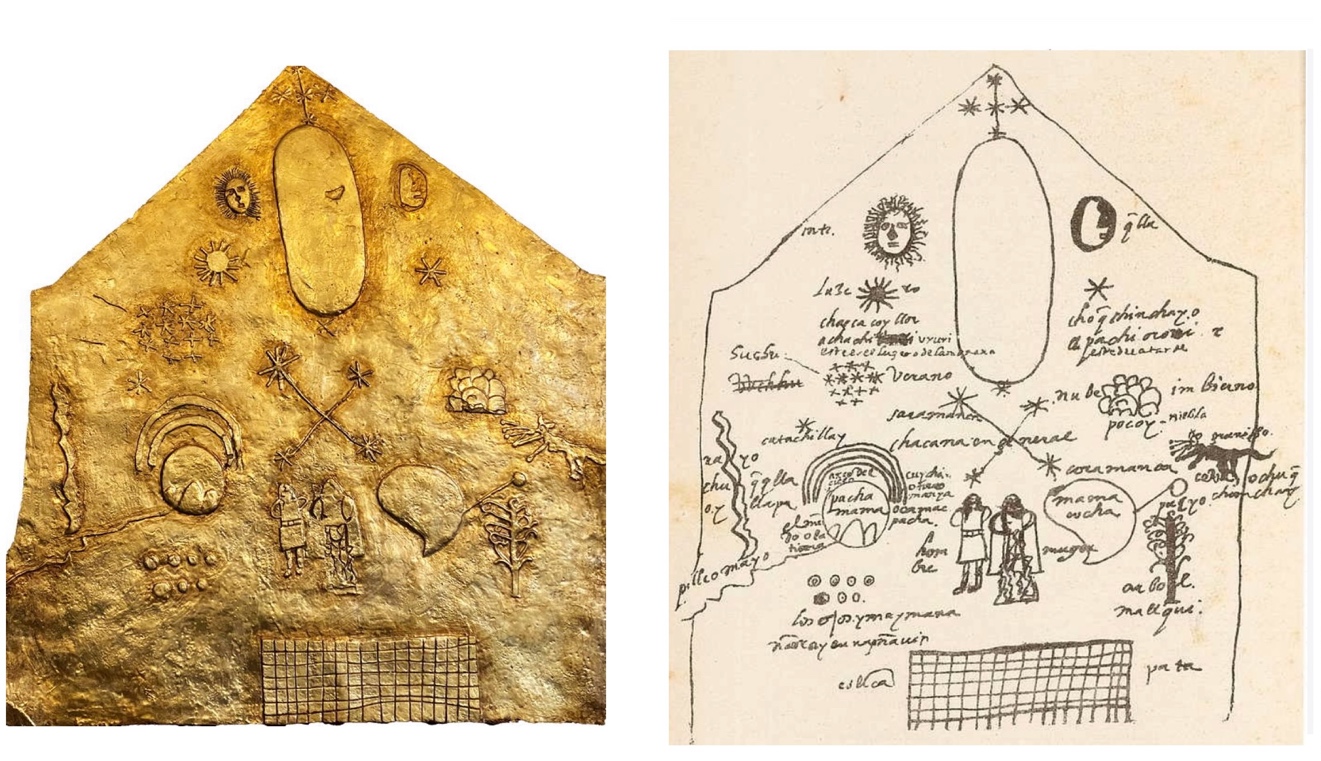
Figure 2. The Incan Altar. Left, a reproduction of the Incan Altar housed in the Coricancha based on the original drawing (right) from Juan de Santa Cruz Pachacuti Yamqui Salcamaygua’s Relación de antigüedades deste Reyno del Piru from 1613. Left credit: Andrew Collins. Right: (public domain.

Immediately beneath the five-star cross is a standing ellipse known in Quechua tradition as the Oval of Viracocha. It is considered to represent the egg of creation, made manifest by the god Viracocha, whose name translates as “foam of the sea.” This is a reference to the cosmic ocean or primordial sea thought by many ancient cultures and contemporary religions to have existed prior to the coming into being of the material universe. It was therefore considered that Viracocha brought forth the universe through his manifestation of the egg of creation.
The Chakana
Directly below the Oval of Viracocha is a grouping of four stars in a diamond pattern, each one linked to its diagonally-placed counterpart by a line creating a Cross Saltire, or Cross of St Andrew. Salcamaygua identified this device as the “Chakana,” or Peruvian Cross.
As a symbol, the Chakana appears all over Peru, as well as in neighboring Bolivia and Chile, as an equal-armed cross, each arm made up of two or three steps representing, it is believed, the three worlds of the Incas. These are Uku Pacha, the Underneath World or Lower World, symbolized by the snake or toad; Kay Pacha, “This World”, the Middle World, represented by the jaguar or puma; and Hanan Pacha, the Upper World or Sky World, symbolized by the condor or eagle.
In the center of the Chakana is usually a circular aperture. In Quechua tradition, this is considered to represent the hole through which life is born into the world via the navel or umbilicus of Pachu Mama, Mother Earth. Through this aperture, cosmic energies, or the divine spirit, nourish life on Earth.
The use of the Chakana is extremely ancient. It is seen, for instance, on a 3000-year-old stone stela from the site of Chavín de Huántar in northern Peru, which is today housed in Lima’s museum of archaeology (see fig. 3). It is deeply incised also into stone building blocks at Tiwanaku, the center of the Tiwanaku culture, which thrived circa 200 BCE–1200 CE (see fig 4a), while a 4000-year-old example of the Chakana in raised relief was found recently on an adobe wall attached to a pyramid forming part of the Miraflores archaeological site, located in the Huaral valley, north of Lima (see fig. 4b). The area was occupied at the time by an Aymara-speaking culture who are thought to have migrated southwards to establish settlements in what is today the department of Puno, as well as further south in the neighboring country of Bolivia (Dávila 2023). This southern movement of this population might well account for why another Chakana in raised relief can be seen on a square slab belonging to the Pucara culture of southern Peru (circa 1800 BCE–400 CE), which is today housed in the small museum in the town of Pucara (see fig. 4c).
The Man and the Woman
Beneath the diamond of stars on the Incan Altar are two human figures described in Spanish as “hombre” and “mujer,” that is, “man” and “woman.” They are taken to represent the ruling Inca (a word meaning “lord” or “ruler”) and his consort, who, ruling from Cusco, acted as conduits between This World and the Upper World. The fact that the gold plaque was located in the Coricancha, the Incan “naval” or center of the world, only emphasizes the connection between the royal couple and the three worlds of Incan cosmology.
The Inca and his consort were almost certainly seen as either incarnations or descendants of the hero twins, Manco Cápac and Mama Ocllo. This brother and sister, the offspring of Inti, the Sun, and Quilla, the Moon, were the legendary founders of Andean civilization. Having been created by Viracocha from the foaming waters of Lake Titicaca, which straddles Peru and Bolivia, they made landfall on the lake’s Island of the Sun, the traditional foundation point of Incan civilization. There, also, in some Andean legends, Viracocha is said to have first appeared in physical form to civilize the world with the help of a group of human individuals remembered as the Viracochas.
According to the Spanish chronicler Garcilaso de la Vega, writing in 1609, before the twins departed the Island of the Sun, a golden scepter was given by Viracocha to Manco Cápac. This he was to carry with him always. Where it sank into the ground, the capital city of a new powerful empire was to be created that would civilize the nations (Vega, 1609). The story goes that wherever the twins stopped, Manco Cápac tried to penetrate the ground with his scepter. This happened finally when the pair reached Huanacauri (also spelt Haunacaure and Wanakawri), a mountain containing a major archaeological site that overlooks the valley where Cusco was later built. The act established Cusco as the navel, or axis mundi (axis of the world), of the future Inca Empire.
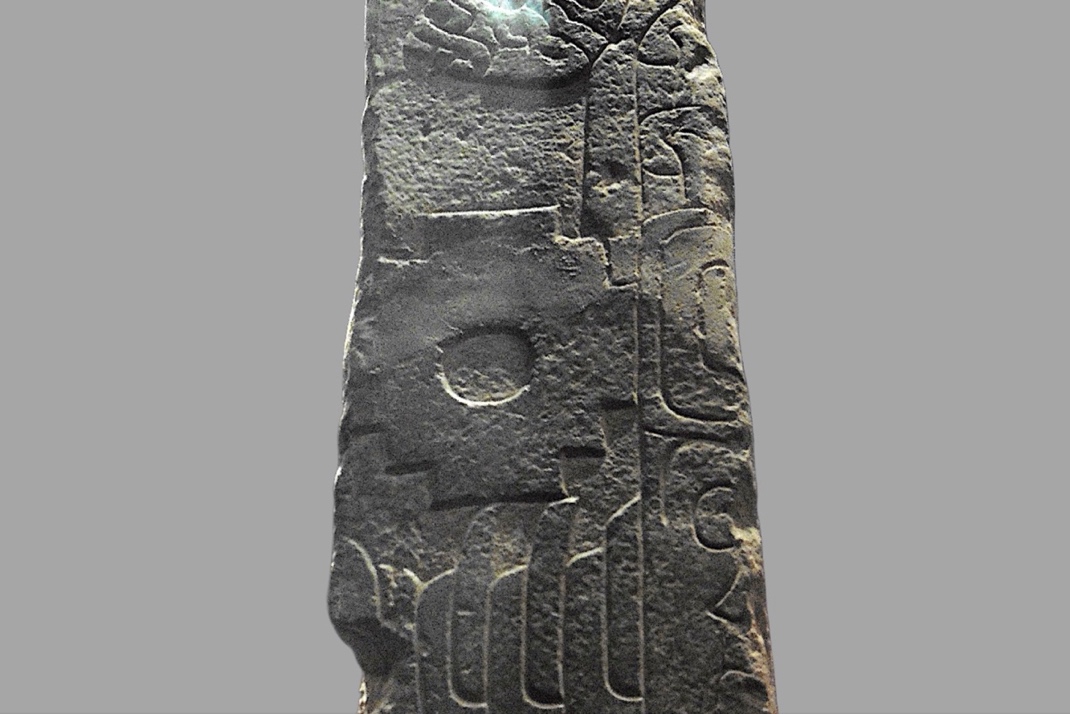
Figure 3. The Chakana or Peruvian Cross on a stela from Chavín de Huántar in northern Peru, as seen in the Lima Archaeological Museum. It is approximately 3000 years old. Credit: Andrew Collins.
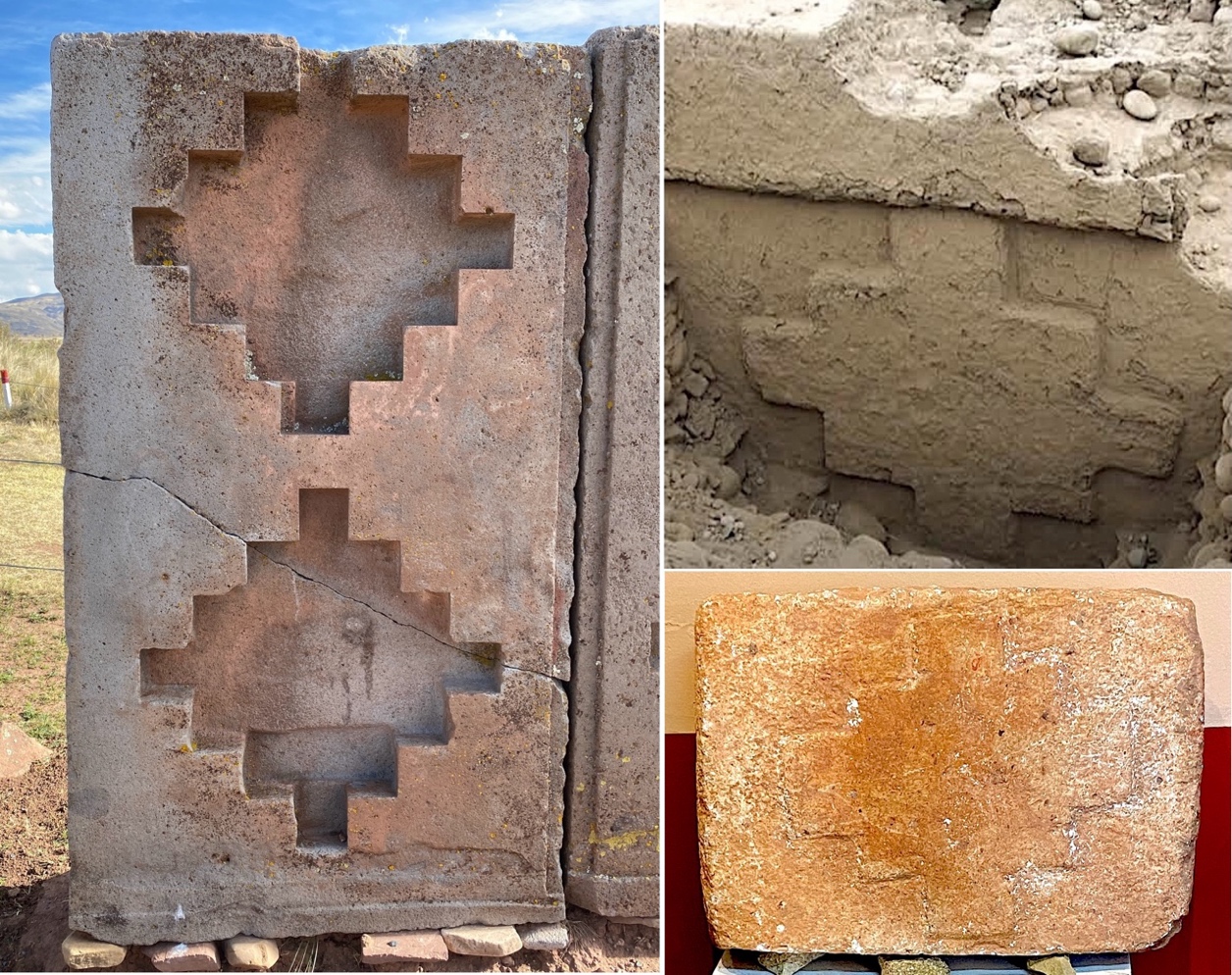
Figure 4a-c: Figure 4a (left), three-step Chakanas deeply incised into a stone block at Tiwanaku. Figure 4b (upper right), Chakana newly discovered on the side of a pyramid at Miraflores, Lima, and Figure 4c (bottom right), square slab belonging to the Pucara culture showing a Chakana in high relief. Pics 4a & c credit: Andrew Collins. Pic 4b (CC0).
.jpg)
To the right of the “man” and “woman” on the Incan Altar is a device shaped like a speech bubble, with the words “Mama Cocha” written across it. From it extends a line ending in a small circle bearing the word “pocyo.” Mama Cocha is the name of an Incan goddess who presides over all bodies of water, including seas, oceans, and lakes, making it clear what the speech bubble represents. The word “pocyo” (usually spelt puquio) is from the Quechua language and means “spring,” “well,” or “fountain,” showing that this is what the small circle represents, the line coming from it signifying a stream that empties into the larger body of water.
Beneath the “man” and “woman” is a horizontal rectangle containing a crude chequerboard made up of seven rows of seventeen squares (although whether this is accurate to the original will never be known). In Quechua tradition, this is said to represent the mineral world, in other words, the physicality of the earth. It can therefore be seen to represent the mineral resources that bring fecundity to the land. The tree symbol mentioned earlier stands to the right of this rectangle, while the sacred river and circle symbolizing Pacha Mama are to its left.
The five main components of the Incan Altar’s central column, viz. the cross of five stars, the Oval of Viracocha, the cross of four stars identified as the Chakana, along with the human couple and the chequerboard, would appear to signify the descent of divine creation from the Orcorara, the “navel” of the Upper World, all the way down to the High Inca and his consort. Their seat, of course, was the earthly navel, the center of the empire corresponding to Cusco’s Coricancha (a Quechua name meaning “corral of gold”). As we see next, this descent from the Upper World, which takes in two groupings of stars, almost certainly relates to the Andean perception of the night sky.
The Milky Way
The Incan Altar’s four-star cross, labelled as the Chakana, is easily identifiable. It is the constellation of Crux, otherwise known as the Southern Cross, a prominent grouping of four stars in a diamond pattern. Not only is it located very close to the southern celestial pole, but it is also positioned on the Milky Way. This, of course, is the glistening band of stars formed by the outer rim of our own Milky Way galaxy. Under good viewing conditions, away from modern light pollution, this can be seen to stretch from horizon to horizon. For many ancient cultures, including those of the Americas, the Milky Way was seen as a celestial road, river or path along which human souls traveled to reach the afterlife (see Collins, 2006, Little 2014, Hancock 2019, and Collins 2024).
Similar beliefs certainly existed among the Inca and Pre-Incan peoples of the Andes; the findings of William F. Sullivan in his essential work The Secret of the Incas: Myth, Astronomy, and the War Against Time, published in 1996, conclusively demonstrate this fact.
The Incan Altar’s middle pillar thus appears to reflect a celestial journey involving the Milky Way that begins in the realm of Viracocha, the place of separation of the unmanifest and manifest, represented by the five-star cross known as the Orcorara, and ends in This World, Kay Pacha, or more precisely at the Coricancha in its role as the Incan “navel” or axis mundi.
So, can we go on to identify the Oval of Viracocha, as well as the Orcorara, known as the Cross of Viracocha?
Orcorara – the Cross of Viracocha
In the Aymara language, still spoken today by certain Andean peoples around Lake Titicaca, orcorara means “path of the herd of Llamas.” It is a reference to an ancient migratory route across the Andes taken by llama herders for trade, trekking, and hiking. Its course was reflected in the heavens by a series of so-called dark cloud constellations formed by the dark nebulous regions of the Milky Way around the Southern Coalsack, which is contained within the starry stream’s central bulge (see fig. 5). One of these constellations is the mother llama, whose eyes are formed by Alpha and Beta Centauri, the two brightest stars in the constellation Centaurus, located close to the Southern Cross. Yet the five-star Orcorara or Cross of Viracocha shown at the apex of the Incan Altar appears not to be a dark cloud constellation but a star-to-star constellation elsewhere in the night sky.
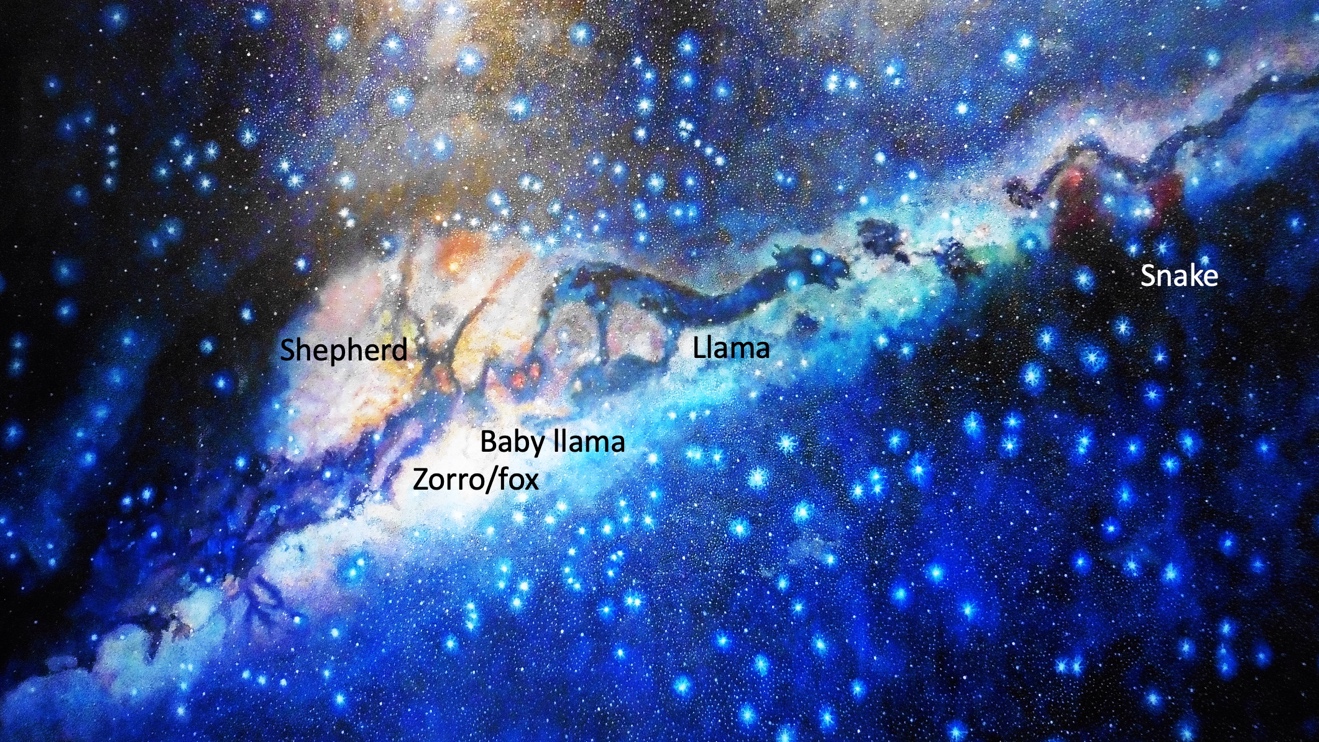
Figure 5. The Milky Way’s central bulge with dark cloud constellations marked. Credit: Andrew Collins.
German ethnologist R. Lehmann-Nitsche (1872-1938), the first Western scholar to review every component of the Incan Altar, proposed that the Orcorara is to be identified with an Andean asterism known as the Three Maries (Lehrmann-Nitsche, 1919). This is made up of the three stars forming the “belt” of Orion, the sky-hunter of Greek mythology. Lehmann-Nitsche’s identity of the Orcorara as Orion was afterwards taken for granted. Yet such a solution can only account for three of Orcorara’s stars, not its five-star cross formation. What is more, the shape of the Orion constellation can in no way be said to resemble a cross. This would imply that the Orcorara’s cruciform appearance is merely symbolic, and not a true representation of the asterism it represents. In the knowledge that the Incan Altar’s four-star diamond cross bears a striking resemblance to the constellation of Crux —the Southern Cross— makes Lehmann-Nitsche’s interpretation of the Orcorara somewhat baffling.
In addition to this, current-day Peruvian guides say that the Orcorara is not Orion. For them, Orion is represented on the Altar by the “arc of the sky” above the circle representing Pacha Mama, an interpretation which is also somewhat baffling.
Clearly, another approach was needed to correctly identify the Orcorara (see fig. 6). One clue comes from its meaning in the Quechua language, which is “constellation of the belly button or navel.” This suggests it can be seen as a celestial reflection of the Coricancha in its role as the earthly “navel” or axis mundi of the Incan world, the two joined together by an invisible umbilicus, along which divine energies were thought to flow in order to sustain the Incan world via its reigning Inca.
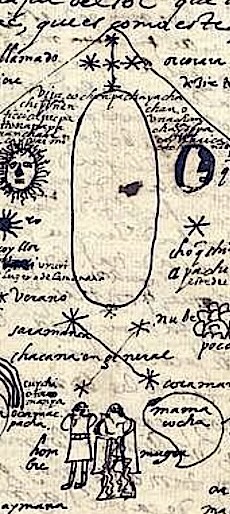
Figure 6. Middle column of the Incan Altar from the drawing made by Santa Cruz Pachacuti Yamqui Salcamaygua in 1613. Note the grouping of five stars at the top called the Orcorara, and the Oval of Viracocha beneath them. Below the oval are the four stars making up the Southern Cross. Public domain.
Center of Origin in the North
A further clue regarding the identity of the Orcorara star cross comes from the work of Gary Urton, a leading scholar in the subject of Andean ethno-astronomy. He was informed by an indigenous person, well versed in Peruvian sky lore, that the Incas believed there were, in fact, two Milky Ways, or celestial rivers (mayu), not one. According to Urton:
The two Mayus originate at a common point in the north, flow in opposite directions from north to south, and collide head-on in the southern Milky Way … These data indicate that the celestial river has a second center, a “center of origin,” in the north [Urton 1982, 59, with current author’s emphasis].
Was this “center of origin” in the northern part of the Milky Way represented by the Orcorara star cross displayed at the top of the Incan Altar? Very likely, the answer is yes, meaning that, should it be identified, this “center of origin” could provide the true location of the seat of Viracocha and the perceived place of first creation in Incan cosmology.
Gary Urton’s findings regarding the existence of twin mayu or rivers of the Milky Way in Incan ethno-astronomy is also touched upon by Italian archaeo-astronomer Giulio Magli. He points out that during the spring and summer months, the Milky Way of the southern sky is very prominent from the latitude of Cusco. Yet in the autumn and winter months, it is the Milky Way of the northern sky that is most prominent. Magli argues that this annual see-sawing of the Milky Way could have led to a belief among the Inca of two celestial rivers, or mayu, one in the north and the other in the south (Magli, 2005). However, Urton’s informant made it clear that the two mayu originate from a single point in the north, creating twin streams that flow separately before coming together in the southern night sky. Almost certainly, their point of convergence was in the vicinity of the Southern Cross, the Chakana or Peruvian Cross of Andean tradition.
Willkamayu – the Sacred River
Regarding the above-mentioned “center of origin” in the northern sky, Magli proposes that this should be seen as the Incan cosmic axis, as well as the celestial counterpart of the Coricancha in its role as the axis mundi of the Incan Empire (Magli, 2005). He additionally notes that in Incan tradition, the Milky Way was reflected on the earth as the Willkamayu, the sacred river of life, today called the Urubamba (although it is still known as the Willkamayu in the area of Machu Picchu). This rises in the mountains north of Lake Titicaca before flowing northwards through the Sacred Valley, passing on its way the Incan cities of Pisac, Ollantaytambo, and Machu Picchu. It then continues north, eventually passing close to the ancient city of Cusco.
These ancient cities, which almost certainly have pre-Incan foundations, were each said to reflect the influence of dark cloud constellations located along the Milky Way. For instance, Pisac forms the shape of the lluthu (also spelt Yuthu or P’isaqa), the Quechua name for a partridge. This is a dark star constellation identified with the part of the Southern Coalsack marked by the Southern Cross. The mountain above the town bears the likeness of the condor, the main totem of Hanan Pacha, the Upper World. Indeed, Pisac’s association with both the lluthu and the condor probably derive from a single, more ancient, association with a sky figure identified as a bird.
Ollantaytambo, on the other hand, forms the shape of a llama, reflected in the sky as a major dark star constellation formed from the outline of the Southern Coalsack with the stars Alpha and Beta Centauri as its eyes.
Machu Picchu is said to bear the likeness of a caiman with its jaws open, a creature forming another dark star constellation. As a sky figure, this is almost certainly to be identified with the mouth-like termination of the Milky Way’s Dark Rift in the vicinity of Sagittarius and Scorpius. This same celestial form, constrained by the Galactic Bulge, marking the central area of the Milky Way galaxy, is similarly identified as the jaws of a caiman in Mayan astronomy (Jenkins 1998, 122).
Cusco and the Celestial Puma
Cusco itself bears the likeness of a puma, an extremely important animal totem not just in Incan tradition, but also among various Pre-Incan cultures of South America. All of them revered the puma, and/or the jaguar, as a vehicle of cosmic power, due to its strength, prowess, and agility. It was also a psychopomp able to accompany a human soul travelling between Kay Pacha, This World, and either the underworld or the sky world.
The significance of the Urubamba River is in its role as a terrestrial reflection of the Milky Way. Rituals and ceremonies honoring both its star-to-star and dark cloud constellations are reported to have taken place at key sites along the banks of the river in the years following the Spanish Conquest.
Among these events were the celebrated ceremonies and pilgrimages centered on Cusco at the time of the winter (June) solstice. These are recorded by Cristóbal de Molina, a priest at the city’s hospital for native people, who wrote between the years 1570 and 1584 (see Molina 2011). Beginning in the city, priests and their entourage would travel southeastwards following the path of the Sacred River. Eventually, they would reach the pass of La Raya, where the Urubamba or Willkamayu takes its rise. Here, the Sun was said to have been born anew. Following offerings and rites, the officiating priests would then make their return to Cusco before heading northwestwards to connect with the Urubamba once more. In this manner, the Incas were able to synchronize their world both with the rebirth of the Sun and with the Milky Way in its role as a reflection, as well as an extension, of Willkamayu, the sacred river of life.
As an earthly reflection of the celestial puma, Cusco is laid out in the form of the animal’s basic shape, its navel corresponding to the position of the Coricancha. Its head is the great ceremonial complex of Sacsayhuaman, located on a hill above the city. Its teeth are the site’s ascending terraces of gigantic polygonal blocks, some weighing as much as 200 tons apiece. Even today, the Peruvians acknowledge Cusco’s role as a landscape puma, which, like the Sun, is seen to be reborn at the time of the winter solstice. There are even metal plaques set into the pavement at Cusco showing the city’s outline as the puma, with each one displaying an arrow pointing towards sunrise (see fig. 7).
Even though Cusco’s animistic form as a puma does not seem in doubt, the whereabouts of its corresponding sky figure on the Milky Way, in its capacity as an extension of Willkamayu, the sacred river of life, does not appear to have been preserved. However, Giulo Magli felt there was a clue in the knowledge that the city is located at the confluence of two rivers, the Tullumayu and Huatanay, which converge in the vicinity of the puma’s tail before emptying into the nearby Urubamba River.
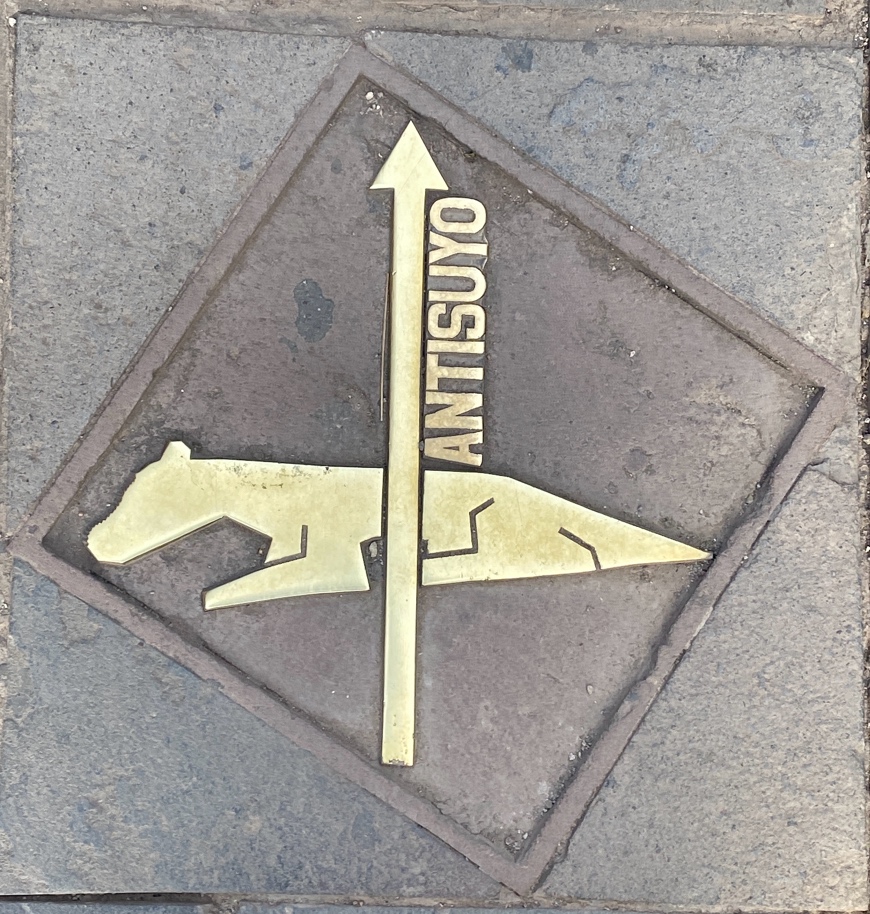
Figure 7. One of the markers on the streets of Cusco indicating the city’s role as a terrestrial puma. The arrow shows the direction of sunrise (“antisuyo” in Quechua). Credit: Andrew Collins.
Magli sees this natural fork in the Sacred River as a terrestrial reflection of the Milky Way’s Dark Rift, called also the Cygnus Rift, the northern entrance to which is the dark nebulous region known as the Northern Coalsack (Magli 2005). This area of the starry stream is highlighted in the night sky by the stars of the Cygnus constellation, referred to also as the Northern Cross due to the cruciform shape formed by its principal stars. More pertinently, Magli proposes that the northern entrance to the Dark Rift overlaid by the stars of Cygnus is the missing dark cloud constellation of the puma, reflected on the ground by Cusco’s own role as a landscape puma.
If Magli is right, then Cusco’s celestial counterpart is the northern opening of the Milky Way’s Dark Rift, marked by the stars forming the constellation of Cygnus. This then was the “center of origin” from which the two mayu or branches of the Milky Way, in its role as a celestial river, split in two before flowing in opposite directions into the southern night sky (see fig. 8). There they converged, almost certainly in the region of the Southern Cross (the Northern Cross’s celestial counterpart), creating a point of access into Kay Pacha, This World, for cosmic energies that had begun their journey in the Northern Cross. This then acted as a cosmic axis reflected on the ground by the Coricancha in its role as the center or navel of This World, creating a perfect expression of “as above, so below.”
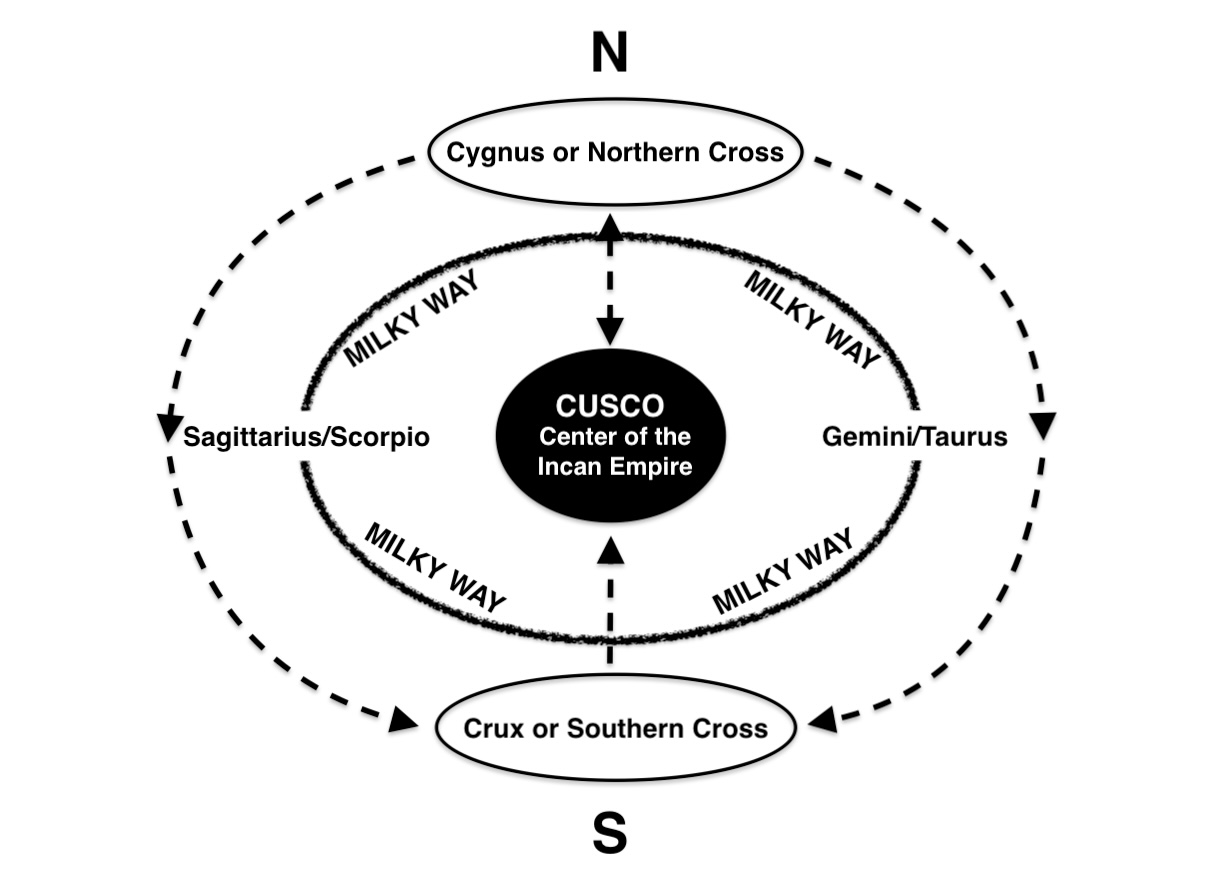
Figure 8. Incan cosmological schema as recorded by Gary Urton of two Milky Ways, or sacred rivers (mayu). They flow from a common “center of origin” in the north before colliding in the south. There they combine to flow through to the Incan capital of Cusco in its role as the center or “navel” of the Incan Empire. The “center of origin” in the north can be identified as Cygnus in its role as the Northern Cross, while the meeting point of these two mayu in the southern sky can be identified as the Chacana, that is, the constellation of Crux, the Southern Cross. The two celestial crosses counterbalance each other. Credit: Andrew Collins.
The fact that the Urubamba, as the Willkamayu, flows through Peru’s Sacred Valley from Machu Picchu in the south to Cusco in the north can be seen as marking the passage of these divine energies from the Upper World, via the Southern Cross, in its role as the original Chakana or Peruvian Cross, into This World. The fact that the ancient Incan cities located on its path reflect dark cloud constellations along the Milky Way only goes to emphasize this conclusion.
With this realization it now becomes possible to identify the five-star cross known as the Orcorara at the apex of the Incan Altar. It is almost certainly the five central stars of Cygnus in its role as the Northern Cross, viz. Deneb, Gienah (Epsilon Cygni), Sadr, Rukh (or Al Fawaris), and Eta Cygni (η Cygni). Together they form a perfect equal-armed cross, exactly in the manner shown on the Incan Altar. The vertical line connecting three of the five stars—Deneb, Sadr and Eta Cygni—most likely reflects the passage of the divine spirit from Deneb, Cygnus’s brightest star, marking the northern opening of the Milky Way’s Dark Rift, through into the southern night sky, the direction in which the line points.
The Oval of Viracocha, seen in Peruvian sky lore as the egg of creation, is positioned immediately below the Orcorara star cross, now identified as the five central stars of Cygnus, and directly above the diagonal cross of four stars that we have already identified as the Southern Cross. Both celestial crosses lie on the Milky Way opposite each other. This makes it clear that the Oval of Viracocha is almost certainly the Milky Way itself. Its shape echoes the manner that the Milky Way is divided into two separate arches, one above the ecliptic in the northern part of the sky and the other below the ecliptic in the southern part of the sky. Joining the two halves together could very well explain the visual appearance of the Oval of Viracocha as shown on the Incan Altar. What is more, being so important to the Incan civilization, it would be a strange omission if the Altar did not feature the Milky Way.
The Great Snake, Amaru
The god Viracocha is often represented as anthropomorphic stelae, especially at the presumed point of origin of his cult at Tiwanaku, close to Lake Titicaca in northern Bolivia. Running up the side of these stelae is usually a winding snake interpreted by Quechea-speaking guides as Amaru, the great snake who is a personification of the Milky Way (he also presides over lightning). According to Rumi Llakta Alegría, a Peruvian guide well versed in Incan cosmology and astronomy, Amaru in Quechua means the “snake that bites its tail,” recalling the Ouroboros of Greco-Egyptian tradition. Viracocha has a close relationship with Amaru, sometimes as an opponent and at other times as an ally. Alegría told the author that Amaru and Viracocha are essentially one and the same; Amaru simply being Viracocha’s serpentine form.
If the Oval of Viracocha is indeed a metaphor for the Milky Way then its identity as the egg of creation conjures the idea of a snake surrounding the cosmic egg, a concept familiar from Greco-Egyptian and Greek Pelasgian tradition (see fig. 9). In many ancient mythologies, both in the ancient world and also in the Americas, the Milky Way was seen as a cosmic serpent, often identified with the world-encircling serpent that swims in the cosmic ocean that surrounds the physical world (see Collins 2024 for a full review of this subject).
Bringing together these themes in Incan tradition is the site of Amaru Muru, close to Lake Titicaca in southern Peru. This is a gigantic rock-cut false door some seven metres (23 feet) in height and width, cut into the red sandstone bedrock with a smaller T-shaped doorway carved into its base (see fig. 10). Considered to be Inca in origin, the site is known also as Puerta del sol, or Gateway of the Sun. Its Quechua name, Amaru Muru, honors Amaru, the great snake in its role as the Milky Way (muru is Spanish for “wall,” making this doorway the “wall of the great snake”). There is even a simulacrum of a snake formed from the red sandstone immediately above the doorway, emphasizing the site’s serpentine nature.
The presumed function of the Amaru Muru doorway is to quite literally portal one’s consciousness into an otherworldly environment to connect with the Milky Way in its form as Amaru, the great snake. Alegría informed the author that it would take place at the time of the winter (June) solstice, when the dark cloud constellation known as the mother llama was directly overhead. The twin stars Alpha and Beta Centauri, which form her eyes, lie next to the Southern Cross, meaning that this would have been overhead at the same time.
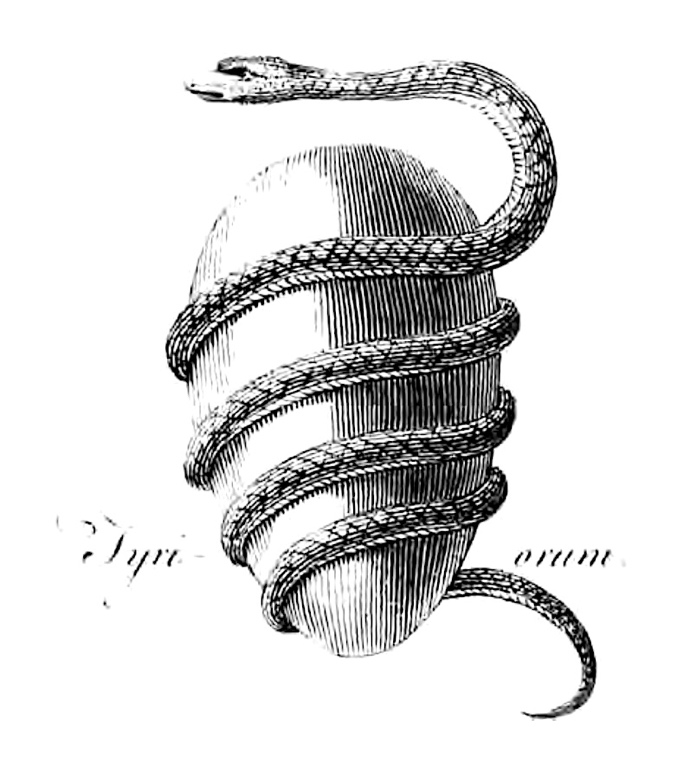
Figure 9. The “Universal Egg” of Pelasgian tradition, with the serpent Ophion wrapped around it. Was this how the Oval of Viracocha was conceived in Incan tradition as the cosmic serpent surrounding the egg of creation? Ilustration from A New System, or, An Analysis of Ancient Mythology (vol. II, plate iv) written by Jacob Bryant (1715–1804) and published in 1774. Engraving by James Basire (1730–1802). Public domain.
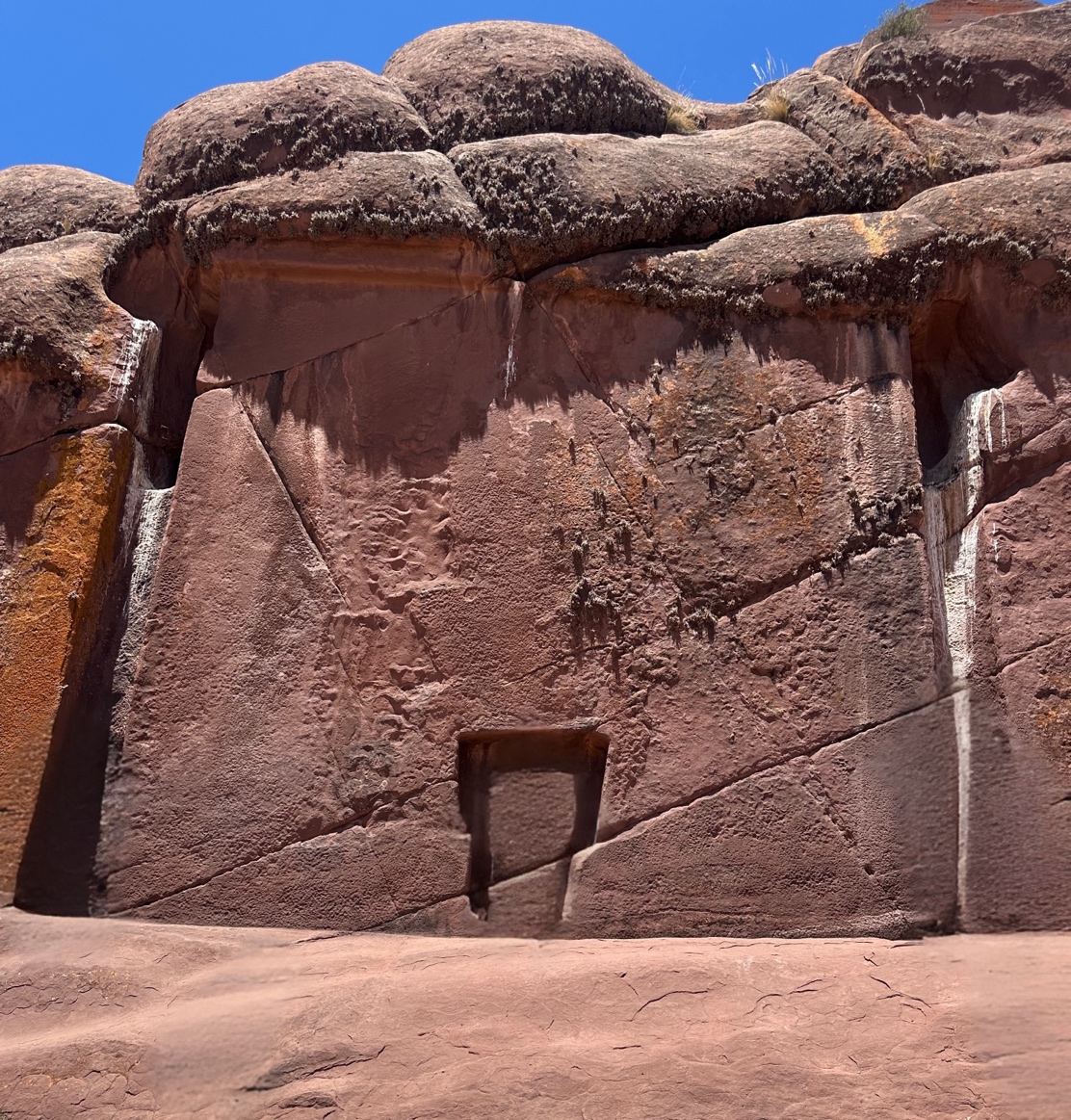
Figure 10. Amaru Muru, a false gateway near Lake Titicaca in southern Peru. Credit: Carmela Phillips.
Conclusion
We are now in a much better position to properly identify the principal components of the Incan Altar’s middle column, starting with the Orcorara or Cross of Viracocha. This cluster of five stars in the shape of an equal-armed cross located immediately below its gable roof symbolizing the arch of heaven is likely the five central stars of Cygnus in their guise as the Northern Cross. The Oval of Viracocha, on the other hand, is almost certainly the Milky Way in its role as the great snake Amaru, that is, Viracocha in his serpentine form, while the diamond formation of stars immediately below it is the Southern Cross,2 the two celestial crosses counterbalancing each other at opposite ends of the sky.
If correct, then in Incan cosmology the “divine spirit” was seen to emerge from the Northern Cross, in its capacity as the cosmic navel or “center of centers,” as well as the place of first creation, before flowing through the twin mayu, or parallel sacred rivers, of the Milky Way to reach the area of Crux, the Southern Cross, identified as the Chacana of Andean tradition. These cosmic energies would then pass through its circular aperture into Kay Pacha, “This World,” and flow, symbolically at least, northwards along the Urubamba River, in its role as Willkamayu, the sacred river of life, until they reached Cusco’s Coricancha (see fig. 11) in its role as the earthly navel of the Incan world.
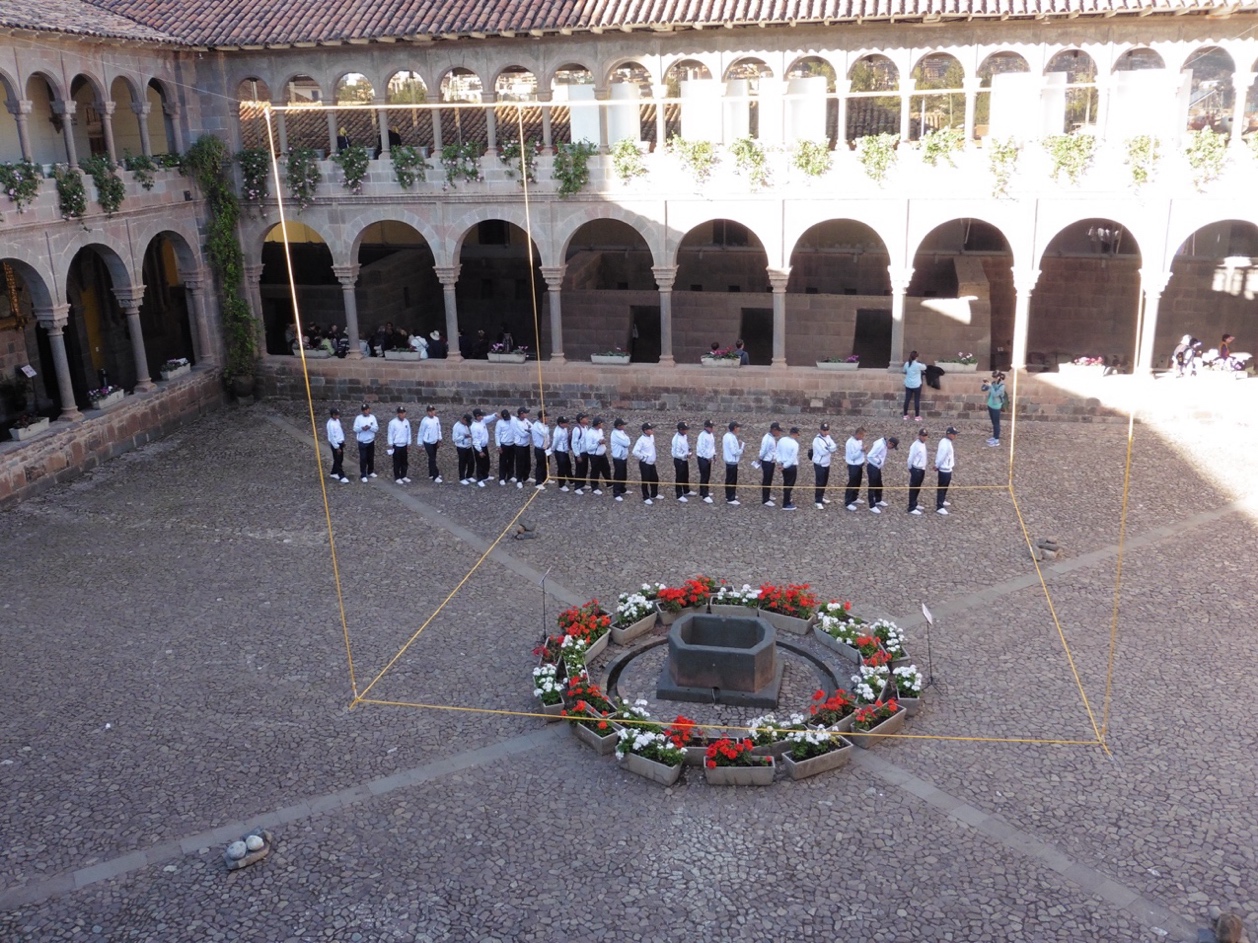
Figure 11. The central court of the Convent of Santo Domingo, Cusco, showing the position of the center or navel of the Inca Empire today marked by a hollow vessel. Credit: Andrew Collins
From there, these energies would be channeled through the ruling Inca and his consort, as incarnations or descendants of the hero twins Manco Cápac and Mama Ocllo, into every part of the Incan Empire via a series of 41 energy lines, known as ceki, that emanate out from the Coricancha to connect with a whole series of wak’a (also spelt huaca), that is, religious shrines scattered about the Peruvian landscape.
The connection made between the Upper World and This World by the Incas was expressed annually within the Inti Raymi festival of the Sun, which took place at Cusco during the winter (June) solstice. This was presided over by the reigning Inca, and every Incan noble was required to take part in this annual event, while the public was encouraged to come to the city to witness these extraordinary celebrations. In more recent times, the Inti Raymi festival has been revived with a new Inca appointed to head the celebrations (see fig. 12).
The purpose of Inti Raymi was to synchronize the heavens with the Coricancha in its role as the Temple of the Sun, the timing of this event coinciding with when the Milky Way aligned with the Urubamba River in its capacity as Willkamayu, the sacred river of life. At such times, it was deemed that Heaven and Earth were in perfect harmony, enabling the Inca and his consort to channel cosmic energies into every part of the empire.
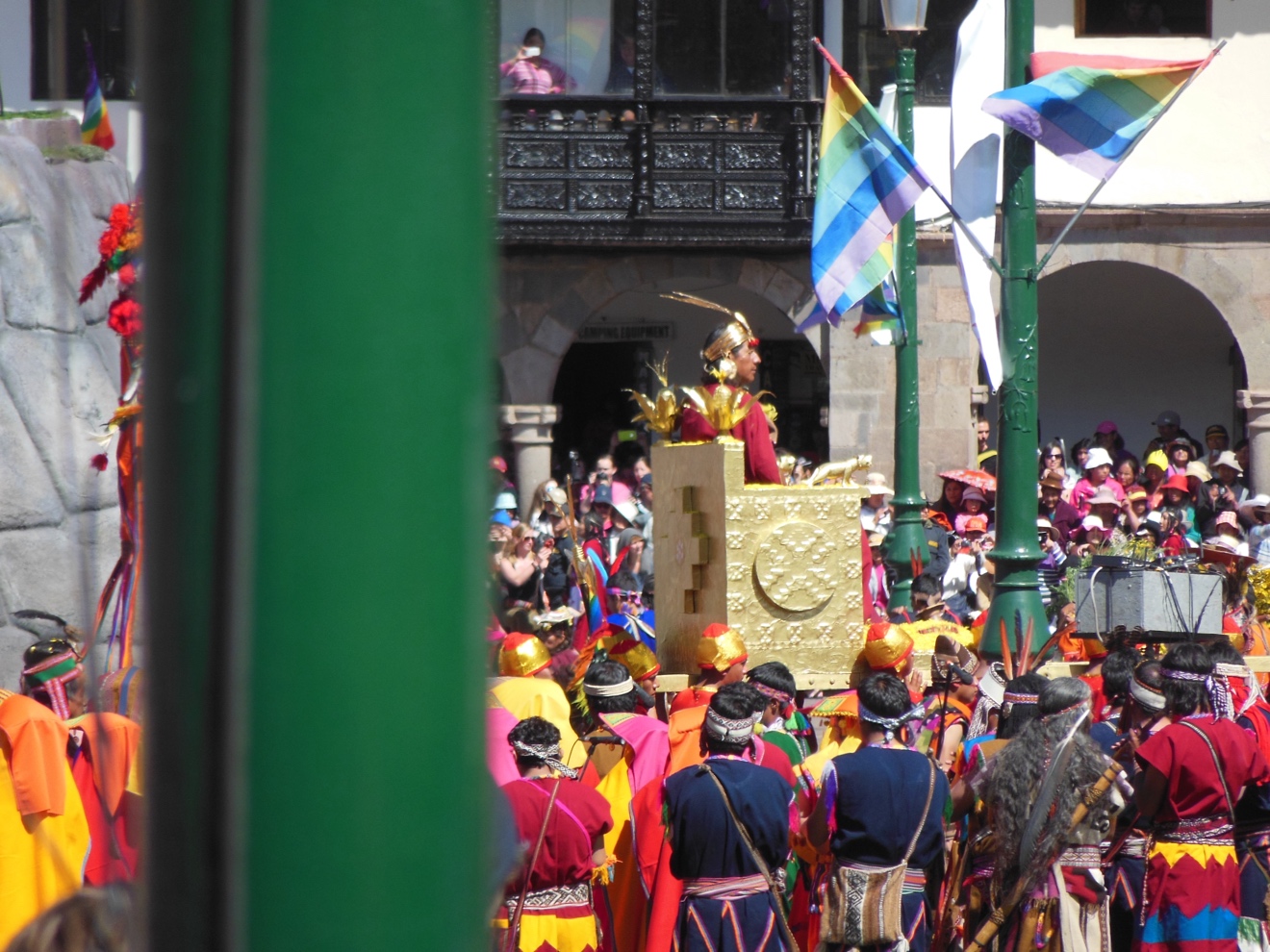
Figure 12. The reigning Inca on his mobile seat of office during the Inti Raymi festival in 2015. Credit: Andrew Collins.
Origins in the Northern Hemisphere
If the hypothesis presented here is correct, then it seems highly likely that the Incas recognized a “center of centers,” a point of first creation and abode of their creator god Viracocha in the northern night sky, despite the fact that Peru lies deep within the southern hemisphere. If this were the case, then what could possibly have led them to adopt a cross-like constellation in the northern part of the Milky Way as the origin point not only of the divine spirit that nourished life on earth, but also where human souls were seen to enter this world?
The easiest and most parsimonious answer is that the Inca civilization had roots in the northern hemisphere. This does not mean that the Incas originated in the northern hemisphere, only that some part of their population, perhaps an elite class, had ancestry in the north. As we have seen, the oldest known Chakanas have been found at archaeological sites in northern Peru, such as Chavín de Huántar and Miraflores in Lima. What is more, the “Chuque chinchay,” the so-called “jaguar of gold,” of the Incan Altar, would appear to have been venerated also at Chavín de Huántar, perhaps indicating a southerly migration of ideas into the Andean highlands around Lake Titicaca.
Elsewhere, the current author has demonstrated that the culture attached to the cultural and ceremonial center of Chavín de Huántar, which thrived 1000–500 BCE, would appear to have had close trading relations with the Olmec civilization of Central America, which thrived circa 1200–400 BCE (see Collins 2000, ch. 12). Coca leaves, important to the economy of the Chavín, would appear to have been transported directly from the Chavín center of Bagua, located in the northern highlands of Peru, via Ecuador and Colombia to the Central American territories of the Olmec. This then provides additional evidence of a potential line of transmission for cosmological ideas to move freely between the northern and southern hemispheres as much as 3000 years ago.
If correct, this could help explain the Incas’ profound interest in the northern night sky. Yet their equal interest in the southern night sky, particularly the Milky Way, must have come from earlier cultures they either conquered or integrated into their multi-cultural society. This would have included descendants of such peoples as the Pucara culture of southern Peru, the Tiwanaku culture of Bolivia, the Wari, Nazcans, and Paracans of central Peru, and the Chavín, Moche and Chimú peoples of northern Peru. All of them, especially those in the north of the empire, could have themselves contributed to the Incan interest in the northern night sky.
If this is true, who then were the true northern ancestors of South America’s Incan civilization? When did they flourish, and what do we know about them? More importantly, how do the cosmological notions outlined in this article connect with other similar ideas regarding a place of first creation and point of entry into the Upper World corresponding with the stars of Cygnus and the northern opening of the Milky Way’s Dark Rift?
Arguably, the answer is linked with the dissemination of cosmological knowledge during the Upper Palaeolithic age, circa 45,000-11,600 years ago, and after that into the Neolithic period at Taş Tepeler sites such as Göbekli Tepe, Karahan Tepe and Sayburç in southeastern Turkey. As far back as 9600 BCE this immensely sophisticated high culture would appear to have formulated a cosmogonic schema that included the importance of Cygnus and the Milky Way’s Dark Rift as marking the entrance to the sky world, along with the division of the universe into three worlds (see, for instance, Collins 2014, Collins 2018, Collins 2024, as well as public lectures by J.J. Ainsworth and Debbie Cartwright).
Incredibly, the three worlds of the Incas are represented by almost identical creatures as those displayed on Göbekli Tepe’s famous Pillar 43, otherwise known as the Vulture Stone. As previously indicated, the Incan Upper World, Hanan Pacha, is represented by the condor or eagle; that of Kay Pacha, This World, by the puma or jaguar, and that of Uku Pacha, the Underneath World or Lower World, by the snake or toad, while on Pillar 43 three creatures are positioned next to three “handbags,” which are in fact rectangular worlds or realms complete with arched roofs signifying each of their firmaments. All three are positioned within a watery domain signified by rows of chevrons that are meant to symbolize the cosmic ocean or primeval sea. Next to the left-hand “handbag” is a large bird, arguably a crane or flamingo, symbolizing the Upper World. On the right of the central handbag is a leopard, signifying the Middle World, while next to the right-hand handbag is a frog or toad signifying the Lower World (see Collins, 2024). What this tends to imply is a shared origin behind each of these cosmological traditions found at different times on two different continents.
Such ideas are strikingly similar also to what we find in connection with the cosmological traditions of the mound-building cultures of the American continent. For them, and their tribal descendants through at least until the nineteenth century, the Milky Way was considered the Path of Souls in a death journey that began at the time of the winter solstice with a leap of faith towards an “ogee” or portal corresponding with the Orion Nebula (M42) in the “sword” of the Orion constellation. From there, the soul continued along the starry stream until it reached the northern opening of the Milky Way’s Dark Rift, marked (see Little 2014 and Hancock 2019 for a summary of this subject). Only after successfully navigating a sky figure, often seen in terms of a bird shaman called Brain Smasher who was synonymous with the Cygnus star Deneb, was the soul allowed to achieve entry into the afterlife. These same Native American cultures also recognized the existence of a three-tiered universe, just like the Andean peoples of South America and those of the Taş Tepeler communities at places like Göbekli Tepe and Karahan Tepe.
If correct, then there is every chance that the cosmological notions adopted by the Incas and outlined on the Incan Altar, preserve ideas that were known to the inhabitants of both the Eurasian continent and the Americas thousands of years prior to the drowning some 11,000–12,000 years ago of the Beringia land bridge that linked Siberia with the American continent.3 These are exciting lines of enquiry that hopefully will be more fully explored in the years to come.
-Andrew Collins1
Bibliography
Antonello, Elio. 2013. “The Myths of the Bear.” ArXiv website (May 2, 2013).
Collins, Andrew. 2000. Gateway to Atlantis. London: Headline.
Collins, Andrew. 2006. The Cygnus Mystery. London: Watkins, 2006.
———. 2014. Göbekli Tepe: Genesis of the Gods. Rochester, VT: Inner Traditions/Bear & Company.
———. 2018. The Cygnus Key. Rochester, VT: Inner Traditions/Bear & Company.
———. 2024. Karahan Tepe. Rochester, VT.: Inner Traditions/Bear & Company.
Coombs, Alistair. 2017. “Denisovan Star Trails: Archaic Memory of the Pleiades in the
World’s First Story.” Graham Hancock website (December 13).
Dávila, Luis Zuta. 2023. “Cruz andina descubierta en Huaral evidenciaría ocupación aimara en costa de Perú.” El Peruano website (May 25, 2023)
Hancock, Graham. 2019. America Before: The Key to Earth’s Lost Civilization. New York, N.Y.: Coronet.
Jenkins, John Major. 1998. Maya Cosmogenesis 2012. Rochester, VT: Inner Traditions/Bear & Company.
Lehmann-Nitsche, R. Mitología Sudamericana II. La cosmogonía según los puelches de la Patagonia. Revista del Museo de La Plata XXIV, 1919: 182-205.
Little, Greg. Path of Souls: The Native American Death Journey. Memphis, TN: Eagle Wing Books, Memphis, 2014.
Magli, Guilio. 2005. “On the astronomical content of the sacred landscape of Cusco in Inka times.” Nexus Network Journal 7, No. 2: 22–32.
Molina, Cristóbal de. [16th century] 2011. Account of the Fables and Rites of the Incas (intro Brian S. Bauer, Vania Smith-Oka and Gabriel S. Bauer). Austin, Tx.: University of Texas Press.
Salcamaygua, Juan de Santa Cruz Pachacuti Yamqui. 1613. Relación de antigüedades deste Reyno del Piru. Unpublished manuscript. See “Relación de antigüedades deste reino del Pirú (1613).” Picryl website.
Sullivan, William Francis. 1996. The Secret of the Incas: Myth, Astronomy, and the War Against Time. New York: Crown Publishers.
Urton, Gary. At the Crossroads of the Earth and the Sky: An Andean Cosmology. Austin: University of Texas Press, 1982.
Vega, Garcilaso de la. 1609. Comentarios reales de los incas o Primera parte de los comentarios reales. Lisbon, Portugal: Pedro Crasbeeck.
Public lectures
Ainsworth, J.J. 2024. “Astro-Mythology of Göbekli Tepe & the Earliest Creation Story.” ORIGINS Conference 2024. https://www.youtube.com/watch?v=FFkAh8oZGUM
Cartwright, Debbie. 2023. “Animism of the Ancients: In Praise of Shamans.” ORIGINS Conference 2023. https://www.youtube.com/watch?v=Wt8CKcxQLgw
Cartwright, Debbie. 2025. “Cosmogony of Chaos: Death and Creation in Taş Tepeler.” ORIGINS Conference 2025.
Acknowledgements
Thanks go out to J.J. Ainsworth, Hugh Newman, Graham Hancock, Leila Hancock, Luke Hancock, Roger G. Gilbertson, Debbie Cartwright, Richard Ward, Carmela Phillips, and the guests of the Megalithomania tours of Peru and Bolivia in 2015 and 2025. Thanks also to Quechua-speaking guide Rumi Llakta Alegría for his in-depth insights in Peruvian ancient sites and Incan astronomy.
1 Private researcher. Email: [email protected].
2 In the illustration of the Incan Altar drawn by Santa Cruz Pachacuti Yamqui Salcamaygua in 1613, immediately beneath the Oval of Viracocha, and above the grouping of four stars in a diamond formation identified as Crux, the Southern Cross, is a tiny star. Although arguably in the vicinity of the Southern Cross, identifying it has proven impossible. All we can say is that it is unlikely to be the twin stars Alpha and Beta Centauri, which lie next to the Southern Cross, as surely these would be shown as two stars.
3 That Pre-Columbian peoples recognized sky figures that almost exactly match those found on the Eurasian continent is not in question. See, for instance, the work of Elio Antonello (2013) on the shared sky lore concerning the constellation of Ursa Major found both on the Eurasian continent and in North America. See also the work of Alistair Coombs (2017) on the Upper Paleolithic origins of stories found worldwide concerning the Pleiades; Greg Little (2014) and Graham Hancock (2019) on the universal origins of the ancient American Path of Souls death journey, as well as the current author’s work on the Paleolithic origins of the Cygnus constellation as a bird associated with the human soul (see Collins 2014 and 2018).
It’s bizarre that whilst reading this article, after about half way through, I started to think about the similarities to both Taş Tepeler sites and what I have read in America Before. Lo and behold you highlight this in the final paragraphs.
Excellent read, I thank you