




ABSTRACT: New rotational periods detected in connection with the passage of the third interstellar visitor, 3I/ATLAS, following its perihelion on October 29, 2025, are examined to find out whether they might contain evidence of a broadcast signal. One of these periodicities determined from the wobble of the comet’s jets was calculated to be 7.2 (± 0.005) hours. Not only does this conform with previous findings concerning the synchronization of 3I/ATLAS’s periodicities with the Earth’s 24-hour rotation cycle, but it also reveals the possible significance of a unit of measure equalling 576 seconds, with 576 being the square of 24. In addition to this, we examine the extraordinary symmetry of 3I/ATLAS’s tripartite jets of ionized gas and dust coming from the nucleus. All three are separated by angles that can be simplified to consecutive single-figure integers with the progression reading seven, eight, and nine forming a circle of 24 parts or “degrees.” This finding, like that in connection with the comet’s periodicities, continues to support the hypothesis that 3I/ATLAS is a directed comet that is a sentient life form of a type previously unrecognised by science.
Keywords: directed comet, interstellar visitor (3I/ATLAS), 144 seconds, ancient time keeping, cosmic mathematics, Platonic year, yuga cycles, fractal intelligence.
- The Passer-by, or The Strange Case of 3I/ATLAS. Is it a plasma-based lifeform?, 2025-11-04
- A Synchronization Detected between 3I/ATLAS’s 16.16-Hour Light Variability Cycle and the Earth’s 24-hour Solar Day, 2025-12-18
- 3I/ATLAS: More Mathematical Correlations with the Earth’s 24-hour Rotational Cycle and the Bizarre Symmetry of its Tripartite Jet Structure
Prior to 3I/ATLAS’s closest approach to the Earth on December 19, 2025, I wrote two articles proposing that this interstellar visitor, the third to grace our skies in the last decade, is what might be termed a “directed comet” (Collins 2025a and 2025b), with this being defined as a celestial object that displays conscious, self-awareness with respect to its passage through a star system. This might include absorbing coronal mass ejections from the host star, and as a result, benefitting from this interaction in order to better continue its journey.
The various anomalies recorded so far in association with 3I/ATLAS (outlined in Loeb 2025) support the notion that it is a directed comet. If correct, then there is every possibility that it is broadcasting intelligent signals. These could be similar to how an airplane transponder works, with a constant signal announcing its presence using a form of unique signature. Other broadcasts could deliberately target intelligent life occupying any of the planets or moons of the system in question. Such attention-seeking broadcasts would most likely convey mathematical and geometrical data, as well as information regarding a targeted planet’s orbital cycles and its relationship to other celestial bodies in the star system.
Messages of this kind could be broadcast utilising light emissions, notable colour changes; cohesion in X-ray, infrared and other forms of energetic activity, and even, dare we say, good old fashioned radio signals of the type we have been trying to pick up from celestial targets since Project Ozma (a forerunner of SETI) back in 1960 (with only one viable candidate so far, this being, of course, the Wow! Signal from 1977).
With such ideas in mind, in the second of the two papers (Collins 2025b) I postulated that the rotation periods associated with 3I/ATLAS (see fig. 1), caused by cyclical variations in brightness, might well contain interpretable information. On examining the duration of these periodicities, determined to be 16.16 (±0.01) hours before perihelion (see Santana-Ros et al. 2025) with a slightly faster rate of 15.48 hours (±0.70 hours) after perihelion (Serra-Ricart et al, 2025)—I noted that they appeared to be synching very well with the Earth’s 24-hour rotation period.
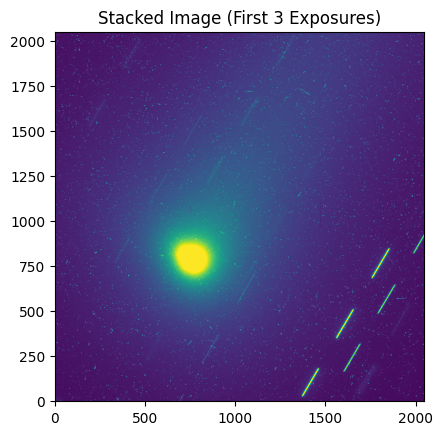
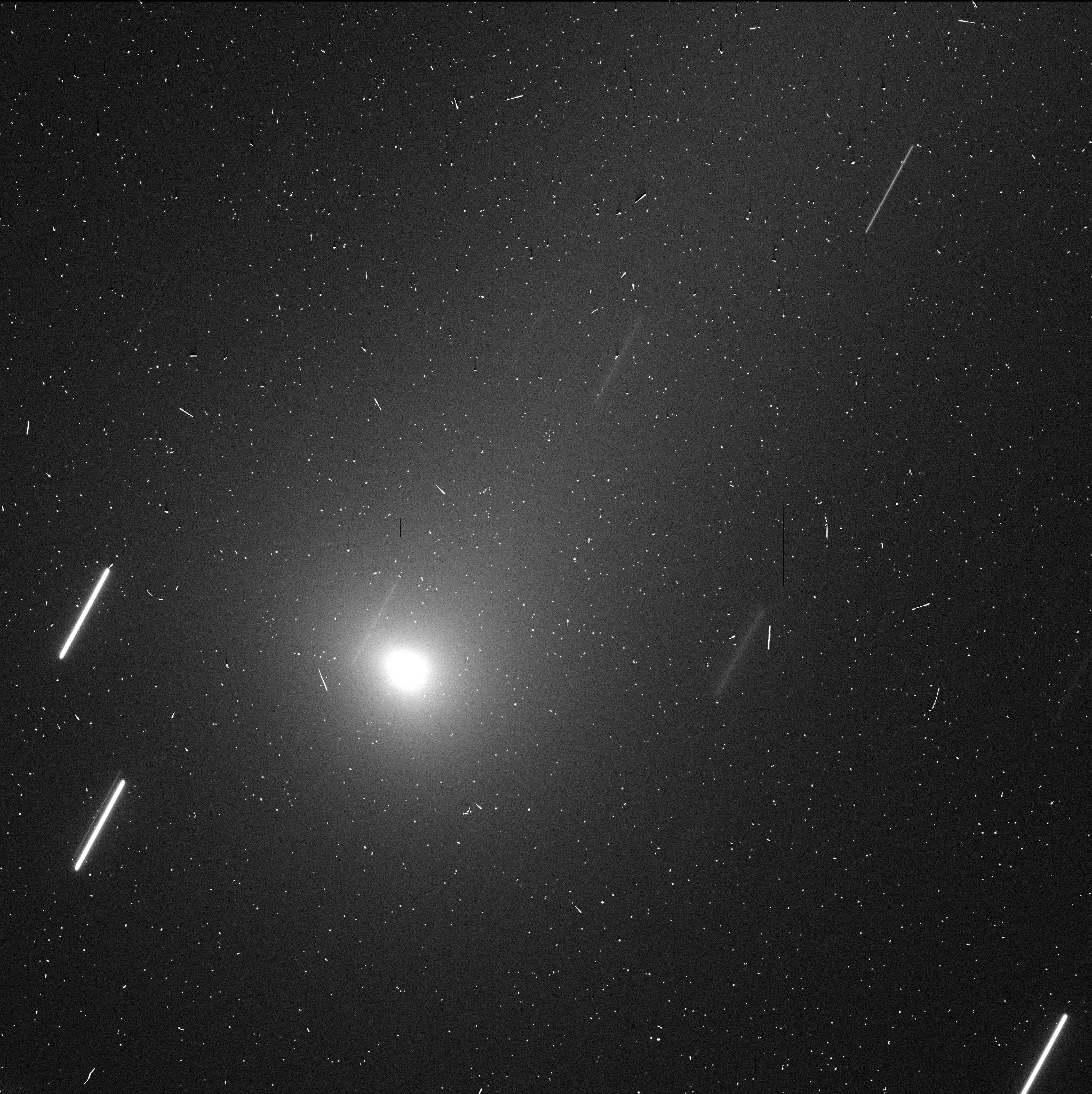
FIGURE 1. Image of 3I/ATLAS taken by the Hubble Space Telescope on January 14, 2026 in six 170 second exposures using the WFC3 UVIS (F350LP) camera. Image processed from NASA/ESA/STScI FITS Data by Luke Hancock (Public Domain)
This synchronization was most easily recognised using a unit of measure equal to 144 seconds with 3I/ATLAS’s 16.16-hour rotation period pre-perihelion displaying a cycle of 404 of these units against the Earth’s own 24-hour rotational cycle, which in length is the equivalent of 600 of these units. This tells us that a 404:600 relationship existed between the two bodies, which, when simplified, offers a whole number ratio of 101:150.
Not only does 144 seconds feature as a unit of time keeping in ancient China, and also in Vedic tradition (Collins 2025a), but 144, the square of 12 (12 x 12 = 144), is a core number featured in cosmic time cycles recorded by the ancient Greeks, the Romans, the Babylonians, and the Vedic chroniclers of the Indian sub-continent. In this knowledge, the synchronization of 3I/ATLAS’s periodicities with those of the Earth’s 24-hour cycle using a time unit of 144 seconds seems unlikely to be without meaning.
“Nothing to See Here” vs Alien Spaceships
Following the publication of the paper in question in December 2025, my speculations were picked up on by news media sources around the world, including the Daily Mail (Melore 2025) and the WION (World Is One News) news network of South Asia (see Singh 2025).
Since then I have kept a watch on the progress of 3I/ATLAS as viewed through the eyes of the international news media, which is generally divided into two opposing camps—those who will do or say anything to ensure that people do not believe this is anything other than a regular comet, and those hoping to find indisputable proof that 3I/ATLAS is of technological origin. What is more, right now the public is being encouraged to wave goodbye to 3I/ATLAS as it heads out towards the planet Jupiter before leaving behind the Solar System for good.
Having outlined my proposal that 3I/ATLAS is a directed comet displaying evidence of intelligent actions through its synchronization with the Earth’s rotational cycle, I was happy to leave the subject there. However, two new pieces of information came to light regarding 3I/ATLAS that I felt were important enough to address. The first relates to two new rotational periods recorded in connection with the comet, with the second relating to the bizarre symmetry of the tripartite jets of ionized gas and dust being released into the object’s coma by its nucleus.
New Rotational Periods
Let’s look first at the new information regarding the comet’s cycles of activity. On January 16, 2026, Harvard theoretical physicist Avi Loeb published details of a new study penned by himself and Toni Scarmato of the Toni Scarmato Astronomical Observatory in Italy that determined two new rotation periods in connection with 3I/ATLAS (see Scarmato and Loeb 2026, and also Loeb 2026a). Both were achieved through a careful examination of Hubble Space Telescope images taken between November 20, 2025 and December 27, 2025. Each one was processed using the Larson-Sekanina Rotational Gradient filter in order to remove the circular symmetric glow around the nucleus. One periodicity, found to be 7.2 (±0.05) hours in duration, was determined through measuring the wobbles associated with the jets, which were found to change by ±20 degrees. The second periodicity, no doubt allied to the first, was determined through an examination of the variations in brightness of the object by ±30 per cent. This yielded a cycle of 7.136 hours (+/-0.001). The slight disparity between the two values is explained by Loeb in the following manner:
The two periods differ slightly, but the small difference is plausibly attributable to systematics and aliasing. The combined data support a post-perihelion rotation period of about 7.1 hours, triggering a periodic precession of the jet structure around the rotation axis of 3I/ATLAS (Loeb 2026a).
This statement perplexed me slightly since 7.1 is not the mean average of 7.136 and 7.2. This would be 7.168. Anyway, let’s examine first the proposed 7.2-hour periodicity.
The 7.2-hour Rotation Period
In terms of units of 144 seconds, there are precisely 180 such units in 7.2. hours, meaning that with the Earth’s 24-hour rotational cycle being 600 of these same units, the relationship between the two celestial bodies is shown in the fraction 180/600, which can be simplified to 3/10. In other words, the 7.2-hour rotational period of 3I/ATLAS is 3/10th of a 24-hour day, a fact which tells us that the two synchronise and reset themselves every three days (based on 7.2 x 10 = 72 hours).
In terms of other units of time keeping, 7.2 hours is 432 minutes, a highly auspicious number recognised as an important base number in cosmic mathematics, particularly that associated with the so-called yuga cycles of Vedic tradition. In terms of seconds, 7.2 hours is 25,920 seconds, another auspicious number since it just happens to be the length in years of the Great Year mentioned in the works of the Greek philosopher Plato (428/427 BCE–348/347 BCE).
A figure of 25,920 years was derived from the understanding that the Sun at the time of the spring equinox rises in the same sign for approximately 2160 years, based on the division of the ecliptic, the Sun’s path, into 12 equal parts, each forming a zodiacal “house” and each occupying 30 degrees of the night sky. Due, however, to the gradual shift of the stars against the local horizon caused by precession, the slow wobble of the Earth on its axis, the Sun will thereafter rise in the next sign along for 2160 years. This process will continue until the equinoctial Sun has risen in all 12 signs and returned back to where it began, a process that defines the length of the Platonic Year.
To achieve a figure of 25,920 years, composed of 12 x 2160 years, Plato, or the source of his information on cosmic time cycles (arguably the Pythagorean School of Croton, Italy, from which he likely gained much of his scientific knowledge) used a series of key numbers derived from the movement of the Sun and Moon, along with an accurate knowledge of the triple Saros eclipse cycle, which is 54 years and 33 days in length. I say this since 480 x 54 = 25,920, 180 x 144 = 25,920, 60 x 432 = 25,920, and 360 x 72 = 25,920. Seventy-two is, of course, a x10 multiple of 7.2. It is also a major cosmic number in its own right, with 72 years being the time it takes for the starry background to shift one degree against the local horizon, something that the ancients would seem to have been aware of in their calculation of the Great Year.
The 7.136-hour Rotation Period
Moving on to the second rotational cycle offered by Scarmato and Loeb in their recent paper, which is 7.136 hours, we find that it fares less well when it comes to seeing it in terms of units of 144 seconds. It is, in fact, 178.4 units of this measure, which seems meaningless. Having said this, 179 units of 144 seconds comes out at 25,776 seconds, a difference of just 86.4 seconds from the proposed 7.136-hour periodicity.
Of the two rotation periods, it is really only the 7.2 hours, determined from the periodic wobble of the comet’s jets, that resonates with the proposal that the cyclical activity of 3I/ATLAS is somehow harmonising with the Earth’s rotational cycle. I say this because if we now compare this figure with its pre-perihelion periodicity of 16.16 (±0.01) hours, the following happens.
Dividing 7.2 by 16.16, we get 0.44554455 … (with 44 and 55 then repeating ad infinitum). As a fraction, 0.4455 … becomes 45/101, showing that the relationship between 7.2 hours and 16.16 hours is 45/101. As a whole number ratio, this can also be read as 90:202 and 180:404, with 180 being the number of units of 144 seconds in 7.2 hours and 404 being the amount in 16.16 hours. With the Earth’s 24-hour rotation cycle constituting 600 of these same units, and 7.2 hours 180, it becomes possible to read all these values in terms of a unit of 576 seconds, with 576 being 4 x 144. When we apply this new, larger measure to the periodicities of 3I/Atlas (see table 1), we find that 16.16 hours is 101 of these 576-second units, 7.2 hours is 45, while the length of a 24-hour day is 150, and a common year of 365 days is 54,750.
What this tells us is that the largest unit of measure that can be used to define the lengths of all these different time cycles—the two periodicities of 3I/ATLAS at 7.2 hours and 16.16 hours, an Earth day of 24 hours, and a common year of 365 days, is 576 seconds, or 9.6 minutes. This makes it clear that 3I/ATLAS’s proposed rotation period of 7.2 hours conforms perfectly with the previously announced orbital period for 3I/ATLAS of 16.16 hours, just as it does with the Earth’s 24-hour rotational cycle. It also suggests that a unit of measure equalling 576 seconds could be important in terms of cosmic timekeeping as defined by the Earth’s relationship to the movement of the celestial bodies.
| Celestial body/ies | Periodicity | In units of 144 seconds | In units of 576 seconds |
|---|---|---|---|
| 3I/ATLAS | 7.2 h | 180 | 45 |
| 3I/ATLAS | 16.16 h | 404 | 101 |
| Earth | 24 h | 600 | 150 |
| Earth and Sun | 365 d | 219000 | 54750 |
TABLE 1. The relationship between the two proposed rotation periods of 3I/ATLAS and the Earth’s 24-hour rotational cycle, and a common year of 365 days.
Even if this is true, it could be that the activities of interstellar objects like 3I/ATLAS and planets such as our own are naturally subject to some kind of fundamental mathematical principle or fractal intelligence that is able to generate numeric patterns that can easily be recognised. The numbers that seem to recur with some regularity, certainly from a geocentric perspective, include 54, 72, 144, 432, and 576.
The Weird Symmetry of the Jets
Leaving behind the rotational periods of 3I/ATLAS, we look now at the very strange symmetry of the three jets of ionized gas and dust being released into the coma of 3I/ATLAS. These can clearly be seen in an image of the comet taken by the Hubble Space Telescope on January 14, 2026, which has been processed through the Larson-Sekanina Rotational Gradient filter to remove the glow centred around the nucleus (see figs. 2 & 3a). This reveals the presence of the comet’s huge anti-tail, which uncharacteristically points towards the Sun. It also shows the three incredible jets of ionized gas and dust, which Avi Loeb has described as spaced approximately 120 degrees or one-third of a circle apart from one another.
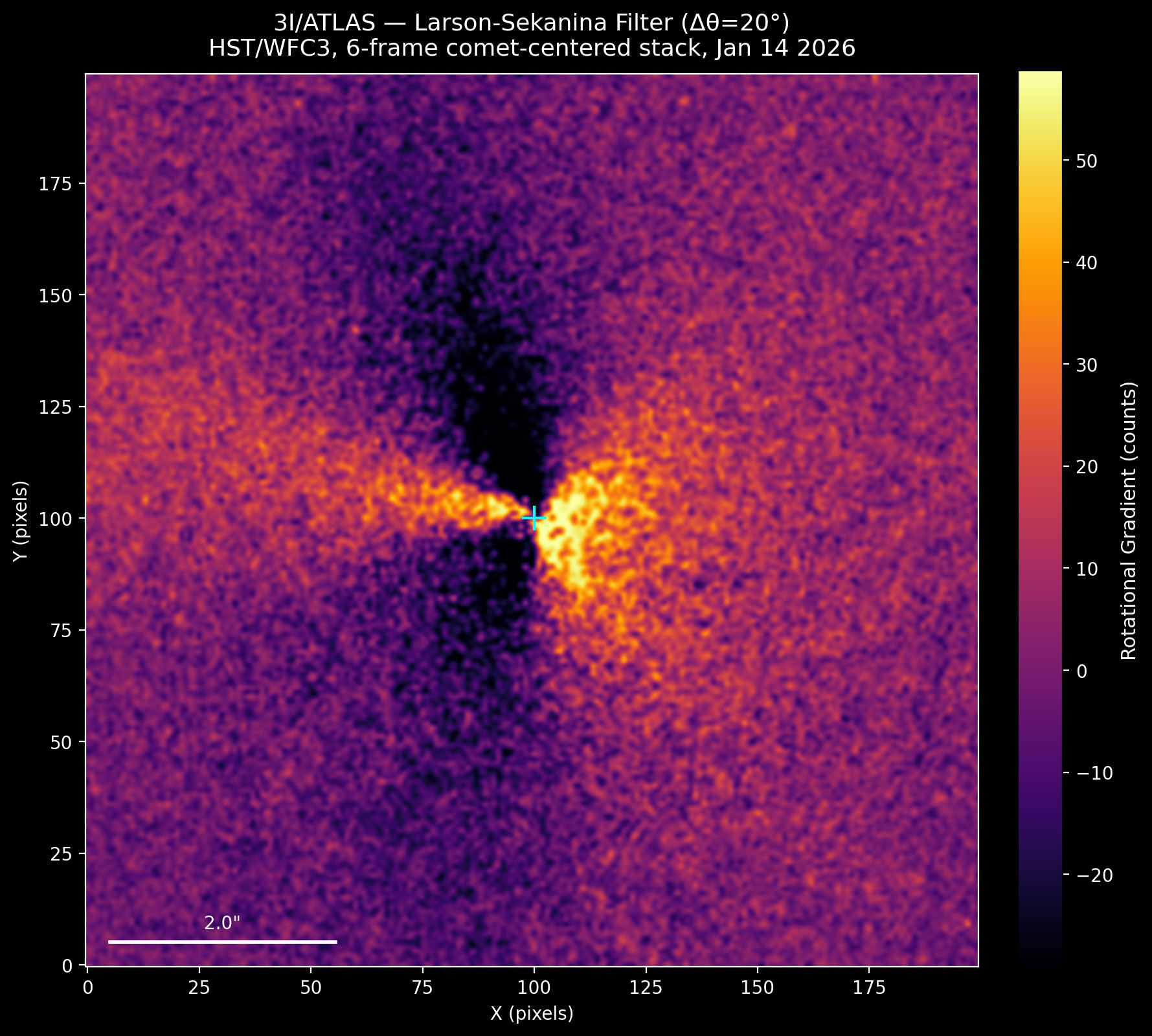
FIGURE 2. Hubble Space Telescope image of 3I/ATLAS taken on January 14, 2026, processed using the Larson-Sekanina Rotational Gradient filter. This removes the glow centred around the nucleus to reveal its quite extraordinary anti-tail (facing left) and tripartite jets. Image processed from NASA/ESA/STScI FITS Data by Luke Hancock (Public Domain)
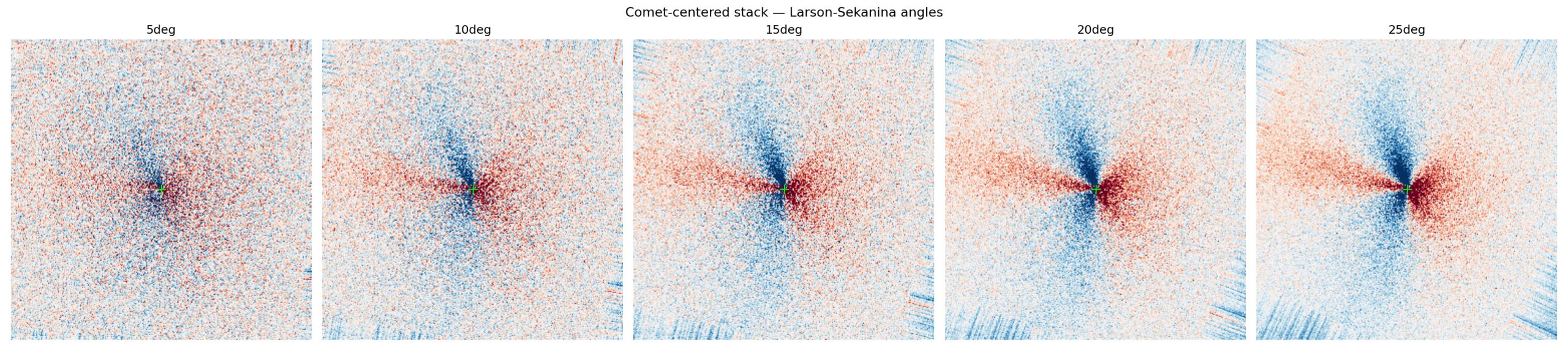
FIGURE 2b. Hubble Space Telescope image of 3I/ATLAS taken on January 14, 2026, processed using the Larson-Sekanina Rotational Gradient filter. Image processed from NASA/ESA/STScI FITS Data by Luke Hancock (Public Domain)
As I examined this image, I saw that the three jets did indeed appear to emerge equidistant from the comet’s nucleus. However, I noticed that the angles between each jet were very slightly different, so I measured them and discovered something of great interest.
Although the angle between the two jets facing away from the Sun is indeed 120 degrees, the next angle of separation dividing the jets, moving anticlockwise, is almost exactly 105 degrees. The third and final angle displayed by the jets, again moving around in an anticlockwise direction, is 135 degrees.
So, in order, we have angles of separation equalling 105 degrees, 120 degrees, and 135 degrees, which together form a circle of 360 degrees (see fig. 3b). Looking closer at these figures, I realised they could be simplified in terms of whole number integers to seven for 105 degrees, eight for 120 degrees, and nine for 135 degrees. This makes a circle of 24 parts or “degrees,” derived from the fact that 7 + 8 + 9 = 24 (see figs. 3c & 3d).
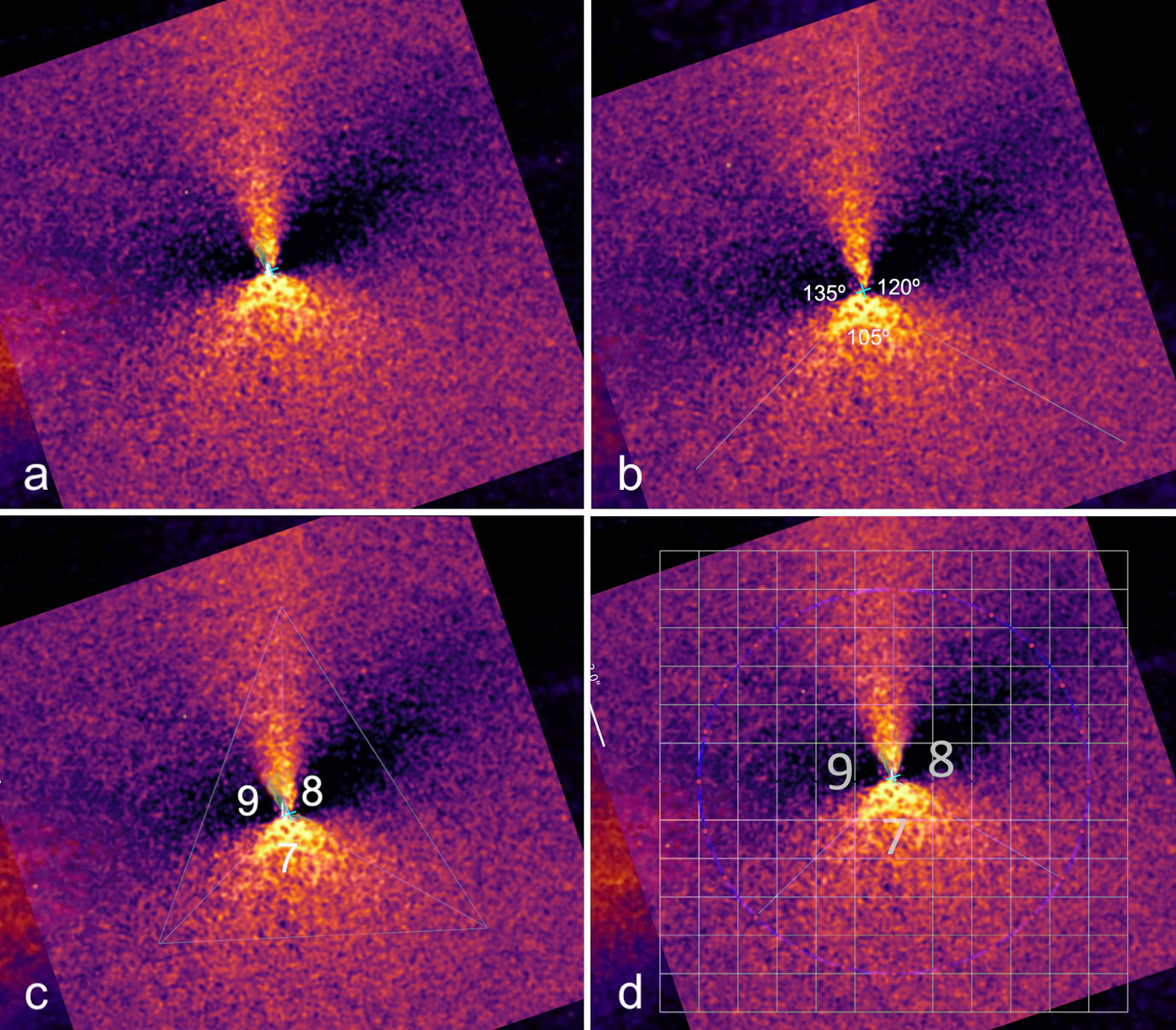
FIGURE 3a–d. The Hubble Space Telescope image from January 14, 2026, processed using the Larson-Sekanina Rotational Gradient filter to reveal its tripartite jets: a) shows the image in question; b) shows the angular division between the three jets anticlockwise as 120 degrees, 105 degrees and 135 degrees; c) shows the three jets providing angular divisions that can be broken down into seven, eight and nine parts, the whole thing constrained by an 7-8-9 triangle; d) shows a 24-point circle and grid plan confirming the angular divisions of the jets into seven, eight and nine parts. Credit: NASA/ESA/STScI, and b–d, NASA/ESA/STScI / Andrew Collins
We must, of course, be careful in these calculations since we cannot be certain that we are witnessing 31/ATLAS truly perpendicular to its trajectory, meaning that the angles could be slightly out. That said, to find such perfect symmetry in the jets being emitted by 3I/ATLAS can only be described as quite extraordinary. With regards to dividing the angle of the jets into 24 parts, we should note that 3 x 24 = 72, 6 x 24 = 144, while 24 x 24 = 576.
The fact that the square root of 576 is 24 can perhaps be seen as significant if we consider the fact that a unit of measure equalling 576 seconds unites two of the recorded rotation periods of 3I/ATLAS with both the Earth’s 24-hour rotational cycle and a common year of 365 days. What is more, to find that the angles between the three jets generate three consecutive single-figure integers in the form of seven, eight and nine, which add up to 24, the number of hours in a day, seems very fortuitous indeed. It is the extraordinary regularity in the angles of the jets that has led Avi Loeb to speculate that their symmetry could be evidence of a technological signature (Loeb 2026b).
For me, the jet symmetry is not evidence of alien technology. Instead, it could be further evidence that 3I/ATLAS is a sentient being capable of controlling, generating, and directing its ionised emissions to display meaningful patterns and even broadcast intelligent signals. If correct, then we can see that these displays contain both mathematical and geometrical data, which are universal in nature and can be easily recorded and interpreted by those monitoring its passage through the inner Solar System.
As the news media is telling us, we have now to say our goodbyes to 3I/ATLAS, although I suspect that for a long time, scientific data will continue to be released, making it clear that this object was never simply a regular comet, as official channels want us to believe. It was never a regular comet, and it is important that we start approaching the presence in our skies of such objects as potential evidence of the existence of intelligent life forms that, although they might possess the body of a comet and produce comet-like comas, are in fact something else altogether—something far more exotic. Until we come to realise this, we will never understand their true nature or their importance to life on Earth.
Bibliography
Collins, Andrew. 2025a. “The Passer-by or the Strange Case of 3I/ATLAS. Is it a plasma-based lifeform?” ResearchGate website (October 2025).
Collins, Andrew. 2025b. “A Synchronization Detected between 3I/ATLAS’s 16.16-Hour Light Variability Cycle and the Earth’s 24-hour Solar Day.” ResearchGate website (December 2025).
Loeb, Avi. 2025. “Anomalies of 3I/ATLAS, Organized by Likelihood.” Medium website (November 23, 2025).
Loeb, Avi. 2026a. “3I/ATLAS Rotates Every 7.1 hours After Perihelion.” Medium website (January 16, 2026).
Loeb, Avi. 2026b. “Are the Three Mini-Jets, Coming Out of 3I/ATLAS at 120 Degree Separation, a Technological Signature?” Medium website (January 20, 2026).
Melore, Chris. 2025. “Interstellar object’s ‘heartbeat’ changes as it makes closest approach to Earth in just hours.” Daily Mail website (December 18, 2025).
Santana-Ros, T., et al. 2025. “Temporal evolution of the third interstellar comet 3I/ATLAS: Spin, color, spectra, and dust activity.” Astronomy Astrophysics 702, L3 (October 2025). https://doi.org/10.1051/0004-6361/202556717.
Scarmato, Toni, and Abraham Loeb. 2026. “Rotation Period of 3I/ATLAS After Perihelion from Jet Position Angle Wobble and Photometric Variability.” Cornell University (https://doi.org/10.48550/arXiv.2601.10860).
Serra-Ricart, M. J. Licandro, and M. R. Alarcon. 2025. “Pre-perihelion detection of a wobbling high-latitude jet in the interstellar comet 3I/ATLAS.” Astronomy & Astrophysics manuscript no. aa58072-25corr (December 16, 2025).
Singh, Anamica. 2025. “3I/ATLAS ‘heartbeat’ aligns with a 144-second timing system used by ancient Indians, researcher claims.” WION website (December 19, 2025).
Thanks to Richard Ward, and Nick Davies for their continued enthusiasm, comments and support regarding my unorthodox approach to the enigma that is 3I/ATLAS.
Article by Andrew Collins, Private researcher. Email [email protected]
Hi, let me know what you think of 3I/Atlas displaying such intelligent actions.
With your mathematical analysis – let’s face it, Math is universal and hence a recognisable information transfer medium – I concur with your theory (theory at this time!) that the comet is indeed a sentient being. The comet course corrections et al are too precise to be accidental and I think it would be foolish to ignore your proposal. Humanity has a rare window of opportunity to observe/analyse this remarkable visitor and should not squander same.
Math(s) is merely linguistic and fictive – for there can only be one of anything.
Only the universe is universal.
Even that is just rhetoric. Exactly equalling maths.
All is poetry.
what do you think of the signal set out by them – 8 13 8, 5 13 8?