





We warmly welcome Dr. Christopher S. Davis, author of Before Sunset: Ice-Age Amazonian Rock Art and Archaeoastronomy at the Younger Dryas, as our featured author this month. Dr. Davis, a tenured instructor of Anthropology at McHenry County College, holds a Ph.D. degree in Archaeology and an M.A. degree in Anthropology from the University of Illinois in Chicago, and a B.A. degree in Chemistry from Dartmouth College. His research focuses on Paleoindians and paleoclimate and involves rock art and archaeoastronomy analyses, lithic and ceramic analyses, and some forensic anthropology. Dr. Davis’ book Before Sunset is a rigorous academic exploration of the oldest rock art dated in the Americas, located in Monte Alegre, Brazil. His book analyzes an ancient ecological-astronomy strategy that theoretically made the rapid human migration in the Americas successful, and provides answers to two vital questions long held by scholars and the general public alike: How did humans survive the rapid and massive climate changes at the end of the Ice Age? And how did founding populations (especially in the Americas) manage successful settlement, relatively rapidly, in ecosystems entirely foreign to them? In his article, Dr. Davis offers some insights into the substantial and novel contributions his book makes to our collective understanding of Ice Age Amazonian rock art and archaeoastronomy of the Younger Dyras.
Interact with Dr. Davis on our AoM forum here
“The rock art at the Painel do Pilão open-air rock shelter, and rock art from two other rock art sites nearby (Serra da Lua and Serra do Sol) convey themes largely focused on sky observations tracking the position of the sun throughout the year. This book presents the detailed examination of that rock art, particularly the art at Painel do Pilão (in chapter 9 of this book), where a possible “hitching post” of the sun was tallied on a pictographic red-and-yellow-ochre-grid, suggesting that the Paleoindian inhabitants took on a major interest in cataloguing the sun’s motion around the time the Younger Dryas begins. Was their interest merely spurred by a noticeable change in temperature, or did they witness something more provoking? The rock art at Serra da Lua (which is also examined in greater detail in chapter 6 of this book) possibly holds the answer—an astonishing answer.”
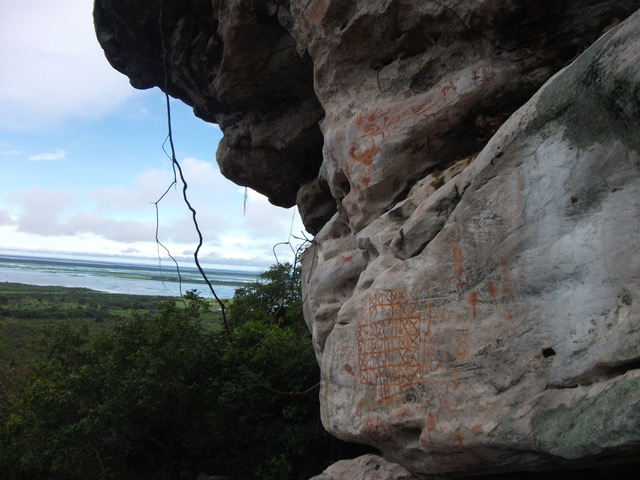
Painel do Pilão – Photo credit: Dr. Christopher S. Davis
For over a decade, there has been a vigorous (and sometimes vicious) debate over theories about the cause of the Younger Dryas climate reversal event roughly 13,000 years ago. Despite attempted control over the public narratives of that debate, research in archaeology, geology, and other paleoclimate studies emerged in support and in refutation of the two main theories on its cause: that the climate reversal was the result of natural and generally gradual warming that created an ice dam of freshwater that eventually burst, or that the climate reversal was the result of a celestial impact that suddenly, rapidly melted continental glaciers (or breaking the ice dam), causing pulses of meltwater flash floods as well as widespread wildfires (biomass burning) and immense particulate air obscurity (atmospheric dust). Most scholars for either theory agree with the general mechanisms that took place—the disruption of the Atlantic meridional overturning circulation (AMOC), as massive freshwater from continental glaciers dumped into the dense and salty ocean, shutting down ocean circulation for a span of time, which shut off the conveyor belt of global temperatures in the water, the air, and particularly the northern landmasses. Deducing that the Younger Dryas was a sudden plunge of cold climate returning on a global scale in a very short time span is not really contested; the hot debate has centered on the trigger that started it.
In this debate, what is often overlooked by the general public is that there was an Oldest and an Older (or Middle) Dryas before the Younger one. The Oldest Dryas is relegated to approximately 18,500 to 14,690 years BP (BP means before present, as agreed to be A.D. 1950, so ~16,550 to ~12,740 B.C. or B.C.E.) based on oxygen-16 (16O) to oxygen-18 (18O) isotope ratios, and pollen and varve data (Renssen and Isarin 2001). Both isotopes occur naturally, but 18O is far less common and ever so slightly heavier, so it less often reaches the polar regions where it can get locked up in glacial ice. A warmer Earth lifts the isotope further into the polar region, where more 18O gets stored than it does during a cooler Earth. The planet’s history of ice ages had been recorded by the relatively low 18O ratios stored in the depths of glacial ice. For the Oldest Dryas, this ~4,000-year period was one of the last vestiges of the “ice age” in general. Or rather, the most recent ice age—there were about 20 ice ages in the ~2-million-year period of the Pleistocene.
The name Dryas comes from the pollen of the Dryas octapetala flower, which grew through parts of Europe when the climate became too cold to support the forests that crowded the land when the Earth was warmer. The Older (Middle) Dryas is the least well-known period and is often ignored from the paleoclimate debate. The Older Dryas from 14,000 to 13,700 years BP (spanning 300 years) is similarly identified from oxygen-isotope ice core ratios and varve pollen data—sandwiched between two warmer periods that signify the beginning of the end of the last ice age: the Bølling interstadial ~14,690 to ~14,000 years BP, and the Allerød interstadial from ~13,700 to ~12,900 BP (Bennike and Mortensen 2018). Often lumped together as the Bølling-Allerød warming period for the entire ~1,700 years, the world was emerging from its glaciated condition.
The Younger Dryas from ~12,900 to ~11,600 years BP is the most well-known period of the terminal Pleistocene. It spans ~1,300 years but is most remarkable due to its sudden and dramatic return to glacier conditions in a very short amount of time. Oxygen isotope data from DYE-3, Camp Century, and GRIP Greenland ice cores indicate an average annual temperature drop of ~10°C in the span of a few decades—or even as little as 3 years (Cheng, et al. 2020; Rasmussen, et al. 2006; Reinig, et al. 2021). It appears to be indisputable that the temperature drop happened within a single lifespan. In other words, people living at the time would have noticed the climate change firsthand, not from accounts of what their elders told them about past conditions, but instead what they witnessed.
Beyond the Greenland ice cores, North Atlantic deep-sea sediment cores containing foraminifera data indicate ~5°C cooling in a span of ~50 to 100 years, and Dryas octapetala pollen in lake varve sediments in Northern Europe and cave speleothems as far away as the Philippines (Partin, et al. 2015) offer supporting data that indicate the climate cooling was global and the rate in which the average annual temperatures fell were in the range of decades, not centuries. However, the cold plunge was not as intense everywhere: between 2°-6°C in Europe, and ~3°C in North America, with some global air temperature estimates averaged to about 7°C (Boulton, et al. 2004).
Enter Monte Alegre. This ancient rock art site is along the lower Amazon River of Brazil, in South America, far from either ocean. Due to archaeological excavations (to bedrock) at the Painel do Pilão open-air rock shelter (Davis 2025), and previous excavations in the cave of Pedra Pintada (Roosevelt, et al. 1996), radiocarbon-dated charcoal (most recently calibrated with the INT CAL 20 curve) indicates that the earliest clear human habitation began ~13,700 years BP at the cave, ~13,200 years BP at the rockshelter, and the radiocarbon date range for activity continues at the rockshelter until 12,755 years BP while the date range in the cave continues until 11,887 years BP. Thereafter, both locations lack radiocarbon evidence for the next several (~6) thousand years.
In Before Sunset: Ice-Age Amazonian Rock Art and Archaeoastronomy at the Younger Dryas, Dr. Christopher S. Davis provides fuller details and new data from the site he presented to Graham Hancock in season 2 of the Netflix series, Ancient Apocalypse. The Paleoindian Monte Alegre hill settlement was apparently abandoned before the Archaic period, but when it was abandoned is most intriguing. The book presents that the date range at Painel do Pilão ends shortly after the Younger Dryas begins, while the date range at Pedra Pintada ends shortly before the Younger Dryas ends. Without getting into the weeds of radiocarbon dating, the average ± accuracy of the cave dates is ~260 years, while the average ± accuracy of the rock shelter dates is ~66 years. The rock shelter dates are more precise, largely due to more advanced dating techniques in the years separating the excavations. Both dates, however, straddle the Younger Dryas period. Although no specific paleoclimate research has been conducted for this tropical location, palm seeds and other flora collected during archaeological excavations suggest the region was still tropical (Roosevelt, et al. 2002). However, broader South America paleoclimate records suggest river levels and precipitation patterns may have been several meters lower than present levels (Betancourt 2000; Fairbanks 1989), with ~5°C lower temperatures during the last Glacial maximum (Stute, et al. 1995). Data for the shift to more humid, tropical conditions akin to today began ~17,000 years BP, with signs of a brief return of increased aridity during the Younger Dryas (Jacob, et al. 2007).
Did Paleoindian rock artists at Serra da Lua paint a comet crashing down upon the earth? Newly presented analysis in this book points to two ancient pictographs, one of a peculiar comet that may have been visible during a solar eclipse, possibly 11,027 B.C. (12,977 BP—near the beginning of the Younger Dryas), and the other depicts a very large earth-diving figure in the shape of a comet, painted as big as the sun painting next to it. Its position along a pictographic-almanac trail between the winter solstice and equinox coincides with the cyclic period today associated with the Taurid meteor showers—the prime suspect of the Younger Dryas Comet Impact hypothesis.
The rock art at the Painel do Pilão open-air rock shelter, and rock art from two other rock art sites nearby (Serra da Lua and Serra do Sol) convey themes largely focused on sky observations tracking the position of the sun throughout the year (Davis, et al. 2017). This book presents a detailed examination of that rock art, particularly the art at Painel do Pilão (in chapter 9 of this book), where a possible “hitching post” of the sun was tallied on a pictographic red-and-yellow-ochre grid, suggesting that the Paleoindian inhabitants took on a major interest in cataloguing the sun’s motion around the time the Younger Dryas begins. Was their interest merely spurred by a noticeable change in temperature, or did they witness something more provoking? The rock art at Serra da Lua (which is also examined in greater detail in chapter 6 of this book) possibly holds the answer—an astonishing answer.
References Cited
Bennike, O. and M. F. Mortensen
Betancourt, J. L.
Davis, C. S.
Davis, C. S., A. C. Roosevelt, W. Barnett and J. P. Brown
Fairbanks, R. G.
Jacob, J., Y. Huang, J.-R. Disnar, A. Sifeddine, M. Boussafir, A. L. S. Albuquerque and B. Turcq
Partin, J., T. Quinn, C.-C. Shen, Y. Okumura, M. Cardenas, F. Siringan, J. Banner, K. Lin, H.-M. Hu and F. Taylor
Renssen, H. and R. F. B. Isarin
Roosevelt, A. C., J. Douglas and L. Brown
Roosevelt, A. C., M. Lima da Costa, C. L. Machado, M. Michab, N. Mercier, H. Valladas, J. Feathers, W. Barnett, M. Imazio, A. Henderson, J. Silva, B. Chernoff, D. S. Reese, J. A. Holman, N. Toth and K. Schick
Stute, M., M. Forster, H. Frischkorn, A. Serejo, J. F. Clark, P. Schlosser, W. S. Broecker and G. Bonani
Wonderful work
paul Devereux?? O think you would enjoy.
A gary david In His book orion zone suggests the hopi kivas align like chakra points, could the other kivas follow the same patern ?wich I belive would In turn represent planets.
You mentioned the grid to map the sun’s movement. Did it change course or did earth the viewing point change ?