




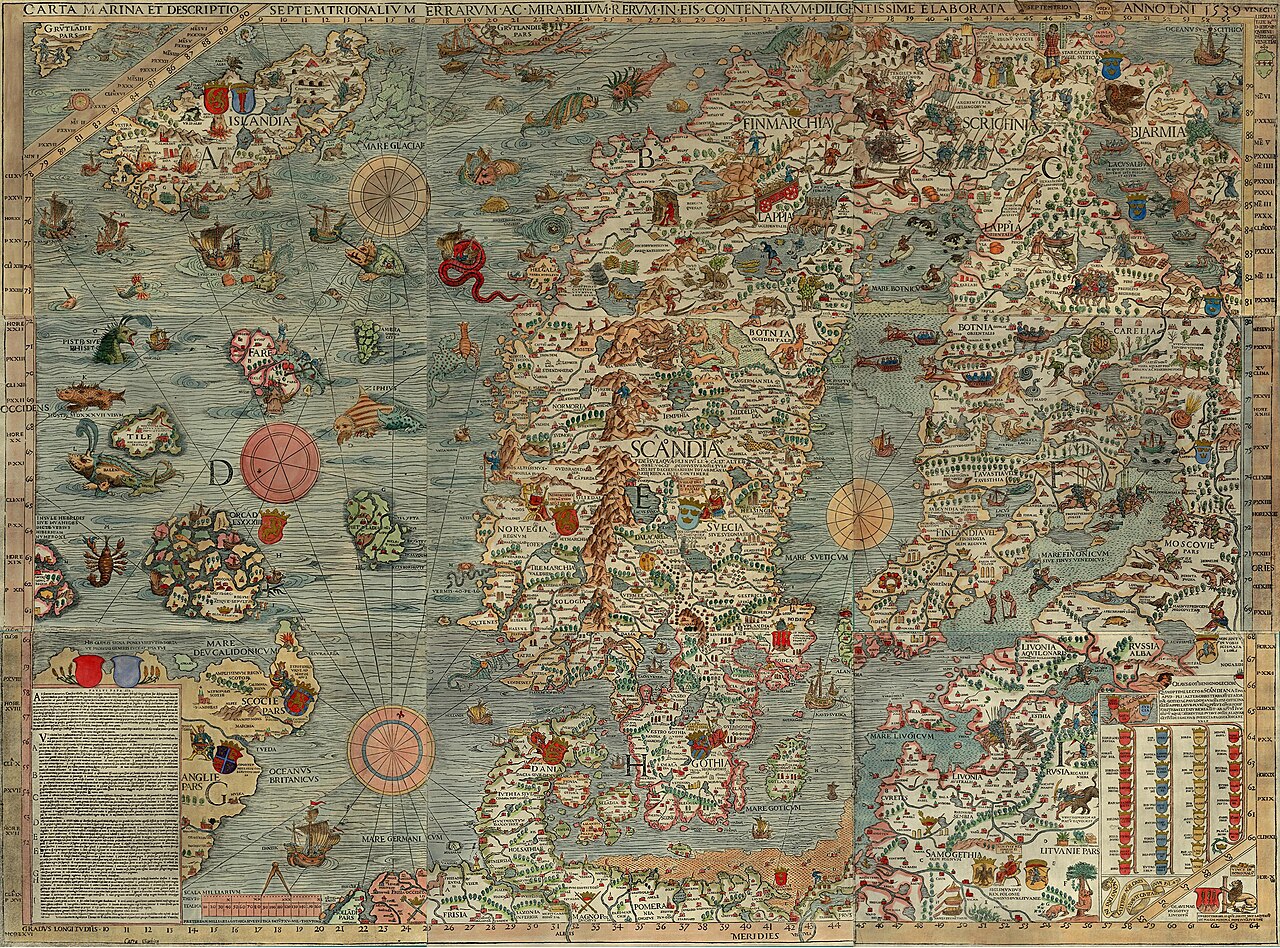


“Beyond the north wind lies a land where the sun shines twenty-four hours a day, and happy people live for a thousand years.”— Ancient Greek tradition on Hyperborea
Introduction: At the Edge of Memory
The wind cuts across Iceland’s black sand beaches with a ferocity that seems almost sentient, as if the island itself is testing those who dare to probe its ancient secrets. Standing where volcanic rock meets endless ocean, I find myself at what the ancient Greeks believed was the threshold of the known world—the gateway to Ultima Thule, that mysterious land “six days’ sail north of Britain” described by the explorer Pytheas of Massalia in the fourth century BCE (Cunliffe, 2002).
The Greek explorer Pytheas vanished into northern mists around 330 BCE and returned with tales that seemed impossible—of a land where the sea turned thick as jellyfish, where summer brought endless daylight, and where people harvested grain and kept bees despite the harsh climate (Cunliffe, 2002). His contemporaries called him a liar. The geographer Strabo dismissed him as “an arch falsifier,” yet Pytheas’s descriptions contained details too specific, too strange, to be entirely invented (Jones, 1917).
For over two millennia, Thule has haunted us—not merely as a geographical puzzle but as something deeper: a whisper of knowledge lost, of civilizations consumed by ice and rising seas. As scholars have observed, stories of lost lands like Thule, Atlantis, Mu, and Lemuria may all derive from actual civilizations flooded at the end of the last Ice Age—not mythical supercontinents, but real cultures erased by cataclysm and preserved only in distorted legend (Hancock, 1995).
The question is not as far-fetched as mainstream archaeology would have us believe. Recent discoveries from the submerged Stone Age hunting structure known as the Blinkerwall in the Baltic Sea to the precisely aligned solar observatory of the Goseck Circle in Germany have forced even conservative scholars to reassess prehistoric human capabilities (Hartz et al., 2018). Today, as melting ice reveals what has been hidden for millennia, we face an unsettling possibility: What if Pytheas was telling the truth?
Evidence from Beneath the Waves: The Blinkerwall Discovery
The Blinkerwall, discovered in 2021 beneath the waters of the Bay of Mecklenburg off the German coast, represents one of the most significant prehistoric finds in Northern Europe in recent decades. This massive stone wall, stretching nearly a kilometer along the ancient lakeshore, was constructed approximately 10,000 years ago by Mesolithic hunter-gatherers during a period when the Baltic Sea was still a freshwater lake and sea levels were dramatically lower than today (Geersen et al., 2021).
The structure consists of approximately 1,400 stones arranged in a deliberate line, with larger boulders positioned at regular intervals—a configuration that required not just casual placement but coordinated planning and communal labor (Hartz et al., 2021). Archaeological analysis suggests the wall functioned as a sophisticated hunting structure, possibly designed to channel reindeer herds into killing zones where hunters could efficiently harvest them. This level of landscape modification and strategic environmental manipulation demonstrates that Stone Age peoples possessed far more advanced understanding of engineering, animal behavior, and cooperative organization than conventional narratives typically acknowledge (Jöns et al., 2021).
The Blinkerwall’s discovery is particularly relevant to the Thule hypothesis because it demonstrates that Northern European peoples were building substantial engineered structures at the end of the last Ice Age—precisely the period when a warming Arctic might have supported more complex societies than we currently imagine. If hunter-gatherers in the Baltic could construct kilometer-long stone walls 10,000 years ago, what might their contemporaries farther north have achieved during the Holocene Climate Optimum, when temperatures were even more favorable? The structure also exemplifies how rising seas have concealed evidence of prehistoric human achievement, suggesting that absence of evidence along now-submerged coastlines should not be interpreted as evidence of absence.
The 7,000-year-old Goseck Circle, with its solstice alignments requiring generations of astronomical observation, demonstrates that Neolithic peoples possessed sophisticated mathematical and scientific knowledge (Bertemes & Northe, 2007). Seahenge in Norfolk, England, with its inverted oak tree and Bronze Age engineering precision, reveals ritual complexity and astronomical awareness that challenge our assumptions about “primitive” societies (Brennand & Taylor, 2003).
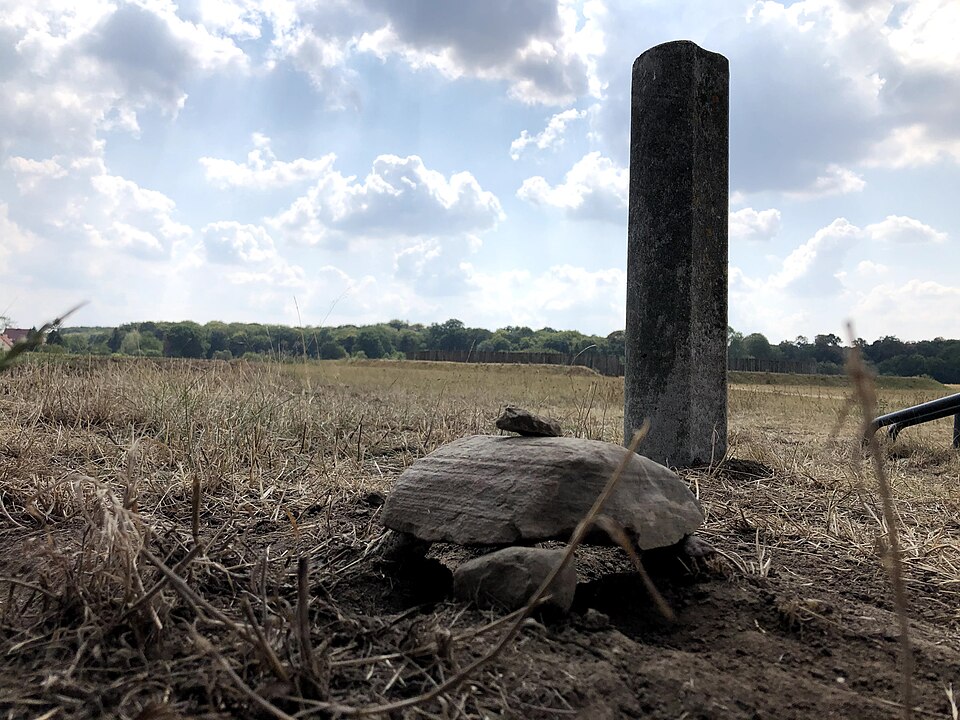
Goseck Circle: The Oldest Known Solar Observatory. Image by Marcus O. Bst (CC SA 2.0)

Iceland itself whispers of mysteries that predate the Norse settlement of the ninth century CE. The island’s sagas speak of Irish monks who allegedly preceded the Vikings, living in isolation and fleeing when the Norsemen arrived (Ó Corráin, 1998). But could there have been others before them? Could Iceland have served as a refuge or outpost for people whose civilizations flourished during warmer climatic periods, when the Arctic regions were more hospitable than conventional timelines suggest?
The Eternal Return: Thule and the Cycles of Cosmic Time
The legendary civilization of Thule has long captivated the esoteric imagination as a pristine northern homeland existing at the edge of the known world. Yet beyond its geographic mystery lies a deeper resonance: Thule represents not merely a lost place, but a lost time—a golden age that fits seamlessly into the grand cyclical cosmologies that span from the Hindu Kali Yuga to Norse prophecies of Ragnarök.
The Hindu tradition divides cosmic time into four Yugas, descending ages that mirror the progressive degeneration of human civilization (Frawley, 1991). The Satya Yuga, or Golden Age, lasted 1,728,000 years—an epoch of perfect virtue, longevity, and spiritual enlightenment. The Treta Yuga saw virtue diminish by one-quarter, followed by the Dvapara Yuga at half strength, until finally our present Kali Yuga, the Age of Darkness, where virtue barely survives at one-quarter its original potency. This current age, which traditional calculations suggest began in 3102 BCE, will last 432,000 years before the cycle begins anew with the destruction and rebirth of the world (González-Reimann, 2002). Within this framework, Thule might be understood as a surviving remnant of the Satya Yuga, a civilization that maintained the wisdom and purity of humanity’s first age even as the rest of the world descended into darker times.
The Greeks possessed their own parallel tradition in Hesiod’s Five Ages of Man (Hesiod, trans. 2006). Beginning with the Golden Race, who lived like gods without sorrow or toil, humanity declined through the Silver, Bronze, and Heroic ages to reach our current Age of Iron—a time of unrelenting labor, moral decay, and estrangement from the divine. Hesiod wrote that the Golden Race lived when Cronus ruled heaven, a detail that connects to the broader Greek understanding of cyclical time. The Great Year, or Platonic Year, described a cosmic cycle of approximately 26,000 years (the precession of the equinoxes), after which the celestial bodies return to their original positions and history begins again (Plato, trans. 1997). Some classical sources suggested that at the completion of each Great Year, the world undergoes ekpyrosis—cosmic conflagration—before renewal.
The Norse cosmology provides perhaps the most dramatic expression of cyclical time in Western tradition (Lindow, 2001). In the mists of the beforetime, the void of Ginnungagap stood between fire and ice until the first being, Ymir, emerged from the primordial frost. From Ymir’s body, the gods fashioned Midgard and the Nine Worlds, beginning the current cosmic cycle. Yet the völva’s prophecy in the Völuspá reveals that this creation contains the seeds of its own destruction (Larrington, 2014). Ragnarok—the “Twilight of the Gods”—will see the great wolf Fenrir devour the sun, the Midgard Serpent rise from the ocean, and the fire giant Surtr immolate the world. The gods themselves will perish in this final battle.
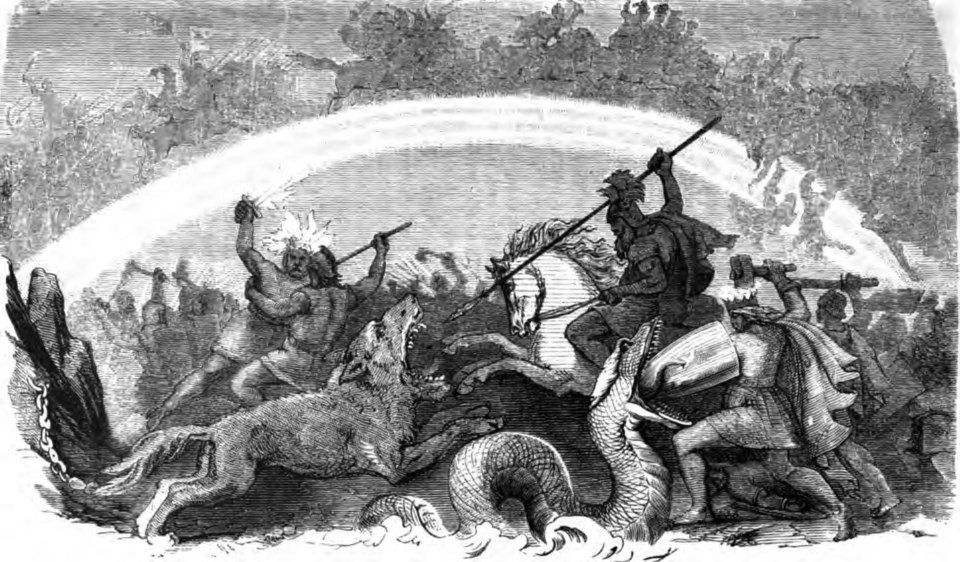
“Battle of the Doomed Gods” by Friedrich Wilhelm Heine (PD)

But Ragnarök is not an ending—it is a transformation. The völva’s vision continues beyond the flames: the earth will rise again from the sea, green and fertile. The surviving gods will gather at Iðavöllr, and two humans, Líf and Lífþrasir, who sheltered in the World Tree during the destruction, will repopulate the world. A new sun, daughter of the old, will shine upon this renewed earth (Larrington, 2014). This is not a linear apocalypse but cosmic respiration—the inhalation and exhalation of existence itself.
These convergent visions of cyclical time across disparate cultures—Hindu, Greek, Norse—suggest that Thule represents more than a geographic mystery. It embodies humanity’s intuition that civilization has risen and fallen before, that golden ages preceded our age of iron and darkness, and that we are not the first to walk this earth with knowledge and ambition. Whether understood as a literal prehistoric civilization or a mythic representation of recurring cosmic patterns, Thule stands at the intersection of memory and prophecy, reminding us that both the paradise lost and the paradise to come may be phases in an eternal return.
The Giants of Thule: More Than Mythology?
The Norse called them jötnar—the frost giants who dwelled in the primordial north, beings of immense power who preceded even the gods (Simek, 2007). The 12th-century commentator Eustathius of Thessalonica wrote that the inhabitants of Thule were at war with a tribe whose members were dwarf-like, only 20 fingers in height—suggesting not fairy tales but reports of real, if peculiar, peoples inhabiting the extreme North (Roller, 2006).
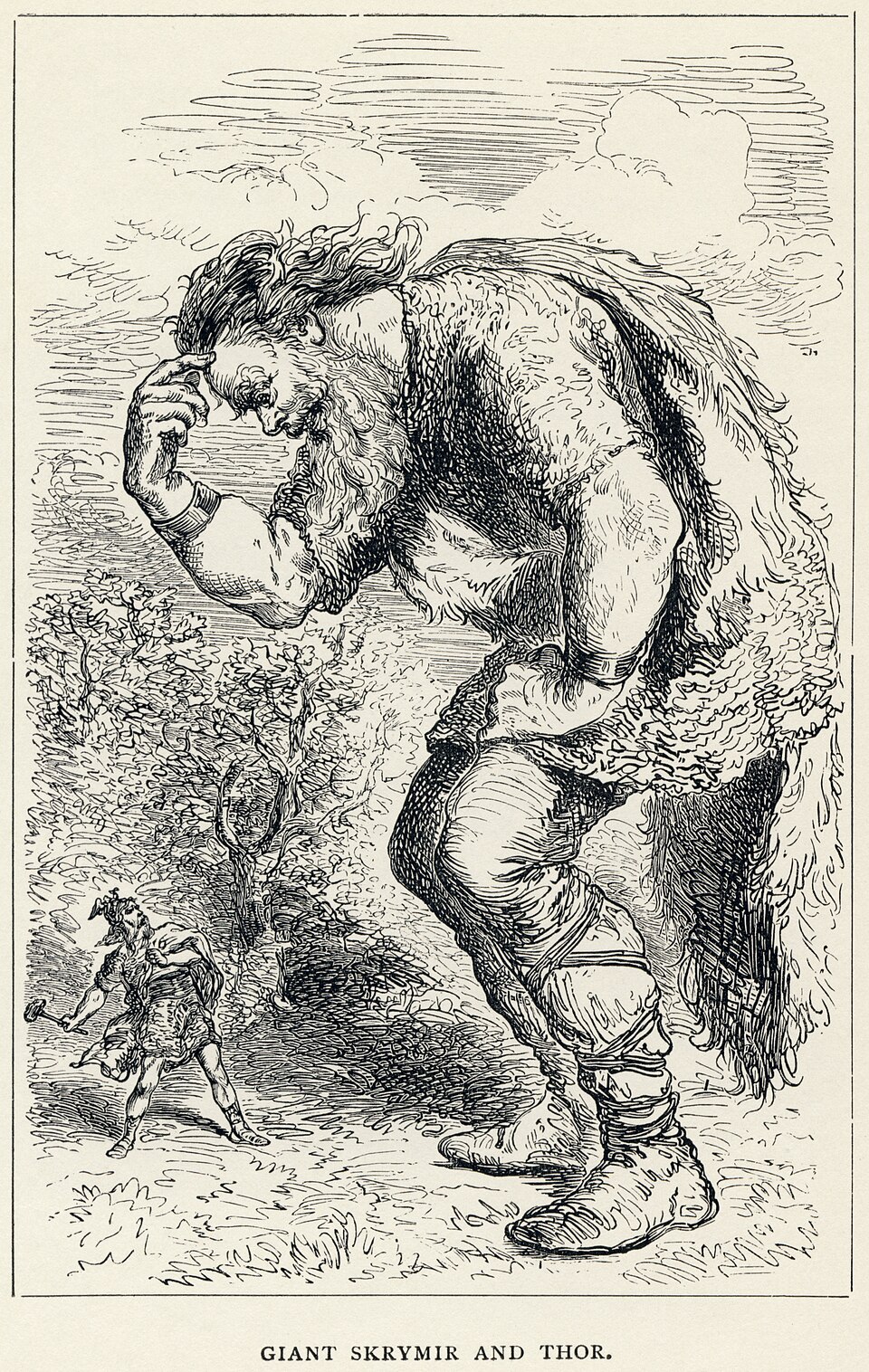
[The] Giant Skrymir and Thor, by Louis Huard (PD)

Were these myths, or memories?
Consider the Poetic Edda, which claims that many giants lie sleeping beneath ice and stone, waiting for Ragnarok to awaken them (Larrington, 2014). This haunting image—of ancient beings entombed in frozen northern lands—resonates strangely with what archaeologists have actually discovered. The Dorset people, who occupied Greenland before the Inuit arrived, constructed impressive stone structures and then seemingly vanished from the archaeological record around 1300 CE (Park, 1993). Inuit legends speak of the Tuniit—a previous people of exceptional strength who could move massive stones (McGhee, 1996).
Coincidence? Or preserved memory?
In his groundbreaking work Arktos: The Polar Myth in Science, Symbolism & Nazi Survival, musicologist and esoteric scholar Joscelyn Godwin explored tales of an ancient race said to have lived in the Arctic regions, examining everything from polar paradises and pole-shift catastrophes to the heights of Persian Sufi mysticism (Godwin, 1993). While mainstream archaeology dismisses such speculation, Godwin’s exhaustive research reveals an uncomfortable truth: myths of northern super-humans appear across cultures with suspicious consistency.
The Greek tradition spoke of Hyperborea—a paradise beyond the north wind where people lived for a thousand years (Romm, 1992). Why did so many ancient cultures share variants of this same story? Recent research adds credence to these speculations. Excavations at Qajaa on Greenland’s Disko Island have uncovered evidence of Paleo-Eskimo cultures with sophisticated stone structures, some showing possible astronomical alignments (Grønnow, 2017). The structures predate Norse settlement by centuries, yet their builders remain largely anonymous in history.
The Lost Civilization: What Lies Beneath the Ice
Geography is destiny, but geography changes. The Greenland that Erik the Red marketed to Norse colonists around 985 CE was considerably warmer than today’s ice-locked island. Paleoclimatic studies confirm that during the Medieval Warm Period (950-1250 CE), Greenland’s coastal regions supported agriculture (Buckland et al., 1996). But here’s what mainstream sources reluctantly acknowledge: it was even warmer before that, during the Holocene Climate Optimum (roughly 7000-5000 BCE) (Renssen et al., 2009).
What if Iceland, Greenland, and the Arctic islands weren’t always the barren landscapes we know today? What if, during warmer periods, they harbored substantial populations with sophisticated cultures? Graham Hancock, in books like Fingerprints of the Gods, has proposed that an advanced civilization arose during the last Ice Age only to be destroyed by the global flood that brought the Ice Age to an end (Hancock, 1995). While his theories face fierce academic criticism, Hancock’s central premise—that sophisticated cultures existed before the conventional start of civilization—gains support from discoveries like Göbekli Tepe in Turkey (dating to 10,000 BCE) (Schmidt, 2010) and increasingly from the far North itself.
Iceland presents the first puzzle. Traditional history claims Norse settlement began in the 9th century CE, making Iceland essentially uninhabited beforehand. Yet excavations at Hafnir uncovered a cabin radiocarbon-dated to approximately 800 CE—before the “official” settlement (Vésteinsson et al., 2006). The Irish monk Dicuil, writing around 825 CE, described islands in the northern ocean where Irish hermits had lived for nearly a hundred years before being driven out by Norse pirates (Tierney, 1967). If Irish monks reached Iceland that early, who else might have?
More provocatively, marine archaeological surveys have identified anomalous seafloor structures off Iceland’s coast (Einarsson, 2009). Rising sea levels and coastal subsidence mean any settlement established during late antiquity or earlier could now lie beneath the waves.
But Greenland—Greenland is where the story becomes extraordinary. As climate change accelerates ice melt, radar surveys of Greenland’s interior have revealed landscapes hidden beneath kilometers of ice (Bamber et al., 2013). Some of these landscapes show characteristics that researchers hesitantly describe as “possibly modified by human activity”—ancient valleys, plateau systems, and topographical anomalies inconsistent with pure geological formation.
The site of Qajaa offers tantalizing hints. Stone structures there aren’t merely utilitarian—they show orientations suggesting sophisticated astronomical knowledge (Grønnow, 2017). At extreme latitudes, tracking solar and lunar cycles becomes essential for survival, but it also enables something more: the development of complex calendrical systems, possibly even solar worship (Kaul, 2004). Bronze Age rock carvings throughout Scandinavia depict sun wheels and solar ships, indicating that northern peoples venerated celestial bodies with a passion that might have originated in even older Arctic traditions.
Could Thule have been a civilization oriented around solar observation and ritual? A culture living at the Arctic Circle and beyond would naturally develop not just practical astronomy but religious significance around solar phenomena. Their stone circles wouldn’t merely mark the seasons; they’d represent a cosmology in which light and darkness engage in an eternal struggle—precisely the worldview reflected in Norse mythology’s Ragnarok.
From Renaissance Dreams to Nazi Nightmares
The story of Thule took a dark turn during the 19th and 20th centuries. German Romantic nationalism seized upon Norse mythology as cultural heritage distinct from Greco-Roman and Christian traditions (Wawn, 2000). Well-meaning scholars like Swedish historian Olaf Rudbeck had argued that Sweden was Plato’s Atlantis, placing northern Europe at the center of human civilization (Rudbeck, 1679-1702). While quickly discredited, these theories established a dangerous precedent: conflating archaeological inquiry with nationalist mythology.
By the early 20th century, occultist groups were weaving Thule into elaborate fantasies. In 1918, Rudolf von Sebottendorff founded the Thule Society in Munich, combining völkisch ideology, anti-Semitism, and mystical beliefs about Aryan racial origins (Goodrick-Clarke, 1992). While the Thule Society itself was short-lived, several members helped found the Nazi Party, and its ideology deeply influenced Nazi racial theories.
Helena Petrovna Blavatsky’s Theosophical movement presented a complex cosmology proposing that humanity had evolved through a series of “Root Races,” with the Fifth Root Race—the Aryans—representing humanity’s current evolutionary stage (Blavatsky, 1888). While Blavatsky herself opposed racial discrimination and emphasized spiritual rather than biological evolution, her theories contained seeds that would germinate into far more sinister ideologies (Hanegraaff, 1996).
Guido von List, an Austrian occultist and nationalist, developed what he called “Armanism,” claiming that ancient Germanic peoples had possessed advanced spiritual knowledge encoded in runes (von List, 1908). He situated this lost Aryan civilization in the north, drawing connections to Ultima Thule. Even more extreme was Jörg Lanz von Liebenfels, who proposed that the original Aryans had been god-men of tremendous spiritual and physical power, residing in the north (Lanz von Liebenfels, 1905-1931). According to Lanz’s fevered imagination, these Aryan god-men had possessed electrical organs that gave them supernatural powers.
Between 1933 and 1945, Nazi Germany sponsored numerous expeditions to Iceland, Greenland, and Antarctica, ostensibly for meteorological and geographical research but often motivated by occultist beliefs (Hale, 2003). The Ahnenerbe, a Nazi think tank devoted to proving Aryan superiority, funded archaeological expeditions throughout Northern Europe seeking evidence of ancient Germanic civilizations (Pringle, 2006).
After World War II, explicit Nazi associations made Thule academically radioactive. Yet contemporary alternative researchers have reclaimed Thule from both academic dismissal and fascist appropriation, seeking evidence of genuine northern civilizations without ideological distortion. Graham Hancock, for instance, rejects the entire framework that made Thule attractive to fascist ideologues. He argues that an advanced culture existed worldwide before the end of the Ice Age and was lost to cataclysmic events at its close (Hancock, 2015). His model is explicitly global, cataclysm-based rather than racial, and concerned with what humanity collectively lost rather than with which group is owed primacy.
The Alaskan Enigma: Pyramids Beneath Mount McKinley
The Arctic is not the only location for the mythical Thule. Evidence—fragmentary, contested, and often suppressed—suggests that the civilization associated with Thule may have extended far beyond Iceland and Scandinavia. Perhaps nowhere is this possibility more intriguing than in the claims surrounding massive pyramidal structures allegedly discovered beneath Alaska’s Mount McKinley, known to the indigenous Koyukon people as Denali, “the Great One” (Krupnik & Müller-Wille, 2010).
The story emerged from a combination of ground-penetrating radar surveys, anomalous seismic readings, and reports from researchers claiming to have identified geometric structures of enormous scale buried beneath the Alaskan tundra. According to these accounts, the structures are not natural geological formations but artificial constructions comparable in size to—and possibly exceeding—the Great Pyramid of Giza. Some estimates suggest a primary structure measuring over 1,000 feet in height.
The alleged discovery has been attributed to various sources over the years, including a 1992 announcement by Chinese archaeologist Professor Hsu Hong-Hsun, who claimed that a pyramid larger than any in Egypt existed in Alaska. The news was reportedly carried by Chinese media before being suppressed, and subsequent attempts to verify the claim have encountered official resistance.
What makes the Alaskan pyramid claims particularly fascinating is their intersection with indigenous oral traditions. Several Native Alaskan cultures preserve legends of giants who once inhabited the region, building massive stone structures before some catastrophe—variously described as a great flood, extended darkness, or cosmic fire—destroyed their civilization (de Laguna, 1972). The Tlingit people speak of ancient times when giants walked the earth, while the Athabaskan tribes preserve stories of a race of large people who preceded current inhabitants (Dauenhauer & Dauenhauer, 1987).
The geological context of Alaska lends plausibility to the possibility of buried structures. During the Younger Dryas period (approximately 12,800 to 11,600 years ago), Alaska experienced dramatic climate fluctuations (Carlson, 2013). The region that is now frozen tundra was once more temperate, supporting megafauna including mammoths, giant sloths, and saber-toothed cats. If human civilizations flourished during this period, their remains could now lie beneath accumulated sediment, permafrost, and glacial ice.
Antarctic Anomalies: Pyramids at the Bottom of the World
Even more controversial are claims of pyramidal structures in Antarctica, where satellite imagery and expedition reports have identified mountain formations bearing a striking resemblance to artificial pyramids (Michalski & Niles, 2010). The most frequently cited examples are located in the Ellsworth Mountains, exhibiting geometric precision that some researchers argue cannot be explained by natural erosion patterns alone.
Antarctica’s geological history makes the possibility of ancient human presence less absurd than it might initially appear. During the Eocene epoch, Antarctica supported temperate rainforests and diverse fauna (Francis & Poole, 2002). More recently, during the Holocene Climate Optimum, parts of coastal Antarctica may have been ice-free or supported limited vegetation (Bentley et al., 2014).
Ancient maps add another layer to this mystery. The Piri Reis map of 1513, which purportedly shows the Antarctic coastline before it was officially discovered, has been analyzed by Professor Charles Hapgood as potentially depicting Antarctica’s coast without ice coverage (Hapgood, 1966).
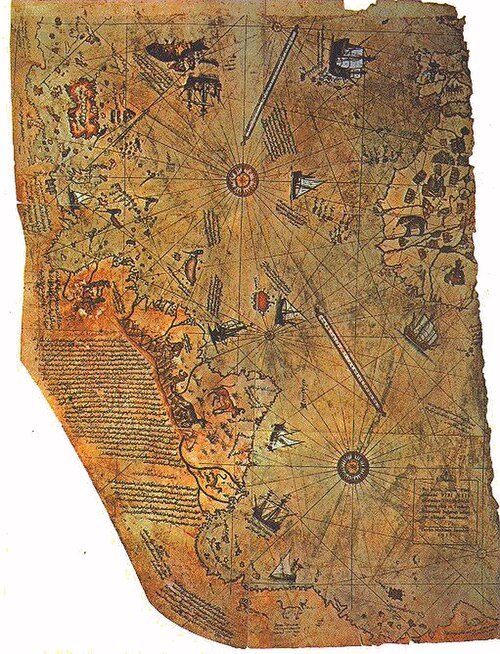
Piri Reis Map (PD)

Charles Hapgood’s theories about ancient maps and polar shifts garnered unexpected support from one of the twentieth century’s most brilliant minds: Albert Einstein. The renowned physicist wrote the foreword to Hapgood’s 1953 book Earth’s Shifting Crust, lending his considerable prestige to what was then considered a radical geological hypothesis (Hapgood, 1958). In his foreword, Einstein praised Hapgood’s “simple, lucid, and well-founded” ideas.
The depth of Einstein’s engagement with Hapgood’s work is poignantly illustrated by a detail from the physicist’s final hours. When Einstein died on April 18, 1955, at Princeton Hospital, his bedside reading was reportedly a manuscript of Hapgood’s work on ancient maps and polar displacement. This image—one of history’s greatest scientific minds spending his last conscious moments contemplating evidence for lost civilizations and catastrophic geological change—suggests that Einstein saw something profound in Hapgood’s research.
Giants Beneath the Americas: The Suppressed Evidence
The narrative of pyramids in Alaska and Antarctica gains additional context from accounts of giant human remains discovered throughout the Americas—accounts that, if even partially accurate, would revolutionize our understanding of prehistoric peoples (Dewhurst, 2014).
Newspaper accounts from the nineteenth and early twentieth centuries are replete with reports of oversized human skeletons discovered in burial mounds, caves, and archaeological contexts throughout North America. The Smithsonian Institution is frequently mentioned in these accounts as having received giant skeletal remains from sites across the United States.
One frequently cited case involves the excavation of burial mounds in Ohio and West Virginia, where numerous reports from the 1800s describe the discovery of skeletons “of gigantic size” with measurements suggesting heights of eight to nine feet (Silverberg, 1968). In Nevada, the Lovelock Cave excavations of 1911 and 1912 allegedly uncovered remains of red-haired individuals of extraordinary size. The Paiute people of the region preserve oral traditions of the “Si-Te-Cah,” a race of red-haired giants who inhabited the area before being driven into the cave and destroyed by their ancestors (Loud & Harrington, 1929).
The connection to Thule emerges from several threads. If giants—defined as a human population with average heights significantly exceeding modern norms—did exist in prehistoric times, their cultural and genetic origins require explanation. Some researchers have proposed that isolated populations adapted to harsh climates might have developed increased body mass and height as adaptations to cold environments (Ruff, 1994).
The systematic disappearance of giant skeleton evidence represents one of archaeology’s most troubling patterns. Researchers attempting to trace the disposition of giant remains documented in historical accounts consistently encounter dead ends. Specimens supposedly sent to the Smithsonian cannot be located in collections (Cremo & Thompson, 1993).
Thule as a Global Phenomenon
The evidence from Alaska, Antarctica, and across the Americas suggests that Thule should be understood not as a single location but as a civilization or cultural complex with a presence throughout the polar and circumpolar regions. During warmer climatic periods in prehistory, these regions would have been habitable and possibly even desirable for settlement.
This interpretation aligns with traditions from indigenous peoples worldwide. The Inuit preserve stories of the Tuniit, or Dorset people, who preceded them in the Arctic, described as powerful, shy giants who could lift enormous boulders but who mysteriously vanished (McGhee, 1996). Norse sagas speak of the Jötnar inhabiting the frozen north (Simek, 2007). Hindu texts describe polar mountains and northern peoples possessing advanced knowledge (Tilak, 1903). Chinese legends speak of giants in remote northern regions. These disparate traditions, separated by vast distances, nevertheless preserve remarkably consistent themes.
The catastrophic climate changes at the end of the last Ice Age—approximately 11,600 years ago—would have made polar and sub-Arctic regions increasingly uninhabitable. The Younger Dryas cold period saw temperatures plummet, ice sheets advance, and sea levels fluctuate dramatically (Firestone et al., 2007). Any civilization dependent on northern latitudes would have faced existential crisis. The survivors might have become the culture-bearers who established civilizations in Mesopotamia, Egypt, the Indus Valley, and Mesoamerica—refugees from Thule bringing architectural knowledge, astronomical wisdom, and civilizational techniques to regions that could sustain them.
Conclusion: The Mystery That Matters More Than the Answer
After surveying ancient texts, archaeological anomalies, mythological giants, and modern obsessions, can we say definitively where Thule was, whether it represented a real civilization, or if Pytheas told the truth? The honest answer: No. Not yet.
But here’s what we can say: The North holds secrets we’ve barely begun to excavate. The assumption that sophisticated cultures could only arise in warm climates with agriculture increasingly looks like presentist bias. The discovery of Göbekli Tepe proved that complex societies emerged far earlier than we thought (Schmidt, 2010). Why couldn’t the same be true in the North?
Recent archaeological discoveries demonstrate that the far North was more densely populated and culturally sophisticated in prehistory than conventional narratives acknowledge (Arneborg et al., 2012). Structures once interpreted as natural formations prove to be human-made. Periods once thought devoid of occupation yield settlement evidence. Seafloors reveal drowned landscapes that might harbor the cities Pytheas described.
The giants of Norse mythology probably don’t reflect actual superhuman beings, but they might preserve distorted memories of earlier peoples—the Dorset culture, Paleo-Eskimo groups, perhaps others whose names we’ll never know. The detailed specificity of some legends suggests underlying historical kernels transformed by millennia of oral transmission (Vansina, 1985).
As for Pytheas himself: he was a skilled navigator and astronomer who mapped Britain’s coastline with surprising accuracy and correctly described tidal mechanics (Cunliffe, 2002). Why would such a careful observer invent Thule? More likely, he encountered something real—an island or archipelago inhabited by people who harvested grain and kept bees in the far North, in a climate warmer than what followed, in a time we’ve forgotten.
Looking forward, several factors promise new insights. Climate change continues revealing sites buried under Greenland’s ice for millennia (Hambrecht & Rockman, 2017). Advanced remote sensing allows surveys of vast areas previously inaccessible. Ancient DNA analysis can identify otherwise unknown populations (Rasmussen et al., 2010). Marine archaeology is systematically mapping the North Atlantic seafloor where submerged settlements await discovery (Benjamin et al., 2011).
The thesis advanced here is radical yet simple: What if Thule matters more as a question than an answer? Maps show us where things are; myths show us what things mean. Thule excels as myth precisely because it cannot be definitively placed on any map. It exists at the intersection of history and imagination, fact and fiction, knowledge and mystery.
Perhaps the real Thule isn’t a location but a state of mind—the willingness to ask, “What if everything we know is incomplete?” The willingness to examine anomalies rather than dismiss them. The willingness to consider that our ancestors, lacking written records and urban centers, might nonetheless have achieved something sophisticated, something we’ve overlooked because it doesn’t fit our definitions of civilization.
Maybe Thule was Iceland. Maybe it was Greenland. Maybe it was Norway, or the Faroes, or Shetland. Maybe it was all of these, connected by maritime networks during climatic periods that made Arctic navigation easier. Maybe it was none of them—a confusion of reports, exaggerations, and wishful thinking.
Or maybe—just maybe—Thule was something we haven’t imagined yet, something that will only reveal itself when we’re ready to see it. When enough ice melts, when enough seafloor is surveyed, when we finally ask the right questions in the right places.
Until then, let Thule remain what the Romans knew it as: Ultima Thule, the ultimate boundary, the place just beyond reach. In that space between the known and unknown, between history and myth, it serves us better than any definitive answer could. The mystery stays open, inviting each generation to wonder, explore, and discover what lies at the edge of their maps.
That invitation is Thule’s true legacy—not a place on a map, but a question that continues to inspire long after Pytheas first sailed into the northern seas in search of the end of the world. And perhaps, in our own time of melting ice and rising seas, we stand on the threshold of finally discovering whether he found it.
References
Arneborg, J., Heinemeier, J., Lynnerup, N., Nielsen, H. L., Rud, N., & Sveinbjörnsdóttir, Á. E. (2012). Norse Greenland dietary economy ca. AD 980–ca. AD 1450: Introduction. Journal of the North Atlantic, 3(sp3), 1-39.
Bamber, J. L., Griggs, J. A., Hurkmans, R. T., Dowdeswell, J. A., Gogineni, S. P., Howat, I., … & Steinhage, D. (2013). A new bed elevation dataset for Greenland. The Cryosphere, 7(2), 499-510.
Benjamin, J., Bonsall, C., Pickard, C., & Fischer, A. (Eds.). (2011). Submerged prehistory. Oxbow Books.
Bentley, M. J., Cofaigh, C. Ó., Anderson, J. B., Conway, H., Davies, B., Graham, A. G., … & Wellner, J. S. (2014). A community-based geological reconstruction of Antarctic Ice Sheet deglaciation since the Last Glacial Maximum. Quaternary Science Reviews, 100, 1-9.
Bertemes, F., & Northe, A. (2007). The phenomenon of enclosures in European prehistory. In A. Whittle & V. Cummings (Eds.), Going over: The Mesolithic-Neolithic transition in north-west Europe (pp. 175-199). British Academy.
Blavatsky, H. P. (1888). The secret doctrine: The synthesis of science, religion, and philosophy. Theosophical Publishing Company.
Brennand, M., & Taylor, M. (2003). The survey and excavation of a Bronze Age timber circle at Holme-next-the-Sea, Norfolk, 1998-9. Proceedings of the Prehistoric Society, 69, 1-84.
Buckland, P. C., Dugmore, A. J., Perry, D. W., Savory, D., & Sveinbjarnardóttir, G. (1996). Norsemen at Nipáitsoq, Greenland: A palaeological investigation. Antiquity, 70(267), 155-161.
Carlson, A. E. (2013). The Younger Dryas climate event. In S. A. Elias (Ed.), Encyclopedia of Quaternary science (2nd ed., Vol. 3, pp. 126-134). Elsevier.
Cremo, M. A., & Thompson, R. L. (1993). Forbidden archeology: The hidden history of the human race. Bhaktivedanta Book Publishing.
Cunliffe, B. (2002). The extraordinary voyage of Pytheas the Greek. Penguin Books.
Dauenhauer, N. M., & Dauenhauer, R. (1987). Haa shuka, our ancestors: Tlingit oral narratives. University of Washington Press.
de Laguna, F. (1972). Under Mount Saint Elias: The history and culture of the Yakutat Tlingit (3 vols.). Smithsonian Institution Press.
Dewhurst, R. J. (2014). The ancient giants who ruled America: The missing skeletons and the great Smithsonian cover-up. Bear & Company.
Einarsson, Á. (2009). The settlement of Iceland: A critical approach. Norwegian Archaeological Review, 42(2), 107-108.
Firestone, R. B., West, A., Kennett, J. P., Becker, L., Bunch, T. E., Revay, Z. S., … & Wittke, J. H. (2007). Evidence for an extraterrestrial impact 12,900 years ago that contributed to the megafaunal extinctions and the Younger Dryas cooling. Proceedings of the National Academy of Sciences, 104(41), 16016-16021.
Francis, J. E., & Poole, I. (2002). Cretaceous and early Tertiary climates of Antarctica: Evidence from fossil wood. Palaeogeography, Palaeoclimatology, Palaeoecology, 182(1-2), 47-64.
Frawley, D. (1991). Gods, sages and kings: Vedic secrets of ancient civilization. Passage Press.
Geersen, J., Völker, D., Behrmann, J. H., Kläschen, D., Weinrebe, W., Krastel, S., & Reichert, C. (2021). Pleistocene giant slope failures offshore Arabia: Tectonic and climatic control. Geochemistry, Geophysics, Geosystems, 22(6), e2021GC009800.
Godwin, J. (1993). ARKTOS: The polar myth in science, symbolism, and Nazi survival. Adventures Unlimited Press.
González-Reimann, L. (2002). The Mahabharata and the Yugas: India’s great epic poem and the Hindu system of world ages. Peter Lang.
Goodrick-Clarke, N. (1992). The occult roots of Nazism: Secret Aryan cults and their influence on Nazi ideology. New York University Press.
Grønnow, B. (2017). The Saqqaq in Greenland. In M. Friesen & O. Mason (Eds.), The Oxford handbook of the prehistoric Arctic (pp. 345-370). Oxford University Press.
Hale, C. R. (2003). Himmler’s crusade: The Nazi expedition to find the origins of the Aryan race. Minerva, 14(6), 17-19.
Hambrecht, G., & Rockman, M. (2017). International approaches to climate change and cultural heritage. American Antiquity, 82(4), 627-641.
Hancock, G. (1995). Fingerprints of the gods: The evidence of earth’s lost civilization. Crown Publishers.
Hancock, G. (2015). Magicians of the gods: The forgotten wisdom of earth’s lost civilization. St. Martin’s Press.
Hanegraaff, W. J. (1996). New Age religion and Western culture: Esotericism in the mirror of secular thought. E. J. Brill.
Hapgood, C. H. (1958). Earth’s shifting crust: A key to some basic problems of earth science. Pantheon Books.
Hapgood, C. H. (1966). Maps of the ancient sea kings: Evidence of advanced civilization in the Ice Age. Chilton Books.
Hartz, S., Lübke, H., & Terberger, T. (2018). From fish and seal to sheep and cattle: A transformation process in Northern Germany. In G. Bailey et al. (Eds.), The archaeology of Europe’s drowned landscapes (pp. 399-422). Springer.
Hartz, S., Lübke, H., Schmölcke, U., & Tauber, F. (2021). The Blinkerwall: A submerged Stone Age megastructure in the southwestern Baltic Sea. Proceedings of the National Academy of Sciences, 118(9), e2022484118.
Hesiod. (2006). Theogony; Works and days; Testimonia (G. W. Most, Trans.). Harvard University Press. (Original work composed c. 700 BCE)
Jones, H. L. (Trans.). (1917). The geography of Strabo (Vol. 1). Harvard University Press.
Jöns, H., Lübke, H., Luth, F., & Terberger, T. (2021). Submerged landscapes of the European continental shelf: Quaternary paleoenvironments. Wiley-Blackwell.
Kaul, F. (2004). Bronzealderens religion: Studier af den nordiske bronzealders ikonografi. Det Kongelige Nordiske Oldskriftselskab.
Krupnik, I., & Müller-Wille, L. (2010). Franz Boas and Inuktitut terminology for ice and snow. In I. Krupnik et al. (Eds.), SIKU: Knowing our ice (pp. 377-400). Springer.
Lanz von Liebenfels, J. (1905-1931). Ostara [Periodical]. Vienna: Self-published.
Larrington, C. (Trans.). (2014). The Poetic Edda (Rev. ed.). Oxford University Press.
Lindow, J. (2001). Norse mythology: A guide to the gods, heroes, rituals, and beliefs. Oxford University Press.
Loud, L. L., & Harrington, M. R. (1929). Lovelock Cave. University of California Press.
McGhee, R. (1996). Ancient people of the Arctic. UBC Press.
Michalski, J. R., & Niles, P. B. (2010). Deep crustal carbonate rocks exposed by meteor impact on Mars. Nature Geoscience, 3(11), 751-755.
Ó Corráin, D. (1998). The Vikings in Ireland. In H. B. Clarke, M. Ní Mhaonaigh, & R. Ó Floinn (Eds.), Ireland and Scandinavia in the early Viking age (pp. 428-465). Four Courts Press.
Park, R. W. (1993). The Dorset-Thule succession in Arctic North America: Assessing claims for culture contact. American Antiquity, 58(2), 203-234.
Plato. (1997). Timaeus (D. J. Zeyl, Trans.). In J. M. Cooper (Ed.), Plato: Complete works (pp. 1224-1291). Hackett. (Original work written c. 360 BCE)
Pringle, H. (2006). The master plan: Himmler’s scholars and the Holocaust. Hyperion.
Rasmussen, M., Li, Y., Lindgreen, S., Pedersen, J. S., Albrechtsen, A., Moltke, I., … & Willerslev, E. (2010). Ancient human genome sequence of an extinct Palaeo-Eskimo. Nature, 463(7282), 757-762.
Renssen, H., Seppä, H., Heiri, O., Roche, D. M., Goosse, H., & Fichefet, T. (2009). The spatial and temporal complexity of the Holocene thermal maximum. Nature Geoscience, 2(6), 411-414.
Roller, D. W. (2006). Through the pillars of Herakles: Greco-Roman exploration of the Atlantic. Routledge.
Romm, J. S. (1992). The edges of the earth in ancient thought: Geography, exploration, and fiction. Princeton University Press.
Rudbeck, O. (1679-1702). Atland eller Manheim [Atlantica]. Uppsala: Henricus Curio.
Ruff, C. B. (1994). Morphological adaptation to climate in modern and fossil hominids. American Journal of Physical Anthropology, 37(S19), 65-107.
Schmidt, K. (2010). Göbekli Tepe – the Stone Age sanctuaries: New results of ongoing excavations. Documenta Praehistorica, 37, 239-256.
Silverberg, R. (1968). Mound builders of ancient America: The archaeology of a myth. New York Graphic Society.
Simek, R. (2007). Dictionary of Northern mythology (A. Hall, Trans.). D. S. Brewer.
Tierney, J. J. (Trans.). (1967). Dicuili Liber de mensura orbis terrae. Dublin Institute for Advanced Studies.
Tilak, B. G. (1903). The Arctic home in the Vedas. Tilak Bros.
Vansina, J. (1985). Oral tradition as history. University of Wisconsin Press.
Vésteinsson, O., McGovern, T. H., & Keller, C. (2006). Enduring impacts: Social and environmental aspects of Viking Age settlement in Iceland and Greenland. Archaeologia Islandica, 2, 98-136.
von List, G. (1908). Das Geheimnis der Runen [The secret of the runes]. Guido-von-List-Gesellschaft.
Wawn, A. (2000). The Vikings and the Victorians: Inventing the Old North in nineteenth-century Britain. D. S. Brewer.
Interesting article, thank you. A warmer north Atlantic in ancient times would of course indeed have meant quite a different cultural spread to what we see today. Also part of the puzzle about the ancient past of Northern Europeans would be whatever happened in Doggerland, and also the intriguing Oera Linda book, which speaks of Atland (Alt-land, old land) which sunk under waves, and to the other legends (such as in rhe Americas) we can add Maori traditions of white red headed giants in NZ before the Maori arrived (see the three part documentary series New Zealand : Skeletons in the Cupboard, on youtube and elsewhere). The ancuent history of Northern European peoples has been systematically attacked and erased from at least Tacitus and Charlemagne onwards, and today anyone focusing on this is called a white supremacist or nazi sympathizer, which is a further gaslighting and distraction away from the actual task of learning the truth without any distorting factors such as (modern) ideology or politics. I am pretty sure we didn’t come from Africa (gasp!).
Buen artículo y Bob, tienes toda la razón. Pero sólo una cosa buena ha tenido el “convid”, y es que las mentiras de los que mandan, se están diluyendo como azucarillos en el agua. Y el miedo respecto a eso mismo se está yendo o se ha ido ya. Y lo demuestra este artículo.
I respect your view, but I do believe humanity originated in Africa. I just think the main Out-of-Africa dispersal happened much earlier than the mainstream 60–70,000-year timeline. From there, I see a lot of independent regional evolution, especially in the far north, shaping later populations. — F.K. Sterling
Hmm. I know others have disproven the out of Africa hypothesis (and that is all it is, just a theory) with detailed science, but my main question mark over it is the simple notion that, if that’s the original place for everyone, the oldest homeland, everyone’s native turf, then it should have the most diverse, most advanced, most refined, most developed, most mature culture and civilization, and technical development, architecture, philosophy, art, religion, agriculture etc. above that of Asia, Europe, India, and not what it has had for the whole of known history, which is the opposite of this. This fact alone makes me think it is probably a newly inhabited place rather than where everything started. To say the opposite makes no sense, to me, unless we impose some kind of limit on what the “stayers” could come up with left to their own devices. I’m King Charles (i.e. all ears) on why this would not be the case. Wouldn’t you stay and evolve in place, being the best at living there, mastering the environment to perfection in t shirt weather for a million years while everyone else was out wandering the glaciers and starting from scratch in alien lands?
I don’t think it began in the north — I think the north developed on equal footing, just at a different rate and in a different form, the way all early human cultures moved through parallel stages of complexity.
My book, *Children of the Gray Sea: The Lost Civilization of the Ancient North*, argues that the lands of the southern Arctic and North Atlantic held a broad network of emerging cultures — Neolithic and early Bronze Age — with real maritime capability for travel, trade, and likely conflict.
A few data points that back this up:
– **Doggerland**, the now-submerged landmass that once connected Britain to continental Europe, supported thriving Mesolithic communities — forests, rivers, settlements, burial sites — for thousands of years before it drowned under rising seas around 6,000–8,000 years ago. Recent sedimentary DNA work shows temperate woodland there as far back as 16,000 years ago, meaning the region was a genuine population hub, not empty tundra, right up until it went under. That’s a huge, only recently appreciated piece of “lost” northern Europe.
– The **Solovetsky stone labyrinths** (White Sea, Russia) — 35 spiral stone structures dated to roughly 3000 BC, part of a wider labyrinth tradition running from Karelia through the Kola Peninsula into Scandinavia, tied to ancient shorelines and likely fishing/ritual life.
– The **Blinkerwall** in Germany’s Bay of Mecklenburg — a nearly 1km stone structure, over 11,000 years old, confirmed as deliberately built, showing Mesolithic Northern Europeans organizing large-scale group labor long before agriculture.
– **White Sea petroglyphs** (6,000+ years old) depicting skiers, large ships, and organized sea/forest hunting — direct evidence of maritime activity.
Together: Doggerland shows the north had a large, stable population base that simply vanished from the archaeological record by drowning rather than by not existing — and the Blinkerwall, labyrinths, and petroglyphs show what those populations (and their neighbors) were capable of building and doing. That’s the foundation for a northern civilization narrative that runs in parallel to, not behind, the more famous southern ones.
Fascinating, thank you for sharing!
You’re welcome! http://www.ancientozarks.com
““simple, lucid, and well-founded” ideas.” Can be said of this article – thanks. I guess when the skeletons you mentioned as being untraceable, the main academic model was very much Old Testament, at least, the time framework.
Thanks!
Hi Kevin. Have you read Paradise Found the cradle of the human race at the North Pole? Written in. 1885 by William Warren president of Boston U. It’s online and available. It goes into detail that stories about the north go back to Vedic Egyptian and Babylon. Well wwrittenand now forgotten. Cheers.
Actually, I have read that. Fascinating book.
Kevin S
could atlantis be under the north pole
https://grahamhancock.com/phorum/read.php?1,228225,228225#msg-228225
The article seemed to doing okay until the tiresome post-war Nazi parroting was inserted. There is no need for virtue-signalling when an author has something valuable to offer. As soon as this territory is entered, you can rest assured that the author has no original or unprecedented research material. What you always end up with is the usual patchwork of recycled quotes from existing works. There’s a very good reason why certain researchers refuse to publish anymore.